

Algebra Calculator
An algebra calculator solves equations and shows the working. Enter a linear equation, a quadratic equation or a system of two equations below — the calculator gives the value of x (and y) with every step shown, free and with no signup.
x = 4
2x + 3 = 11
Move b to the other side: 2x = 11 − (3) = 8.
Divide by 2: x = 8 ÷ 2 = 4.
How algebra works
Linear equations (ax + b = c). Move b to the other side by subtracting it, then divide by a. The tool also handles fractions and decimals — for example, (3/4)x + 1/2 = 2 gives x = 2, because (3/4)x = 3/2 and (3/2) ÷ (3/4) = 2.
Quadratic equations (ax² + bx + c = 0). The discriminant D = b² − 4ac decides the answer: D > 0 gives two real roots, D = 0 gives one repeated root, and D < 0 gives two complex roots. The roots come from the quadratic formula x = (−b ± √D) ÷ 2a.
Systems of two equations. Two lines in x and y usually meet at one point. The tool uses the determinant D = a1b2 − a2b1: if D is not zero there is exactly one (x, y) pair; if D is zero the lines are parallel (no solution) or the same line (infinitely many solutions).
Worked examples
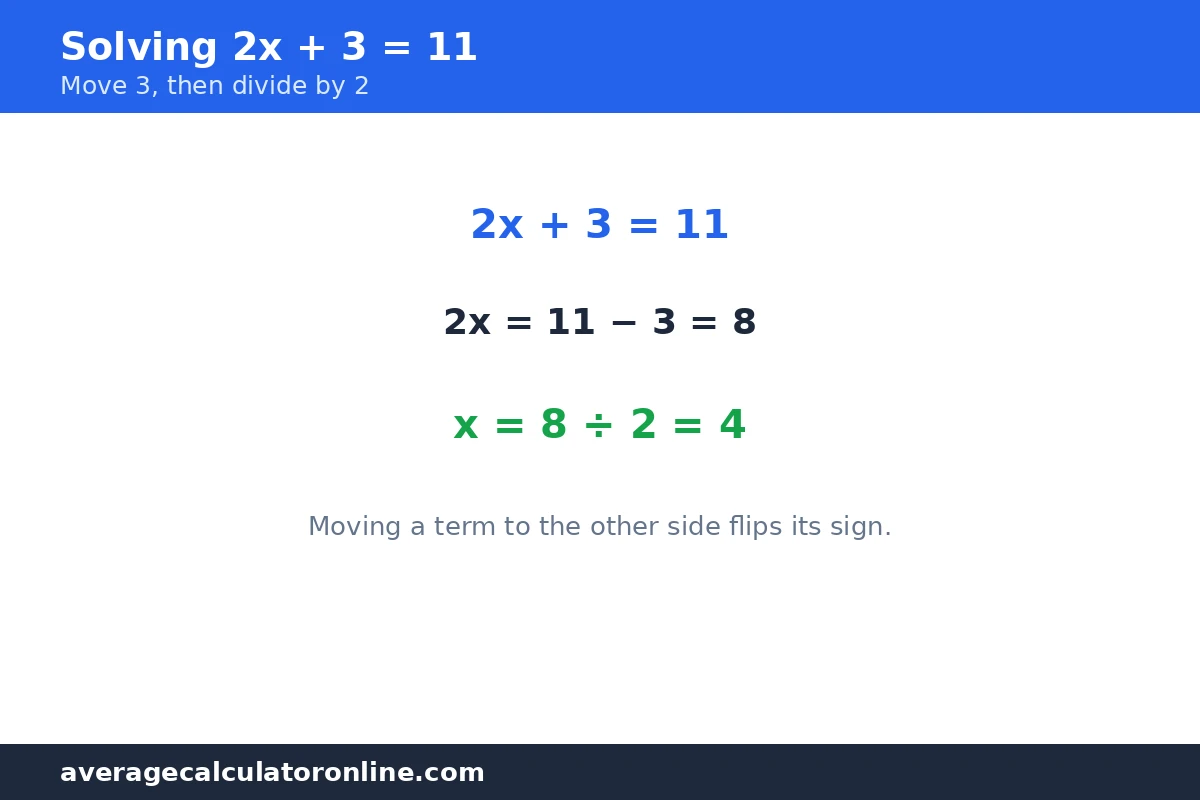
Example 1 — linear: 2x + 3 = 11. Subtract 3: 2x = 8. Divide by 2: x = 4.
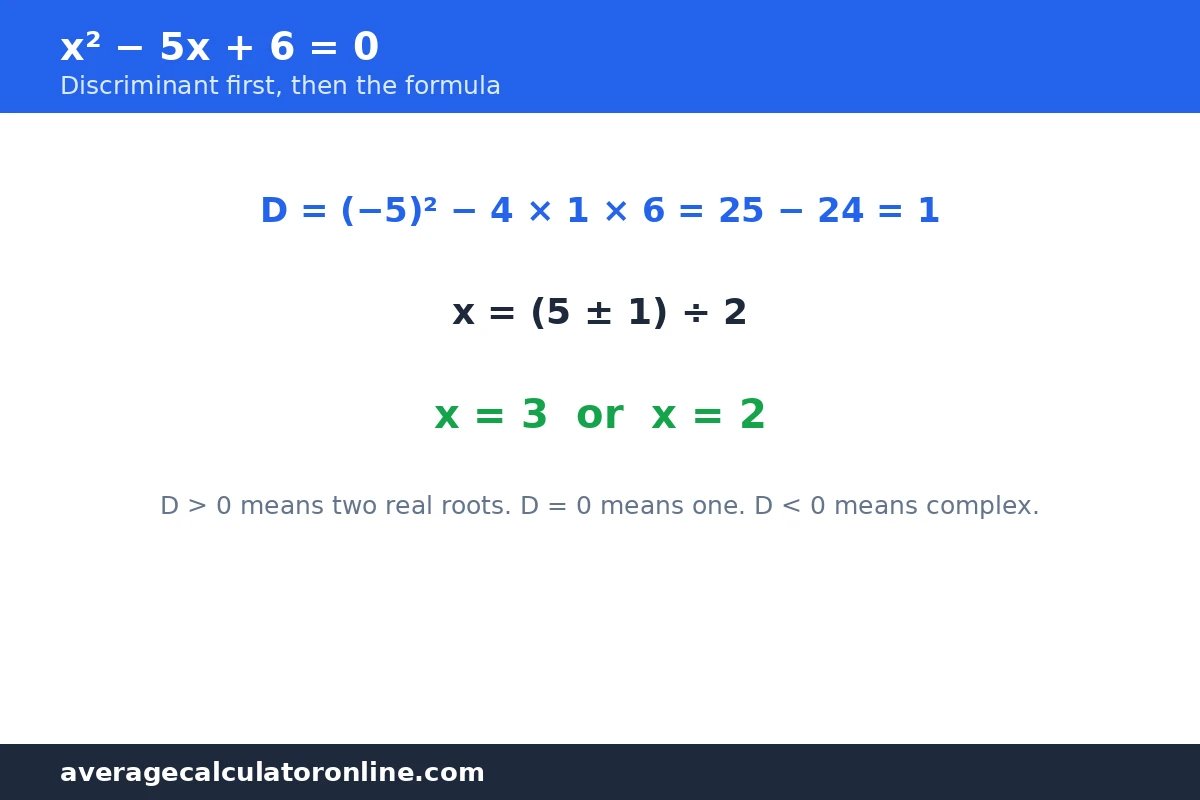
Example 2 — quadratic, two real roots: x² − 5x + 6 = 0. D = (−5)² − 4 × 1 × 6 = 25 − 24 = 1. x = (5 ± 1) ÷ 2, so x = 3 or x = 2. Check: 3² − 15 + 6 = 0 and 2² − 10 + 6 = 0.
Example 3 — quadratic, complex roots: x² + 2x + 5 = 0. D = 2² − 4 × 1 × 5 = 4 − 20 = −16. There are no real roots. x = (−2 ± 4i) ÷ 2, so x = −1 + 2i or x = −1 − 2i.
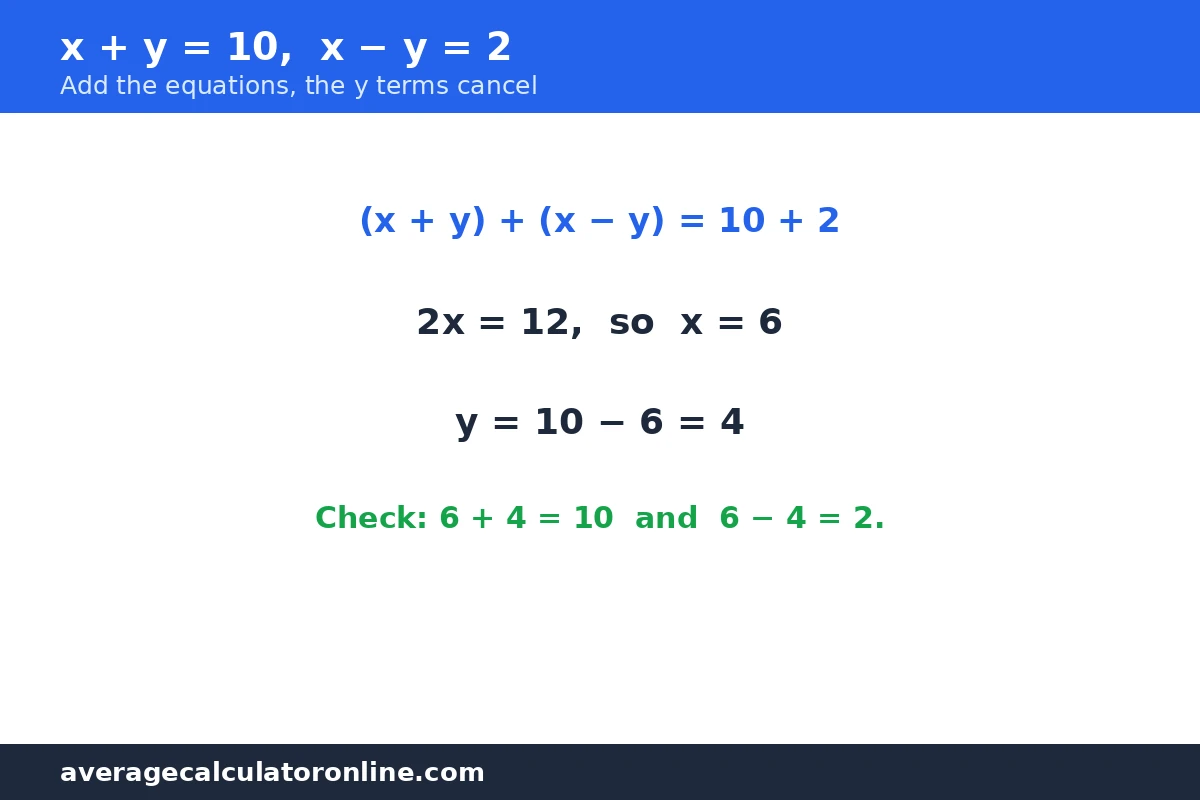
Example 4 — system: x + y = 10 and x − y = 2. Add the equations: 2x = 12, so x = 6. Then y = 10 − 6 = 4. Check: 6 + 4 = 10 and 6 − 4 = 2.
Algebra at a glance
| Type | Equation | Method | Result |
|---|---|---|---|
| Linear | ax + b = c | Move b, divide by a | One value of x |
| Quadratic | ax² + bx + c = 0 | Discriminant + formula | Two, one or no real roots |
| System | Two equations, x and y | Determinant / elimination | One (x, y) pair, none, or infinite |
Common mistakes
Forgetting the ± in the quadratic formula. It gives two roots, not one — for x² − 5x + 6 = 0 the answers are 3 and 2, and leaving out the minus sign loses one of them.
Dropping the sign when moving a term. Moving a term to the other side flips its sign: in 2x + 3 = 11, the 3 becomes −3 on the right, so 2x = 11 − 3 = 8, not 11 + 3.
Reading a negative discriminant as an error. D < 0 does not mean the equation is wrong — it means the roots are complex numbers, which the calculator shows as a ± bi.
Frequently asked questions
What is an algebra calculator?
An algebra calculator solves equations for you and shows the working. Enter the numbers in a linear equation, a quadratic equation or a system of two equations, and it returns the value of x (and y) step by step.
How do I solve 2x + 3 = 11?
Move 3 to the other side: 2x = 11 − 3 = 8, then divide by 2: x = 8 ÷ 2 = 4. The linear mode above does the same steps for any numbers you enter.
How do I solve x² − 5x + 6 = 0?
Use the quadratic formula. The discriminant is D = (−5)² − 4 × 1 × 6 = 1, so x = (5 ± 1) ÷ 2, which gives x = 3 or x = 2. The quadratic mode shows the discriminant and both roots.
What if the quadratic has no real roots?
When the discriminant is negative, there are no real roots — the solutions are complex numbers. For x² + 2x + 5 = 0, D = −16, so the roots are x = −1 + 2i and x = −1 − 2i. The calculator shows them instead of failing.
How do I solve two equations with two unknowns?
Use elimination or substitution. For x + y = 10 and x − y = 2, add the equations: 2x = 12, so x = 6, then y = 10 − 6 = 4. The system mode solves any two linear equations and checks the answer in both.
What does it mean when a system has no solution?
It means the two lines are parallel and never meet. For x + y = 3 and x + y = 5, the left sides are the same but the right sides differ, so no (x, y) pair satisfies both. If both equations describe the same line, there are infinitely many solutions instead.
Source: the quadratic formula and the elimination method are standard algebra — see the Math is Fun algebra index.
Math Calculator ·
Scientific Calculator ·
Slope Calculator ·
GCF Calculator ·
Fraction Calculator ·
Percentage Calculator
Last updated: November 17, 2026.