GPA = sum of (grade points × credit hours) ÷ total credit hours.
Example: A in a 3-credit course, B in a 4-credit course and A in a 3-credit course gives (12 + 12 + 12) ÷ 10 = 3.60. This page uses the US 4.0 scale.
GPA Calculator (US 4.0 scale)
Semester GPA: 3.60
Total credit hours: 10 | Total grade points: 36.00
How to calculate GPA
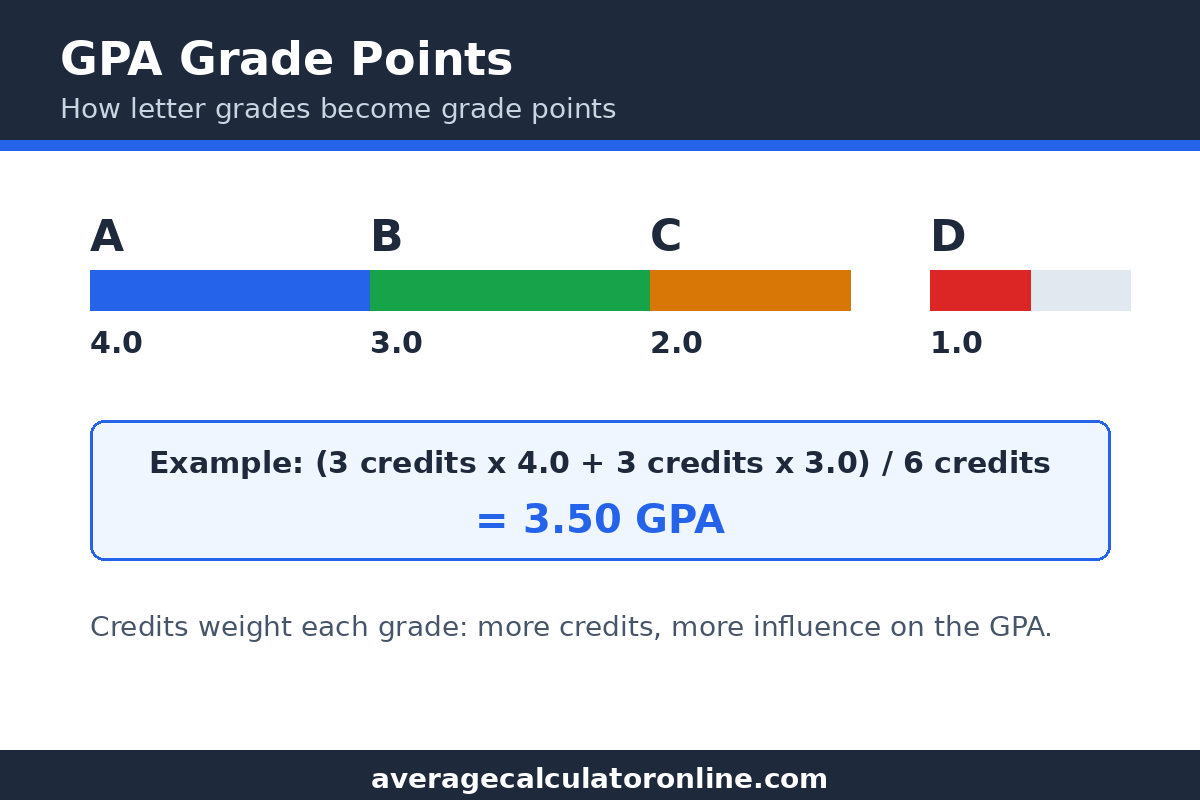
- Convert each letter grade to points (A = 4.0, B = 3.0, C = 2.0, D = 1.0, F = 0.0).
- Multiply each grade’s points by its credit hours.
- Add the points, add the credits, and divide points by credits.
Repeated a course? Enter only the new grade, not the old one — most schools replace the previous grade in the GPA calculation. Check your school’s policy, because some average the two attempts instead.
Worked example
A in a 3-credit course, B in a 4-credit course, A in a 3-credit course: (4.0 × 3 + 3.0 × 4 + 4.0 × 3) ÷ 10 = 36 ÷ 10 = 3.60.

Grade point table (US 4.0 scale)
| Grade | Points | Grade | Points |
|---|---|---|---|
| A | 4.0 | C | 2.0 |
| A− | 3.7 | C− | 1.7 |
| B+ | 3.3 | D+ | 1.3 |
| B | 3.0 | D | 1.0 |
| B− | 2.7 | F | 0.0 |
How to raise your GPA
Credits are the lever: a high grade in a 4-credit course moves your GPA more than the same grade in a 1-credit course. Use the Goal GPA mode above to find the exact average you need next semester — and remember that early semesters count just as much as later ones, so a single bad semester takes several good ones to offset.

GPA vs percentage
There is no single official GPA-to-percentage formula — schools convert differently. A rough guide used by many converters is percentage ≈ GPA × 25 (so 3.6 ≈ 90%), but always use your school’s own scale for anything official.

Disclaimer: results here are estimates for planning, not official records. Your school’s registrar is the only source for your official GPA.
Frequently asked questions
What is the difference between GPA and CGPA?
GPA usually means one semester; CGPA (cumulative GPA) covers all semesters so far. Use the Cumulative mode above for CGPA.
What is the difference between weighted and unweighted GPA?
Unweighted GPA caps at 4.0. Weighted GPA gives extra points for harder courses (for example AP or honors), so it can exceed 4.0 — this calculator uses the unweighted 4.0 scale.
Can GPA exceed 4.0?
On an unweighted 4.0 scale, no — 4.0 is the maximum. On a weighted scale, yes: honors and AP courses can push it to 4.5 or 5.0.
How many A’s do I need to reach my goal GPA?
Use the Goal GPA mode: enter your current GPA and credits, your target, and your future credits, and it shows the exact average you need.
Do pass/fail courses affect GPA?
Usually no — pass/fail courses normally carry no grade points and are excluded from GPA, though they still count toward earned credits. Check your school’s policy.
How do I convert GPA to a percentage?
There is no universal formula. A common rough conversion is percentage ≈ GPA × 25, but your school’s own scale is the only official one.
Related calculators
Last updated: November 1, 2026.