Compound Interest Calculator
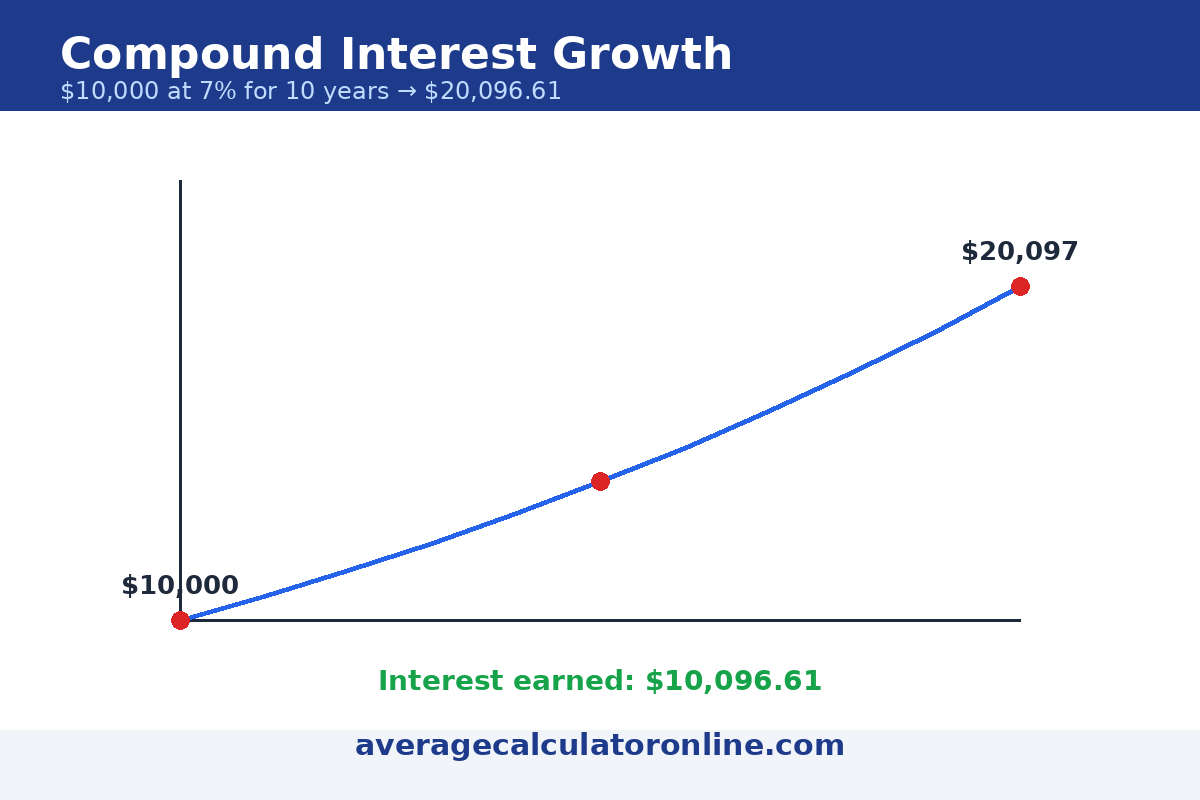
Total interest earned: $10096.61
| Year | Balance | Interest earned |
|---|---|---|
| 1 | $10722.90 | $722.90 |
| 2 | $11498.06 | $775.16 |
| 3 | $12329.26 | $831.20 |
| 4 | $13220.54 | $891.28 |
| 5 | $14176.25 | $955.71 |
| 6 | $15201.06 | $1024.80 |
| 7 | $16299.94 | $1098.89 |
| 8 | $17478.26 | $1178.32 |
| 9 | $18741.77 | $1263.51 |
| 10 | $20096.61 | $1354.84 |
Direct answer: Compound interest formula: A = P × (1 + r ÷ n)^(n × t), where P is the principal, r the annual rate as a decimal, n the number of compounding periods per year, and t the number of years. Example: $10,000 at 7% compounded monthly for 10 years → $20,096.61.
How the formula works
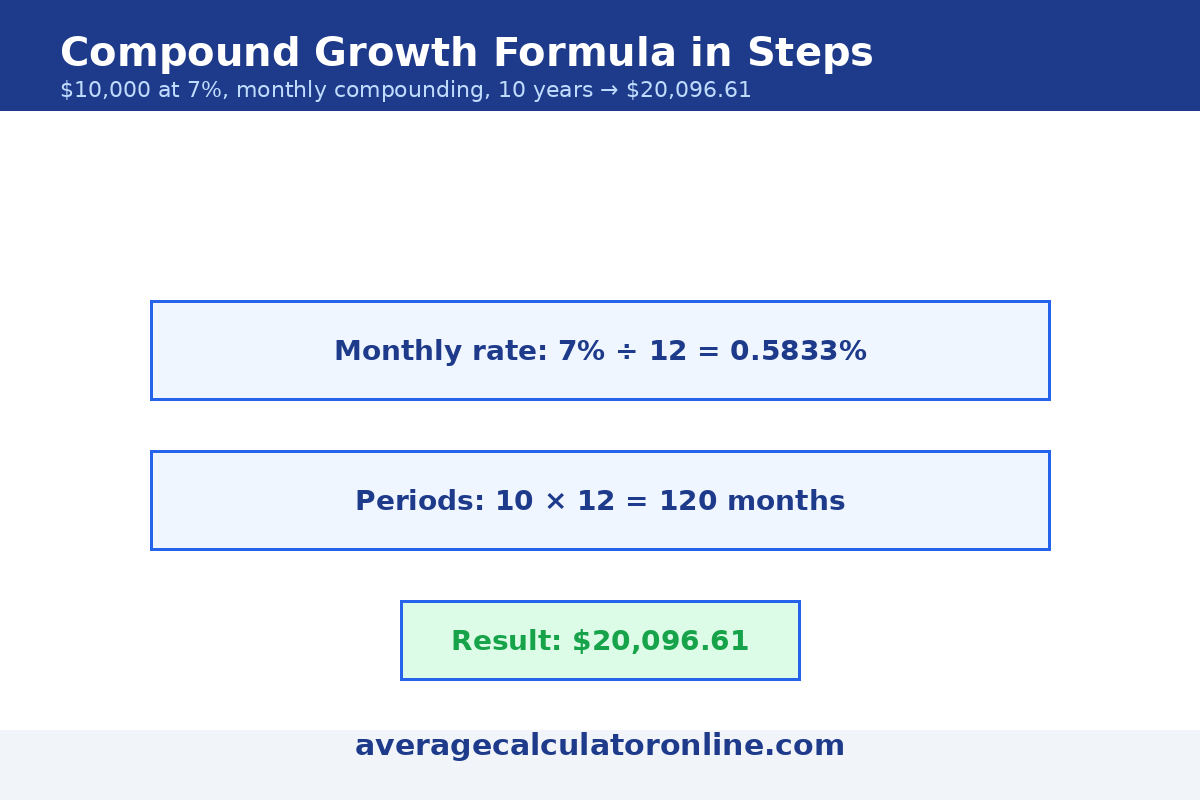
With P = $10,000, r = 0.07, n = 12, t = 10: A = 10,000 × (1 + 0.07 ÷ 12)^(12 × 10) = 10,000 × (1.005833)^120 = 10,000 × 2.009661 = $20,096.61. Total interest = $20,096.61 − $10,000 = $10,096.61 — more than the original principal.
Worked examples
Example 1 — the default case: $10,000 at 7% compounded monthly for 10 years → future value $20,096.61, total interest $10,096.61.
Example 2 — more frequent compounding: The same $10,000 at 7% compounded daily (n = 365) for 10 years → about $20,136.18 — a bit more than monthly compounding, because interest starts earning interest sooner.
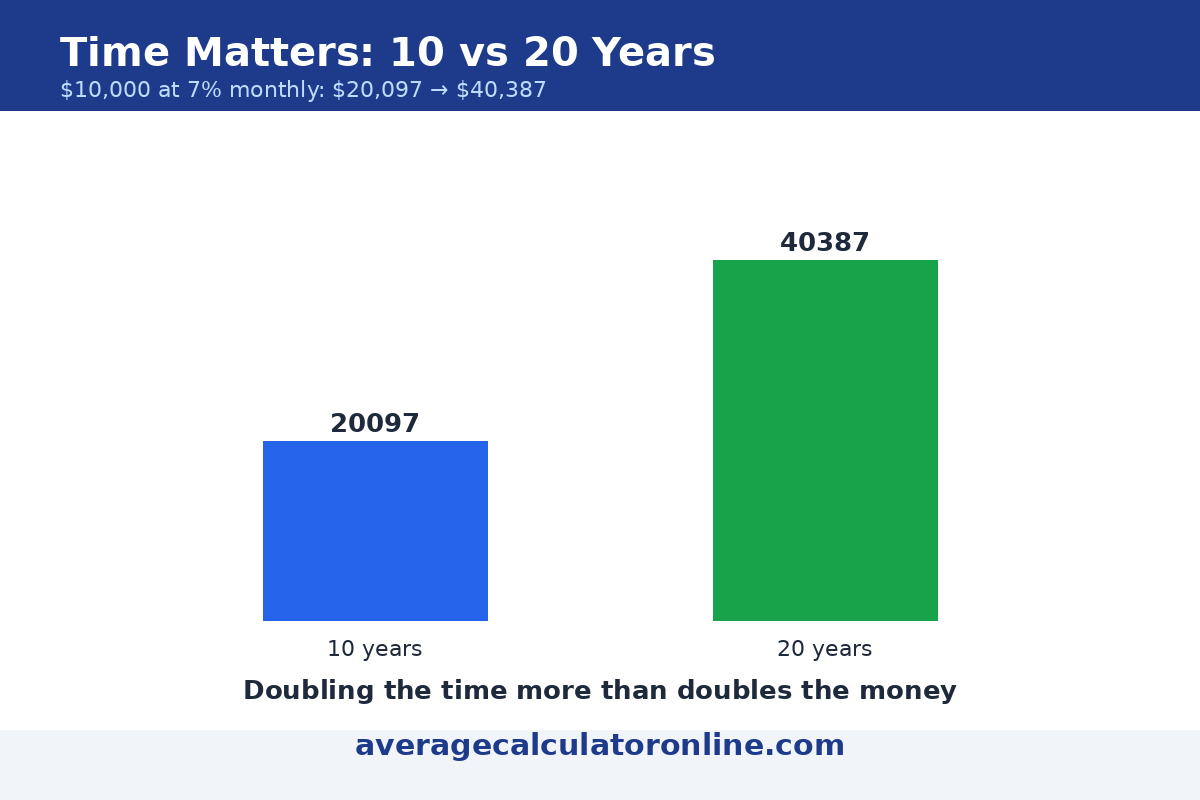
Example 3 — time beats rate: $5,000 at 7% monthly compounding for 20 years → about $20,193.69, nearly the same as Example 1’s $20,096.61. Starting with half the money but doubling the time gives a similar result — time is the most powerful input.
Yearly breakdown (default case)
Run the calculator to see each year’s balance and interest. Year 1 ends near $10,722.90; interest grows each year because every year’s balance includes the interest earned so far — that acceleration is the whole point of compounding.
Compounding frequencies compared
| Frequency | Periods/year (n) | $10,000 at 7% for 10 years |
|---|---|---|
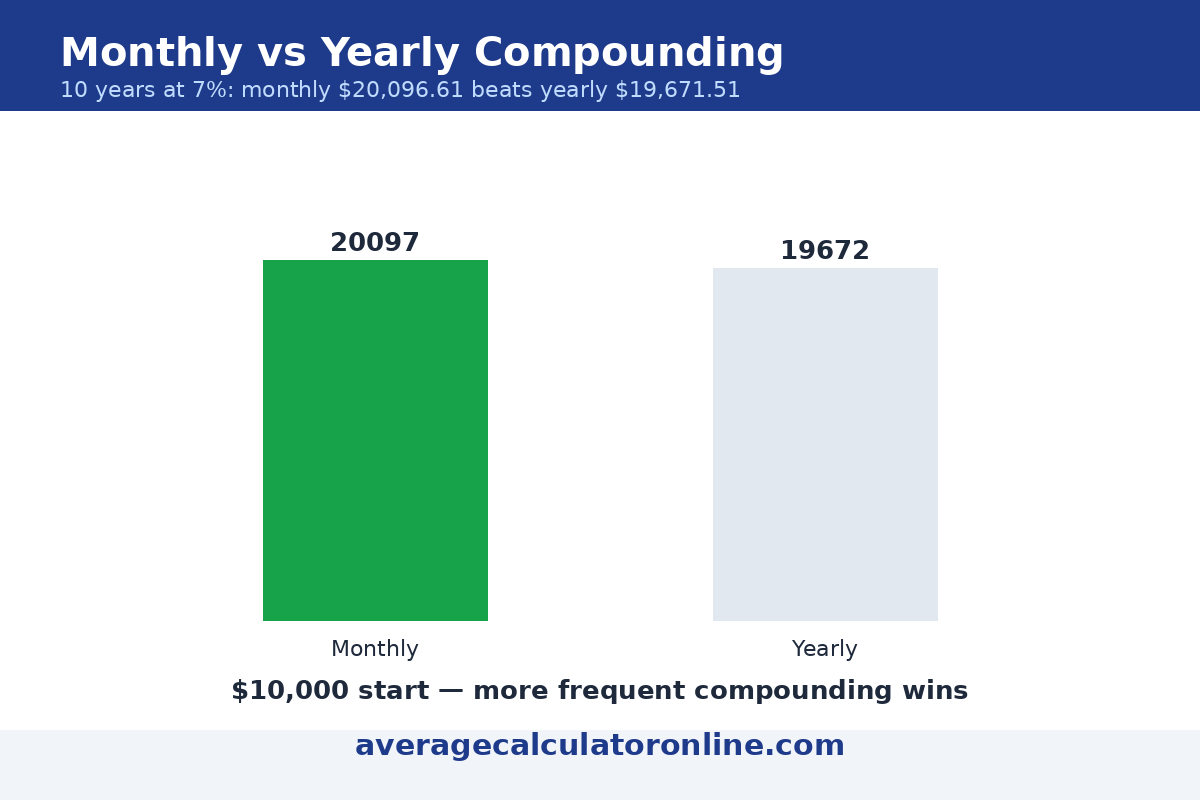
| Annually | 1 | $19,671.51 |
| Semi-annually | 2 | $19,897.92 |
| Quarterly | 4 | $20,015.97 |
| Monthly | 12 | $20,096.61 |
| Daily | 365 | $20,136.18 |
Frequently asked questions
What is compound interest?
Interest calculated on the initial principal plus all interest earned so far, so your balance grows faster each period.
How much will $10,000 grow to at 7% in 10 years?
Compounded monthly, it grows to $20,096.61 — $10,096.61 of interest on top of your $10,000.
What is the compound interest formula?
A = P × (1 + r ÷ n)^(n × t). P is principal, r the annual rate, n compounding periods per year, t years.
Does compounding frequency matter much?
Somewhat. On $10,000 at 7% for 10 years, monthly compounding beats annual compounding by about $425. More frequent compounding always earns slightly more.
Why does time matter more than rate?
Growth is exponential, so extra years multiply on top of an already larger balance. Starting early with a modest rate often beats starting late with a high rate.
Is this real investment advice?
No. This is an estimate tool — real investments vary with market performance, fees, and taxes. Consult a qualified financial professional.
Disclaimer: This calculator provides estimates for education only and is not financial or investment advice. Real returns depend on market performance, fees, and taxes. Consult a qualified financial professional before investing.
Compound Interest: A Deeper Look
The calculator above shows the destination — the future value. This guide explains the journey: how compounding builds month by month, why it beats simple interest, and why time is the most powerful input of all.
The growth curve, year by year
Compound growth starts slowly and finishes steeply. On $10,000 at 7% compounded monthly, the first year adds about $723 — but the tenth year alone adds roughly $1,355, because every earlier year’s interest is now earning interest of its own. That accelerating curve is the whole story of compounding.
Compound vs. simple interest
Simple interest pays only on the original principal — a straight line. Compound interest pays on the growing balance — a curve. Over 20 years at 7%, the same $10,000 reaches $24,000 with simple interest but $40,387 with monthly compounding. The gap is pure “interest on interest”.
Why monthly compounding beats annual
With monthly compounding, each month’s interest joins the balance and starts earning the very next month — twelve growth steps per year instead of one. At a 7% nominal rate, monthly compounding gives an effective annual rate of (1 + 0.07/12)12 − 1 ≈ 7.23%, versus exactly 7.00% compounded annually.
Time value of money
A dollar today is worth more than a dollar in ten years, because today’s dollar can be put to work. At 7% compounded monthly, $10,000 today becomes about $20,097 in 10 years, $40,387 in 20, and $81,165 in 30. The rule of 72 gives a quick check: 72 ÷ 7 ≈ 10.3 years to double.
Worked examples
Example A — starting small, starting early: $5,000 at 7% compounded monthly for 20 years → about $20,194. Time does the heavy lifting.
Example B — the doubling check: The rule of 72 says 7% doubles money in about 10.3 years; the exact monthly-compounding figure is about 9.9 years.
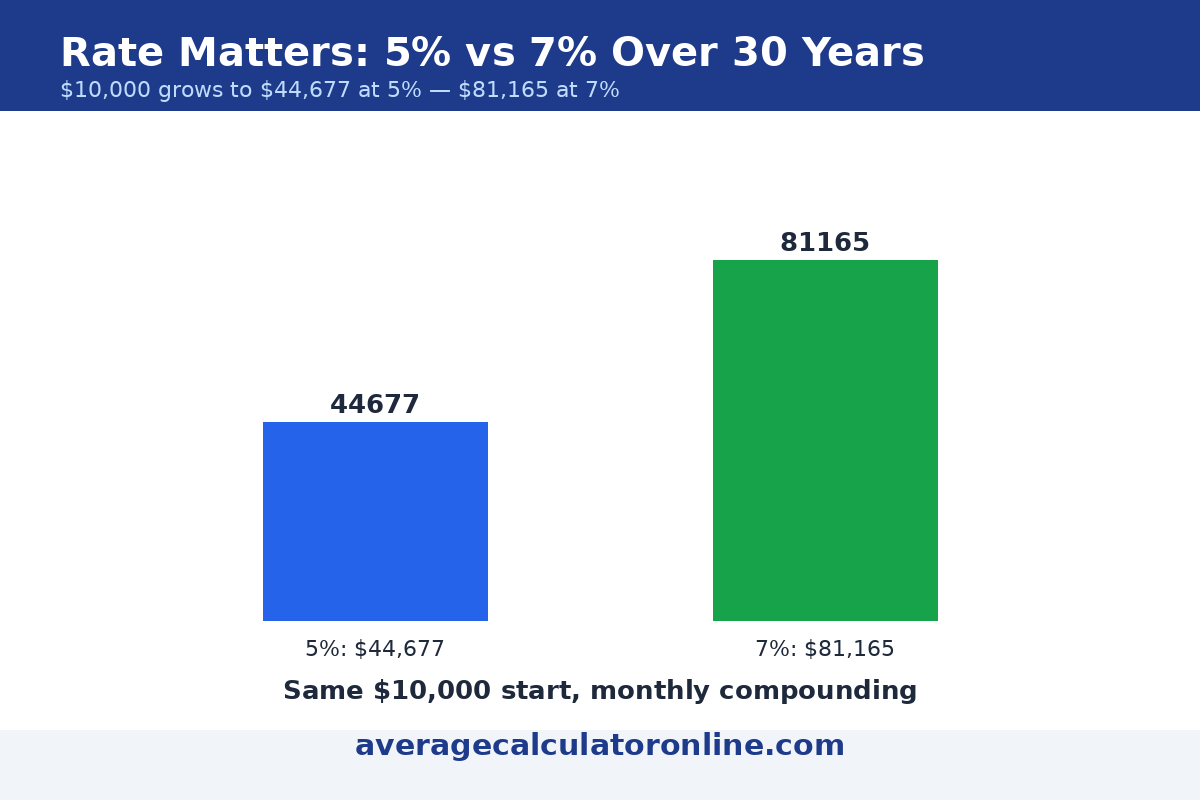
Example C — rate vs. rate: $10,000 for 30 years at 5% → about $44,677.44; at 7% → about $81,165. Two percentage points are worth roughly $36,488 over three decades.
Two questions worth asking
Should I use the nominal rate or the effective rate? For comparing accounts, use the effective annual rate — it already includes the compounding frequency. A 7% nominal rate compounded monthly is 7.23% effective.
Does compounding help borrowers too? Yes — in reverse. Credit-card balances compound against you. But interest dominating early loan payments is not caused by compounding frequency: in amortization, early payments are mostly interest simply because the outstanding balance is at its largest at the start.
Remember: these are planning estimates, not investment advice. Real returns vary with markets, fees, taxes, and inflation.
Last updated: November 1, 2026.