BMI Calculator
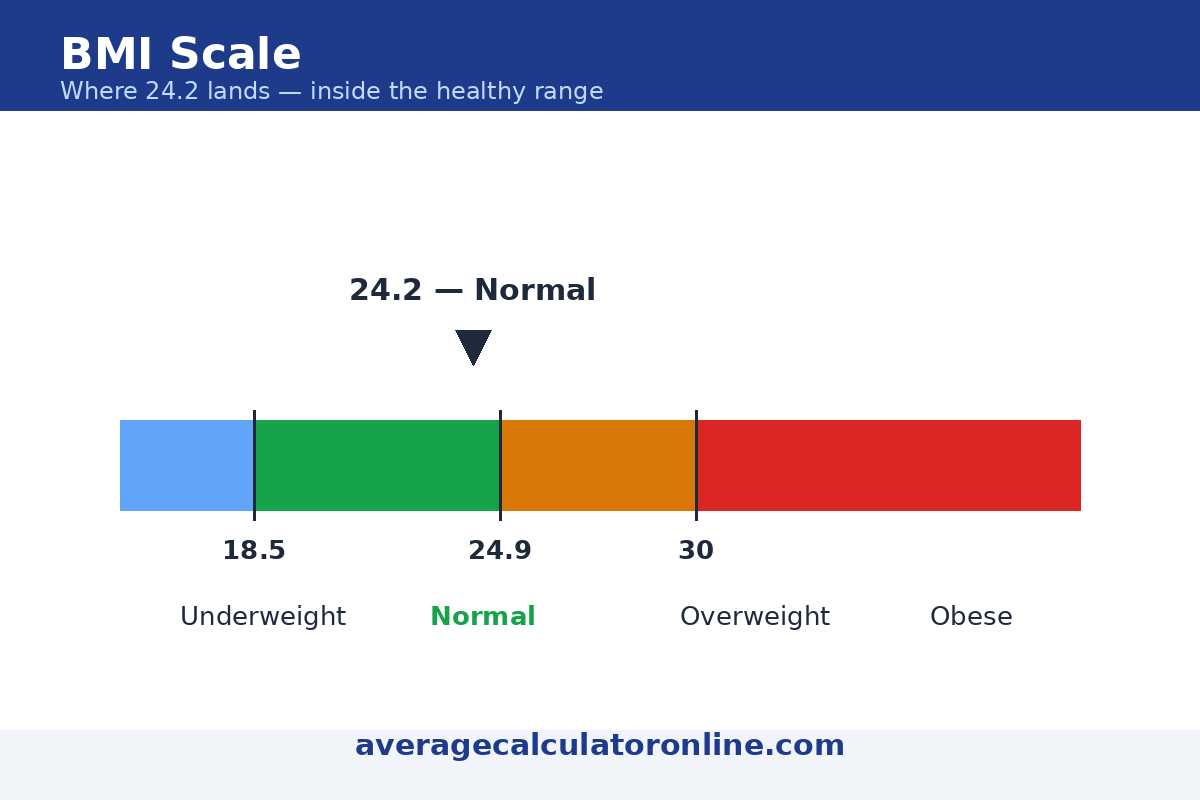
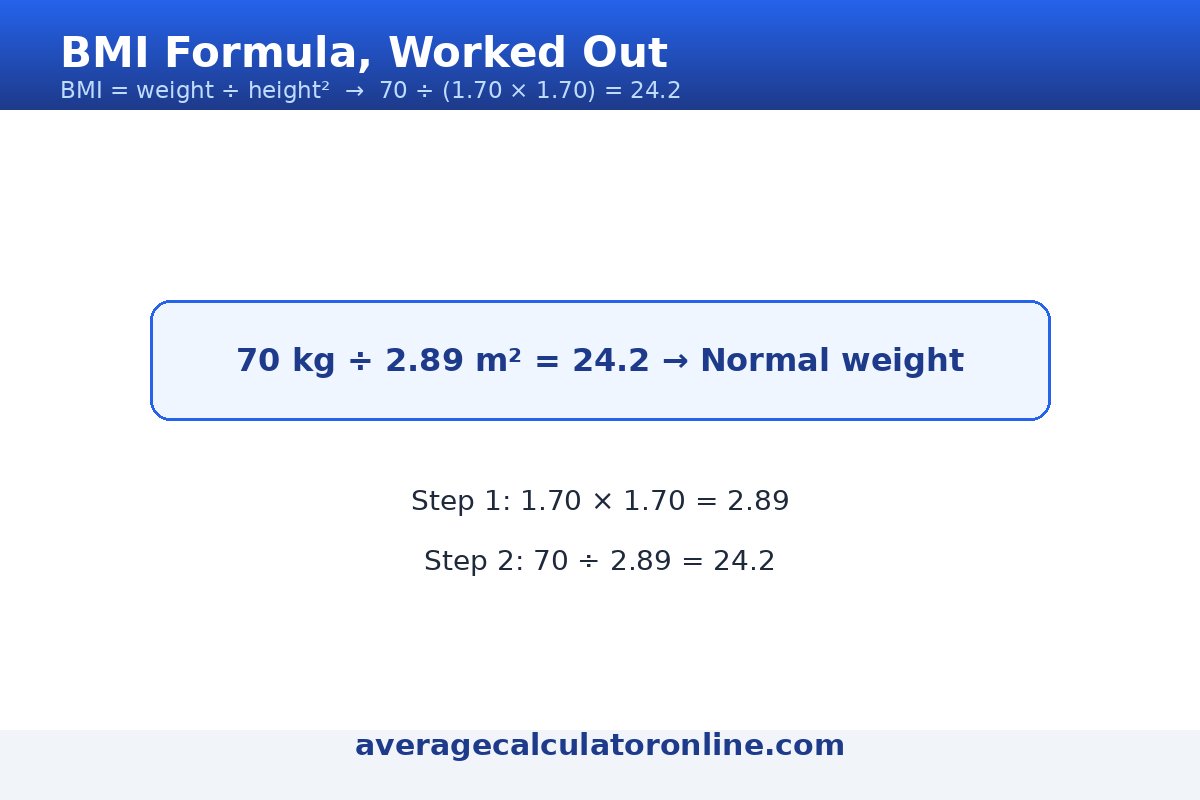
Direct answer: BMI (Body Mass Index) is your weight in kilograms divided by the square of your height in metres: BMI = kg ÷ m². A BMI of 18.5 to 24.9 is considered the healthy range for most adults. Example: 70 kg ÷ (1.70 m)² = 24.2 — Normal weight.
How BMI is calculated
Formula (metric): BMI = weight (kg) ÷ height (m)². Formula (imperial): BMI = 703 × weight (lbs) ÷ height (inches)². Both formulas give the same result when the units are converted correctly.
| BMI | Category |
|---|---|
| Below 18.5 | Underweight |
| 18.5 – 24.9 | Normal weight |
| 25.0 – 29.9 | Overweight |
| 30.0 and above | Obese |
Worked examples
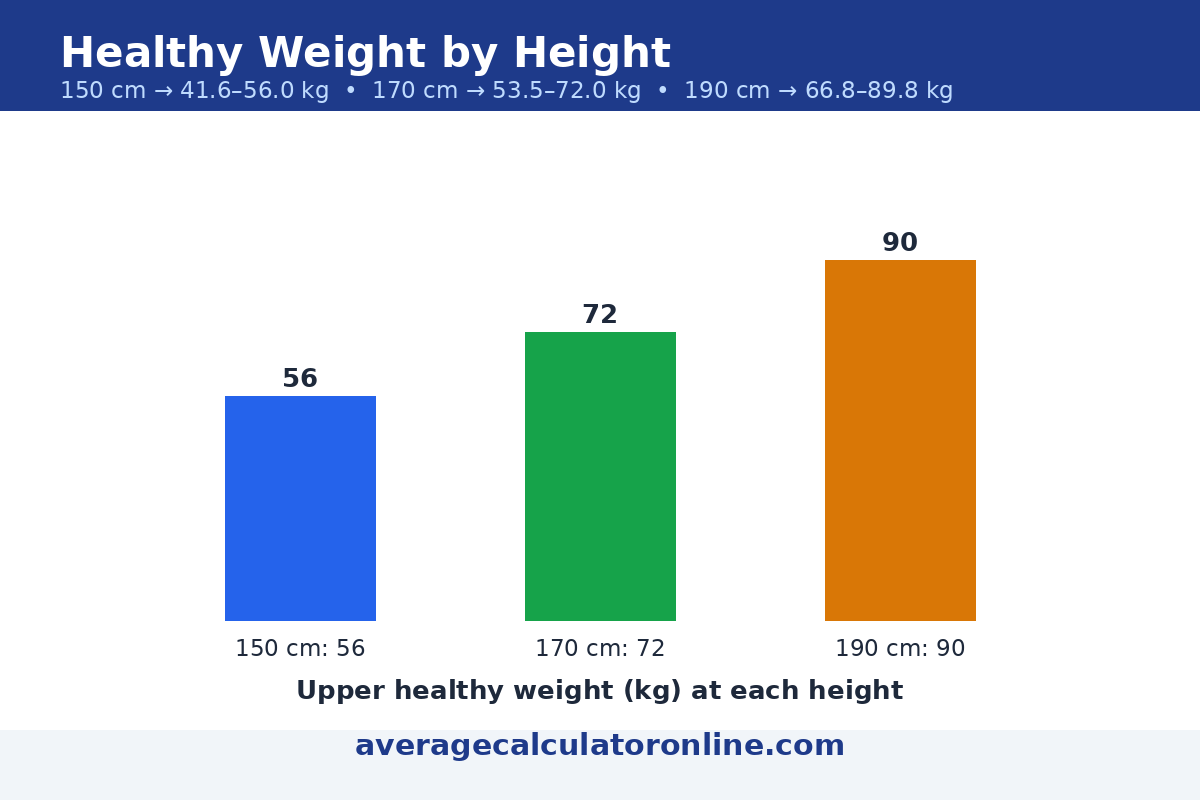
Example 1: Height 170 cm, weight 70 kg. BMI = 70 ÷ 1.70² = 70 ÷ 2.89 = 24.2 — Normal weight. Healthy range for 170 cm: 53.5 to 72.0 kg.
Example 2: Height 175 cm, weight 90 kg. BMI = 90 ÷ 1.75² = 90 ÷ 3.0625 = 29.4 — Overweight, just below the obese threshold.
Example 3: Height 5 ft 7 in (67 in), weight 154 lbs. BMI = 703 × 154 ÷ 67² = 108,262 ÷ 4,489 = 24.1 — Normal weight.
When BMI can mislead
BMI does not measure body fat directly. Very muscular people, athletes, pregnant women, and children should not rely on adult BMI categories alone. For children, age- and sex-specific BMI percentiles are used instead. BMI is a screening tool, not a diagnosis — this page is for general information only, not medical advice.
Frequently asked questions
What is a good BMI?
For most adults, 18.5 to 24.9 is considered healthy. The lowest health risk is generally seen around 20 to 25.
How do I calculate BMI without a calculator?
Divide your weight in kilograms by your height in metres squared. Example: 70 kg and 1.70 m gives 70 ÷ 2.89 = 24.2.
Is BMI the same for men and women?
The formula is the same, but women naturally carry more body fat at the same BMI, and health risks can differ slightly by sex and age.
What BMI is obese?
A BMI of 30 or above is classified as obese; 25 to 29.9 is overweight.
How do I lower my BMI?
BMI falls when weight falls relative to height — through a calorie deficit, regular activity, and consistent habits. This calculator shows your healthy weight range as a target.
Is BMI accurate for muscular people?
Not always. Muscle weighs more than fat, so a muscular person can have a high BMI with low body fat. Waist measurement and body-fat estimates add context.
BMI Categories: An In-Depth Guide
The BMI calculator sorts your result into four standard categories defined by the World Health Organization. Each category is a screening band, not a diagnosis — but each one points to a different sensible next step.
Underweight — below 18.5
A BMI under 18.5 can signal undernourishment, a thyroid problem, or simply a very light frame. Health risks include weakened immunity, bone loss, and fertility problems. The sensible response is not just “eat more” but to eat nutrient-dense food and add strength training, ideally under a clinician’s guidance.
Normal weight — 18.5 to 24.9
This is the band linked with the lowest average risk of weight-related disease for most adults. “Normal” is still a range, not a single target: 24.9 and 18.6 carry different profiles, and fitness, diet quality, sleep, and smoking matter alongside the number.
Overweight — 25.0 to 29.9
In this band, the risk of type 2 diabetes, high blood pressure, and joint strain rises gradually with the number. The good news: losing just 5-10% of body weight is enough to meaningfully improve blood pressure and blood sugar – you do not need to reach the middle of the normal band to benefit.
Obese — 30.0 and above
A BMI of 30 or more is classified as obese, and risk rises further with each sub-class: Class I (30-34.9), Class II (35-39.9), and Class III (40+). This is the band where medical guidance, not just a diet plan, is the right next step, because the risks of heart disease, stroke, sleep apnea, and several cancers are substantially higher.
The constant 703 is the unit-conversion factor that makes pounds-per-square-inch equivalent to kilograms-per-square-metre — without it the imperial formula would be off by a factor of about 703.

Limitations of BMI: What the Number Cannot Tell You
BMI is a screening tool, not a body-composition scan. Knowing where it breaks down keeps you from misreading your result.
Muscle and athletic builds
Muscle is denser than fat. A lean athlete can land in the “overweight” band with a low body-fat percentage — for this group, waist measurement or a body-fat estimate is far more informative than BMI.
Age
Older adults often lose muscle while keeping the same weight, so the same BMI can mean a higher fat percentage at 70 than at 30. Some researchers suggest a slightly higher healthy range for older adults, though no universal standard exists.
Pregnancy and children
BMI is not valid during pregnancy (weight gain is expected and healthy) or for children — children’s BMI is interpreted against age- and sex-specific percentile charts, not the adult cutoffs.
Ethnicity
Risk thresholds differ between populations: the WHO suggests lower cutoffs (overweight from 23, obese from 27.5) as action points for many Asian populations, who tend to carry more body fat at a given BMI.
Fat distribution
BMI says nothing about where fat sits — and abdominal fat predicts disease better than total weight. Pairing your BMI with a waist measurement (or the waist-to-height ratio, ideally under 0.5) gives a much fuller picture.

Try the bmi calculator above with both unit systems — it shows your healthy weight range alongside the result.
Sources & review
BMI categories on this page follow the World Health Organization (who.int) and CDC (cdc.gov) adult BMI ranges. Reviewed by the Average Calculator Team. Last reviewed: 1 November 2026. BMI is a general screening measure, not a diagnosis — talk to a clinician about your health.
Disclaimer: This tool provides general information only, not medical advice. BMI does not diagnose health conditions; consult a clinician for a full assessment.
Last updated: November 1, 2026.