

Final Grade Calculator
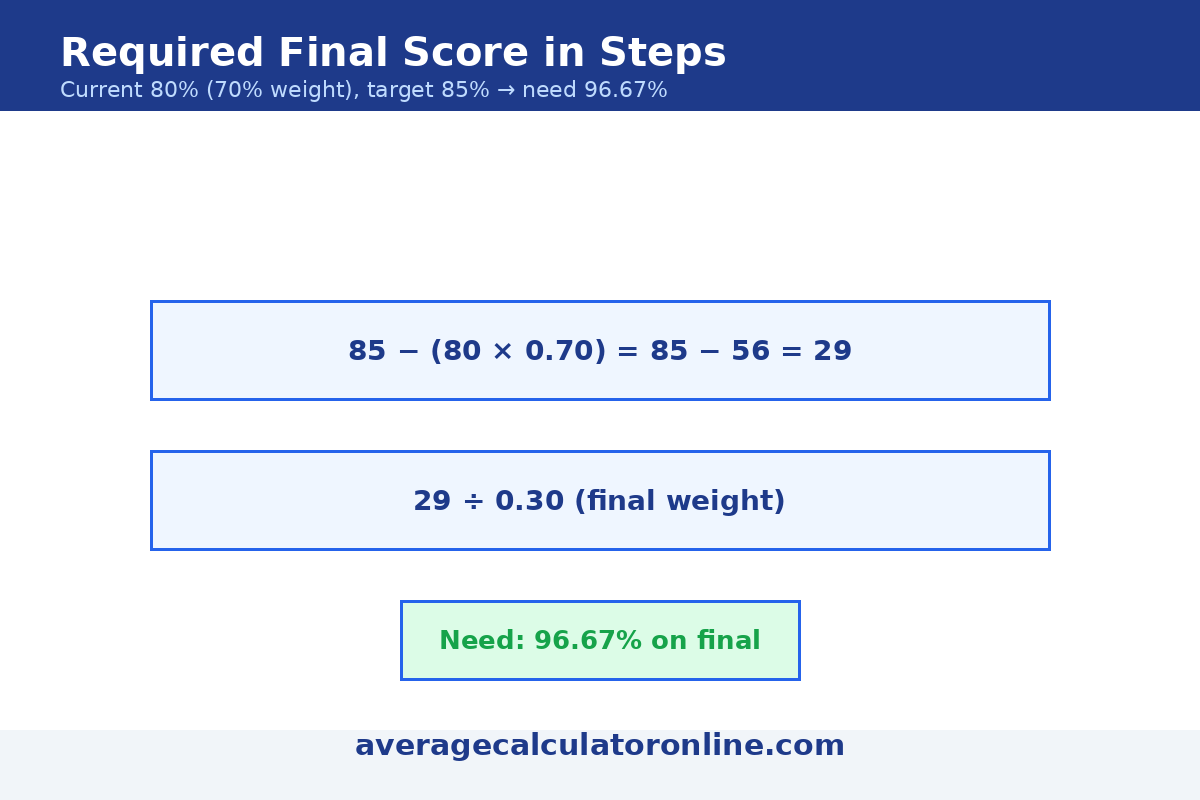
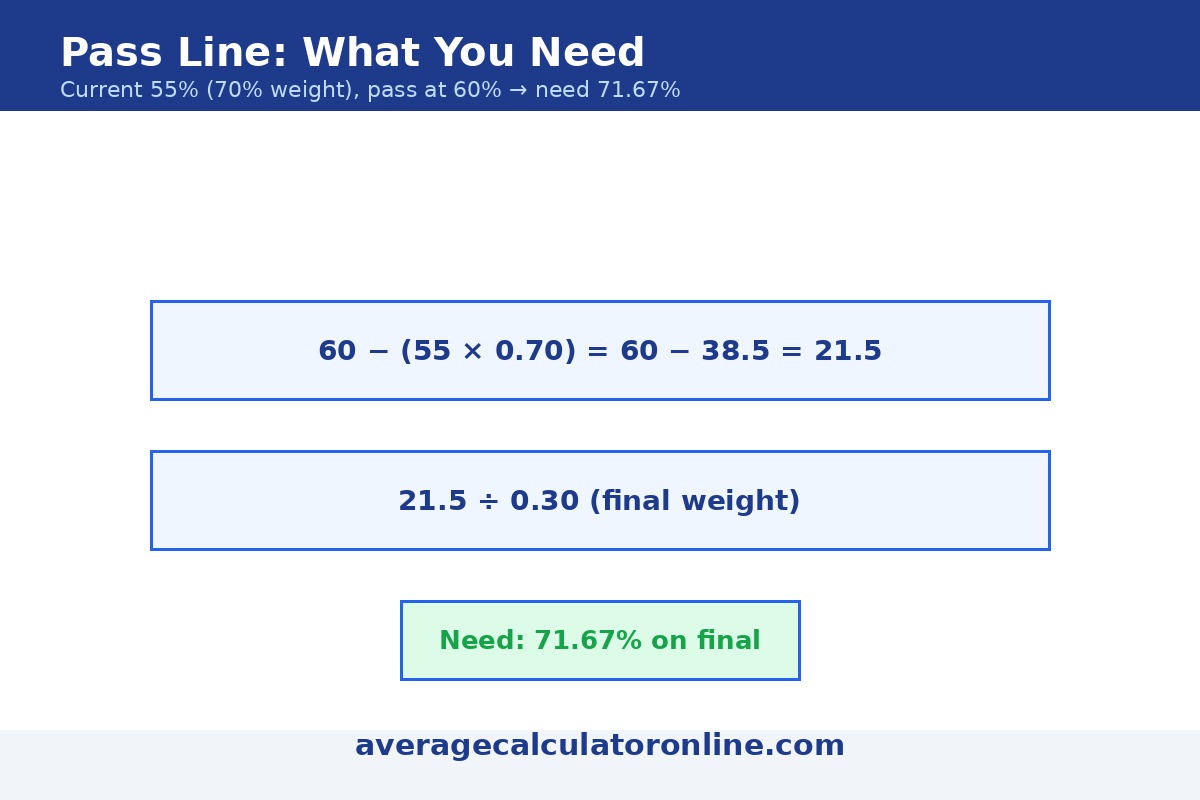
Direct answer: Required final score = (desired grade − current grade × (1 − final weight)) ÷ final weight. If the answer is above 100%, the target cannot be reached on the final alone.
Worked examples
Example 1: Current 88%, target 90%, final worth 40%. Required = (90 − 88 × 0.60) ÷ 0.40 = (90 − 52.8) ÷ 0.40 = 93.0% on the final.
Example 2: Current 85%, target 90%, final worth 30%. Required = (90 − 85 × 0.70) ÷ 0.30 = (90 − 59.5) ÷ 0.30 = 101.7% — impossible, so the target needs a lower goal or extra credit.
Example 3: Current 92%, target 90%, final worth 20%. Required = (90 − 92 × 0.80) ÷ 0.20 = (90 − 73.6) ÷ 0.20 = 82.0% on the final — comfortable.
Why the final’s weight changes everything
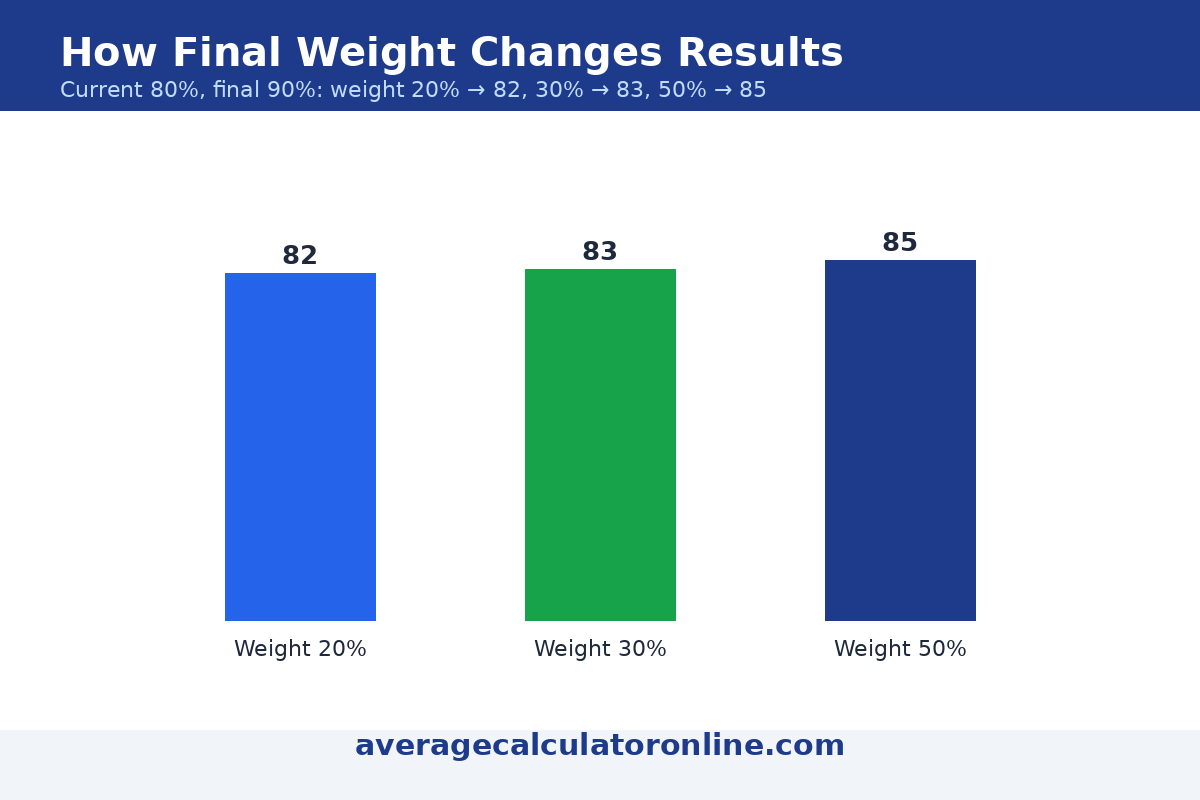
With a heavy final (40–50%), one exam can move your grade several points. With a light final (10–20%), even a perfect score barely moves it — in that case your current grade almost is your final grade. Check your syllabus for the exact weight before trusting any result.
Frequently asked questions
How do I calculate the grade I need on my final?
Use (desired − current × (1 − final weight)) ÷ final weight. Example: current 88, target 90, final 40% gives (90 − 52.8) ÷ 0.40 = 93%.
What if the required score is over 100%?
Then the target is mathematically impossible on the final alone. Aim for a lower target, ask about extra credit, or accept the highest reachable grade.
What if the required score is negative?
You have already locked in your target — even a zero on the final keeps you at or above it.
What is the difference from a grade calculator?
A grade calculator averages scores you already have. This one works backwards from a target to find the one score you still need.
Does this work with letter grades?
Convert letters to percentages first using your school’s scale (often A = 90–100, B = 80–89), then enter the numbers.
What if my final is worth a fraction, like 1/3?
Enter 33.33 as the weight. The formula works with any weight between 0 and 100.
Final Grade Deep Dive: The Math Behind “What Do I Need?”
The calculator above answers one question: the exam score you need. This guide goes deeper — the formula behind it, why the final’s weight changes everything, and what-if scenarios so you can plan your study time where it counts.
The required-score formula
Your overall grade is a weighted average: current grade × (1 − final weight) + exam score × final weight. Solving for the exam score gives required = (target − current × (1 − w)) ÷ w. With a current 88%, a 90% target, and a 40% final: (90 − 88 × 0.60) ÷ 0.40 = 93.0%.
Why the final’s weight changes everything
Think of your grade as a pie. Everything you have already earned is locked in; only the final’s slice is still in play. The bigger that slice, the more the exam can move your average — in both directions. A 40% final is a second chance; a 10% final barely matters.
What-if scenarios
Find your current grade on the left and your target across the top (final worth 30%). Green cells are comfortable, amber means a near-perfect exam, red means the target is mathematically out of reach — time to adjust the goal, not the study plan.

How your exam score moves the overall grade
With a current 88% and a 40% final, every 10 points on the exam moves your overall grade by 4 points. Scoring 90 on the final lands you at 88.8 — just short of 90. Scoring a perfect 100 takes you to 92.8.
Worked examples
Example A — the default case: Current 88%, target 90%, final worth 40% → (90 − 88 × 0.60) ÷ 0.40 = 93.0%. Tough but doable.
Example B — resetting an impossible target: Current 85%, target 90%, final worth 30% → 101.7%, impossible. Lowering the target to 88% needs (88 − 85 × 0.70) ÷ 0.30 = 95.0% — hard, but real.
Example C — a comfortable cushion: Current 92%, target 90%, final worth 20% → (90 − 92 × 0.80) ÷ 0.20 = 82.0%. You can afford an off day.
Two questions worth asking
Should I study more for a heavy final or a light one? Heavy, always — each hour there moves your grade more. But a light final is also low-risk: it cannot hurt you much either.
What if my professor drops the lowest quiz? Recalculate your current grade without that quiz first, then use the new current grade here. Dropped low scores raise your “current” and lower what the final must do.
Last updated: November 1, 2026.