
Fraction Calculator
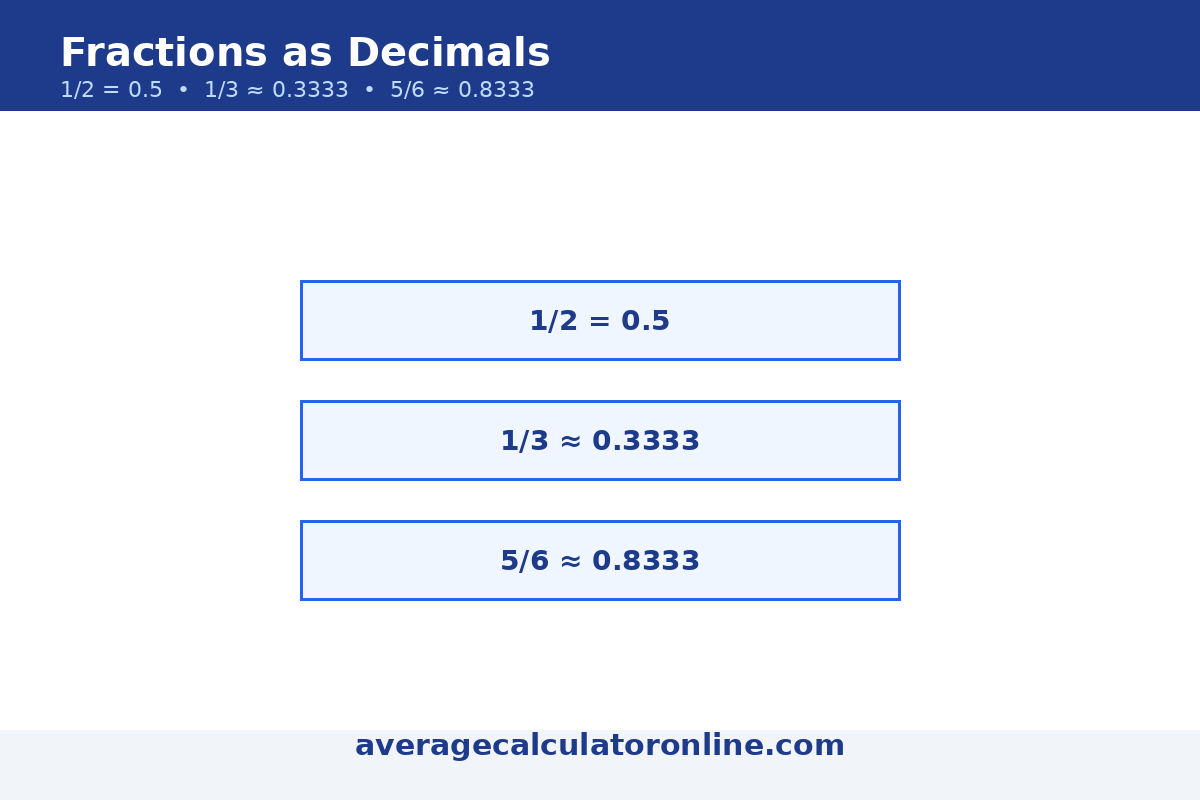
As a decimal: 0.8333
Steps: (1×3 + 1×2) ÷ (2×3) = 5/6; simplified by dividing by GCD 1.
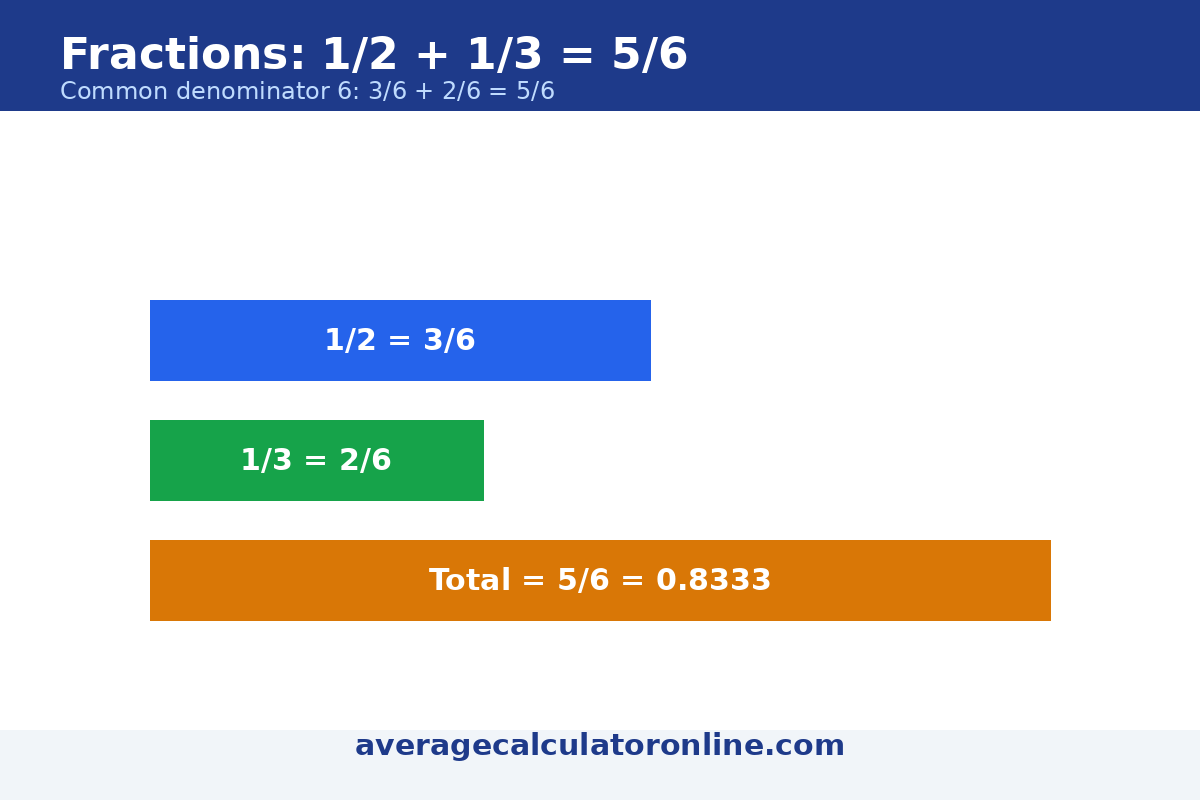
Direct answer: 1/2 + 1/3 = 5/6. To add or subtract, convert to a common denominator; to multiply, multiply straight across; to divide, flip the second fraction and multiply. Every answer here is simplified automatically. See the worked examples below for full step-by-step solutions to try.
Use the whole-number boxes to enter mixed numbers such as 2 1/2; every result shows the simplified fraction, its mixed-number form, and its decimal value rounded to four places.
Worked examples
Addition: 1/2 + 1/3 = (3 + 2) ÷ 6 = 5/6.
Subtraction: 3/4 − 1/8 = (6 − 1) ÷ 8 = 5/8.
Multiplication: 2/3 × 3/4 = 6/12 = 1/2 after dividing by GCD 6.
Division: 3/4 ÷ 1/2 = 3/4 × 2/1 = 6/4 = 3/2 (or 1½).
Mixed numbers: 2 1/2 + 1 1/4 = 5/2 + 5/4 = (10 + 5) ÷ 4 = 15/4 (or 3 3/4 = 3.75).
How each operation works
Add/subtract: find a common denominator (multiplying the denominators always works), rewrite both fractions, then add or subtract the numerators.
Multiply: numerator × numerator over denominator × denominator, then simplify.
Divide: multiply by the reciprocal — flip the second fraction — then simplify. Simplifying means dividing numerator and denominator by their greatest common divisor (GCD).
Frequently asked questions
What if a denominator is zero?
That is undefined in mathematics, so the calculator refuses it instead of guessing.
Can I enter mixed numbers?
Yes. Fill in the whole-number box for each fraction — for example, whole number 2 with numerator 1 and denominator 2 for 2 1/2. Mixed numbers are converted to improper fractions before the calculation, and the result is also shown in mixed-number form.
Does the calculator show decimals?
Yes. Every result includes its decimal value rounded to four places, alongside the simplified fraction and the mixed-number form.
Fractions: A Deep Dive
The calculator above handles the arithmetic. This guide explains what fractions mean, how each operation works, how to simplify with the GCD, and how to move between mixed numbers and improper fractions — with worked examples for every rule.
1. What a Fraction Really Means
A fraction like 3/4 has two parts: the numerator (3 — how many parts you have) and the denominator (4 — how many equal parts the whole is split into). A larger denominator means smaller pieces: 1/8 of a pizza is much less than 1/2 of one.
2. Adding and Subtracting Fractions
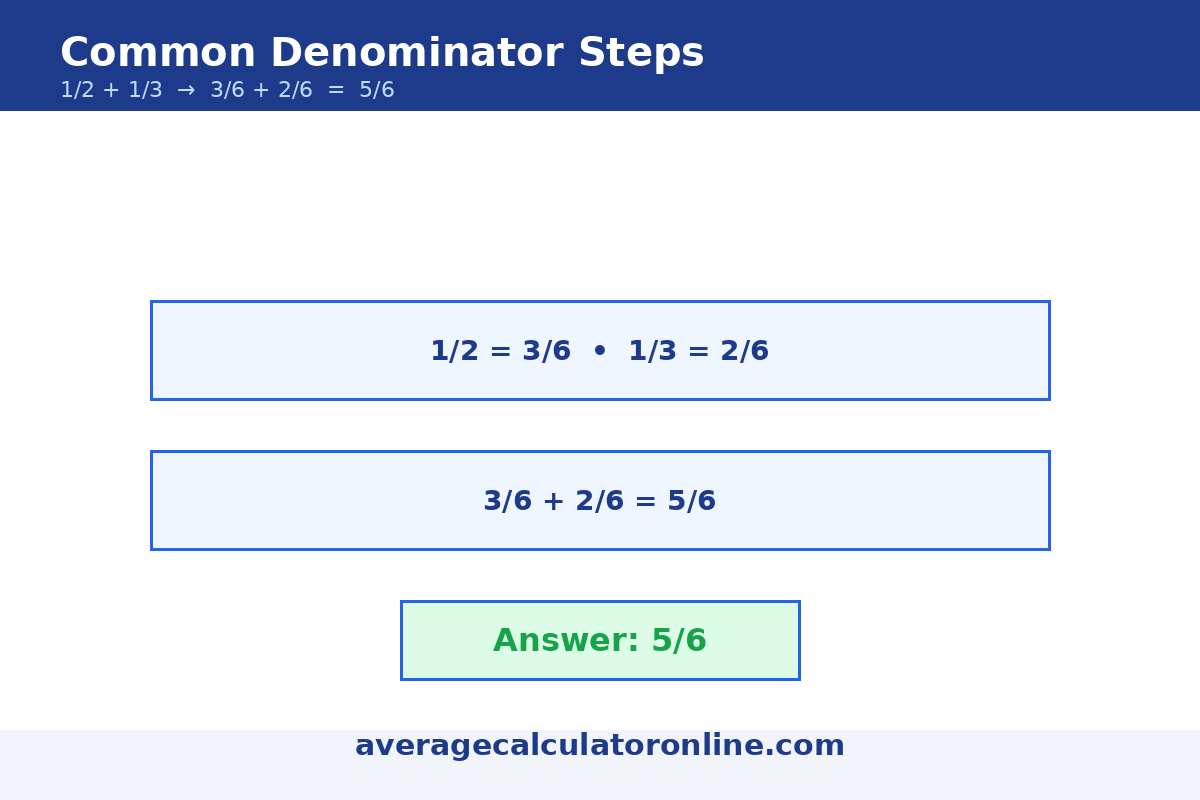
You can only add or subtract pieces of the same size — that means a common denominator. If the denominators already match, add the numerators and keep the denominator: 1/4 + 1/4 = 2/4 = 1/2. If they differ, convert first using the least common denominator (multiplying the two denominators always works): 1/2 + 1/3 = 3/6 + 2/6 = 5/6. Subtraction works the same way: 3/4 − 1/8 = 6/8 − 1/8 = 5/8.
3. Simplifying with the GCD
A fraction is simplified when the numerator and denominator share no common divisor except 1. To simplify, divide both by their greatest common divisor (GCD) — the biggest number that divides both. For 12/16 the GCD is 4, so 12/16 = 3/4. You can also simplify in smaller steps: 12/16 → 6/8 → 3/4. The value never changes; only the pieces get bigger and fewer.

4. Multiplying and Dividing Fractions
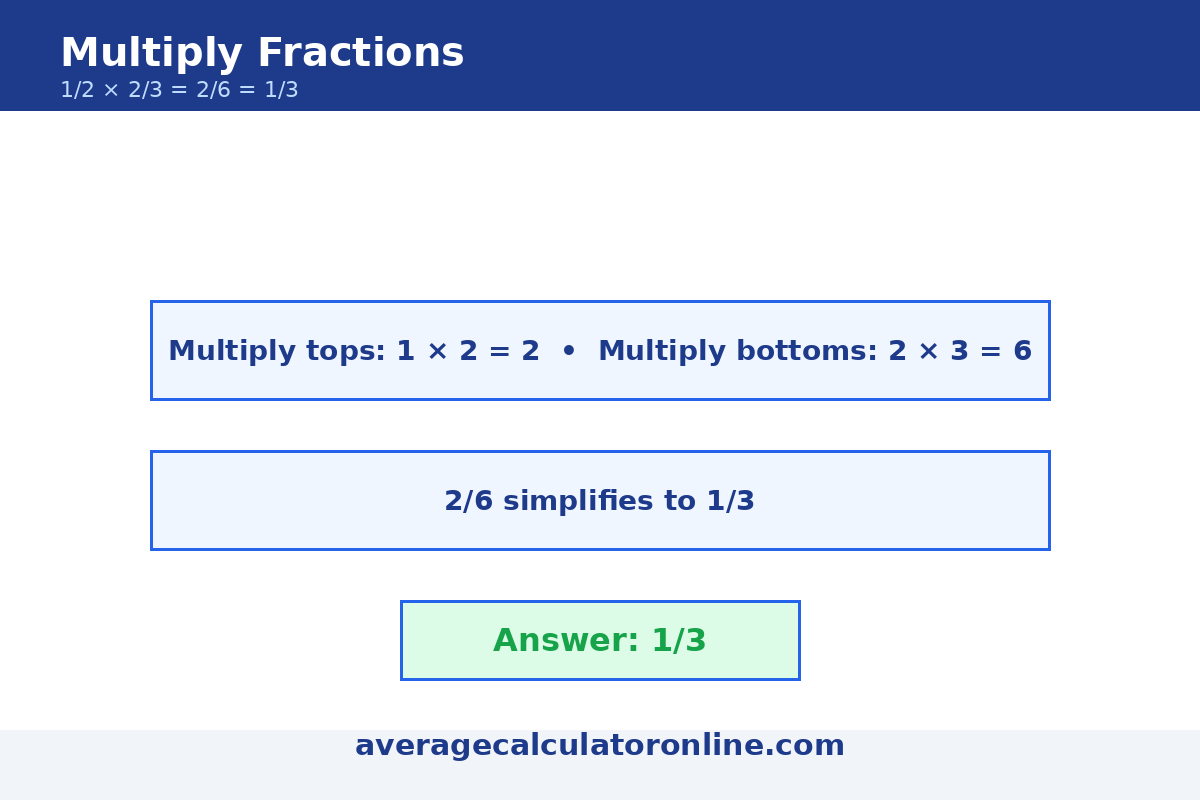
Multiplying is the easy one: multiply straight across — numerator × numerator over denominator × denominator — then simplify. Example: 2/3 × 3/4 = 6/12 = 1/2. (Tip: cancel common factors before multiplying to keep numbers small: the 3s cancel, leaving 2/4 = 1/2.)
Dividing means multiplying by the reciprocal — flip the second fraction, then multiply as usual. Example: 3/4 ÷ 1/2 = 3/4 × 2/1 = 6/4 = 3/2 (or 1½). Dividing by a fraction is the same as asking “how many of these fit inside,” and the answer can be bigger than what you started with.
5. Mixed Numbers and Improper Fractions
A mixed number like 2 1/2 combines a whole number with a fraction — two whole units plus one half. An improper fraction has a numerator at least as big as its denominator (5/2). Convert a mixed number by multiplying the whole by the denominator and adding the numerator: 2 1/2 = (2×2 + 1)/2 = 5/2. Go the other way by dividing: 7/3 = 2 remainder 1 = 2 1/3.
6. Worked Examples
- Addition: 1/2 + 1/3 = 3/6 + 2/6 = 5/6.
- Subtraction: 3/4 − 1/8 = 6/8 − 1/8 = 5/8.
- Multiplication: 2/3 × 3/4 = 6/12 = 1/2.
- Division: 3/4 ÷ 1/2 = 3/4 × 2/1 = 6/4 = 3/2.
- Simplification: 8/12 → GCD is 4 → 2/3.
- Mixed number: 7/3 = 2 1/3.
Last updated: November 1, 2026.