Loan Calculator
Total interest: $3999.20
Number of payments: 60
Direct answer: Monthly loan payment = P × r × (1 + r)ⁿ ÷ ((1 + r)ⁿ − 1), where P is the loan amount, r the monthly rate, and n the number of monthly payments. Early payments are mostly interest; later payments are mostly principal.
Worked examples
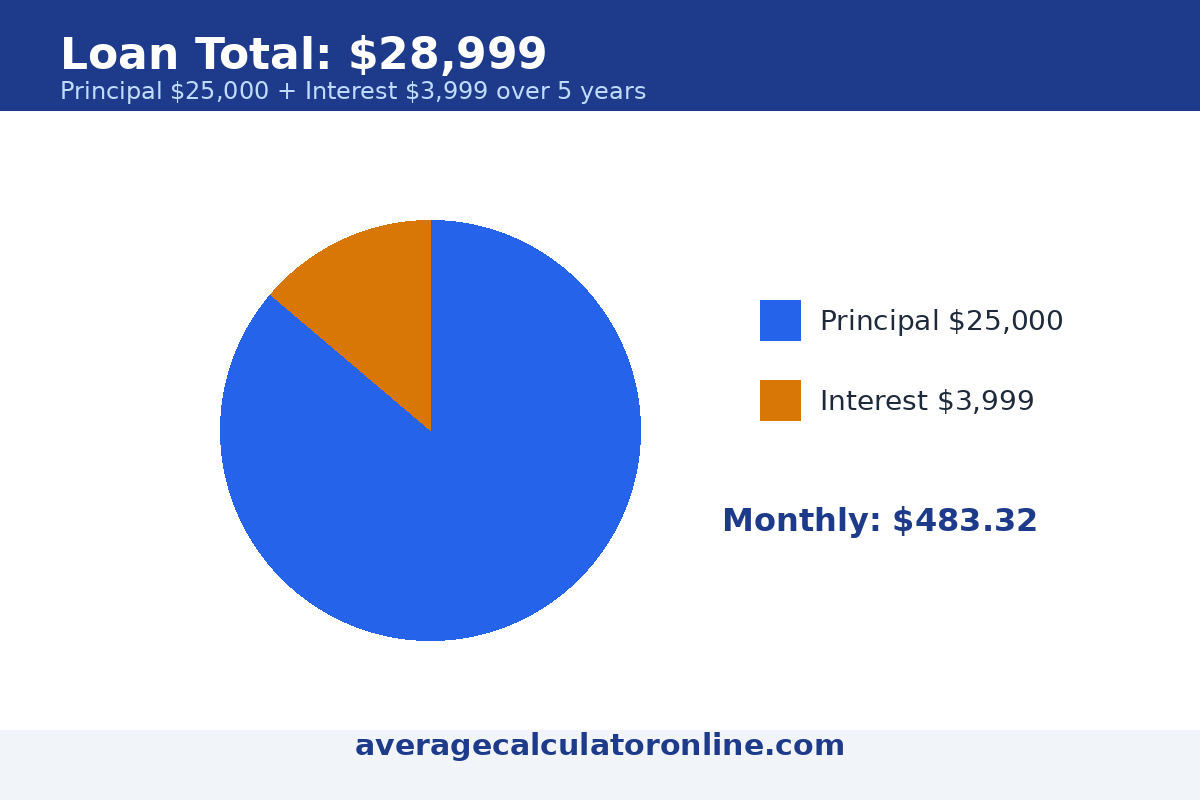
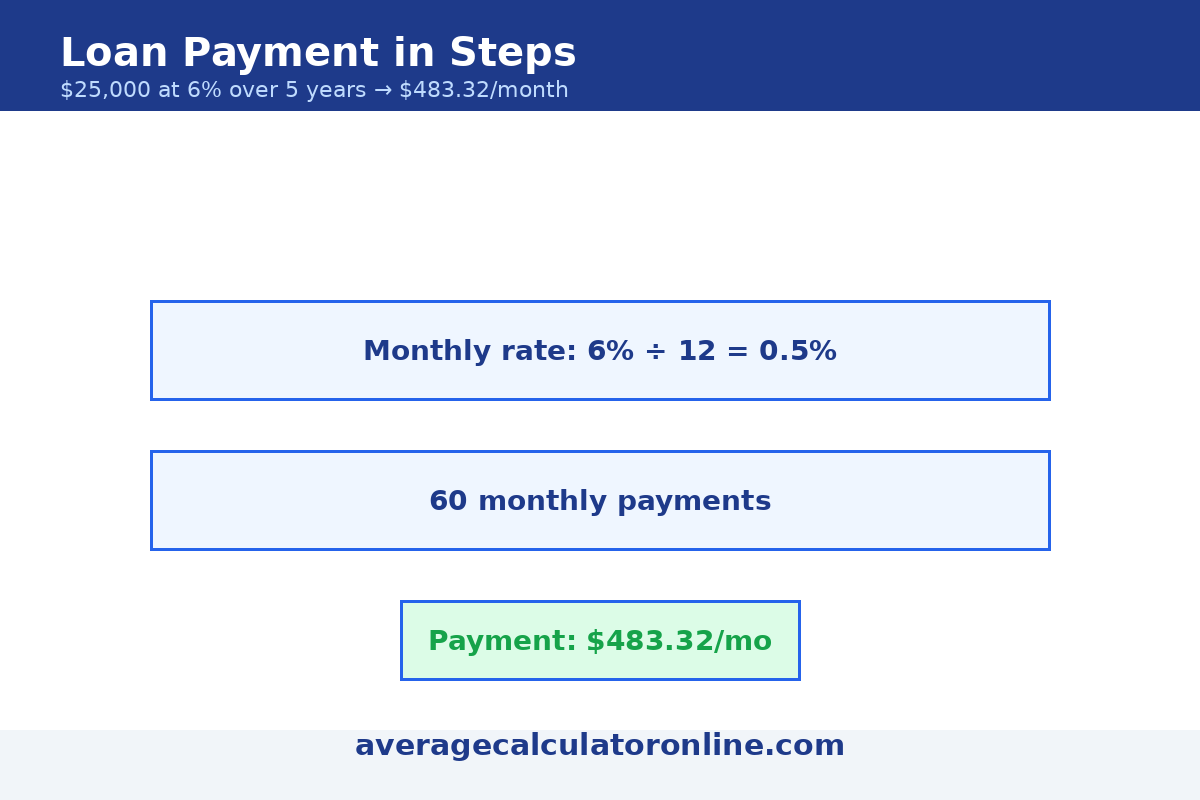
Example 1: $25,000 at 6% over 5 years (60 payments). Monthly rate 0.005. Payment = $483.32/month, total $28,999.20, interest $3,999.20.
Example 2: $10,000 at 8% over 3 years (36 payments). Payment ≈ $313.36/month, total ≈ $11,281, interest ≈ $1,281.
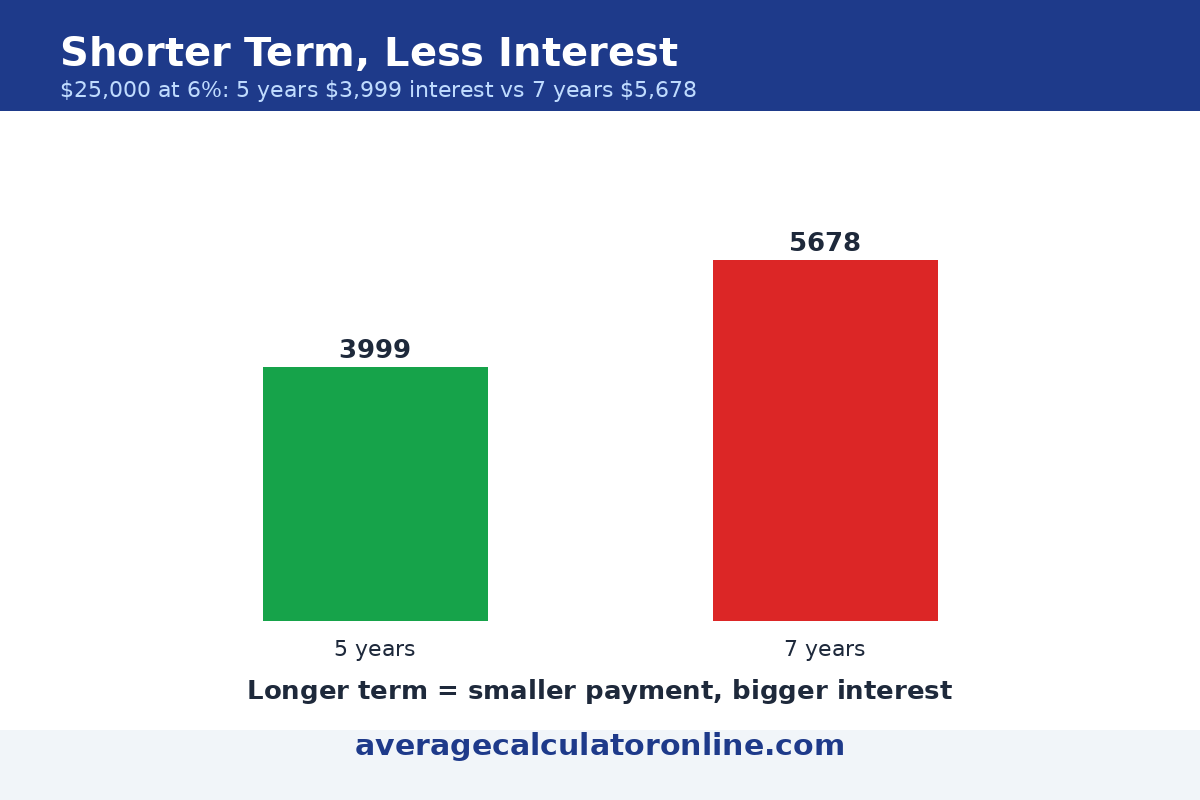
Example 3 — longer term costs more: The same $25,000 at 6% over 7 years (84 payments) drops the payment to about $365/month but raises total interest to roughly $5,678 — smaller payments, bigger total cost.
What affects your payment most
Three things: the amount borrowed, the interest rate, and the term. Rate matters most over long terms — one percentage point on a large loan can mean thousands in interest. Fees, late charges, and variable rates are not included here; your lender’s offer is the final word.
Frequently asked questions
How is a loan payment calculated?
With the amortization formula: M = P × r × (1 + r)ⁿ ÷ ((1 + r)ⁿ − 1). P is the amount, r the monthly rate, n the number of payments.
What is the payment on a $25,000 loan at 6% for 5 years?
$483.32 per month, $28,999.20 in total, $3,999.20 of it interest.
Does a longer term save money?
It lowers the monthly payment but raises total interest — you pay for longer, so the lender earns more.
What is the difference from a mortgage calculator?
The math is identical. A mortgage calculator is usually framed around a home price and down payment; this one starts from the loan amount itself.
Do extra payments help?
Yes. Paying extra principal shortens the loan and cuts total interest, because future interest is charged on a smaller balance.
Are taxes or fees included?
No. This tool covers principal and interest only; origination fees, insurance, and taxes are separate.
Disclaimer: This calculator provides estimates for education only and is not financial or lending advice. Actual payments depend on your lender, credit, fees, and loan terms.
Loan Deep Dive: Where Every Payment Goes
The calculator above gives you the monthly payment. This guide opens up the payment itself: how much of it is interest, how much actually shrinks your balance, and why the loan term you pick matters more than the rate you get.
The amortization schedule
Every payment is split into interest (the lender’s fee for that month) and principal (the part that reduces what you owe). Because interest is charged on the remaining balance, early payments are interest-heavy; as the balance falls, more of each payment attacks the principal. On a $25,000 loan at 6% over 5 years, the balance falls slowly at first, then faster:

Your total cost, split
Over 5 years you pay $28,999.20 in total — the $25,000 you borrowed plus $3,999.20 of interest. That 14% “extra” is the true price of borrowing, and it is the number to compare when shopping for loans, not just the monthly payment.

Interest vs. principal, year by year
Zoom into each year’s $5,799.84 of payments and the shift is dramatic: year 1 sends $1,380 to interest, while year 5 sends only $184. This is why extra payments early in a loan save far more than extra payments late — early principal reductions wipe out the most future interest.
Term comparison: shorter vs. longer
The term is a trade-off machine. Stretching $25,000 at 6% from 3 years to 7 years cuts the monthly payment from $761 to $365 — but total interest more than doubles, from $2,379.74 to $5,678. Borrow short when cash flow allows; borrow long only when you must.
Worked examples
Example A — a smaller loan: $10,000 at 8% over 3 years → about $313.36/month, $11,280.96 total, $1,280.96 of interest.
Example B — the power of extra payments: Add $100/month to the $25,000 / 6% / 5-year loan and it finishes in about 49 months instead of 60, saving roughly $790 in interest.
Example C — stretching the term: The same $25,000 at 6% over 7 years drops the payment to $365.21/month but raises total interest to $5,678 — $1,679 more than the 5-year term.
Two questions worth asking
Should I pick the lowest monthly payment? Only if cash flow forces it. Compare total interest across terms — the cheapest payment is usually the most expensive loan.
When do extra payments help most? Early. An extra $100 in month 6 avoids interest on that $100 for the remaining 54 months; the same $100 in month 54 avoids almost nothing.
Remember: these are planning estimates, not lending advice. Real loans include fees, insurance, and terms that vary by lender.
Last updated: November 1, 2026.