
Concrete Calculator
Direct answer: For a slab, concrete volume = length × width × thickness (in feet). Divide cubic feet by 27 to get cubic yards, then divide by a bag’s yield to get the number of bags. A 20 × 10 ft slab, 4 inches thick, needs 2.47 cubic yards — about 112 eighty-pound bags, or 123 bags with a 10% waste allowance.
Volume: 66.67 cubic feet (2.47 cubic yards)
Bags needed: 112 · With 10% waste allowance: 123 bags

How the calculation works
Step 1: Convert thickness to feet by dividing inches by 12 (4 inches = 0.333 feet — the Fraction Calculator converts decimals like 0.333 to their exact fraction, 1/3). Step 2: Slab or footing volume = length × width × thickness in feet. For a column, use height in feet directly instead of thickness. Step 3: Cubic yards = cubic feet ÷ 27, because 1 cubic yard = 27 cubic feet. Step 4: Bags = volume ÷ the bag’s yield, always rounded up — you cannot buy part of a bag. Step 5: Add a 10% waste allowance for spillage, uneven ground, and form variation — the Percentage Calculator can work out the extra bags from any waste rate.
Bag yields and bags per cubic yard
| Bag weight | Yield per bag | Bags per cubic yard |
|---|---|---|
| 80 lb | 0.6 cubic feet | 45 |
| 60 lb | 0.45 cubic feet | 60 |
| 40 lb | 0.3 cubic feet | 90 |
Ordering ready-mix by the cubic yard is usually cheaper than bags for anything over about 1 cubic yard.
Worked examples
Example 1 (slab): 20 ft × 10 ft, 4 inches thick. Volume = 20 × 10 × (4 ÷ 12) = 66.67 cubic feet = 2.47 cubic yards. At 0.6 cubic feet per 80 lb bag: 66.67 ÷ 0.6 = 111.1, rounded up to 112 bags. With 10% waste: 73.34 cubic feet ÷ 0.6 = 123 bags.
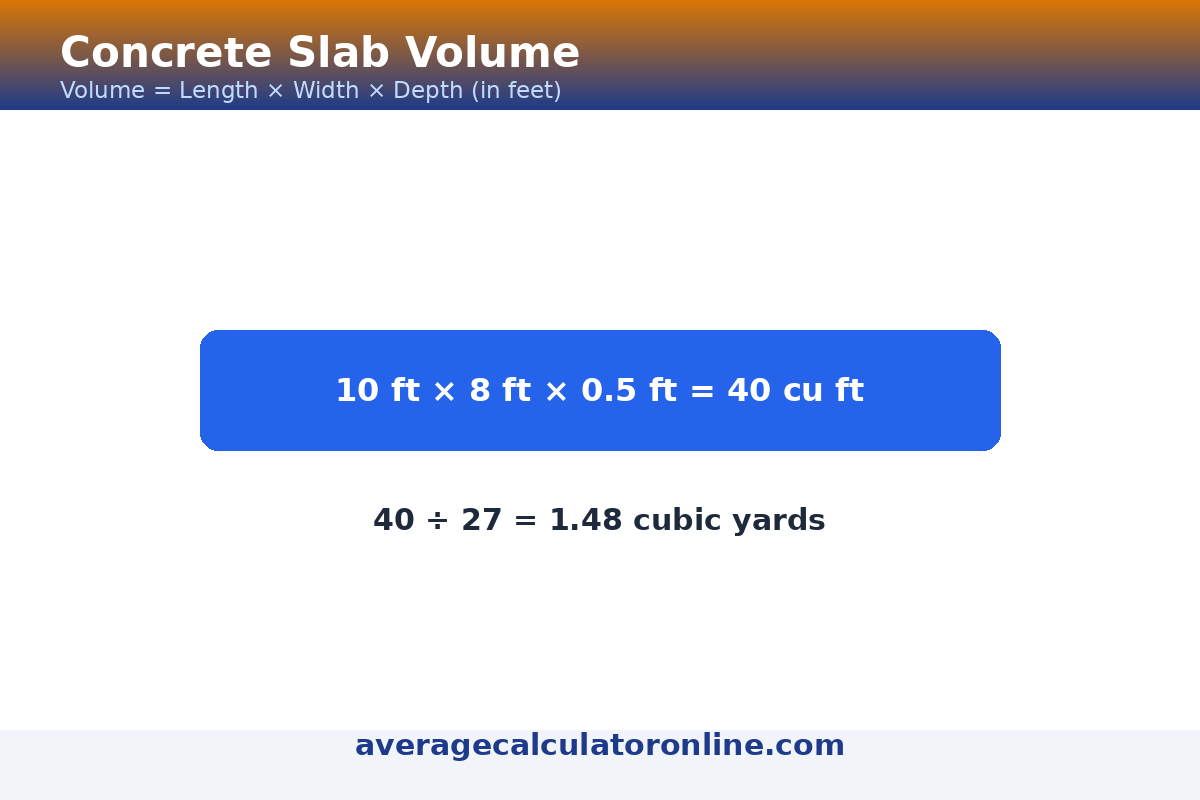
Example 2 (slab): 10 ft × 10 ft, 6 inches thick. Volume = 10 × 10 × 0.5 = 50 cubic feet = 1.85 cubic yards, or 84 eighty-pound bags.
Example 3 (column): 1 ft × 1 ft, 8 feet tall. Volume = 8 cubic feet = 0.30 cubic yards, or 14 eighty-pound bags.
Common mistakes to avoid
The most common error is forgetting to convert thickness from inches to feet — using 4 instead of 0.333 overstates the volume twelvefold. The second is skipping the waste allowance: real slabs are never perfectly level, and running short mid-pour leaves a weak cold joint. For driveways, a 4-inch slab suits cars, while 5–6 inches is the common guidance for heavier vehicles.

FAQs
How do you calculate concrete for a slab?
Multiply length × width × thickness, with thickness in feet (inches ÷ 12). Divide cubic feet by 27 for cubic yards.
How many 80 lb bags are in a cubic yard?
45 bags. One cubic yard is 27 cubic feet, and an 80 lb bag yields 0.6 cubic feet (27 ÷ 0.6 = 45).
Should I add a waste allowance?
Yes, 10% is the standard recommendation for spillage, uneven subgrade, and form variation.
How do you calculate concrete for a footing or column?
The same way: length × width × height, all in feet, then divide by 27 for cubic yards.
How thick should a driveway slab be?
4 inches is common for cars; 5–6 inches is the common guidance for heavier vehicles like trucks and RVs.
Is it cheaper to order ready-mix or bags?
Ready-mix by the cubic yard is usually cheaper and more consistent for jobs over about 1 cubic yard; bags suit small repairs and remote spots.
Disclaimer: Results are estimates only. Confirm thickness, mix strength, and local code requirements with your contractor or supplier.
Related calculators: Volume Calculator · Percentage Calculator · Fraction Calculator
Last updated: November 1, 2026.