Mortgage Calculator
Total of payments: $546106.77
Total interest: $306106.77
Direct answer: Monthly mortgage payment = P × r × (1 + r)ⁿ ÷ ((1 + r)ⁿ − 1), where P is the loan amount, r is the monthly interest rate, and n is the number of monthly payments. This calculator covers principal and interest only — taxes, insurance, and HOA fees are extra.
How the formula works
Example: $300,000 home with $60,000 down leaves a $240,000 loan. At 6.5% over 30 years (360 payments), the monthly rate is 0.065 ÷ 12 = 0.005417. Monthly payment = 240,000 × 0.005417 × (1.005417)³⁶⁰ ÷ ((1.005417)³⁶⁰ − 1) = $1,516.96. Over 360 payments you repay $546,106.77 in total, of which $306,106.77 is interest — more than the loan itself.
Worked examples
Example 1 — shorter term: The same $240,000 at 6.5% over 15 years (180 payments) → $2,090.66/month ($574 more each month), but total repaid is $376,319 with interest of only $136,319 — about $169,800 less interest than the 30-year version. Term length is the single most powerful lever on total interest.
Example 2 — bigger down payment: $300,000 home with 30% down ($90,000) leaves a $210,000 loan → $1,327.34/month at 6.5% over 30 years, total repaid $477,842, interest $267,842 — about $38,000 less interest than the 20%-down case, before even counting PMI savings.
What this calculator does not include
Real monthly housing cost is usually PITI: principal + interest + property taxes + homeowner’s insurance, plus PMI if your down payment is under 20%, and HOA dues where applicable. Use this tool for the loan payment, then add taxes and insurance for the full picture.
Frequently asked questions
How much is the monthly payment on a $300,000 mortgage?
With 20% down ($60,000), a $240,000 loan at 6.5% over 30 years costs $1,516.96 per month in principal and interest.
What is the mortgage formula?
M = P × r × (1 + r)ⁿ ÷ ((1 + r)ⁿ − 1). P is the loan amount, r the monthly rate, n the number of payments.
Does the calculator include taxes and insurance?
No. It calculates principal and interest only. Add property tax, insurance, PMI, and HOA separately.
Is a 15-year or 30-year mortgage better?
A 15-year term has higher monthly payments but much less total interest. A 30-year term is easier monthly but costs far more interest overall.
How does a bigger down payment help?
It lowers the loan amount, the monthly payment, and the total interest — and 20% down usually avoids PMI.
Do extra payments save money?
Yes. Extra principal payments shorten the loan and cut total interest, because interest is charged on the remaining balance.
Disclaimer: This calculator provides estimates for education only and is not financial, mortgage, or legal advice. Actual payments depend on your lender, credit, taxes, insurance, and fees. Consult a qualified mortgage professional before making a borrowing decision.
How Amortization Works: A Deep Dive
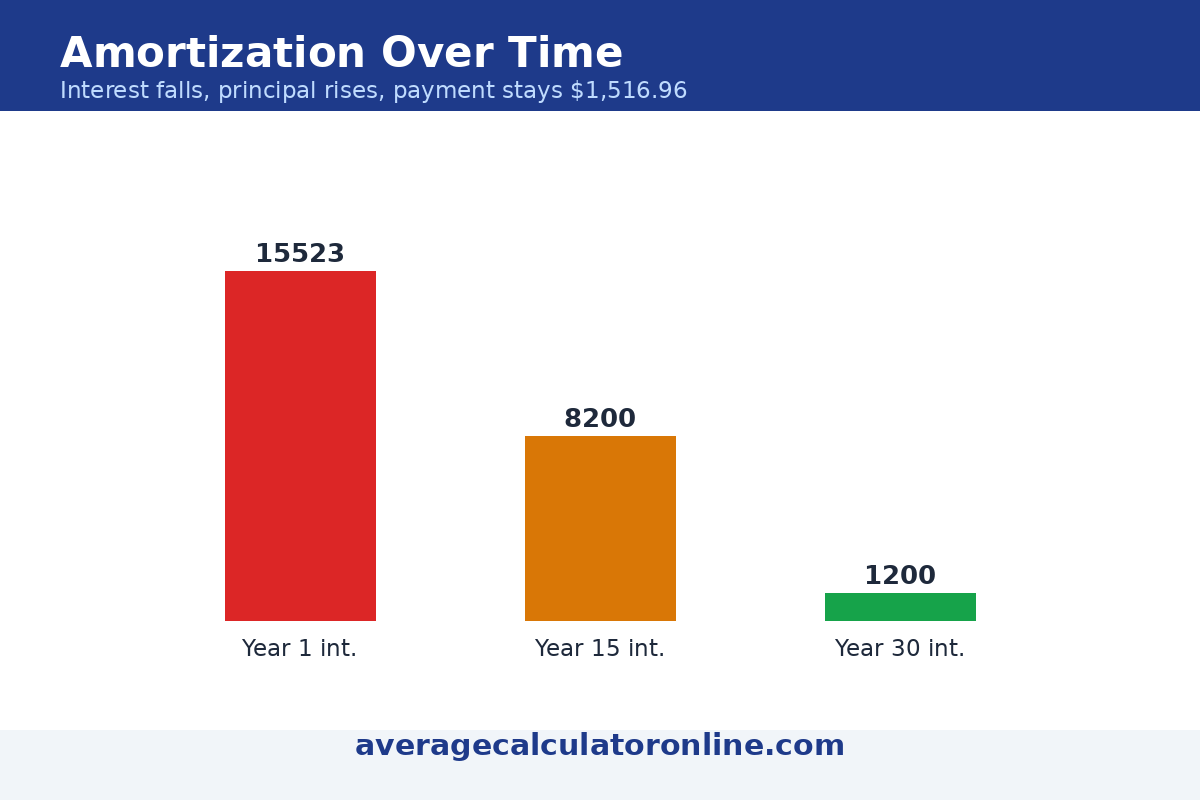
A mortgage calculator spreads one fixed monthly payment over hundreds of equal installments — but the mix inside each payment changes every month. This process is called amortization. Every payment covers the interest charged on the current balance first, and only what is left over reduces the principal.
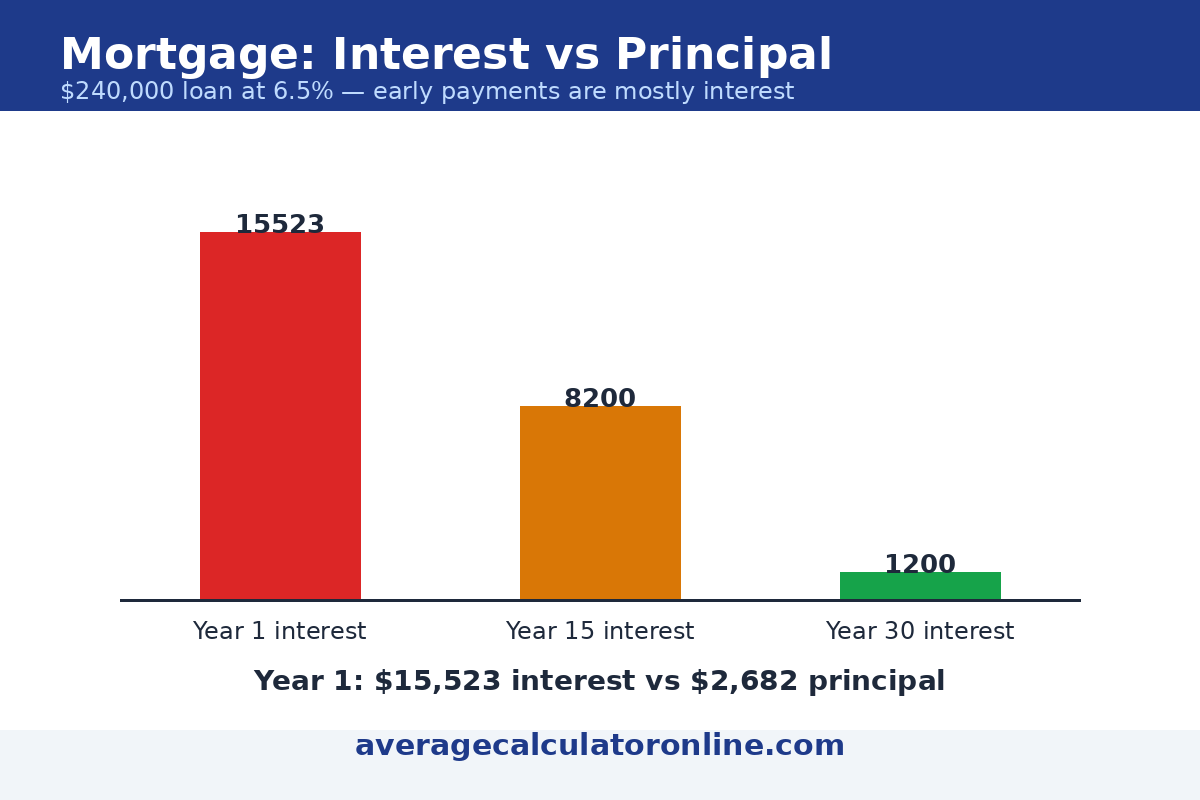
That ordering is why payoff starts so slowly. Take the default case on this page: a $240,000 loan at 6.5% over 30 years. The monthly payment is $1,516.96. In month one, interest alone is $240,000 × 0.065 ÷ 12 = $1,300 — so just $217 of the payment touches the principal. Across the entire first year, you pay $15,521 in interest and only $2,683 toward the loan itself.
The balance curve tells the same story visually: after 15 years — halfway through the loan — you still owe about $174,000, or 73% of what you borrowed. The balance falls slowly at first and then faster, because as the balance shrinks, less interest accrues and more of each fixed payment flows to principal.


Down Payment Impact: A Deep Dive
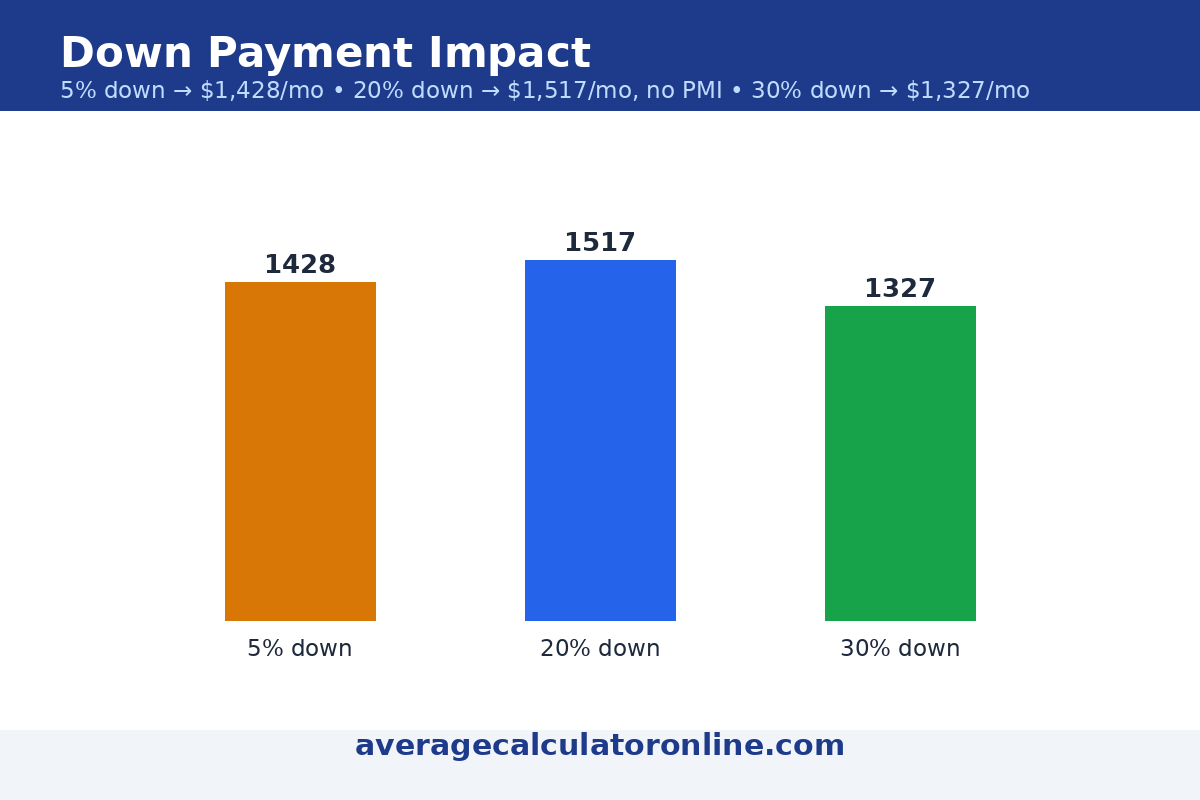
A bigger down payment does three things at once: it shrinks the loan amount, it shrinks the monthly payment, and it shrinks the total interest — because every dollar of down payment is a dollar you never borrow and never pay interest on. The diagram below compares three down payments on the same $300,000 home at 6.5% over 30 years.
Moving from 5% down to 20% down costs an extra $45,000 upfront but cuts the monthly payment by $284 and saves about $57,000 in interest over the life of the loan. Moving from 20% to 30% saves another $190 a month and roughly $38,000 more in interest. There is also a second, often bigger, win at 20%: most conventional lenders stop charging private mortgage insurance (PMI) at 20% down, which can save $100–$200 a month on top.
The trade-off is liquidity. Money put into a down payment is locked in the house — it earns no market return and is expensive to access. The right size is the one that avoids PMI and keeps an emergency fund intact, not necessarily the largest you can stretch to.
Run your own numbers in the mortgage calculator above — try changing the term and the down payment to see how strongly they move the total interest.
Sources & review
Figures on this page were checked against guidance from the Consumer Financial Protection Bureau (consumerfinance.gov) and the IRS (irs.gov). Reviewed by the Average Calculator Team. Last reviewed: 1 November 2026. This calculator gives planning estimates only and is not financial or mortgage advice.
Last updated: November 1, 2026.