Retirement Calculator
Growth: $900,650
Inflation-adjusted value (in current dollars, at 3% inflation): $401,814
Direct answer: Projected value = current savings grown with compound interest + monthly contributions grown with compound interest, using a monthly rate of annual return ÷ 12 over (retirement age − current age) × 12 months.
Worked examples
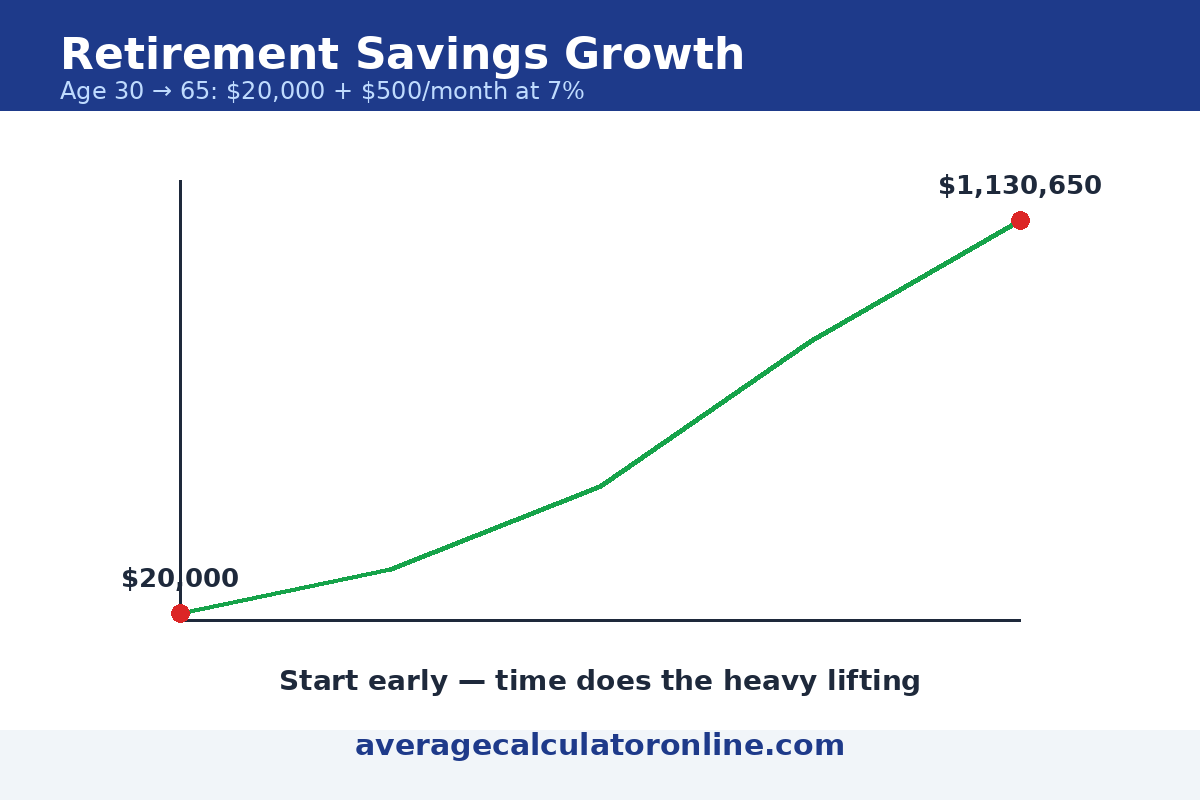
Example 1: Age 30 to 65 (420 months), $20,000 saved, $500/month, 7% nominal annual return. Projected total ≈ $1,130,650.34. Your contributions total $230,000 — the $20,000 starting amount plus $210,000 of monthly contributions ($500 × 420 months), each assumed to be made at month-end. Growth supplies the other $900,650.34, about $900,650. The 7% return is nominal, before inflation.
Example 2 — starting 10 years later: Same plan starting at 40 (300 months) gives roughly $519,500 — waiting 10 years costs about $611,000 of projected value, even though you only skipped $60,000 of contributions.
Example 3 — raising contributions: At 30, raising the monthly contribution from $500 to $750 adds about $450,000 to the age-65 projection, taking it to roughly $1,580,000.
What this projection leaves out
Inflation, taxes, fees, salary growth, employer matches, Social Security or pensions, and market ups and downs are not modelled. A 7% return is an assumption, not a promise — actual investing returns vary and can be negative in some years. Treat the result as a planning illustration, not a guarantee.
Frequently asked questions
How much will I have at retirement?
It depends on your starting savings, monthly contributions, return, and time. Enter your numbers above — time is usually the biggest lever.
How much should I save per month?
Common guidance is 10–15% of income including any employer match, but the right amount depends on your age, goals, and existing savings.
Does starting early really matter?
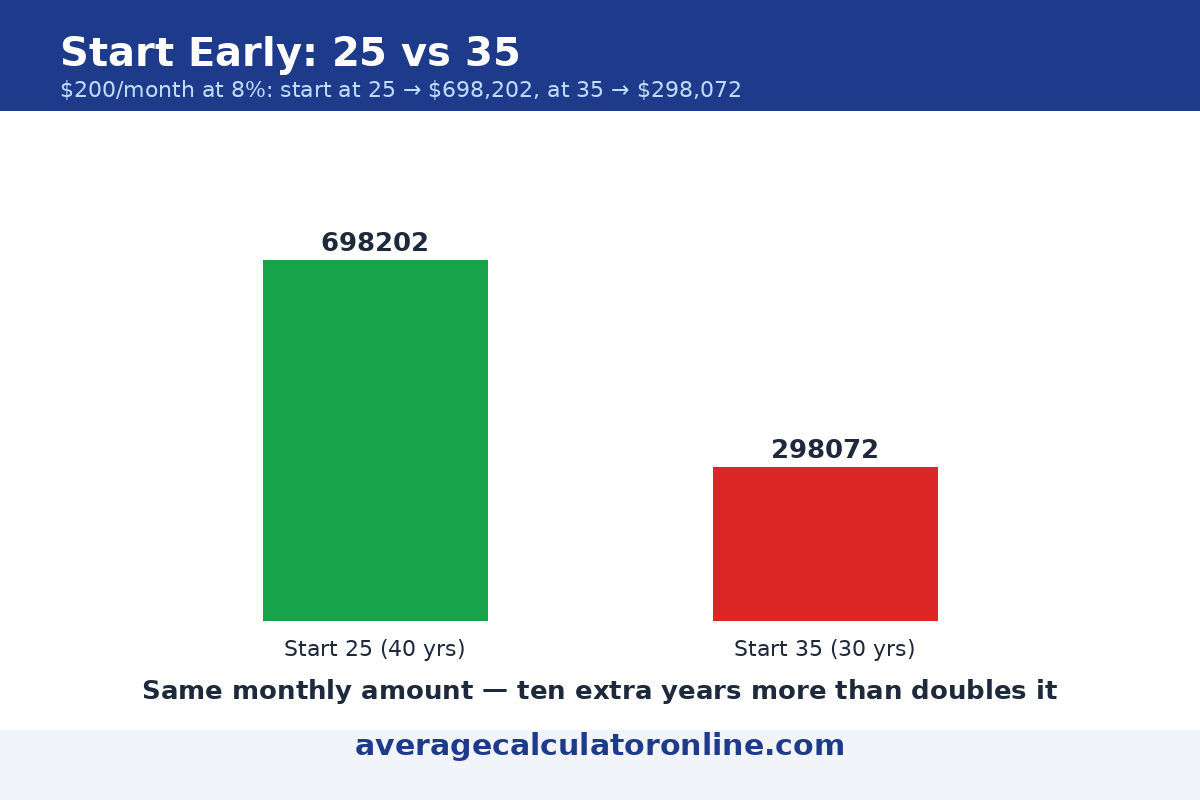
Yes — enormously. Ten extra years of compounding can be worth more than doubling your monthly contribution later.
What return should I assume?
Many planners illustrate with a 5–7% nominal return for a diversified portfolio; the return after inflation will be lower. Lower, more conservative assumptions give safer plans.
Does this include Social Security?
No. This projects only your own savings and contributions; add pensions and Social Security separately for a full picture.
Is this financial advice?
No. This is an educational projection. For personal planning, speak with a qualified financial adviser.
Disclaimer: This calculator provides hypothetical projections for education only and is not investment, retirement, or financial advice. Returns are assumed, not guaranteed, and real outcomes will differ.
Retirement Deep Dive: Building Your $1.1 Million
The calculator above projects one number: your savings at retirement. This guide unpacks it — how growth and contributions combine over decades, why your retirement age is the biggest lever you have, and how a nest egg becomes a paycheck.
Savings growth: the long curve
With $20,000 saved, $500/month, and a 7% return from age 30 to 65, the balance follows the classic compounding curve: slow for the first decade, then steep. Notice the gap between the dashed line (what you put in: $230,000) and the blue curve (what you end with: about $1,130,000) — that gap is growth doing the heavy lifting.
Retirement age: the biggest lever
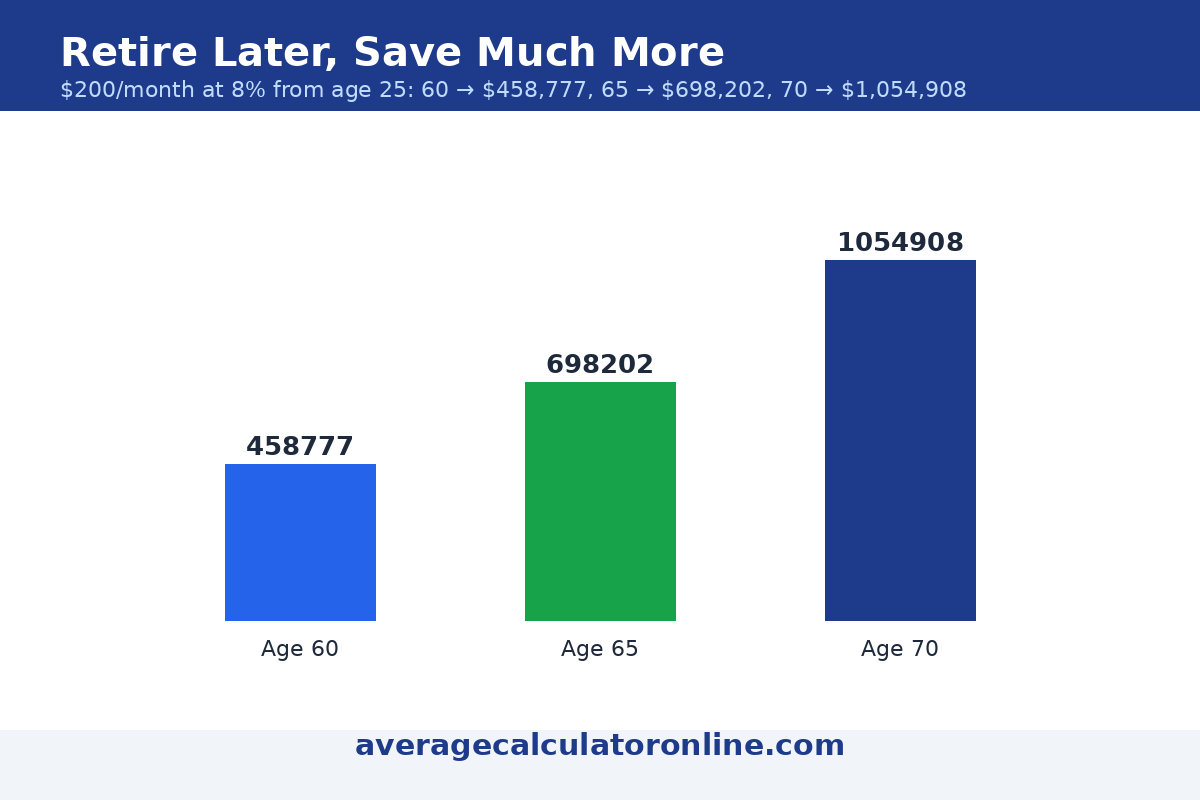
Same plan, three finish lines. Retiring at 60 gives about $772,000; working to 65 gives about $1,130,000; working to 70 gives about $1,638,000. Each extra five years is worth hundreds of thousands — five more years of contributions plus five more years of compounding on a large balance.
Contribution impact: small habits, huge endings
Raising the monthly contribution from $250 to $750 — an extra $500 a month — lifts the age-65 outcome from about $680,000 to about $1,581,000. And in every case, growth (blue) eventually dwarfs contributions (gray): at $500/month, growth supplies roughly 80% of the final balance.
From nest egg to paycheck
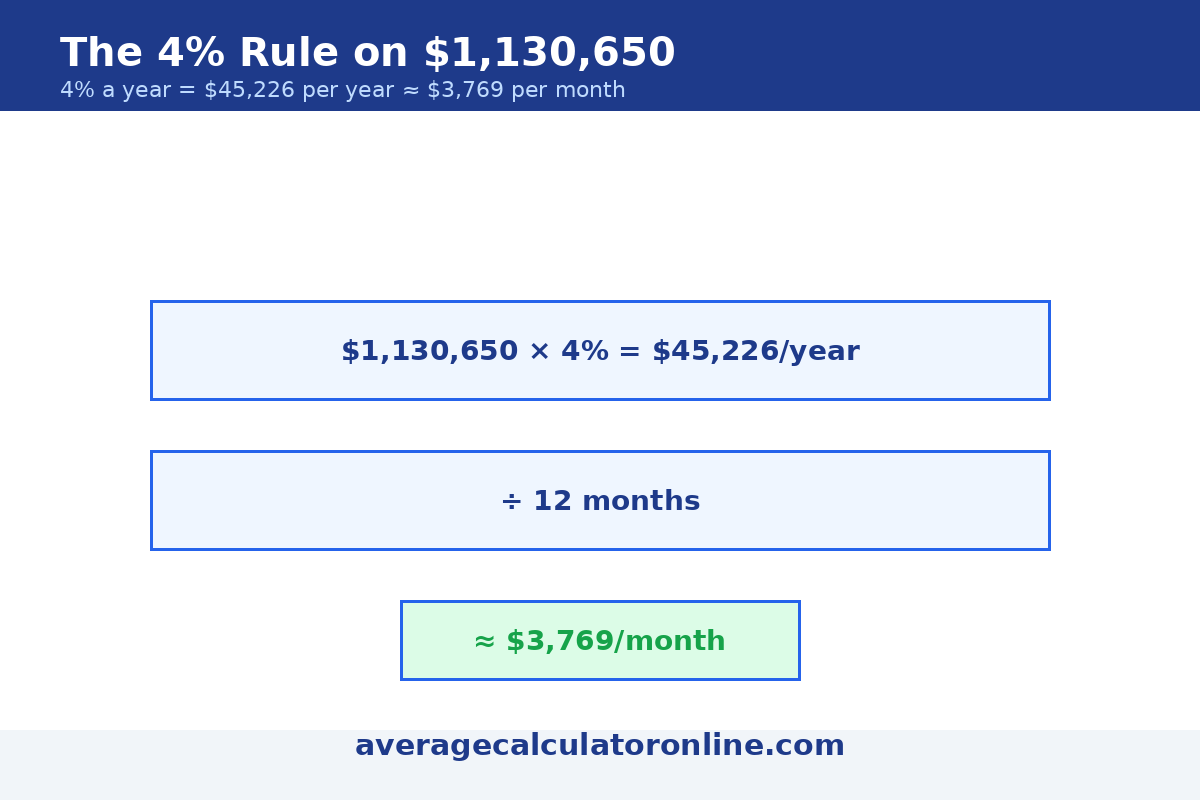
A common rule of thumb, the 4% rule, says you can withdraw about 4% of your savings in the first year of retirement and adjust for inflation after, with the money lasting decades. On a $1,130,650 nest egg that means roughly $45,226 in year one — about $3,769 a month — while the remaining balance keeps growing.
Worked examples
Example A — the default plan: Age 30 to 65, $20,000 saved, $500/month, 7% nominal return → about $1,130,650 at 65. Contributions total $230,000 including the $20,000 starting amount, growth supplies the other $900,650.
Example B — the cost of waiting: The same plan started at 40 instead of 30 → about $519,500. Ten lost years cost more than $600,000.
Example C — raising the habit: From 30, contributing $750/month instead of $500 → about $1,580,900 — an extra $450,000 for an extra $500 a month.
Two questions worth asking
Is 7% realistic? It is a common illustration rate for a diversified stock-heavy portfolio before inflation and fees. Real returns vary — run the calculator at 5% too, and plan around the lower number.
What about inflation? At 3% inflation, $1.13M in 35 years buys what about $400,000 buys today. That is why the contribution habit matters more than the headline number.
Remember: these are hypothetical projections, not financial advice. Real investing involves market risk, taxes, and fees — consider a qualified financial professional for personal planning.
Last updated: November 1, 2026.