
Calorie Calculator
Mild weight loss (−0.5 kg/week): 2133 calories/day
Muscle gain: 2933 calories/day
Direct answer: The Mifflin-St Jeor formula estimates basal metabolic rate (BMR): men = 10 × weight(kg) + 6.25 × height(cm) − 5 × age + 5; women use −161 instead of +5. Multiply BMR by an activity factor (1.2–1.9) to get total daily energy expenditure (TDEE) — your maintenance calories.
Worked examples
Example 2 — female: Female, 30 years, 165 cm, 60 kg, lightly active (1.375): BMR = 600 + 1,031.25 − 150 − 161 = 1,320.25 → TDEE ≈ 1,815 calories/day maintenance.
Example 3 — very active: Male, 40 years, 180 cm, 90 kg, very active (1.725): BMR = 900 + 1,125 − 200 + 5 = 1,830 → TDEE ≈ 3,157 calories/day maintenance.
Activity factors explained
| Lifestyle | Factor |
|---|---|
| Sedentary (desk job, little exercise) | 1.2 |
| Lightly active (1–3 days/week) | 1.375 |
| Moderately active (3–5 days/week) | 1.55 |
| Very active (6–7 days/week) | 1.725 |
| Extremely active (physical job + training) | 1.9 |
Disclaimer: This calculator provides estimates for general information only and is not medical or nutrition advice. Individual calorie needs vary widely. Consult a qualified health professional or registered dietitian before starting a diet or exercise program.
Daily Calorie Needs: A Deeper Look
The calculator above answers “how much?” with a single number. This guide goes deeper: where that number comes from, how each input moves it, and how to turn it into a practical daily eating target.
From BMR to TDEE: the full chain
Your body burns energy in layers. Basal metabolic rate (BMR) is the cost of keeping you alive at complete rest — breathing, circulation, brain function. The Mifflin-St Jeor equation estimates BMR from weight, height, age, and sex. Because you are not at rest all day, BMR is multiplied by an activity factor to produce total daily energy expenditure (TDEE) — the number that actually guides how much to eat.
Activity multipliers, step by step
The five multipliers are the crudest — and most powerful — lever in the formula. Moving from “lightly active” (1.375) to “very active” (1.725) raises the same person’s target by about 25%. Be honest here: most desk workers who exercise two or three times a week are “lightly active”, not “moderately active”.
Turning TDEE into a goal
Maintenance means eating at TDEE. For fat loss, a deficit of about 500 kcal/day leads to roughly 0.5 kg per week — fast enough to see progress, slow enough to protect muscle and energy. For lean muscle gain, a surplus of 250–350 kcal/day on training days is plenty; larger surpluses mostly add fat.
A concrete macro split
Calories set the direction; macros set the composition. A practical starting split for the 2,633 kcal example is 30% protein, 40% carbohydrates, 30% fat — about 197 g protein, 263 g carbs, and 88 g fat. Keep protein near 1.6–2.2 g per kg of body weight when dieting to protect muscle.
Worked examples
Example A — moderate deficit: Woman, 45 years, 160 cm, 68 kg, sedentary (1.2). BMR = 10×68 + 6.25×160 − 5×45 − 161 = 1,294. TDEE ≈ 1,553. A 500 kcal deficit gives about 1,050 kcal/day — very low, so a gentler 300 kcal deficit (≈ 1,250/day) is the safer starting point.
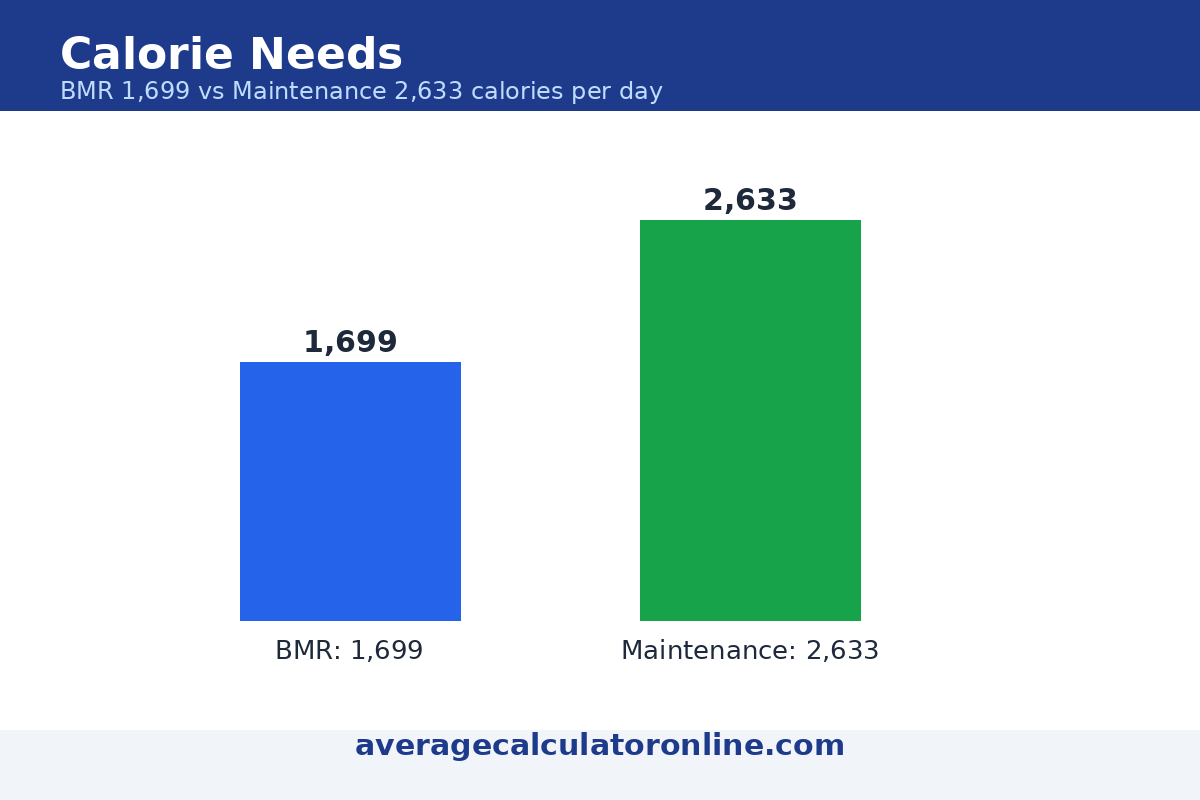
Example B — recomposition: Man, 30 years, 175 cm, 75 kg, moderately active (1.55). BMR ≈ 1,699, TDEE ≈ 2,633. Eating at maintenance with high protein and progressive training builds muscle while slowly leaning out.
Example C — lean gain: Man, 25 years, 185 cm, 80 kg, very active (1.725). BMR ≈ 1,836, TDEE ≈ 3,167. A 300 kcal surplus sets the target near 3,470 kcal/day.
Two questions worth asking
Should I eat back exercise calories? If you already chose an honest activity level, usually not — the multiplier covers it. Fitness trackers often overestimate burn, so eating back those calories can erase a deficit.
How often should I recalculate? Every 4–6 weeks, or after every 3–5 kg of weight change. A lighter body has a lower BMR, so targets must move down as you lose.
Last updated: November 1, 2026.