

GCF Calculator
Enter two or three whole numbers. Leave the third box empty for two numbers.
GCF of 48 and 180 is 12.
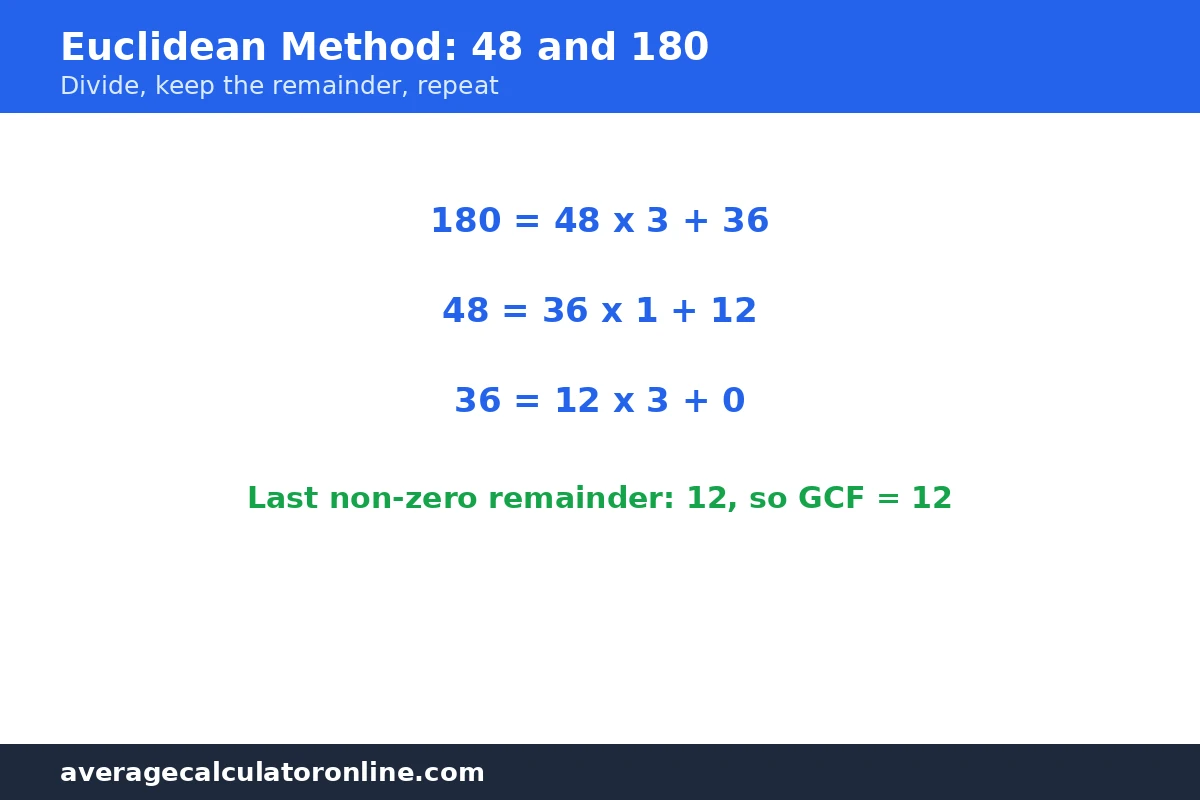
LCM of 48 and 180 is 720. The Euclidean method: 180 = 48 x 3 + 36, then 48 = 36 x 1 + 12, then 36 = 12 x 3 + 0, so the last non-zero remainder is 12.
Direct answer: A GCF calculator finds the greatest common factor of two or three numbers: the largest whole number that divides all of them with no remainder. The GCF of 48 and 180 is 12, because 12 divides both, and no larger number does. This page shows the Euclidean method step by step, so you can check the answer by hand. For the smallest number both divide into, see the least common multiple on the LCM page, and for the full factor lists, see the factor page.
By Average Calculator Team. Last reviewed: 16 November 2026.
How the greatest common factor works
The greatest common factor, or GCF, is the largest whole number that divides two or more numbers with no remainder. The factors of 48 are 1, 2, 3, 4, 6, 8, 12, 16, 24, and 48. The factors of 180 are 1, 2, 3, 4, 5, 6, 9, 10, 12, 15, 18, 20, 30, 36, 45, 60, 90, and 180. The numbers in both lists are 1, 2, 3, 4, 6, and 12, and the largest of them is 12, so the GCF of 48 and 180 is 12. Listing factors works for small numbers, but it gets slow fast, which is why the Euclidean method below is the standard tool. The factor calculator lists the factors of any number for you.
The Euclidean method is faster. Divide the larger number by the smaller one and keep the remainder. Then divide the old divisor by the remainder, and repeat until the remainder is 0. The last non-zero remainder is the GCF. For three numbers, find the GCF of the first two, then find the GCF of that result and the third number. The LCM calculator uses the same GCF to find the least common multiple.
Worked examples
Example 1: GCF of 48 and 180. Divide 180 by 48: 180 = 48 x 3 + 36. Divide 48 by 36: 48 = 36 x 1 + 12. Divide 36 by 12: 36 = 12 x 3 + 0. The last non-zero remainder is 12, so the GCF of 48 and 180 is 12. The LCM is 48 x 180 / 12 = 720.
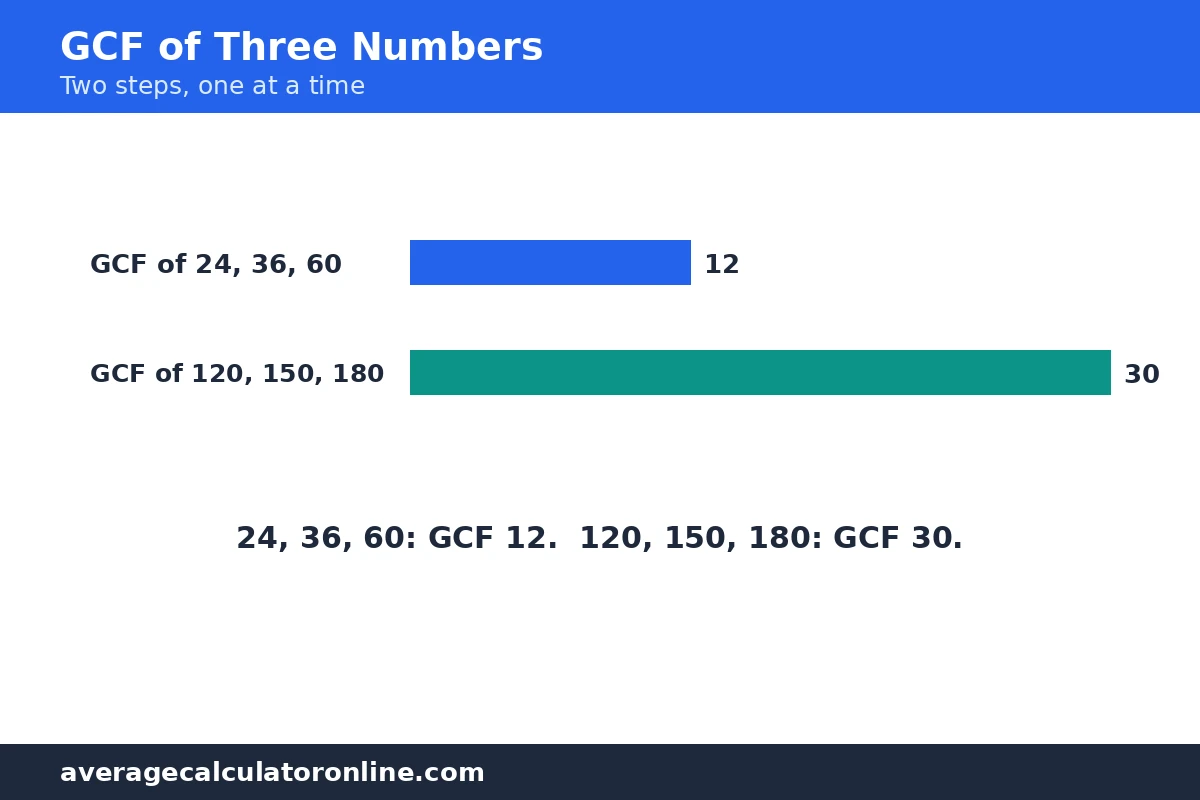
Example 2, three numbers: GCF of 24, 36, and 60. First, the GCF of 24 and 36 is 12, because 36 = 24 x 1 + 12, and 24 = 12 x 2 + 0. Then the GCF of 12 and 60 is 12, because 60 = 12 x 5 + 0. So the GCF of 24, 36, and 60 is 12.
Example 3, coprime numbers: GCF of 17 and 23. Both are prime numbers, and neither divides the other. The Euclidean method gives 23 = 17 x 1 + 6, 17 = 6 x 2 + 5, 6 = 5 x 1 + 1, and 5 = 1 x 5 + 0, so the last non-zero remainder is 1. Numbers with a GCF of 1 are called coprime, and their LCM is just their product: 17 x 23 = 391.
Example 4: GCF of 54 and 81. Divide 81 by 54: 81 = 54 x 1 + 27. Divide 54 by 27: 54 = 27 x 2 + 0. The last non-zero remainder is 27, so the GCF of 54 and 81 is 27. The LCM is 54 x 81 / 27 = 162.
Example 5, three larger numbers: GCF of 120, 150, and 180. The GCF of 120 and 150 is 30, because 150 = 120 x 1 + 30, and 120 = 30 x 4 + 0. Then the GCF of 30 and 180 is 30, because 180 = 30 x 6 + 0. So the GCF of 120, 150, and 180 is 30.
GCF and LCM side by side
The GCF and the LCM are linked by one formula: for any two numbers, GCF x LCM equals the product of the two numbers. The table checks the link for the examples above.
| Numbers | GCF | LCM | GCF x LCM | Product |
|---|---|---|---|---|
| 48 and 180 | 12 | 720 | 8,640 | 8,640 |
| 54 and 81 | 27 | 162 | 4,374 | 4,374 |
| 17 and 23 | 1 | 391 | 391 | 391 |
The link is a fast check on your answer: if GCF x LCM does not equal the product of the two numbers, one of the two is wrong. The fraction calculator uses the GCF to simplify fractions to lowest terms.
Common mistakes
Stopping one step too early: the GCF is the last non-zero remainder, not the first remainder. For 48 and 180, the first remainder is 36, but the GCF is 12. Keep dividing until the remainder is 0.
Dividing the wrong way round: always divide the larger number by the smaller one first. Dividing 48 by 180 gives 0 with a remainder of 48, which wastes a step and confuses the chain.
Forgetting the third number: for three numbers, the GCF of the first two is only a halfway answer. The GCF of 24 and 36 is 12, but the GCF of 24, 36, and 60 is also 12 only because 12 divides 60. Always run the third number through the same step.
Confusing GCF with LCM: the GCF is the largest number that divides into both, and it is never larger than the smaller number. The LCM is the smallest number both divide into, and it is never smaller than the larger number. For 48 and 180, the GCF is 12 and the LCM is 720. The math calculator checks the arithmetic if you want to verify a step.
Frequently asked questions
What is the greatest common factor?
The greatest common factor, or GCF, is the largest whole number that divides two or more numbers with no remainder. The GCF of 48 and 180 is 12, because 12 divides both 48 and 180, and no larger number does. It is also called the greatest common divisor, or GCD.
How do I find the GCF of two numbers?
Use the Euclidean method: divide the larger number by the smaller one and keep the remainder, then divide the old divisor by the remainder, and repeat until the remainder is 0. The last non-zero remainder is the GCF. For 48 and 180, the steps give remainders 36, then 12, then 0, so the GCF is 12.
How do I find the GCF of three numbers?
Find the GCF of the first two numbers, then find the GCF of that result and the third number. The GCF of 24 and 36 is 12, and the GCF of 12 and 60 is 12, so the GCF of 24, 36, and 60 is 12. The same rule works for four or more numbers, one step at a time.
What is the GCF of 17 and 23?
The GCF of 17 and 23 is 1, because both numbers are prime and neither divides the other. Numbers with a GCF of 1 are called coprime, and their least common multiple is just their product, which is 17 times 23, or 391.
What is the difference between GCF and LCM?
The GCF is the largest number that divides into both numbers, and it is never larger than the smaller number. The LCM is the smallest number that both numbers divide into, and it is never smaller than the larger number. For 48 and 180, the GCF is 12 and the LCM is 720, and 12 times 720 equals 48 times 180.
What is the GCF used for?
The GCF is used to simplify fractions to lowest terms, to split things into equal groups, and to find the LCM. To simplify 48 over 180, divide the top and the bottom by their GCF of 12, which gives 4 over 15. It is also used in algebra to factor expressions.
Factor Calculator ·
LCM Calculator ·
Fraction Calculator ·
Math Calculator ·
Percentage Calculator ·
Last updated: November 16, 2026.