
Factor Calculator
Direct answer
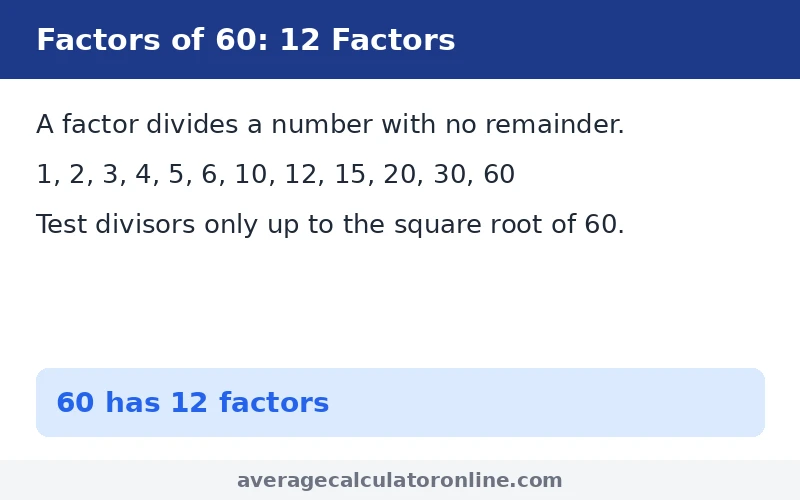
A factor of a number is a whole number that divides it with no remainder. For example, the factors of 60 are 1, 2, 3, 4, 5, 6, 10, 12, 15, 20, 30, 60 — 12 factors in total. Prime factorization breaks a number into prime factors: 60 = 2² × 3 × 5. Enter any whole number below and the tool lists all its factors, its factor pairs, its prime factorization, and whether it is prime or composite.
Factor Calculator
Inputs
| Field | Default | Unit |
|---|---|---|
| Whole number | 60 | — |
Outputs
| Output | How it is found | Default result (60) |
|---|---|---|
| All factors | Test every divisor up to the square root of the number | 1, 2, 3, 4, 5, 6, 10, 12, 15, 20, 30, 60 |
| Total factor count | Count of the factors | 12 |
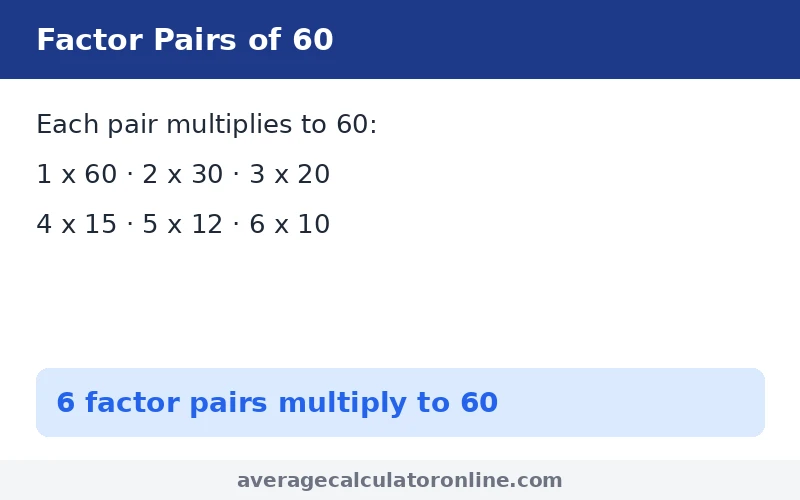
| Factor pairs | Each divisor paired with its quotient | 1 × 60, 2 × 30, 3 × 20, 4 × 15, 5 × 12, 6 × 10 |
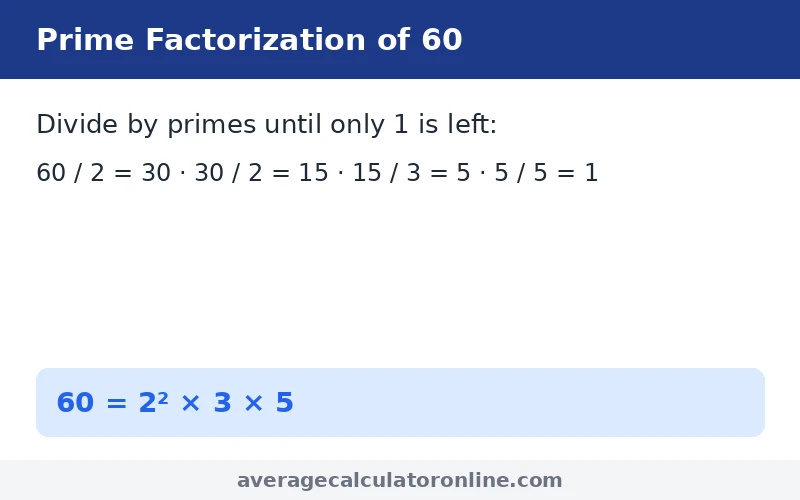
| Prime factorization | Repeated division by prime numbers | 60 = 2² × 3 × 5 |
| Prime or composite | More than two factors means composite; exactly two means prime | 60 is a composite number |
Defaults on load: 60 → 12 factors, prime factorization 2² × 3 × 5, composite. The result shows as soon as the page loads, before you enter anything.
How it works
- Find the factors by testing divisors up to the square root. To factor 60, test 1, 2, 3, 4, 5, 6 and 7 (√60 ≈ 7.75, so testing up to 7 is enough). Every divisor found gives two factors at once: the divisor and its quotient. For example, 60 ÷ 5 = 12, so both 5 and 12 are factors. Testing past the square root only repeats pairs already found.
- Pair them up. Each divisor and its quotient form a factor pair: 1 × 60, 2 × 30, 3 × 20, 4 × 15, 5 × 12, 6 × 10. Every pair multiplies back to the original number.
- Prime factorization by repeated division. Divide by the smallest prime that goes in evenly, and repeat on the quotient until only 1 is left: 60 ÷ 2 = 30, 30 ÷ 2 = 15, 15 ÷ 3 = 5, 5 ÷ 5 = 1. Collect the divisors: 2 × 2 × 3 × 5, written with exponents as 2² × 3 × 5.
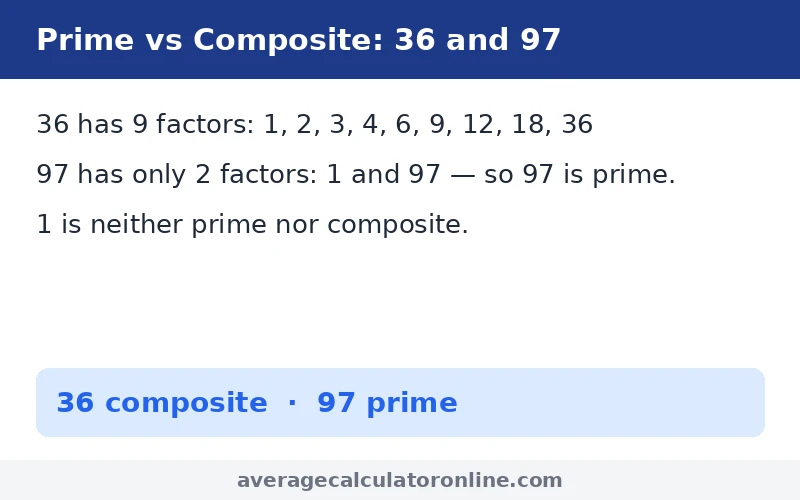
- Prime or composite. A number with exactly two factors (1 and itself) is prime. A number with more than two factors is composite. The number 1 has only one factor, so it is neither prime nor composite.
Factors of 1–20
| Number | Factors | Count |
|---|---|---|
| 1 | 1 | 1 |
| 2 | 1, 2 | 2 |
| 3 | 1, 3 | 2 |
| 4 | 1, 2, 4 | 3 |
| 5 | 1, 5 | 2 |
| 6 | 1, 2, 3, 6 | 4 |
| 7 | 1, 7 | 2 |
| 8 | 1, 2, 4, 8 | 4 |
| 9 | 1, 3, 9 | 3 |
| 10 | 1, 2, 5, 10 | 4 |
| 11 | 1, 11 | 2 |
| 12 | 1, 2, 3, 4, 6, 12 | 6 |
| 13 | 1, 13 | 2 |
| 14 | 1, 2, 7, 14 | 4 |
| 15 | 1, 3, 5, 15 | 4 |
| 16 | 1, 2, 4, 8, 16 | 5 |
| 17 | 1, 17 | 2 |
| 18 | 1, 2, 3, 6, 9, 18 | 6 |
| 19 | 1, 19 | 2 |
| 20 | 1, 2, 4, 5, 10, 20 | 6 |
Prime numbers in this range (exactly two factors) are 2, 3, 5, 7, 11, 13, 17 and 19. Perfect squares — 1, 4, 9, 16 — have an odd number of factors, because their square root pairs with itself (for example, 4 × 4 = 16). Once you have the factors, the LCM calculator finds the smallest number two numbers share as a multiple, and the math calculator covers the basic add, subtract, multiply and divide steps behind all of it.
Worked examples
Example 1 — The default: factors of 60
Test divisors up to √60 ≈ 7.75, so 1 through 7.
- Divisors that divide 60 evenly: 1, 2, 3, 4, 5, 6 (7 does not: 60 ÷ 7 = 8.57…)
- Full factor list: 1, 2, 3, 4, 5, 6, 10, 12, 15, 20, 30, 60 — 12 factors
- Factor pairs: 1 × 60, 2 × 30, 3 × 20, 4 × 15, 5 × 12, 6 × 10 — 6 pairs
- Prime factorization: 60 ÷ 2 = 30, 30 ÷ 2 = 15, 15 ÷ 3 = 5, 5 ÷ 5 = 1 → 60 = 2² × 3 × 5
- 12 factors is more than two, so 60 is composite.
Example 2 — A perfect square: factors of 36
Test divisors up to √36 = 6.
- Full factor list: 1, 2, 3, 4, 6, 9, 12, 18, 36 — 9 factors
- Factor pairs: 1 × 36, 2 × 18, 3 × 12, 4 × 9, 6 × 6 — 5 pairs (6 × 6 is the middle pair, which is why the count is odd)
- Prime factorization: 36 ÷ 2 = 18, 18 ÷ 2 = 9, 9 ÷ 3 = 3, 3 ÷ 3 = 1 → 36 = 2² × 3²
- 36 is composite.
Example 3 — A prime number: factors of 97
Test divisors up to √97 ≈ 9.85, so 2 through 9. None of 2, 3, 4, 5, 6, 7, 8 or 9 divides 97 evenly.
- Full factor list: 1, 97 — 2 factors
- Factor pairs: 1 × 97 — 1 pair
- Prime factorization: 97 = 97 (97 is itself prime)
- Exactly two factors, so 97 is prime.
Example 4 — A round number: factors of 100
Test divisors up to √100 = 10.
- Full factor list: 1, 2, 4, 5, 10, 20, 25, 50, 100 — 9 factors
- Factor pairs: 1 × 100, 2 × 50, 4 × 25, 5 × 20, 10 × 10 — 5 pairs
- Prime factorization: 100 ÷ 2 = 50, 50 ÷ 2 = 25, 25 ÷ 5 = 5, 5 ÷ 5 = 1 → 100 = 2² × 5²
- 100 is composite.
Tips and mistakes
- Stop at the square root. Once you pass √n, every divisor you find is a repeat of a pair already found. For 60, √60 ≈ 7.75, so testing 1–7 finds all 12 factors.
- Do not forget 1 and the number itself. Every positive whole number has 1 and itself as factors. A common mistake is listing only the “middle” factors and missing these two.
- Do not confuse factors with multiples. Factors divide a number (factors of 12 are 1, 2, 3, 4, 6, 12); multiples are what you get by multiplying it (multiples of 12 are 12, 24, 36, 48, …). Factors are finite; multiples go on forever.
- 1 is neither prime nor composite. It has only one factor (itself), so it fails both definitions. Saying “1 is prime” is the most common factor mistake.
- Prime factorization is unique. Every whole number greater than 1 breaks into exactly one set of prime factors (in a different order at most). That is why 60 is always 2² × 3 × 5 and never anything else.
- Use prime factorization for GCD and LCM. The greatest common divisor of 48 and 60 is 12 (48 = 2⁴ × 3, 60 = 2² × 3 × 5, shared primes 2² × 3 = 12). The least common multiple of 12 and 18 is 36 (12 = 2² × 3, 18 = 2 × 3², highest powers 2² × 3² = 36).
Sources
Factorisation is standard number theory — see Prime Factorization on MathWorld. Reviewed by the Average Calculator Team. Last reviewed: 7 November 2026.
Frequently asked questions
What is a factor of a number?
A factor is a whole number that divides another number with no remainder. For example, 5 is a factor of 60 because 60 ÷ 5 = 12 exactly. The factors of 60 are 1, 2, 3, 4, 5, 6, 10, 12, 15, 20, 30 and 60.
How do you find all the factors of a number?
Test every whole number from 1 up to the square root of the number. Each divisor that divides evenly gives two factors: itself and its quotient. For 60, the square root is about 7.75, so testing 1 to 7 finds divisors 1, 2, 3, 4, 5 and 6, which give all 12 factors: 1, 2, 3, 4, 5, 6, 10, 12, 15, 20, 30, 60.
What is prime factorization?
Prime factorization breaks a number into prime factors by repeated division. Divide by the smallest prime that goes in evenly and repeat until only 1 is left. For 60: 60 ÷ 2 = 30, 30 ÷ 2 = 15, 15 ÷ 3 = 5, 5 ÷ 5 = 1, so 60 = 2² × 3 × 5.
How do you know if a number is prime?
A prime number has exactly two factors: 1 and itself. Test divisors up to its square root — if none divides evenly, it is prime. For example, 97 has only the factors 1 and 97, so 97 is prime. The number 1 is neither prime nor composite because it has only one factor.
What is the difference between factors and multiples?
Factors divide a number: the factors of 12 are 1, 2, 3, 4, 6 and 12. Multiples are made by multiplying a number: the multiples of 12 are 12, 24, 36, 48 and so on. A number has a finite set of factors but infinitely many multiples.
What are factor pairs?
A factor pair is two factors that multiply to the original number. The factor pairs of 60 are 1 × 60, 2 × 30, 3 × 20, 4 × 15, 5 × 12 and 6 × 10. Every factor belongs to exactly one pair, and a perfect square such as 36 has one pair where both numbers are the same: 6 × 6.
Disclaimer
This calculator works with positive whole numbers up to 100,000,000 and shows exact arithmetic results for the number entered. It is a general-purpose math tool for learning and checking homework, not a substitute for a teacher or textbook. Results are only as correct as the number entered.
Related calculators
- Average Calculator Online — the homepage average tool
- Fraction Calculator — fraction arithmetic, where factors simplify fractions
- Scientific Calculator — powers, roots and scientific functions
- Percentage Calculator — percentage calculations
- Ratio Calculator — ratios, simplified using the greatest common divisor
Last updated: November 7, 2026.