Area Calculator: Rectangles, Circles, Triangles and L-Shaped Rooms
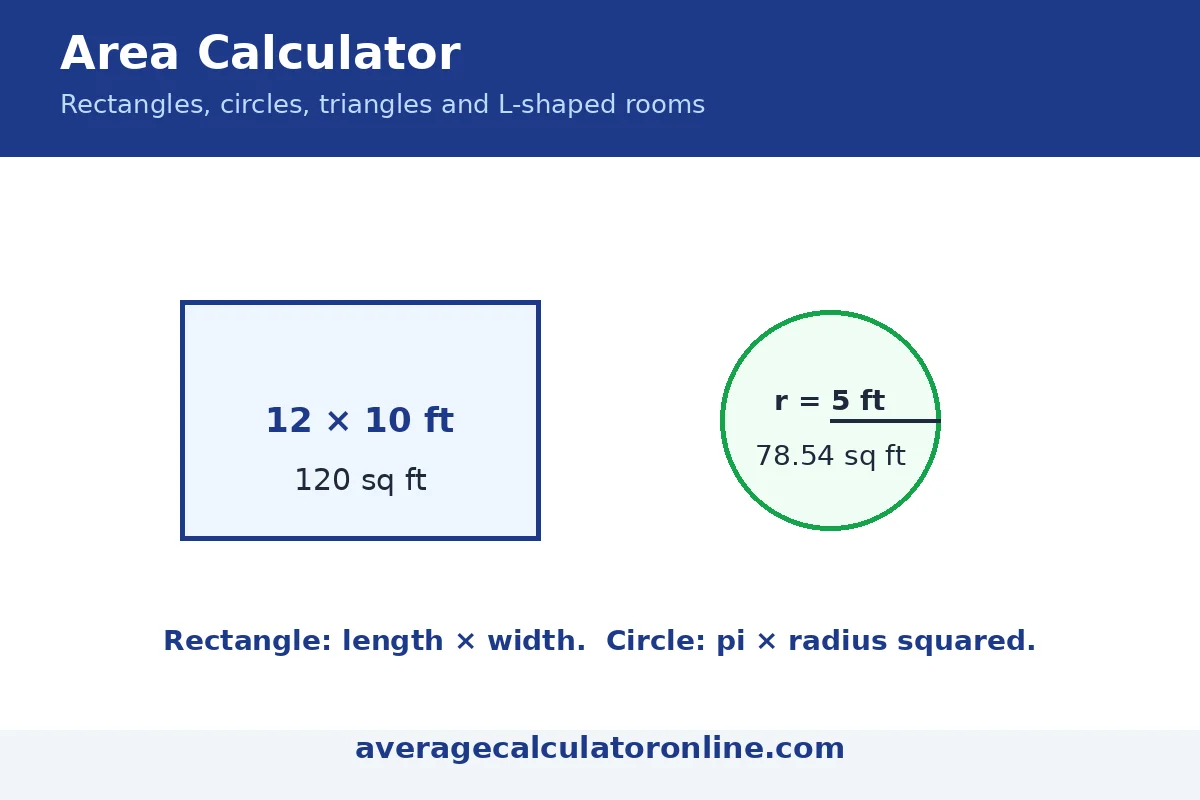
Short answer: Area measures a flat surface in square units. Rectangle: length times width. Circle: pi times radius squared. Triangle: base times height divided by 2. A 12 by 10 foot rectangle covers 120 square feet, which is 13.33 square yards or 11.15 square meters. Use the area calculator for rectangles, circles, triangles, squares, parallelograms, trapezoids and ellipses, with unit conversions built in.
Area formulas by shape
Every flat shape has one formula, and every formula needs its dimensions in the same unit before you multiply. Mixing feet and inches in one sum is the most common area mistake.
| Shape | Formula | Example |
|---|---|---|
| Rectangle | Length times Width | 12 times 10 = 120 sq ft |
| Square | Side times Side | 15 times 15 = 225 sq ft |
| Circle | pi times Radius squared | pi times 5 squared = 78.54 sq ft |
| Triangle | (Base times Height) divided by 2 | (10 times 6) divided by 2 = 30 sq ft |
| Parallelogram | Base times Height | 10 times 6 = 60 sq ft |
| Trapezoid | ((Base 1 + Base 2) divided by 2) times Height | ((8 + 12) divided by 2) times 5 = 50 sq ft |
| Ellipse | pi times Semi-axis 1 times Semi-axis 2 | pi times 6 times 4 = 75.40 sq ft |
Worked examples
Example 1, rectangle: 12 feet times 10 feet is 120 square feet. Convert it: 120 divided by 9 is 13.33 square yards, and 120 times 0.092903 is 11.15 square meters.
Example 2, circle: a radius of 5 feet. Area is pi times 5 squared, which is pi times 25, which is 78.54 square feet. Measure the radius, half the diameter, not the diameter itself: using 10 as the radius would give four times the true area.
Example 3, triangle: a base of 10 feet and a height of 6 feet. Area is 10 times 6 divided by 2, which is 30 square feet. The height is measured at a right angle to the base, not along the sloping side. A triangle with the same base and a height of 8 feet covers 40 square feet, because 10 times 8 divided by 2 is 40.
Example 4, square: a side of 15 feet. Area is 15 times 15, which is 225 square feet. That is 25 square yards, because 225 divided by 9 is 25, and 0.00517 acres, because 225 divided by 43560 is 0.00517.
Example 5, trapezoid: bases of 8 feet and 12 feet, height 5 feet. Area is 8 plus 12 divided by 2, times 5, which is 10 times 5, which is 50 square feet. The two bases are the parallel sides, and the height is the distance between them.
Example 6, ellipse: semi-axes of 6 feet and 4 feet. Area is pi times 6 times 4, which is 75.40 square feet. The same ellipse is 12 feet wide and 8 feet tall in full size.
L-shaped rooms and irregular areas
For an irregular room or plot, split it into rectangles and triangles, calculate each part, and add the results.
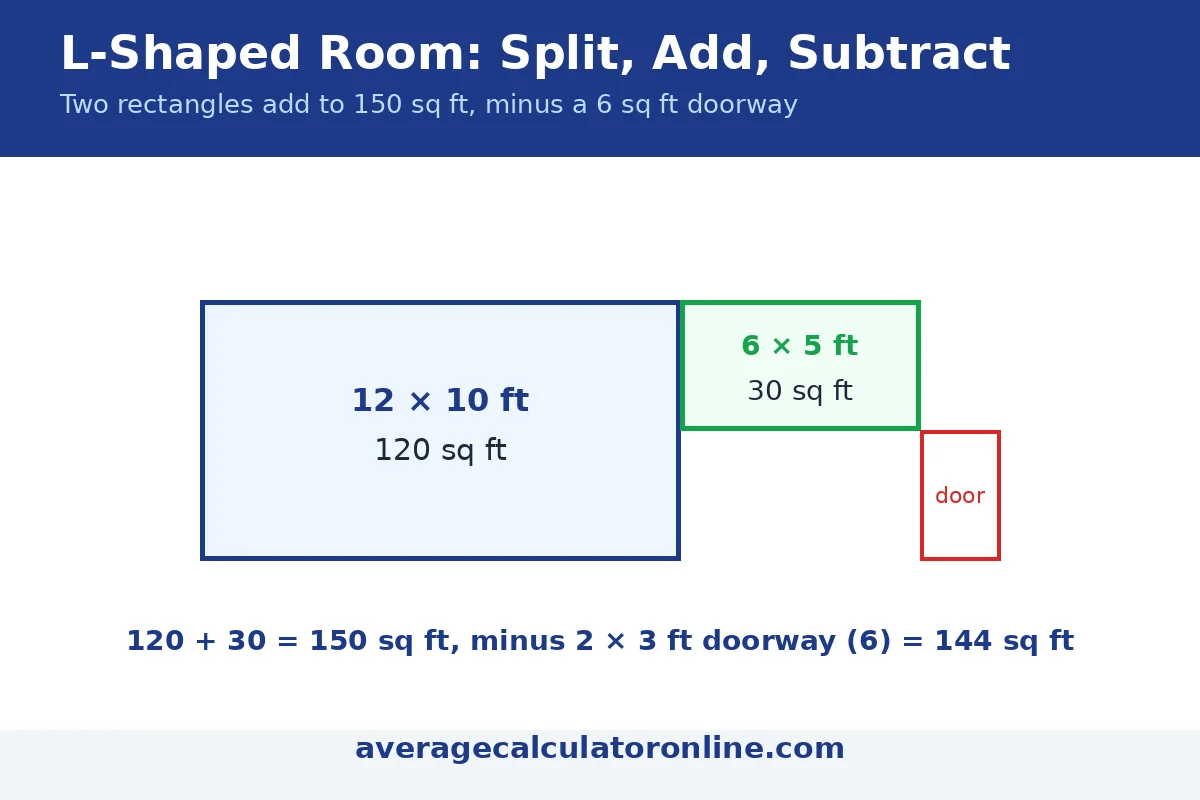
Example, the L-shaped room: split the room into two rectangles, 12 by 10 feet and 6 by 5 feet. Their areas are 120 and 30 square feet, giving 150 square feet in total. Then subtract the 2 by 3 foot doorway opening, which is 6 square feet: 150 minus 6 is 144 square feet. That is the area to order flooring or paint for, and the doorway is left out because it is not floored.
The same method works for any irregular shape: a garden with a rectangular lawn and a triangular bed is the rectangle area plus the triangle area, and a plot with a bite taken out of one corner is the full rectangle minus the missing piece. When the space also has depth, the volume calculator takes the calculation into three dimensions.
Measure twice before ordering flooring or paint, and add 5 to 10 percent extra for cutting waste.
Area unit conversions
Area units convert by the square of the length conversion. 1 yard is 3 feet, so 1 square yard is 9 square feet. 1 meter is about 3.28 feet, so 1 square meter is 10.7639 square feet. The conversions below cover the units the area calculator offers.
| Conversion | Factor |
|---|---|
| Square feet to square yards | divide by 9 |
| Square yards to square feet | multiply by 9 |
| Square feet to square meters | multiply by 0.092903 |
| Square meters to square feet | multiply by 10.7639 |
| Square feet to acres | divide by 43,560 |
| Acres to square feet | multiply by 43,560 |
For land, acres are the usual unit. For rooms and flooring, square feet and square yards are the usual units. Carpet is often sold by the square yard, so a 120 square foot room needs 13.33 square yards. Paint coverage is usually given in square feet per gallon, so divide the wall area by the coverage to get the gallons needed.
Area versus perimeter
Area measures the surface inside a shape in square units, while perimeter measures the distance around its edge in ordinary units. A 12 by 10 foot rectangle has an area of 120 square feet and a perimeter of 44 feet, because 12 plus 10 plus 12 plus 10 is 44.
Perimeter is what you need for fencing and edging. Area is what you need for flooring, paint, carpet and turf. Check which unit the product is sold in before you multiply.
Common mistakes
Mixing units: keep every dimension in the same unit before multiplying. 12 feet by 10 inches is not 120 of anything useful. Convert first, then multiply.
Using the diameter for a circle: the formula needs the radius, which is half the diameter. Using the diameter gives four times the true area.
Measuring triangle height along the slope: the height is the perpendicular distance from the base to the opposite corner, not the length of the sloping side.
Using full axes for an ellipse: the formula needs semi-axes, half the full width and half the full height. Full axes give four times the true area.
Forgetting the doorway or the missing piece: an L-shaped room is two rectangles added together, and any opening that is not floored comes off the total. The example above gives 144 square feet, not 150, once the doorway is subtracted.
Coverage planning: paint and flooring from the room area
An area on its own does not buy paint or flooring. Products are sold by coverage, so divide the area by the coverage, then round up: a part tin or a part pack cannot be bought.
Example, paint: a room 12 feet by 10 feet with 8 foot ceilings has four walls: two are 12 times 8, which is 96 square feet each, and two are 10 times 8, which is 80 square feet each. The total wall area is 96 plus 96 plus 80 plus 80, which is 352 square feet. If one gallon covers 350 square feet, one coat needs 352 divided by 350, which is 1.01 gallons, so buy 2 gallons. Two coats need 704 divided by 350, which is 2.01 gallons, so buy 3 gallons. Check the coverage on the tin, because it varies by brand.
Example, flooring: the L-shaped room in this guide covers 144 square feet. With 10 percent cutting waste, order 144 times 1.10, which is 158.40 square feet, so order 159 square feet. With 5 percent waste, order 144 times 1.05, which is 151.20 square feet, so order 152 square feet. Carpet is sold by the square yard: 144 square feet is 16 square yards, and 10 percent extra gives 17.6 square yards, so order 18 square yards. For the concrete under a floor, the concrete calculator turns the same area and a thickness into cubic yards.
FAQ
How do you calculate the area of a rectangle?
Multiply length times width, with both dimensions in the same unit. A rectangle 12 feet by 10 feet covers 120 square feet.
How do you calculate the area of a circle?
Multiply pi by the radius squared. For a radius of 5 feet, the area is pi times 25, which is 78.54 square feet. Measure the radius, which is half the diameter, not the diameter itself.
How do you calculate the area of a triangle?
Multiply the base by the height and divide by 2. A triangle with a base of 10 feet and a height of 6 feet covers 30 square feet. The height is measured at a right angle to the base.
How do you measure an L-shaped room?
Split the room into two rectangles, work out each area, and add the results. A room split into 12 by 10 feet and 6 by 5 feet gives 120 plus 30, which is 150 square feet. If a 2 by 3 foot doorway opening is not floored, subtract 6 square feet to get 144 square feet.
How many square feet are in a square yard?
One square yard equals 9 square feet, so divide square feet by 9 to get square yards. A room of 120 square feet is 13.33 square yards.
What is the difference between area and perimeter?
Area measures the surface inside a shape in square units, while perimeter measures the distance around its edge in ordinary units. A 12 by 10 foot rectangle has an area of 120 square feet and a perimeter of 44 feet.
Related calculators: Area Calculator · Volume Calculator · Concrete Calculator · Math Calculator