Debt-to-Income Ratio Calculator
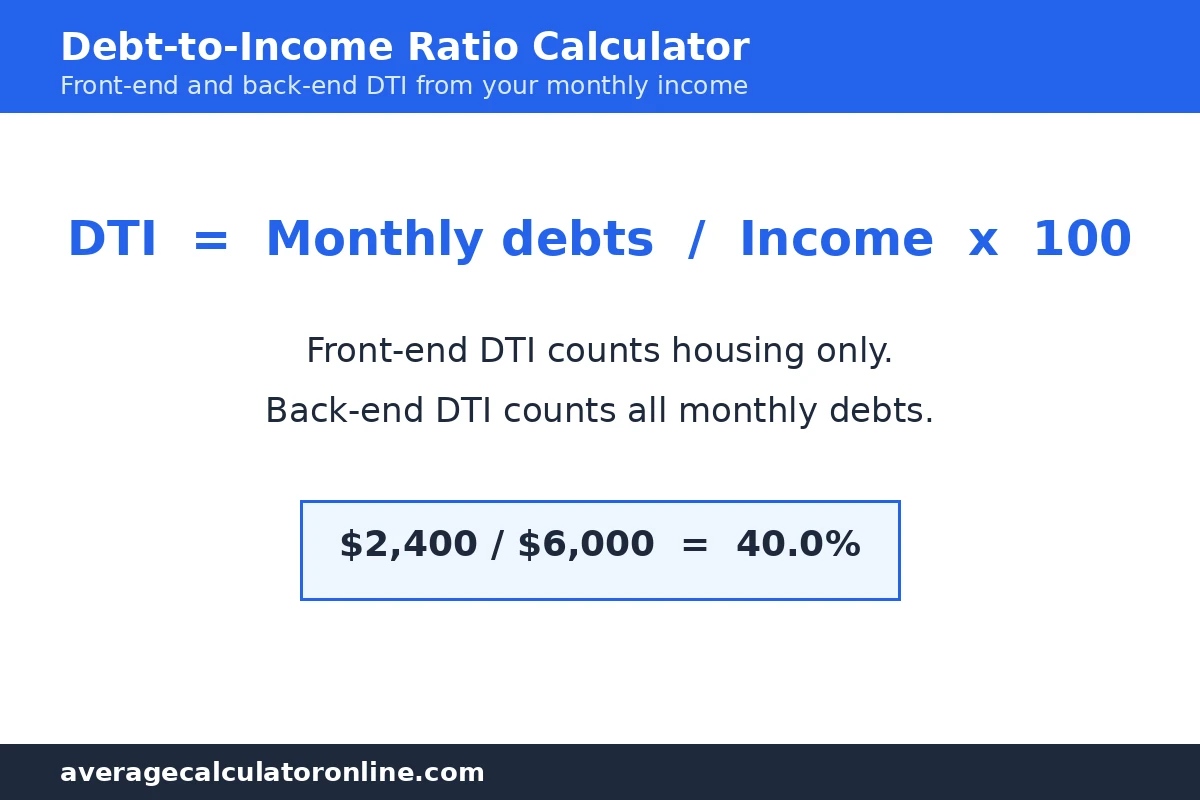
Direct answer: DTI = total monthly debt payments / gross monthly income x 100. On $6,000 of monthly income with a $1,500 housing payment and $900 of other debts, the front-end DTI is 25.0% and the back-end DTI is 40.0%.
By Average Calculator Team. Last reviewed: 15 November 2026.
How DTI works
DTI measures the share of your gross monthly income that goes to debt payments. Gross income is your pay before taxes, so use the gross figure from your pay slip. The paycheck calculator can help you work out gross pay from your hours and rate.
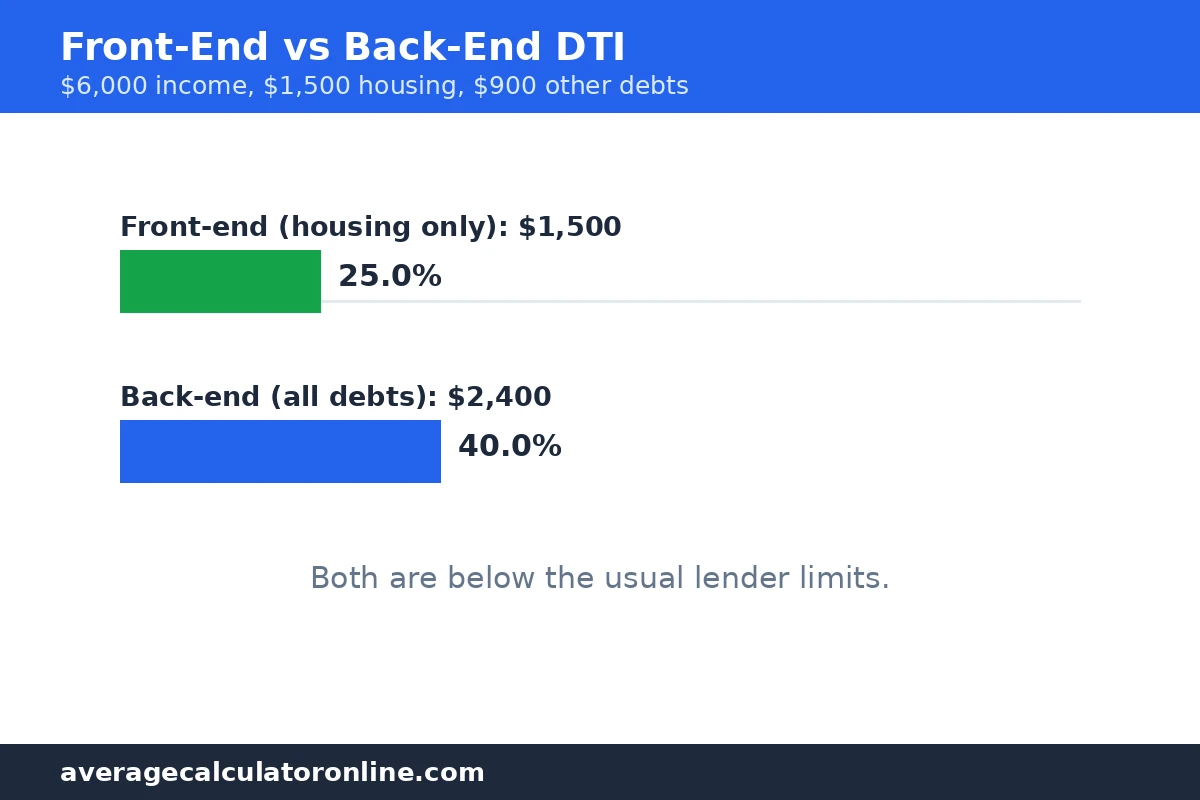
Front-end DTI counts housing only: rent or mortgage payment divided by gross monthly income. Include property taxes, home insurance, and HOA fees in the housing payment if they apply to you. Back-end DTI counts all monthly debts: housing plus car loans, student loans, credit card minimums, personal loans, and any other monthly debts, divided by gross monthly income. Lenders look at both numbers, and the back-end number is usually the one that decides an application. Work out the monthly payment on a home loan with the mortgage calculator.
Worked examples
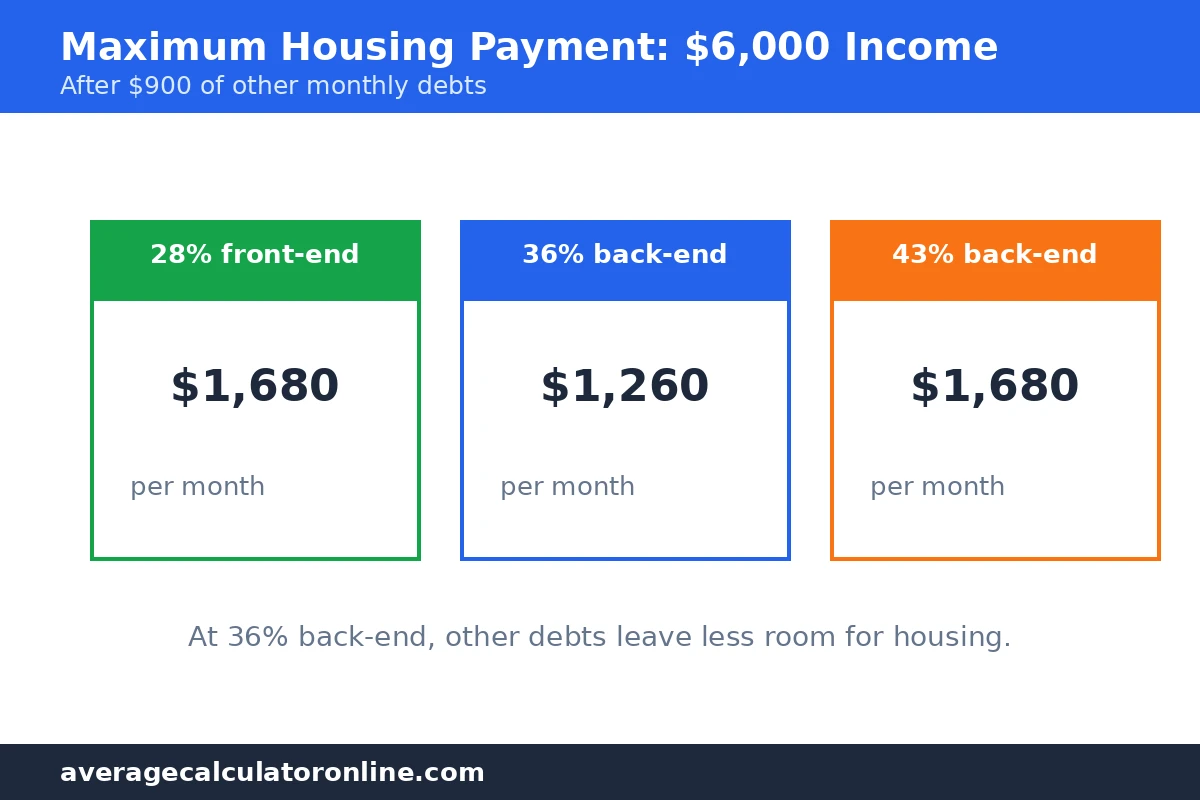
Example 1: $6,000 of monthly income, $1,500 housing, and $900 of other debts ($350 car + $250 student loan + $200 credit cards + $100 personal loan). Front-end DTI = 1,500 / 6,000 x 100 = 25.0%. Back-end DTI = 2,400 / 6,000 x 100 = 40.0%. Maximum housing payment: $1,680 at the 28% front-end limit, $1,260 at the 36% back-end limit, and $1,680 at the 43% back-end limit.
Example 2: $4,500 of monthly income, $1,350 housing, and $600 of other debts. Front-end DTI = 1,350 / 4,500 x 100 = 30.0%. Back-end DTI = 1,950 / 4,500 x 100 = 43.3%. Maximum housing payment: $1,260 at 28%, $1,020 at 36% back-end, and $1,335 at 43% back-end.
Example 3: $8,000 of monthly income, $1,800 housing, and $1,400 of other debts. Front-end DTI = 1,800 / 8,000 x 100 = 22.5%. Back-end DTI = 3,200 / 8,000 x 100 = 40.0%. Maximum housing payment: $2,240 at 28%, $1,480 at 36% back-end, and $2,040 at 43% back-end.
Example 4, income needed: Your housing payment is $2,000 and your other debts are $1,000, so your total debts are $3,000 a month. To keep back-end DTI at or below 36%, you need income of 3,000 / 0.36 = $8,333.33 a month, or about $100,000 a year. To keep front-end DTI at or below 28%, you need income of 2,000 / 0.28 = $7,142.86 a month, so the back-end limit is the binding one.
Example 5, CFPB check: $2,000 of monthly debts on $6,000 of monthly income is 2,000 / 6,000 x 100 = 33.3% back-end DTI. That is under the 36% common standard and under the 43% level the thresholds table above calls the conventional maximum. The CFPB uses the same DTI math when it explains how lenders look at a mortgage application.
Lender DTI thresholds
| DTI | Level | What it means |
|---|---|---|
| 28% front-end | Ideal for housing | Most lenders like to see housing at or below 28% of gross income. |
| 36% back-end | Common standard | Total debts at or below 36% is the standard many lenders use. |
| 43% back-end | Conventional maximum | Many conventional mortgage lenders accept up to 43%. |
| 50% back-end | High | A few loan programs allow up to 50% with strong compensating factors, but approval is harder. |
These are common guide levels, not a promise of approval. Each lender applies its own rules, and credit history, down payment, and cash reserves all matter alongside DTI.

Common mistakes
Using take-home pay instead of gross pay: DTI uses gross monthly income before taxes. Using take-home pay makes your DTI look higher than the lender will count it.
Leaving out a debt: count every monthly debt payment, including the full credit card minimum and any buy-now-pay-later payment. Check the monthly payment on a car loan with the car payment calculator if you are unsure of the figure.
Forgetting that DTI is not a budget: DTI does not include food, utilities, transport, or other living costs. A DTI of 40% can still feel tight if living costs are high, so check it against a full monthly budget. The living wage calculator shows what income covers basic costs in your area, and the loan calculator shows the monthly payment on any new loan before you apply.
Frequently asked questions
What is a debt-to-income ratio?
A debt-to-income ratio, or DTI, is the share of your gross monthly income that goes to debt payments. Divide your total monthly debt payments by your gross monthly income and multiply by 100. Lenders use DTI to judge whether you can afford a new loan payment.
What is the difference between front-end and back-end DTI?
Front-end DTI counts housing only: your rent or mortgage payment divided by your gross monthly income. Back-end DTI counts all monthly debts: housing plus car loans, student loans, credit card minimums, personal loans, and any other monthly debts, divided by your gross monthly income. Lenders look at both numbers.
What is a good debt-to-income ratio?
A back-end DTI of 36 percent or less is a common standard, and a front-end DTI of 28 percent or less is a common ideal for housing. Many conventional mortgage lenders accept a back-end DTI up to 43 percent. A DTI above 43 percent makes approval harder, and a DTI at or above 50 percent is high by most lender standards.
How do I calculate my DTI ratio?
Add up all your monthly debt payments, including housing, car loans, student loans, credit card minimum payments, personal loans, and other monthly debts. Divide that total by your gross monthly income before taxes, then multiply by 100. For example, 2400 dollars of monthly debts on 6000 dollars of income gives a back-end DTI of 40.0 percent.
Does DTI include taxes and living costs?
No. DTI uses gross monthly income before taxes, and it counts debt payments only. It does not include income tax, food, utilities, transport, or other living costs. Two households with the same DTI can have very different budgets, so use DTI together with a full monthly budget.
Can I get a mortgage with a DTI above 43 percent?
It is possible but harder. Some loan programs allow a back-end DTI up to 50 percent when the borrower has strong compensating factors, such as a large down payment, strong credit, or cash reserves. A higher DTI usually means a higher rate or a smaller loan, so lowering debts or raising income before you apply can improve your options.
What is the 28/36 rule?
The 28/36 rule is a lender guideline: housing costs (front-end DTI) should stay at or below 28% of gross monthly income, and all debts combined (back-end DTI) at or below 36%. It is a guideline, not a law — the lender thresholds table above shows the same 28% and 36% as the common standard, and some loan programs accept up to 43% or even 50% with strong compensating factors.
What DTI do FHA/VA loans allow?
It depends on the loan type, and limits change, so treat these numbers as lender guidance rather than a guarantee. FHA loans generally allow 31% front-end and 43% back-end DTI, and up to 57% back-end with compensating factors. VA loans have no formal DTI cap — the VA looks at residual income (the money left after debts and living costs) alongside DTI, and lenders can approve higher ratios with strong compensating factors. USDA loans generally allow 41% back-end, up to 46% with compensating factors. Fannie Mae generally allows 45% back-end on manual underwriting and up to 50% through Desktop Underwriter. The CFPB explains how lenders use DTI when deciding a mortgage.
Disclaimer: This calculator gives estimates only and is not financial advice. Lenders use their own underwriting rules, and they may count debts and income differently from this calculator. Talk to a licensed financial adviser or your lender before you make a borrowing decision.
Last updated: November 21, 2026.