
Household Budget Wage Calculator
Enter your household’s monthly expenses and work hours to find the wage your household actually needs.
Required monthly income: $3200.00 (expenses $3200.00 + 0% buffer)
Required hourly wage: $18.46
Required weekly income: $738.46
Required annual salary: $38400.00
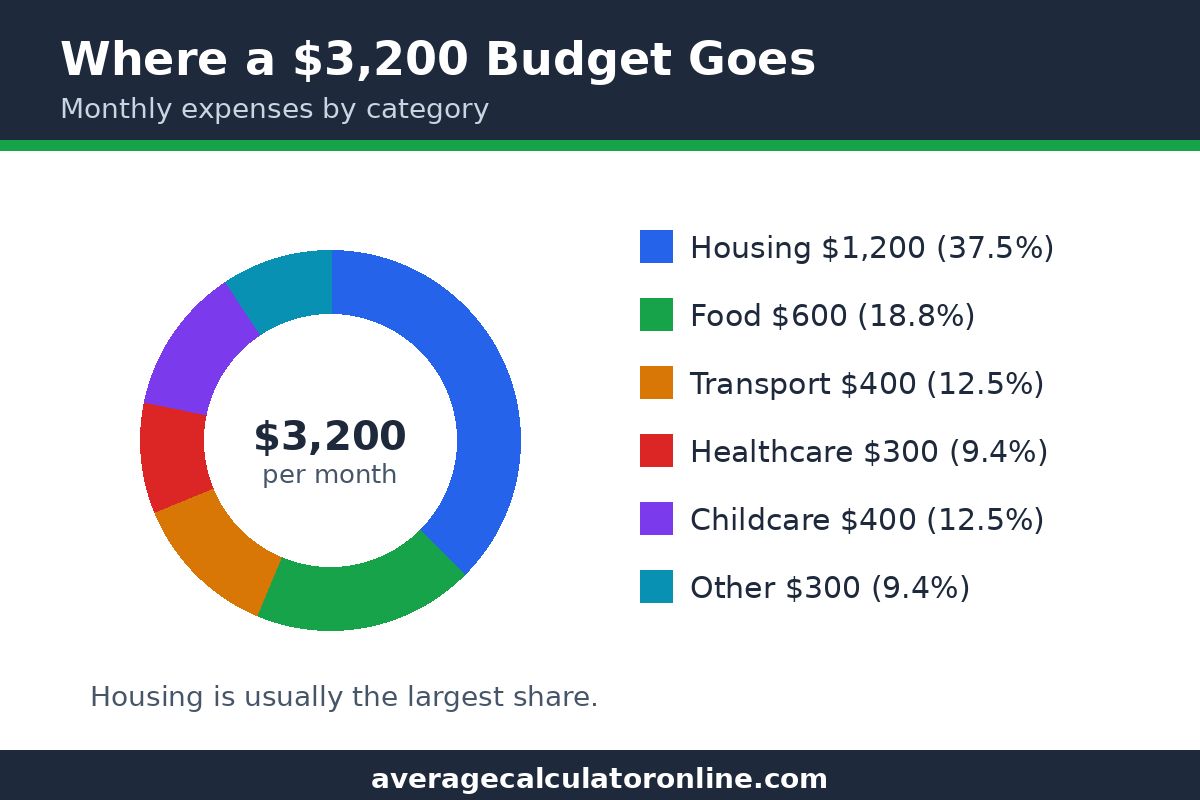
Understanding the living wage
A living wage is the pay rate that lets a household cover its basic needs without relying on assistance: rent, food, transport, healthcare, childcare and other essentials. Unlike the minimum wage, which is set by law, a living wage is calculated from real costs — so it changes with the city, the household size and the number of earners. Two households in the same city can have very different living wages if one has children and the other does not.
This calculator works from your own expenses, not from a government table. That makes it honest for any city or country: enter what your household actually spends, and it tells you the hourly wage and annual salary that spending requires.
How the calculation works
Step 1: Add up monthly expenses across the six categories.
Step 2: Add your savings buffer, if any (0% keeps the result at bare costs).
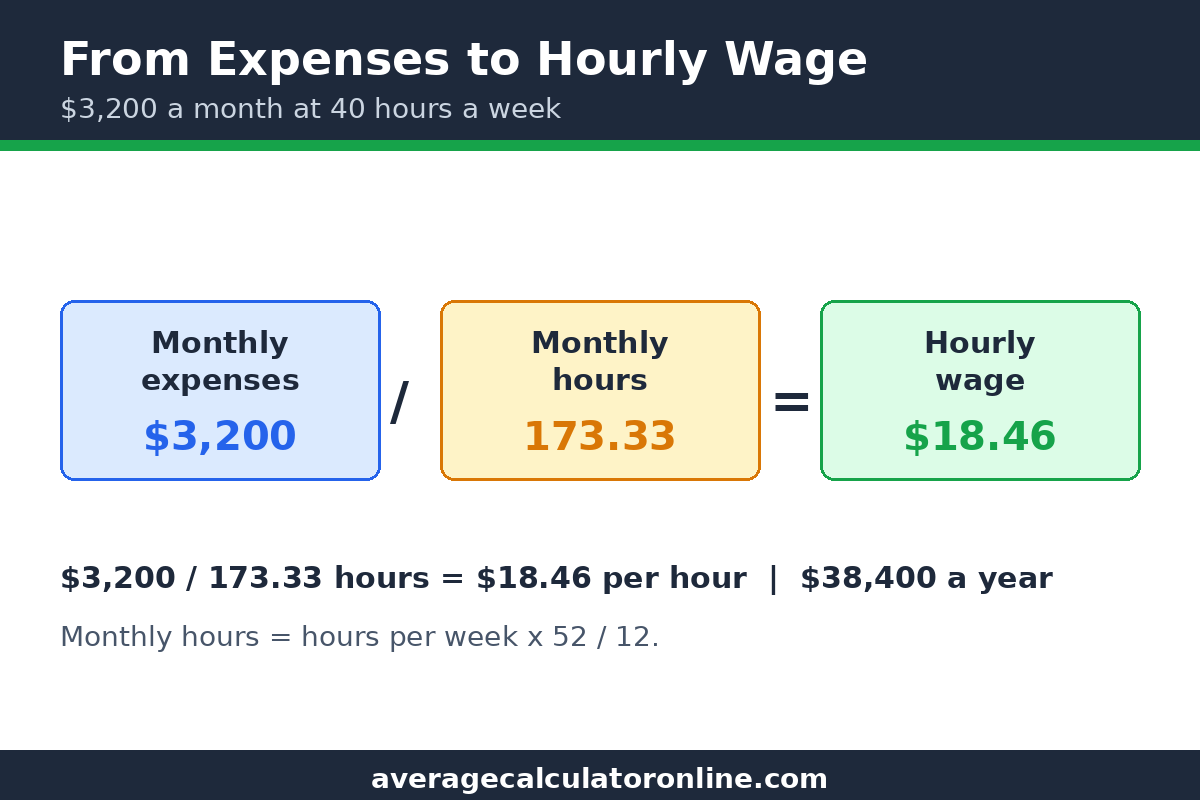
Step 3: Required hourly wage = required monthly income ÷ (hours per week × 52 ÷ 12).
Step 4: Required annual salary = required monthly income × 12. Estimate the tax on that salary with the Tax Calculator.
The 52 ÷ 12 factor converts weekly hours into average monthly hours (about 173.33 hours for a 40-hour week). That is why $3,200 a month at 40 hours a week gives $3,200 ÷ 173.33 = $18.46 per hour.
Worked examples
| Household | Monthly expenses | Hours/week | Required hourly wage | Required annual salary |
|---|---|---|---|---|
| Single adult, low costs | $1,800 | 40 | $10.38 | $21,600 |
| Family, typical costs | $3,200 | 40 | $18.46 | $38,400 |
| Family, part-time hours | $3,200 | 25 | $29.54 | $38,400 |
Notice the third row: the annual salary stays $38,400 because the household’s costs did not change — but fewer hours mean each hour must pay more. That is the part-time trap many households face.
What counts as a basic expense?
| Category | Usually includes |
|---|---|
| Housing | Rent or mortgage payment, utilities |
| Food | Groceries and basic household food |
| Transport | Car costs or public transit, fuel |
| Healthcare | Insurance premiums, regular medical costs |
| Childcare | Daycare, after-school care |
| Other essentials | Clothing, phone, basic household goods |
Luxuries, vacations and debt payments are not basic expenses. If you include them, the result is a “comfortable wage”, not a living wage — still useful, but a different number.
Living wage vs minimum wage
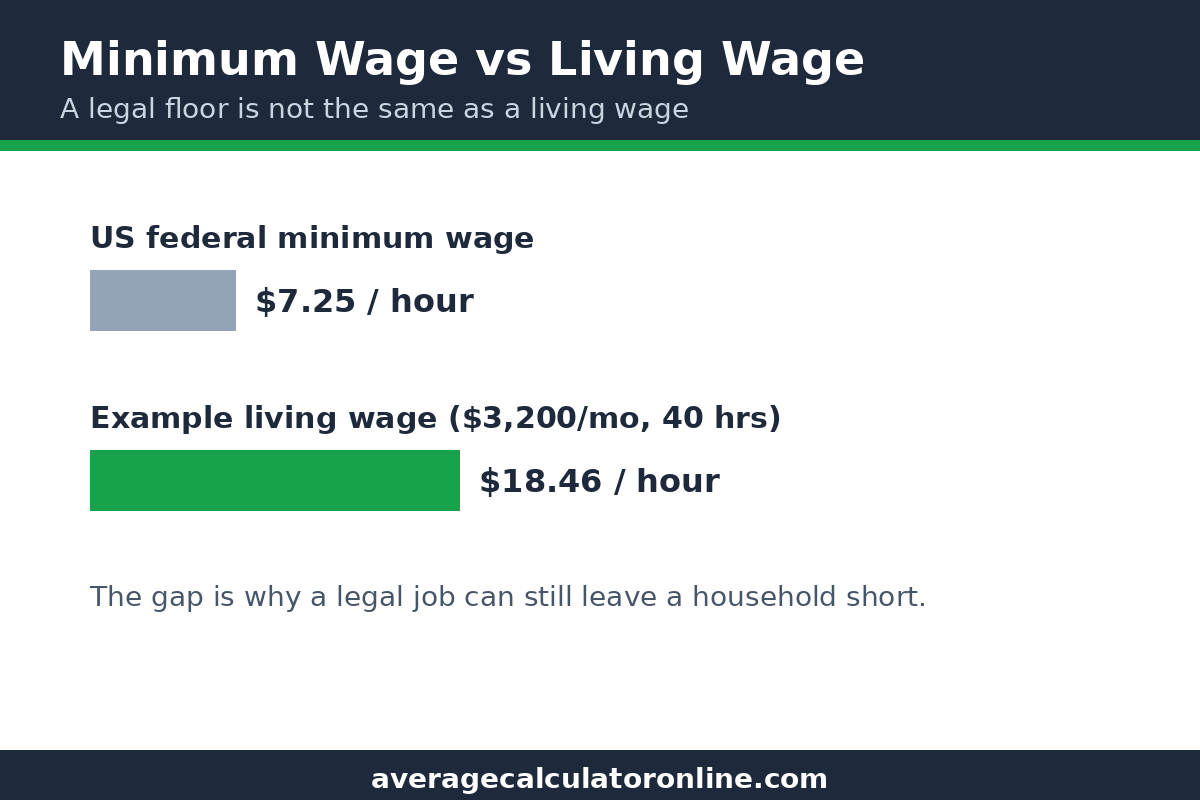
The minimum wage is the lowest hourly pay the law allows (in the US, the federal minimum is $7.25 per hour, unchanged since 2009; many states and cities set higher rates). The living wage is the hourly pay that actually covers a household’s basic costs in a given place. A job can pay above the minimum wage and still fall short of the living wage — that gap is what this calculator measures when you enter your current wage for comparison.
Tips to close the gap
- Find the biggest category first. Housing usually dominates — even a small rent change moves the required wage more than any other saving.
- Count every earner. In a two-earner household, the required wage can be split; the calculator shows the single-earner figure, so divide the annual salary by the number of earners for a per-person target.
- Use the result in a pay conversation. A specific number (“my household needs $18.46 an hour to cover $3,200 of costs”) is far stronger than a general request for a raise. See what that wage means per paycheck with the Paycheck Calculator.
- Recalculate when costs change. Rent rises, childcare starts or ends, or hours change — each one changes the required wage.
Frequently asked questions
What is a living wage?
A living wage is the hourly pay a household needs to cover its basic monthly expenses — housing, food, transport, healthcare, childcare and other essentials — without outside assistance.
How is a living wage different from the minimum wage?
The minimum wage is a legal floor set by government. A living wage is calculated from actual costs, so it varies by city and household size and is usually higher than the minimum wage.
How do you calculate a living wage?
Add up monthly basic expenses, then divide by monthly work hours: required hourly wage = monthly expenses ÷ (hours per week × 52 ÷ 12). Annual salary = monthly expenses × 12.
Does the living wage change by city or family size?
Yes. Higher rents raise it, and children raise it further through childcare, food and healthcare costs. This calculator handles both, because it uses your own expense figures.
What expenses should I include?
Include basic needs only: housing, food, transport, healthcare, childcare and other essentials. Leave out luxuries, vacations and debt payments if you want a true living-wage figure.
Can I use this result to negotiate pay?
Yes — it gives you a concrete, cost-based number for a pay discussion. It is an estimate based on the expenses you entered, so keep your expense list realistic and up to date.
Disclaimer: This calculator provides estimates only, not financial advice. Results depend on the expenses and hours you enter; actual needs vary by location, household and personal circumstances.
Last updated: November 1, 2026.