
Hours Calculator
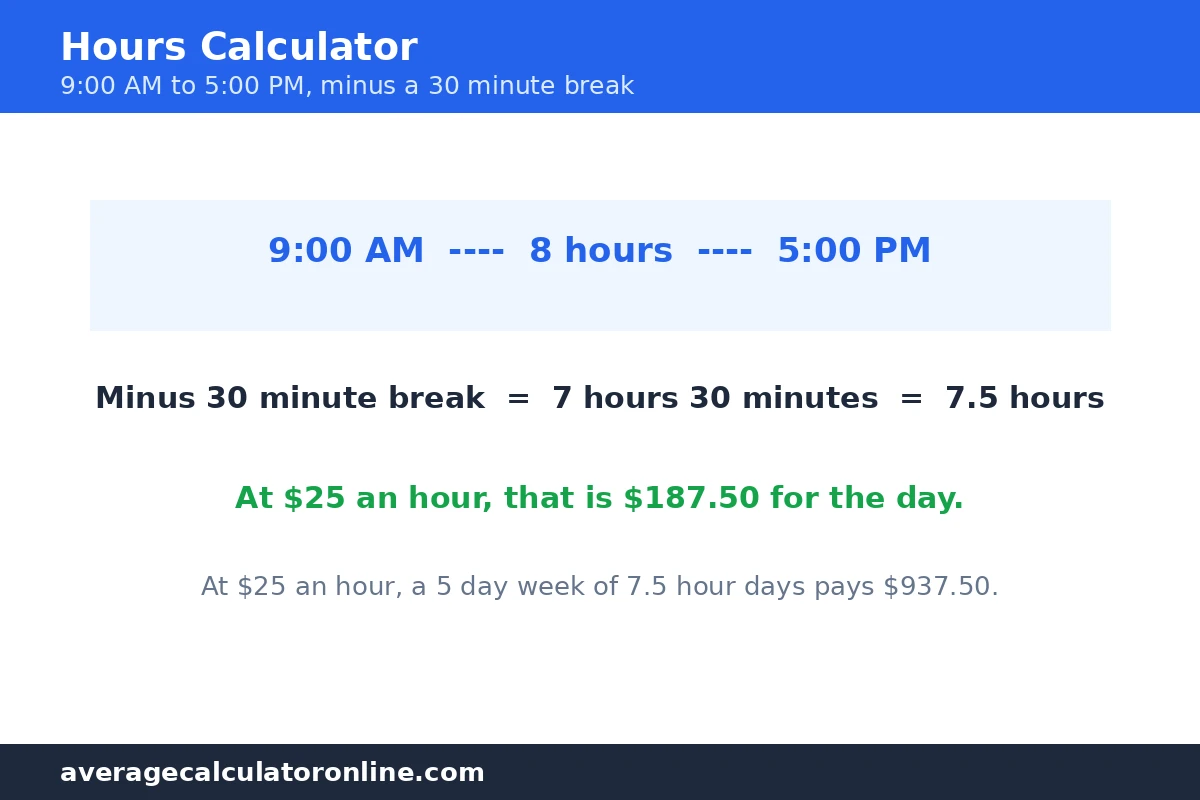
Total time: 7.5 hours (7 hours 30 minutes)
Gross pay at $25.00 per hour: $187.50.
Direct answer: An hours calculator finds the time between two clock times and turns it into decimal hours, and it can turn those hours into pay. From 9:00 AM to 5:00 PM with a 30 minute break is 7.5 hours, and at $25 an hour that pays $187.50. The same tool handles overnight shifts, lunch breaks, and weekly totals.
By Average Calculator Team. Last reviewed: 16 November 2026.
How hours are calculated
Take the end time, subtract the start time, and subtract any break. The result in minutes divided by 60 is the decimal hours that payroll systems use. A 30 minute break is 0.5 hours, a 15 minute break is 0.25 hours, and a 45 minute break is 0.75 hours. Gross pay is decimal hours times the hourly rate. For a full pay period, use the paycheck calculator, and for dates and deadlines use the date calculator.
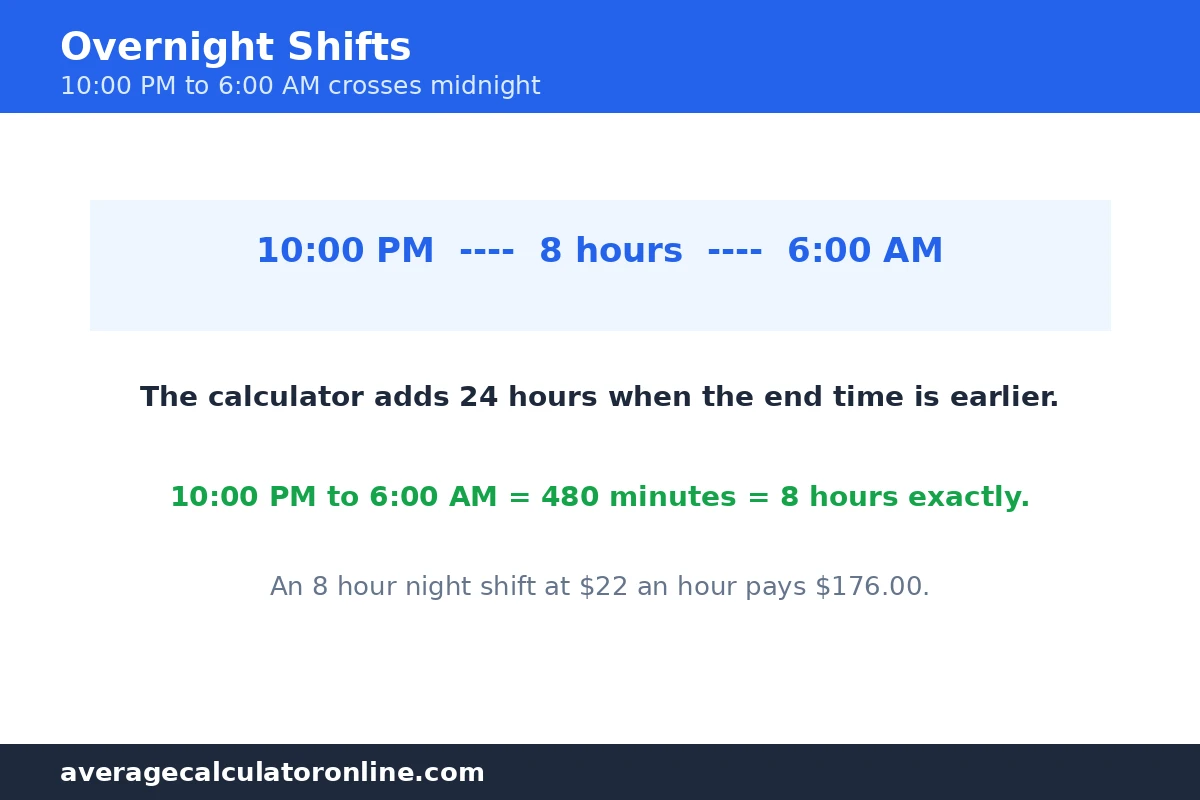
Overnight shifts need one extra step: when the end time is earlier than the start time, add 24 hours to the end time before you subtract. A shift from 10:00 PM to 6:00 AM is 6:00 AM plus 24 hours minus 10:00 PM, which is 480 minutes, or 8 hours. This calculator does that step for you.

Worked examples
Example 1: 9:00 AM to 5:00 PM with a 30 minute break. The span is 8 hours, or 480 minutes. Minus the 30 minute break, the worked time is 450 minutes. In decimal hours that is 450 / 60 = 7.5 hours, which is 7 hours 30 minutes. At $25 an hour, the gross pay is 7.5 x $25 = $187.50. Over a 5 day week of the same shifts, the total is 5 x 7.5 = 37.5 hours and 37.5 x $25 = $937.50.
Example 2: 8:30 AM to 4:45 PM with no break. The span is 495 minutes. In decimal hours that is 495 / 60 = 8.25 hours, which is 8 hours 15 minutes. At $30 an hour, the gross pay is 8.25 x $30 = $247.50.
Example 3, overnight: 10:00 PM to 6:00 AM with no break. The end time is earlier than the start time, so add 24 hours: 6:00 AM becomes 30:00, and 30:00 minus 22:00 is 8 hours. At $22 an hour, the gross pay is 8 x $22 = $176.00.
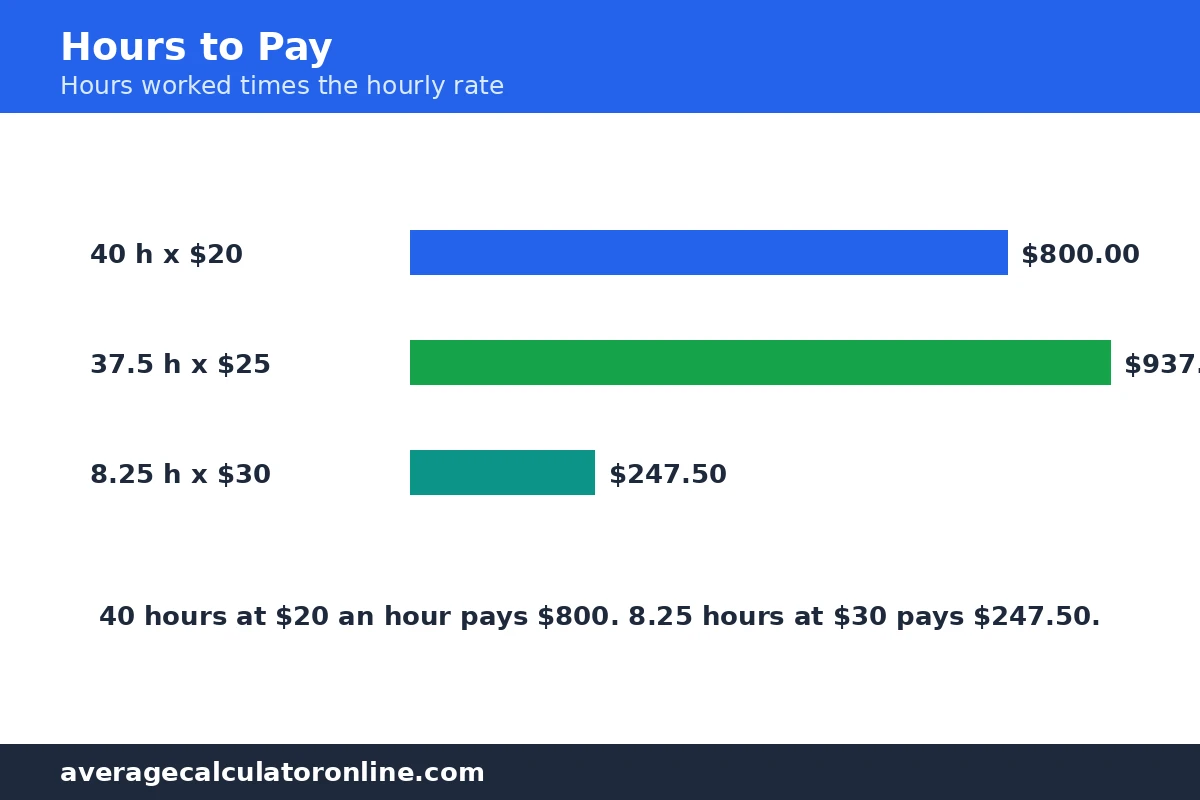
Example 4, a full week: 40 hours at $20 an hour pays 40 x $20 = $800.00. The same week with 5 hours of overtime at time and a half ($30 an hour) pays $800.00 + (5 x $30) = $950.00. Overtime rules differ by state and employer, so check your own pay policy before you rely on the overtime figure.
Minutes to decimal hours
Time cards and payroll software use decimal hours, not hours and minutes. The conversion is minutes divided by 60. The most common mistake is writing 7 hours 30 minutes as 7.3 hours, when it is really 7.5 hours.
| Minutes | Decimal hours |
|---|---|
| 15 minutes | 0.25 hours |
| 30 minutes | 0.50 hours |
| 45 minutes | 0.75 hours |
| 60 minutes | 1.00 hours |
| 90 minutes | 1.50 hours |
| 8 hours 15 minutes | 8.25 hours |
To convert the other way, multiply the decimal part by 60: 0.25 hours is 0.25 x 60 = 15 minutes, and 8.25 hours is 8 hours plus 0.25 x 60 = 15 minutes. For time spans across days, see the time calculator.
Common mistakes
Forgetting the break: 9:00 AM to 5:00 PM is 8 hours on the clock, but 7.5 hours worked after a 30 minute break. At $25 an hour, the forgotten break is worth $12.50 a day.
Writing 7:30 as 7.3 hours: 30 minutes is half an hour, so 7 hours 30 minutes is 7.5 hours, not 7.3. The 0.2 hour error is 12 minutes, and it repeats on every shift.
Mixing up AM and PM: 5:00 PM is 17:00, not 5:00. Entering 5:00 AM as the end of a 9:00 AM shift gives a negative span, which the overnight rule turns into a very long shift. Check AM and PM before you press calculate.
Rounding minutes the wrong way: some employers round to the nearest quarter hour, but you should record exact minutes first and let the payroll system do the rounding. Rounding each shift by hand can cost or gain real money over a month. To check a full period, add the daily totals and compare with the percentage calculator for any overtime share.
Frequently asked questions
How do I calculate the hours between two times?
Subtract the start time from the end time, then subtract any break. From 9:00 AM to 5:00 PM is 8 hours, and minus a 30 minute break it is 7.5 hours. If the end time is earlier than the start time, as on an overnight shift, add 24 hours to the end time first.
How do I convert minutes to decimal hours?
Divide the minutes by 60. 15 minutes is 0.25 hours, 30 minutes is 0.50 hours, 45 minutes is 0.75 hours, and 90 minutes is 1.50 hours. To go back, multiply the decimal part by 60: 0.25 hours times 60 is 15 minutes.
How do I calculate work hours with a lunch break?
Find the span from start to end, then subtract the break. A shift from 9:00 AM to 5:00 PM is 480 minutes, and minus a 30 minute break it is 450 minutes, which is 7.5 hours. At 25 dollars an hour, that shift pays 187.50 dollars.
How do I calculate hours for an overnight shift?
Add 24 hours to the end time when it is earlier than the start time, then subtract as usual. A shift from 10:00 PM to 6:00 AM is 6:00 AM plus 24 hours minus 10:00 PM, which is 480 minutes, or 8 hours. At 22 dollars an hour, that shift pays 176.00 dollars.
How do I calculate pay from hours worked?
Multiply the decimal hours by the hourly rate. 40 hours at 20 dollars an hour pays 800 dollars, and 8.25 hours at 30 dollars an hour pays 247.50 dollars. Gross pay is before tax and deductions: your take-home pay is lower, and the paycheck calculator shows the difference.
What is 7 hours 30 minutes in decimal hours?
7 hours 30 minutes is 7.5 hours, because 30 minutes is half an hour. The common mistake is writing 7.3 hours, which is only 7 hours 18 minutes. Divide the minutes by 60 every time: 30 divided by 60 is 0.5, so the answer is 7.5 hours.
Time Calculator ·
Date Calculator ·
Age Calculator ·
Paycheck Calculator ·
Percentage Calculator ·
Last updated: November 16, 2026.