
Macro Calculator
Macro Calculator
Start with your calories: this tool splits calories you already know. If you do not know your daily calories yet, find your TDEE first or calculate your daily calories, then come back and enter the number below.
Presets:
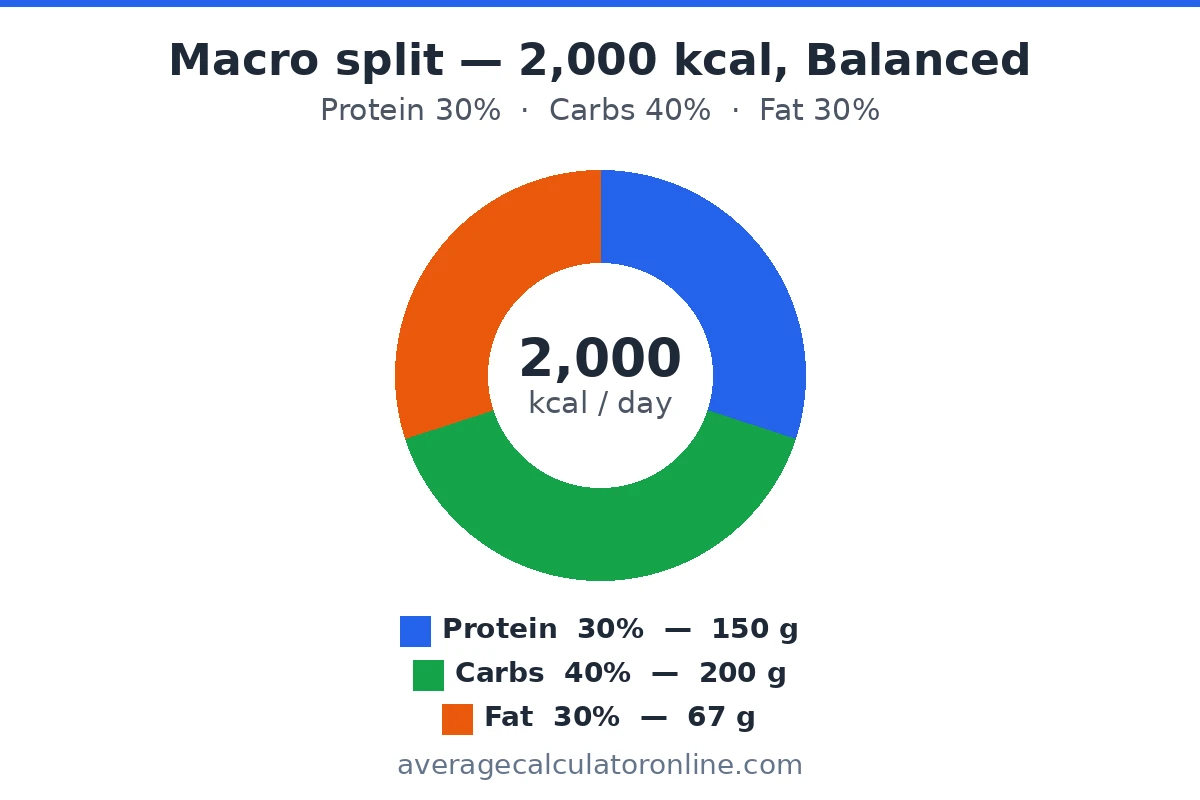
Your macros for 2000 calories a day:
| Macro | Grams | Calories |
|---|---|---|
| Protein (30%) | 150 g | 600 kcal |
| Carbs (40%) | 200 g | 800 kcal |
| Fat (30%) | 67 g | 600 kcal |
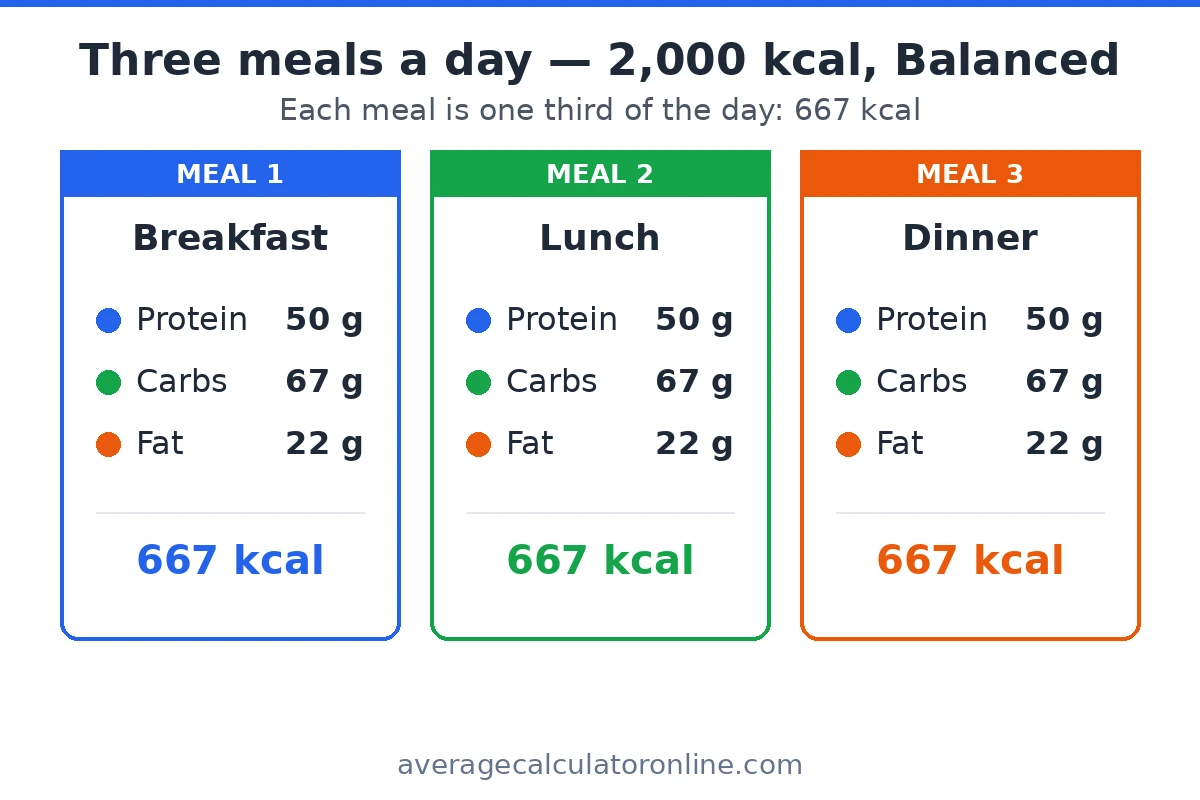
Per meal (3 meals a day): protein 50 g (200 kcal), carbs 67 g (267 kcal), fat 22 g (200 kcal).
Direct answer
A macro calculator splits your daily calories into protein, carbohydrates and fat — the three macronutrients, or “macros” — and turns each share into grams. You enter your daily calories and the percentage of calories for each macro. The tool multiplies your calories by each percentage, then divides by the calories in one gram: protein and carbohydrates provide 4 calories per gram, fat provides 9 calories per gram.
For the default of 2,000 calories a day at the Balanced split (30% protein, 40% carbs, 30% fat), that works out to 150 g of protein (600 kcal), 200 g of carbs (800 kcal) and 67 g of fat (600 kcal). Enter your own numbers above. If you do not know your daily calories yet, work them out first with the TDEE Calculator or the Calorie Calculator, then come back here to split them.
Inputs
| Field | Default |
|---|---|
| Daily calories | 2000 |
| Protein % | 30 |
| Carbs % | 40 |
| Fat % | 30 |
Outputs
| Output | Formula | Default result |
|---|---|---|
| Protein | Calories × 30% ÷ 4 | 150 g (600 kcal) |
| Carbs | Calories × 40% ÷ 4 | 200 g (800 kcal) |
| Fat | Calories × 30% ÷ 9 | 67 g (600 kcal) |
| Per meal (3 meals) | Each macro ÷ 3 | Protein 50 g, carbs 67 g, fat 22 g |
Defaults on load: 2,000 calories at Balanced 30/40/30 → protein 150 g (600 kcal), carbs 200 g (800 kcal), fat 67 g (600 kcal), or per meal (3 meals): protein 50 g, carbs 67 g, fat 22 g. The tool must show these results before the visitor types anything, and must recalculate on every input change. The three percentages must add up to 100 — otherwise the tool shows an error message instead of a number (never NaN or Infinity). Grams are rounded to the nearest whole gram, so grams × 4 or 9 can differ from the calories shown by a few calories — for example, 67 g of fat × 9 = 603 kcal against the 600 kcal shown.
How it works
- Enter your daily calories. This is the number the split applies to. If you do not know it, the TDEE Calculator estimates it from your age, weight, height and activity level.
- Pick a split. Use one of the four preset buttons, or type your own percentages. The three percentages must add up to 100.
- Multiply calories by each percentage. At 2,000 calories and 30% protein: 2,000 × 0.30 = 600 kcal of protein. At 40% carbs: 2,000 × 0.40 = 800 kcal of carbs. At 30% fat: 2,000 × 0.30 = 600 kcal of fat.
- Divide by the calories per gram. Protein and carbs divide by 4, fat divides by 9. So 600 ÷ 4 = 150 g of protein, 800 ÷ 4 = 200 g of carbs, and 600 ÷ 9 = 66.7, rounded to 67 g of fat.
- Split each total across 3 meals. The tool divides every macro by 3: 150 ÷ 3 = 50 g of protein per meal, 200 ÷ 3 = 67 g of carbs per meal, 67 ÷ 3 = 22 g of fat per meal.
Macro splits compared
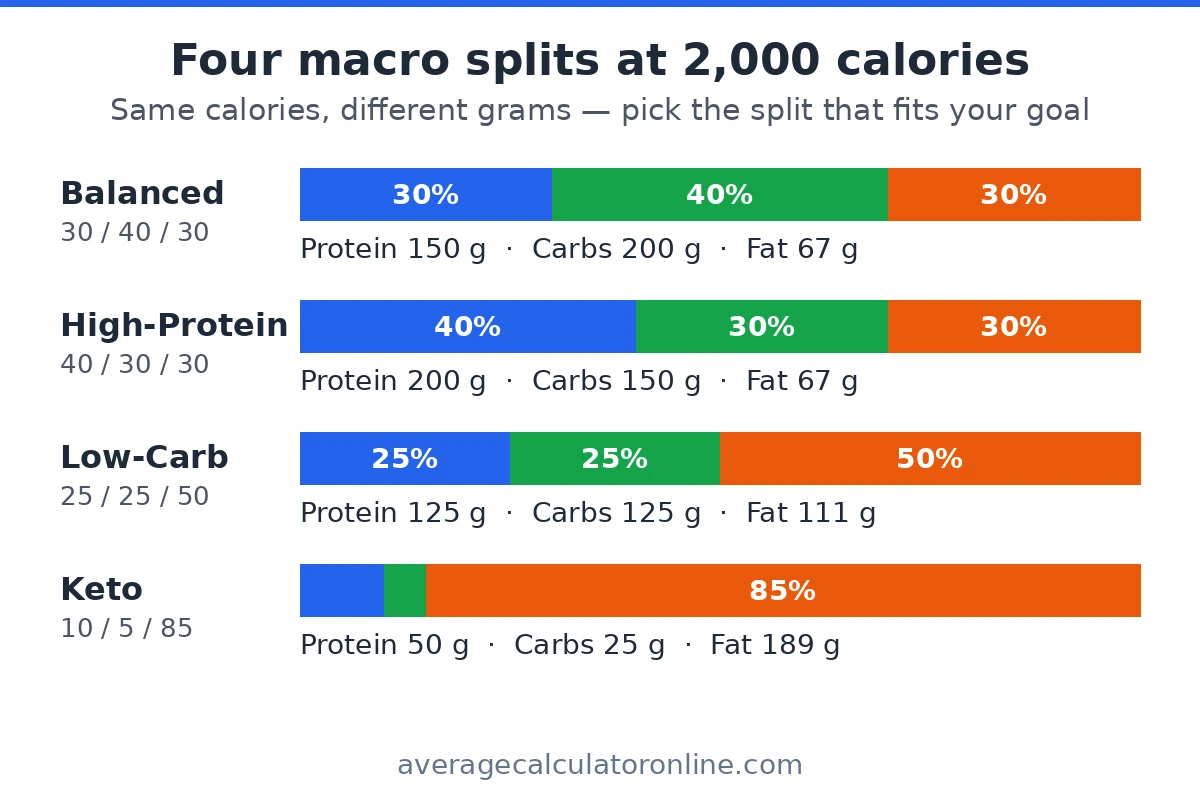
The same 2,000 calories give very different grams depending on the split. The table below compares the four presets at 2,000 calories a day — the tool’s preset buttons use exactly these splits.
| Split | Protein % | Carbs % | Fat % | Protein | Carbs | Fat |
|---|---|---|---|---|---|---|
| Balanced | 30 | 40 | 30 | 150 g | 200 g | 67 g |
| High-Protein | 40 | 30 | 30 | 200 g | 150 g | 67 g |
| Low-Carb | 25 | 25 | 50 | 125 g | 125 g | 111 g |
| Keto | 10 | 5 | 85 | 50 g | 25 g | 189 g |
Balanced suits most active adults. High-Protein suits people training hard who want to protect muscle. Low-Carb and Keto cut carbs sharply and raise fat — they are not for everyone, so read the warning below before picking one.
Worked examples (all recomputed)
Example 1 — The default: 2,000 calories, Balanced 30/40/30
- Protein: 2,000 × 30% = 600 kcal; 600 ÷ 4 = 150 g
- Carbs: 2,000 × 40% = 800 kcal; 800 ÷ 4 = 200 g
- Fat: 2,000 × 30% = 600 kcal; 600 ÷ 9 = 66.7 → 67 g
- Per meal (3 meals): protein 150 ÷ 3 = 50 g, carbs 200 ÷ 3 = 67 g, fat 67 ÷ 3 = 22 g
Example 2 — High-Protein: 2,500 calories, 40/30/30
- Protein: 2,500 × 40% = 1,000 kcal; 1,000 ÷ 4 = 250 g
- Carbs: 2,500 × 30% = 750 kcal; 750 ÷ 4 = 187.5 → 188 g
- Fat: 2,500 × 30% = 750 kcal; 750 ÷ 9 = 83.3 → 83 g
- Per meal (3 meals): protein 250 ÷ 3 = 83 g, carbs 188 ÷ 3 = 63 g, fat 83 ÷ 3 = 28 g
Example 3 — Keto: 1,800 calories, 10/5/85
- Protein: 1,800 × 10% = 180 kcal; 180 ÷ 4 = 45 g
- Carbs: 1,800 × 5% = 90 kcal; 90 ÷ 4 = 22.5 → 23 g
- Fat: 1,800 × 85% = 1,530 kcal; 1,530 ÷ 9 = 170 g
- Per meal (3 meals): protein 45 ÷ 3 = 15 g, carbs 23 ÷ 3 = 8 g, fat 170 ÷ 3 = 57 g
Example 4 — Low-Carb: 2,200 calories, 25/25/50
- Protein: 2,200 × 25% = 550 kcal; 550 ÷ 4 = 137.5 → 138 g
- Carbs: 2,200 × 25% = 550 kcal; 550 ÷ 4 = 137.5 → 138 g
- Fat: 2,200 × 50% = 1,100 kcal; 1,100 ÷ 9 = 122.2 → 122 g
- Per meal (3 meals): protein 138 ÷ 3 = 46 g, carbs 138 ÷ 3 = 46 g, fat 122 ÷ 3 = 41 g
Where percentages can mislead
A percentage on its own tells you nothing. 30% protein is 113 g at 1,500 calories a day and 225 g at 3,000 calories a day — the same split, very different amounts of food. Always fix your total calories first (the TDEE Calculator gives you that number), then choose the split.
Very low-carb splits also mislead in the other direction: keto looks like a small change (5% carbs) but it is a big change in grams — 25 g of carbs at 2,000 calories, about one slice of bread. A split that low is not suitable for everyone; see the FAQ below and the disclaimer at the bottom of this page.
Finally, remember the rounding: grams are whole numbers, so 67 g of fat × 9 kcal = 603 kcal, not the 600 kcal the percentage gives. The difference is a few calories and does not matter in practice.
Tips and mistakes
- Get the calories right first. The split matters less than the total. Use the TDEE Calculator for maintenance, or the Calorie Deficit Calculator if you want to lose weight.
- Do not force percentages that add to more or less than 100. The tool stops you with an error — fix the numbers instead of working around it.
- Set protein for your training first. The Protein Calculator works out your protein in grams; then split the remaining calories between carbs and fat.
- Track for two to three weeks before changing the split. One day of numbers tells you nothing; weight, energy and training over weeks tell you whether the split works.
- Do not copy someone else’s grams. Grams depend on your calories — 150 g of protein at 2,000 calories becomes 225 g at 3,000 calories on the same split.
- Weigh food for a week if the results do not match. Eyeballing portions is the most common reason the numbers on the page and the numbers on the scale disagree. The BMI Calculator can help you track the trend.
Frequently asked questions
What is a macro calculator?
A macro calculator splits your daily calories into protein, carbohydrates and fat. You enter your daily calories and the percentage of calories for each macro, and it converts each share into grams: protein and carbohydrates provide 4 calories per gram, fat provides 9 calories per gram. For example, 2,000 calories at 30% protein is 600 calories of protein, or 150 grams.
How do you calculate macros from calories?
Multiply your daily calories by the percentage for each macro, then divide by the calories per gram: protein and carbs divide by 4, fat divides by 9. For 2,000 calories at 30% protein, 40% carbs and 30% fat: protein is 2,000 × 0.30 ÷ 4 = 150 g, carbs are 2,000 × 0.40 ÷ 4 = 200 g, and fat is 2,000 × 0.30 ÷ 9 = 67 g.
What is a good macro split for beginners?
Start with the Balanced split: 30% protein, 40% carbs, 30% fat. It suits most active adults. Try it for two to three weeks, watch your weight, energy and training, then adjust one number at a time — for example, raise protein if you are training hard.
How many grams of protein do I need per day?
It depends on your calories and your split. At 2,000 calories and 30% protein, the answer is 150 grams. People who train regularly often aim for about 0.7 to 1 gram of protein per pound of body weight as a starting point, but that is general guidance, not a prescription for any one person.
Is keto safe for everyone?
No. A very low-carb split such as keto (10% protein, 5% carbs, 85% fat) is not suitable for everyone — for example, people with certain medical conditions, and women who are pregnant or breastfeeding, should not start it without medical advice. This calculator gives general information only; ask a doctor or a registered dietitian before changing your diet.
Why do my percentages have to add up to 100?
Because the three macros must account for all of your daily calories. If they add up to less than 100%, some calories are unassigned; if they add up to more, you are counting the same calories twice. The tool shows an error until the three percentages add up to exactly 100%.
What macros for weight loss?
For weight loss, keep protein high and calories below your TDEE. A common starting split is High-Protein 40/30/30 — 40% protein, 30% carbs, 30% fat — at a calorie target below maintenance, with protein around 1.6–2.2 g per kg of bodyweight. Set the deficit first with the calorie deficit calculator, then split those calories here. This is general guidance, not medical advice — if you have a medical condition, talk to a doctor or dietitian first.
What macros for muscle gain?
For muscle gain, eat slightly above your TDEE — a small surplus, roughly 5–10% above maintenance — and keep protein at 1.6–2.2 g per kg of bodyweight. A split like Balanced 30/40/30 or High-Protein 40/30/30 works well, with the extra calories coming mostly from carbs to fuel training. Find your maintenance calories first with the TDEE calculator, then add the surplus and split the total here.
How much protein per kg of bodyweight?
A common target is 1.6–2.2 g of protein per kg of bodyweight per day — the metric version of the 0.7–1 g per pound figure in the protein answer above. For example, a 70 kg person would aim for about 112–154 g of protein a day. People who train regularly usually sit at the higher end. For a per-person target from your own stats, use the protein calculator.
Sources
Protein and carbohydrate provide 4 kcal per gram and fat provides 9 kcal per gram — the standard Atwater values used in nutrition labelling. Daily calorie needs on this site come from the TDEE Calculator, which uses the Mifflin-St Jeor equation. Reviewed by the Average Calculator Team. Last reviewed: 9 November 2026.
Disclaimer
The results on this page are estimates for planning only. They are not medical, diet or nutrition advice, and they do not diagnose or treat any condition. A very low-carb or keto split is not suitable for everyone. Talk to a doctor or a registered dietitian before changing your diet, especially if you are pregnant, breastfeeding, under 18, or managing a medical condition.
Related calculators
Last updated: November 21, 2026.