Protein Calculator
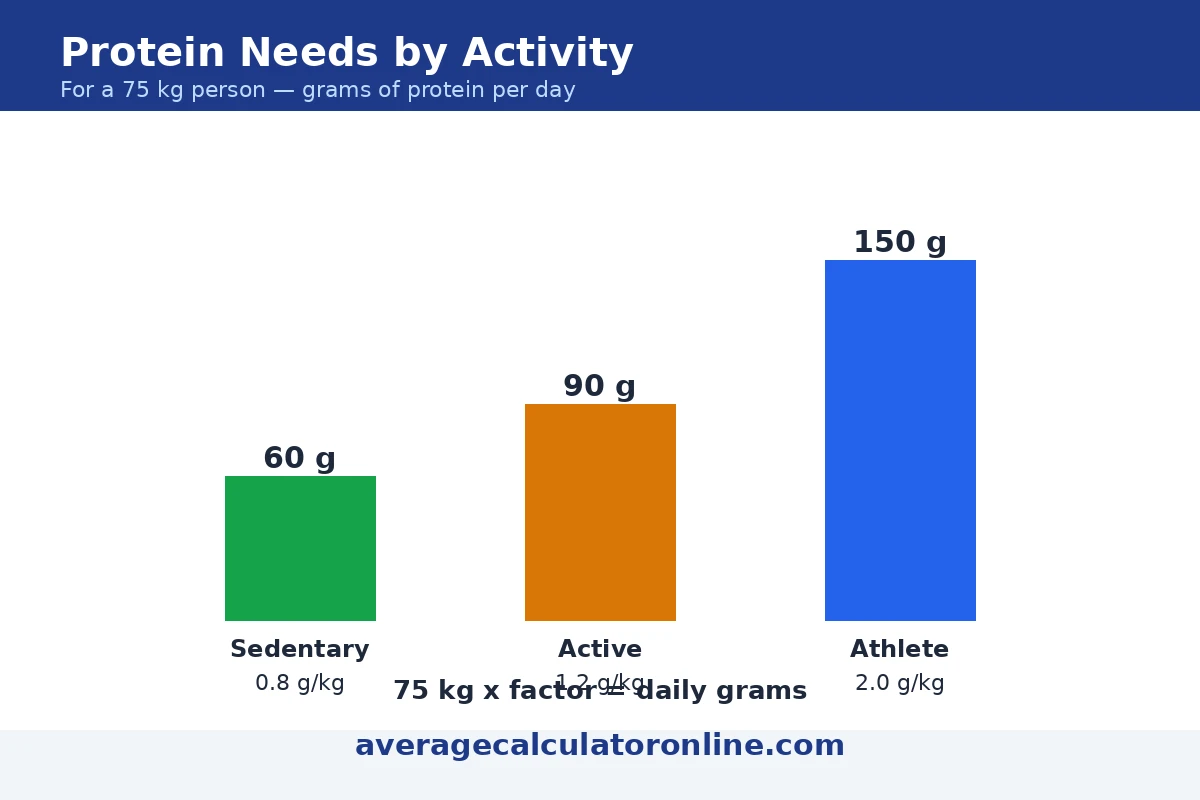
Direct answer: Daily protein = body weight × a factor for your goal. General health: 0.8 g per kg. Active lifestyle: 1.2 g per kg. Building muscle: about 1.8 g per kg. For example, a 75 kg person building muscle needs about 135 g of protein per day.
Daily protein: 135 g per day
About 34 g per meal across 4 meals
How the calculation works
Step 1: Take body weight in kilograms. Step 2: Multiply by the factor for your goal (0.8, 1.2, 1.8, or 2.0 g/kg). Step 3: Divide the daily total by your number of meals to get a per-meal target.
Protein formulas
Daily protein (g) = body weight (kg) × goal factor (g/kg). Per-meal protein (g) = daily protein ÷ meals per day. The goal factors used above are:
- General health: 0.8 g/kg
- Active lifestyle: 1.2 g/kg
- Build muscle: 1.8 g/kg
- Athlete / intense training: 2.0 g/kg
Worked examples
Example 1: 75 kg, building muscle (1.8 g/kg). Daily protein = 75 × 1.8 = 135 g. Across 4 meals, that is about 34 g per meal.
Example 2: 80 kg athlete (2.0 g/kg). Daily protein = 80 × 2.0 = 160 g. Across 4 meals, that is 40 g per meal.
Example 3: 75 kg, general health (0.8 g/kg). Daily protein = 75 × 0.8 = 60 g.
What to watch out for
Very high intakes over a long period are not necessary for most people and are best discussed with a clinician, especially with kidney conditions. Spreading protein across meals is generally more useful than eating it all at once.
Protein and your diet: general guidance
Protein is in every cell of the body, and you need to eat some every day because the body does not store it the way it stores fat or carbohydrates. Good dietary sources include meat, dairy products, nuts, and certain grains and beans. Animal proteins are generally complete, supplying all the essential amino acids, while most plant proteins are incomplete — eating a variety of plant protein sources across the day covers the full range (MedlinePlus).
Needs rise with activity: the International Society of Sports Nutrition’s position stand on protein and exercise reviews the evidence on protein requirements for active people and athletes, who generally need more per kilogram than sedentary adults (Jäger et al., 2017). Spreading your target across meals, as the calculator does, is a practical way to reach a daily total.
This is general information only, not medical advice — see the disclaimer below.
Sources
- U.S. National Library of Medicine — MedlinePlus, “Dietary Proteins” (medlineplus.gov/dietaryproteins.html).
- Jäger R. et al., “International Society of Sports Nutrition position stand: protein and exercise,” Journal of the International Society of Sports Nutrition 14, 20 (2017) (link.springer.com/article/10.1186/s12970-017-0177-8).
FAQs
How much protein do I need per day?
It depends on body weight and goal: about 0.8 g per kg for general health, 1.2 g per kg for an active lifestyle, and 1.6–2.2 g per kg for building muscle. For example, a 75 kg adult needs about 60 g per day for general health (75 × 0.8). Athletes and very active people fall at the higher end of the range.
How is protein calculated per kilogram?
Multiply your body weight in kilograms by the factor for your goal. For example, 75 kg × 1.8 = 135 g per day. Then divide by your number of meals per day to get a per-meal target.
Is too much protein harmful?
For healthy adults, moderately high intakes are generally considered safe. Very high intakes over a long period are best discussed with a clinician, especially if you have kidney conditions. When in doubt, stay near the factor for your goal rather than far above it.
How much protein should I eat per meal?
Divide your daily total by your number of meals. For 135 g across 4 meals, that is about 34 g per meal. The calculator above does this division for you automatically.
What are good sources of protein?
Meat, dairy products, nuts, and certain grains and beans all provide dietary protein. Animal proteins are generally complete, meaning they supply all the essential amino acids, while most plant proteins are incomplete. Eating a variety of plant protein sources each day covers the full set of amino acids your body needs.
Does it matter when I eat protein?
Total daily intake matters more than exact timing for most people. Still, spreading protein across three or four meals — including one within a few hours of training — is a practical habit for active people. Use the per-meal target from the calculator above as a guide, not a strict rule.
Disclaimer: This tool provides general information only, not medical or nutrition advice. Consult a clinician before changing your diet, especially with a medical condition.
Related calculators: BMI Calculator · Calorie Calculator · Calorie Deficit Calculator
Last updated: November 1, 2026.