

Sales Tax Calculator
Sales tax: $7.25
Total with tax: $107.25.
Direct answer: A sales tax calculator adds tax to a price, or works out the tax hidden inside a total. On a $100 price at a 7.25% rate, the sales tax is $7.25 and the total with tax is $107.25. The rate is one you enter: there is no single US sales tax rate, because each state sets its own base rate and counties and cities add local tax on top.
By Average Calculator Team. Last reviewed: 16 November 2026.
How sales tax is calculated
To add tax: tax = price x rate / 100, and total = price + tax. To remove tax from a total: price before tax = total / (1 + rate / 100), and tax = total – price before tax. The reverse step trips people up: on a $108 total at 8%, the tax is not 8% of $108, which would be $8.64. The tax is 8% of the pre-tax price, which is $100.00, so the tax is $8.00. Always divide by 1 plus the rate to strip tax out.
The rate you enter should be the combined rate at the address of the sale: the state base rate plus any county, city, and district tax. The state base rates in the table below are 2026 statewide base rates from the Tax Foundation midyear 2026 table. Local tax can add 2 to 3 points on top, so the rate at the register is often higher than the base rate. For tax on income instead, use the tax calculator.

Worked examples
Example 1: Price $100, rate 7.25% (the California state base rate). Tax is $100 x 7.25 / 100 = $7.25. Total is $100 + $7.25 = $107.25.
Example 2: Price $250, rate 6.25% (the Texas state base rate). Tax is $250 x 6.25 / 100 = $15.63 (15.625 rounded to cents). Total is $250 + $15.63 = $265.63.
Example 3: Price $49.99, rate 8%. Tax is $49.99 x 8 / 100 = $4.00 (3.9992 rounded to cents). Total is $49.99 + $4.00 = $53.99.
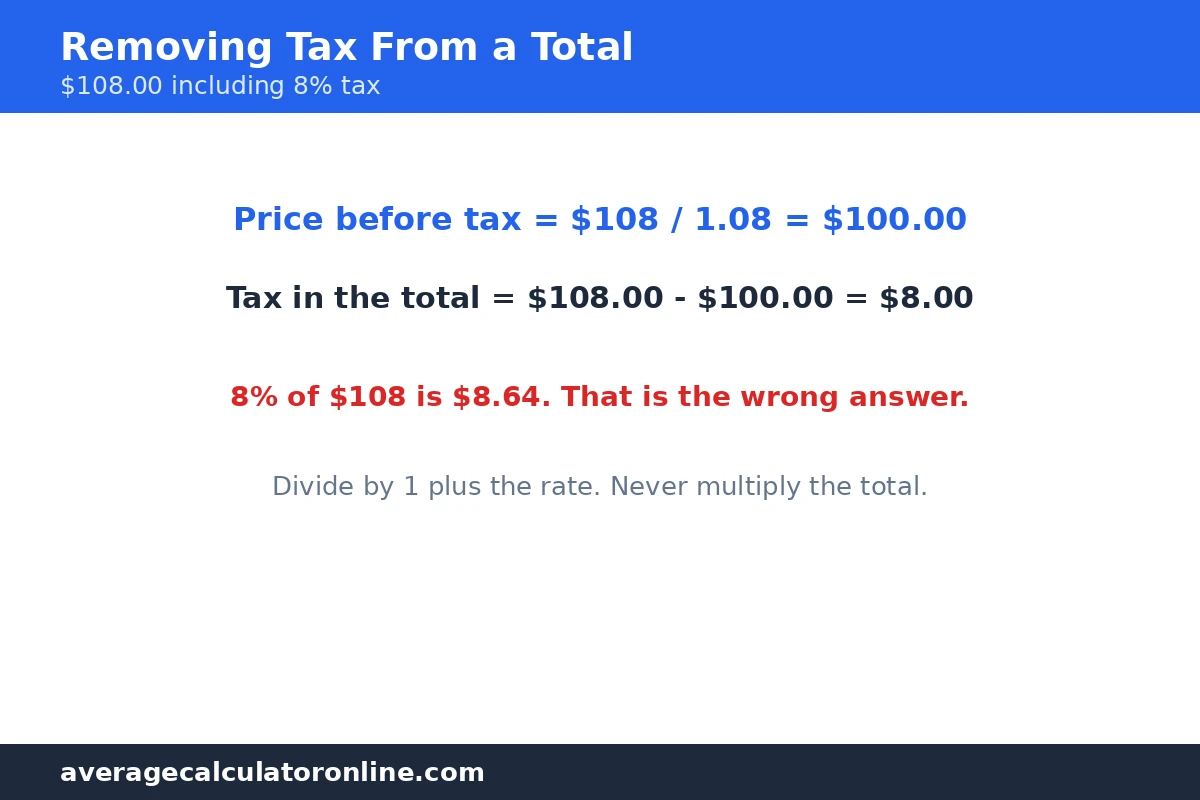
Example 4, removing tax: Total $108.00 including 8% tax. Price before tax is $108 / (1 + 0.08) = $108 / 1.08 = $100.00. Tax in the total is $108.00 – $100.00 = $8.00. To split a restaurant bill the same way, use the tip calculator.
State base rates, 2026 examples
These are statewide base rates only, checked against the Tax Foundation midyear 2026 table. They are examples to show the range, not the rate at your address: counties and cities add local tax, and some goods are exempt. Five states have no statewide sales tax at all: Oregon, Delaware, Montana, New Hampshire, and Alaska, though some Alaska localities levy their own.
| State | Base rate | Tax on $100 |
|---|---|---|
| California | 7.25% | $7.25 |
| Texas | 6.25% | $6.25 |
| Florida | 6% | $6.00 |
| New York | 4% | $4.00 |
On a $30,000 car, the state base tax alone is $2,175.00 in California (7.25%) and $1,875.00 in Texas (6.25%), a gap of $300.00 before local tax. Check your state revenue department for the exact combined rate at an address before you rely on a figure. For the percent change between two prices, use the percentage calculator.
Common mistakes
Using the base rate as the full rate: the state base rate is only the start. In New York City, the 4% state rate plus local tax reaches about 8.875%, so the tax on a $100 item is $8.88 and the total is $108.88, not $104.00. Enter the combined rate, not the base rate.
Taking a percent of the total to remove tax: on a $108 total at 8%, 8% of $108 is $8.64, which is wrong. The tax is 8% of the pre-tax price of $100.00, which is $8.00. Divide by 1.08, never multiply the total by the rate.
Rounding too early: on a $250 item at 6.25%, the exact tax is $15.625. Round to cents once, at the end, to get $15.63. Rounding the rate or the price first moves the total by cents that add up across a whole order. The VAT calculator works the same add and remove math for value added tax.
Forgetting exempt items: many states exempt groceries and prescription drugs, or tax them at a lower rate, so the rate can differ by item in the same basket. Check the rules for your state before you apply one rate to everything.
Frequently asked questions
How do I calculate sales tax?
Multiply the price by the tax rate and divide by 100. On a 100 dollar price at 7.25 percent, the tax is 100 times 7.25 divided by 100, which is 7.25 dollars, and the total is 107.25 dollars. Enter the combined rate for your address, not just the state base rate.
How do I remove sales tax from a total?
Divide the total by one plus the rate as a decimal. On a 108 dollar total at 8 percent, the price before tax is 108 divided by 1.08, which is 100 dollars, and the tax is 8 dollars. Never take 8 percent of the total, which would give 8.64 dollars and the wrong answer.
What is the sales tax rate in California?
The California statewide base rate is 7.25 percent in 2026, the highest state base rate in the country. Counties and districts add local tax on top, so the combined rate at an address is often higher, and some cities pass 10 percent. Check the California rate lookup for the exact rate at an address.
What is the sales tax rate in Texas?
The Texas statewide base rate is 6.25 percent in 2026. Local jurisdictions can add up to 2 percent, for a maximum combined rate of 8.25 percent. On a 250 dollar price, the state base tax alone is 15.63 dollars, for a total of 265.63 dollars.
Which states have no sales tax?
Five states have no statewide sales tax: Oregon, Delaware, Montana, New Hampshire, and Alaska. Alaska allows some localities to levy their own sales tax, so a purchase there can still be taxed. The other 45 states all have a statewide base rate.
Is sales tax the same as VAT?
No. Sales tax is charged once, at the final sale to the customer, and the rate varies by state and locality. VAT, value added tax, is charged at each stage of production and is common outside the United States. The math to add and remove them is the same, but the rules and the rates are different.
Note: This calculator is for education and planning only. It adds or removes sales tax at a rate you enter, using the statewide base rates shown as examples. Actual rates vary by address, local tax, and item, and rates change over time. The results here are estimates, not tax advice.
Income Tax Calculator ·
Percentage Calculator ·
Tip Calculator ·
VAT Calculator ·
Last updated: November 21, 2026.