
Income Tax Calculator
How to use: Enter your income, filing status and any state rate, then press Calculate — the tool shows your federal tax, taxable income and effective rate.
Direct answer
This page is the detailed 2026 brackets calculator — the full IRS bracket tables for every filing status, with worked examples. Federal income tax is worked out in two steps. First, taxable income = annual income − deduction (your standard deduction, or your itemized deductions if they are larger). Second, the tax is worked out from the bracket table for your filing status — each slice of taxable income is taxed at its own rate. Effective rate = federal tax ÷ annual income.
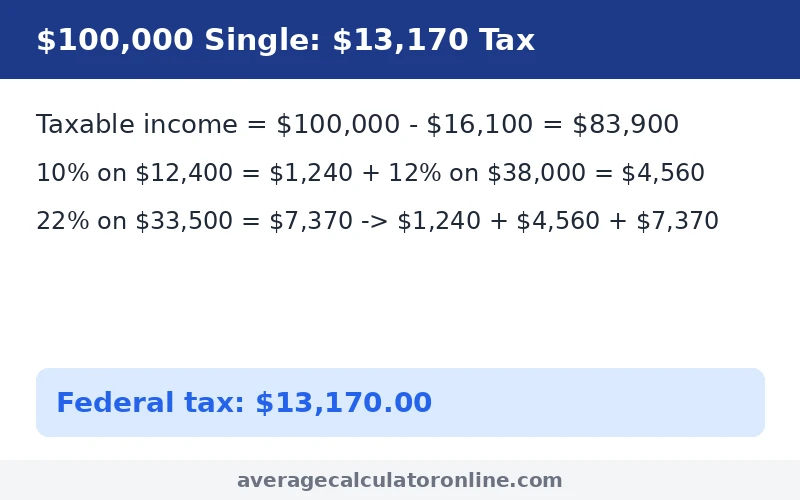
For the default example, $100,000 as a single filer with the 2026 standard deduction: taxable income is $100,000 − $16,100 = $83,900, federal tax is $13,170.00, the effective rate is 13.17%, and the marginal rate is 22%. Enter your own income and filing status below and the tool does the same calculation for you. For a faster estimate without the tables, use the Tax Calculator. Estimates only, not financial or tax advice.
The tool
Federal income tax estimator
Estimates only, not financial or tax advice. 2026 federal brackets (IRS Rev. Proc. 2025-32).
Inputs
| Field | Default | Notes |
|---|---|---|
| Annual income | 100000 | $ |
| Filing status | Single | Single, Married filing jointly, Head of household, Married filing separately |
| Deduction | Standard | Standard, or itemized with your own amount |
| State tax rate (optional) | blank (0) | Enter your own rate only — no state rate is assumed or hard-coded |
Outputs
| Output | Formula | Default result |
|---|---|---|
| Taxable income | Income − deduction | $83,900.00 |
| Federal tax | Bracket table on taxable income | $13,170.00 |
| Marginal rate | Rate on the top slice of taxable income | 22% |
| Effective rate | Federal tax ÷ income | 13.17% |
| Monthly take-home | (Income − federal tax − state tax if entered) ÷ 12 | $7,235.83 |
Defaults on load: $100,000 single, standard deduction → $13,170.00 federal tax. The tool shows this result as soon as the page loads, and recalculates on every input change.
How it works
- Subtract the deduction. Taxable income is what is left after the standard deduction (or your itemized deductions, if you choose them and they are larger). For a single filer in 2026 the standard deduction is $16,100, so $100,000 of income becomes $83,900 of taxable income. Tax is charged on the $83,900, not on the full $100,000.
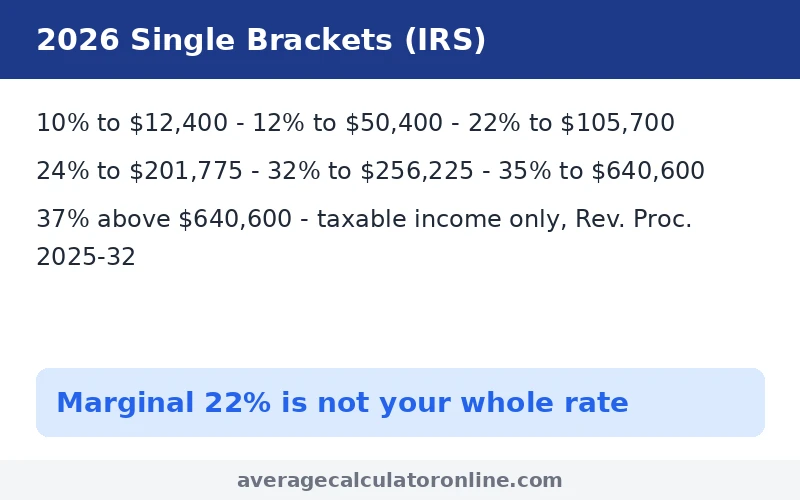
- Walk through the brackets. Each slice of taxable income is taxed at its own rate: the first $12,400 at 10%, the next slice up to $50,400 at 12%, the next up to $105,700 at 22%, and so on. Only the dollars above each threshold pay the higher rate — the dollars below keep their lower rates.
- Read the two rates apart. Your marginal rate is the rate on your top slice of income (22% in the $100,000 single example). Your effective rate is the average across all slices — total tax divided by total income (13.17% in the same example). The marginal rate is always higher than the effective rate for anyone above the first bracket.
- Standard vs itemized. Take whichever deduction is larger. If your itemized deductions (mortgage interest, charitable gifts, state and local taxes within their limits, and other qualifying items) add up to more than your standard deduction, itemizing lowers taxable income and therefore tax. If they add up to less, the standard deduction wins. Example 4 below shows both sides of that line.
- State tax is separate and optional. This tool estimates federal tax only. If you enter a state tax rate, it is applied to taxable income as an estimate and shown separately; no state rate is built in, because state tax varies by state and some states have no income tax at all.
2026 federal tax brackets — single filers (IRS Rev. Proc. 2025-32, §4.01 Table 3)
| Rate | Taxable income |
|---|---|
| 10% | $0 – $12,400 |
| 12% | $12,400 – $50,400 |
| 22% | $50,400 – $105,700 |
| 24% | $105,700 – $201,775 |
| 32% | $201,775 – $256,225 |
| 35% | $256,225 – $640,600 |
| 37% | Over $640,600 |
2026 federal tax brackets — married filing jointly (IRS Rev. Proc. 2025-32, §4.01 Table 1)
| Rate | Taxable income |
|---|---|
| 10% | $0 – $24,800 |
| 12% | $24,800 – $100,800 |
| 22% | $100,800 – $211,400 |
| 24% | $211,400 – $403,550 |
| 32% | $403,550 – $512,450 |
| 35% | $512,450 – $768,700 |
| 37% | Over $768,700 |
2026 federal tax brackets — head of household (IRS Rev. Proc. 2025-32, §4.01 Table 2)
| Rate | Taxable income |
|---|---|
| 10% | $0 – $17,700 |
| 12% | $17,700 – $67,450 |
| 22% | $67,450 – $105,700 |
| 24% | $105,700 – $201,750 |
| 32% | $201,750 – $256,200 |
| 35% | $256,200 – $640,600 |
| 37% | Over $640,600 |
2026 federal tax brackets — married filing separately (IRS Rev. Proc. 2025-32, §4.01 Table 4)
| Rate | Taxable income |
|---|---|
| 10% | $0 – $12,400 |
| 12% | $12,400 – $50,400 |
| 22% | $50,400 – $105,700 |
| 24% | $105,700 – $201,775 |
| 32% | $201,775 – $256,225 |
| 35% | $256,225 – $384,350 |
| 37% | Over $384,350 |
2026 standard deduction by filing status (IRS Rev. Proc. 2025-32, §4.14)
| Filing status | Standard deduction |
|---|---|
| Single | $16,100 |
| Married filing jointly | $32,200 |
| Head of household | $24,150 |
| Married filing separately | $16,100 |
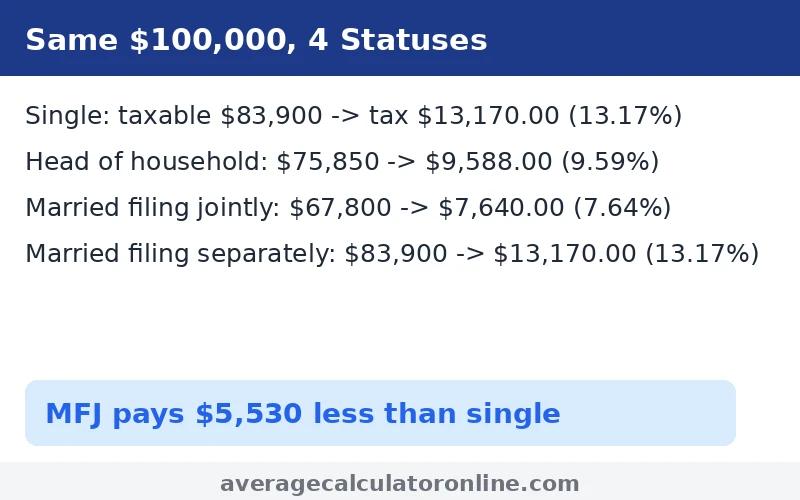
Same $100,000 income, four filing statuses
| Filing status | Deduction | Taxable income | Federal tax | Effective rate | Marginal rate |
|---|---|---|---|---|---|
| Single | $16,100 | $83,900 | $13,170.00 | 13.17% | 22% |
| Head of household | $24,150 | $75,850 | $9,588.00 | 9.59% | 22% |
| Married filing jointly | $32,200 | $67,800 | $7,640.00 | 7.64% | 12% |
| Married filing separately | $16,100 | $83,900 | $13,170.00 | 13.17% | 22% |
Married filing jointly pays $13,170.00 − $7,640.00 = $5,530.00 less than single on the same $100,000, because the joint standard deduction is larger and the joint brackets are wider. For a broader estimate that is not limited to federal income tax, the tax calculator covers the same 2026 brackets, and the paycheck calculator shows what each paycheck looks like after federal and state withholding.
Worked examples
Example 1 — $50,000 single: $3,820.00 tax
Income $50,000, single, standard deduction $16,100.
- Taxable income: 50,000 − 16,100 = $33,900
- 10% on $12,400 = $1,240.00; 12% on $21,500 ($33,900 − $12,400) = $2,580.00
- Federal tax: 1,240 + 2,580 = $3,820.00
- Effective rate: 3,820 ÷ 50,000 = 7.64%; marginal rate 12%; monthly take-home: (50,000 − 3,820) ÷ 12 = $3,848.33
Example 2 — $100,000 single: $13,170.00 tax (the tool default)
Income $100,000, single, standard deduction $16,100.
- Taxable income: 100,000 − 16,100 = $83,900
- 10% on $12,400 = $1,240.00; 12% on $38,000 = $4,560.00; 22% on $33,500 ($83,900 − $50,400) = $7,370.00
- Federal tax: 1,240 + 4,560 + 7,370 = $13,170.00
- Effective rate: 13,170 ÷ 100,000 = 13.17%; marginal rate 22%; monthly take-home: (100,000 − 13,170) ÷ 12 = $7,235.83
Example 3 — $150,000 single: $24,734.00 tax
Income $150,000, single, standard deduction $16,100.
- Taxable income: 150,000 − 16,100 = $133,900
- 10% on $12,400 = $1,240.00; 12% on $38,000 = $4,560.00; 22% on $55,300 = $12,166.00; 24% on $28,200 ($133,900 − $105,700) = $6,768.00
- Federal tax: 1,240 + 4,560 + 12,166 + 6,768 = $24,734.00
- Effective rate: 24,734 ÷ 150,000 = 16.49%; marginal rate 24%; monthly take-home: (150,000 − 24,734) ÷ 12 = $10,438.83
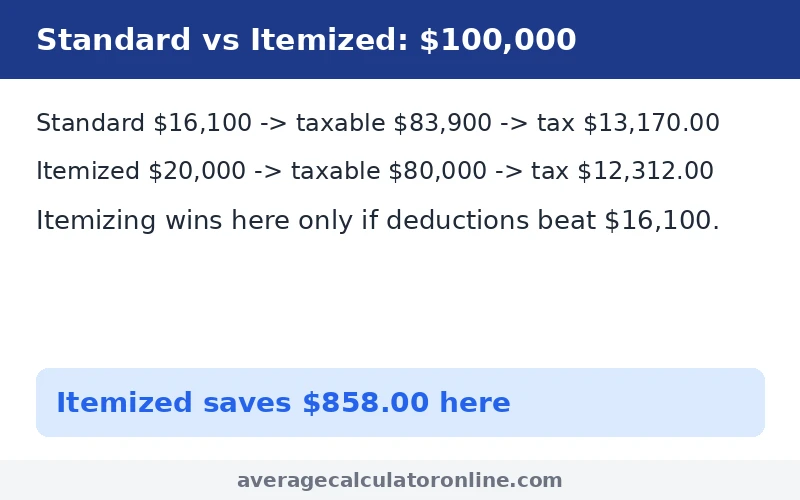
Example 4 — Standard vs itemized on $100,000 single
Same $100,000 income, single filer, two deduction choices:
- Standard $16,100: taxable $83,900 → federal tax $13,170.00 (effective 13.17%).
- Itemized $20,000: taxable 100,000 − 20,000 = $80,000 → federal tax $12,312.00 (effective 12.31%). Itemizing saves 13,170 − 12,312 = $858.00, and monthly take-home rises to $7,307.33.
- Itemized $12,000 instead: taxable $88,000 → federal tax $14,072.00 — $902.00 more than the standard deduction. Itemizing only wins when your itemized total beats the standard deduction; here the break-even point is exactly $16,100.
Tips and mistakes
- Do not tax your full salary. The most common mistake is applying a bracket rate to gross income. Subtract the deduction first — on $100,000 single, the first $16,100 is not taxed at all under the standard deduction.
- Do not confuse marginal with effective. A 22% marginal rate does not mean you pay 22% of your income in tax. On $100,000 single the effective rate is 13.17% — the 22% applies only to the slice of taxable income above $50,400.
- Compare deductions before choosing. Add up your itemized deductions first. If the total is below your standard deduction ($16,100 single, $32,200 married filing jointly, $24,150 head of household in 2026), the standard deduction is the better choice — itemizing with $12,000 on a single return costs $902.00 extra in Example 4.
- A raise that crosses a bracket edge is still a raise. Only the dollars above the threshold pay the higher rate, so moving into the 24% bracket never makes your take-home pay fall.
- Remember what this estimate leaves out. Federal income tax here is before tax credits (such as the child tax credit), payroll taxes, and state tax. A credit reduces tax dollar-for-dollar and is not part of this calculation; check the IRS instructions for credits that may apply to you.
Sources
Brackets and standard deductions are from IRS Revenue Procedure 2025-32 (Internal Revenue Bulletin 2025-45, §4.01 Tables 1–4 and §4.14). Reviewed by the Average Calculator Team. Last reviewed: 7 November 2026.
FAQs
How much federal tax do I pay on $100,000 as a single filer?
With the 2026 standard deduction of $16,100, taxable income is $83,900 and federal tax is $13,170.00 — an effective rate of 13.17% and a marginal rate of 22%. That is federal income tax only, before credits, payroll taxes, and any state tax.
How do tax brackets work — what is the difference between marginal and effective rate?
Tax brackets are marginal: each slice of taxable income is taxed at its own rate, and only the dollars above each threshold pay the higher rate. Your marginal rate is the rate on your top slice (22% on $100,000 single). Your effective rate is total tax divided by total income (13.17% on the same return) — always lower than the marginal rate once you are above the first bracket.
Should I take the standard deduction or itemize?
Take whichever is larger. For 2026 the standard deduction is $16,100 single, $32,200 married filing jointly, and $24,150 head of household. On $100,000 single, itemizing $20,000 beats the standard deduction and saves $858.00 in federal tax ($12,312.00 vs $13,170.00), but itemizing only $12,000 costs $902.00 extra — so add up your itemized deductions before choosing.
How much federal tax do I pay on $50,000 or $150,000 as a single filer?
On $50,000 single with the standard deduction, taxable income is $33,900 and federal tax is $3,820.00 (7.64% effective, 12% marginal). On $150,000 single, taxable income is $133,900 and federal tax is $24,734.00 (16.49% effective, 24% marginal). Both use the 2026 standard deduction of $16,100.
Does filing jointly lower my federal tax?
Usually, yes, on the same income. On $100,000 with the 2026 standard deductions, married filing jointly pays $7,640.00 (7.64% effective, 12% marginal) versus $13,170.00 single (13.17% effective, 22% marginal) — $5,530.00 less — because the joint standard deduction is $32,200 instead of $16,100 and the joint brackets are wider. Head of household falls in between at $9,588.00.
Does this calculator include state tax?
No — it estimates federal income tax only. State tax is shown only if you enter a rate yourself, applied to taxable income as an estimate; no state rate is built in, because state tax varies by state and some states have no income tax. For example, at a 5% rate you enter on the $100,000 single default, estimated state tax is $4,195.00 and monthly take-home after federal and state tax is $6,886.25.
Disclaimer
Estimates only, not financial or tax advice. All figures on this page are 2026 federal income-tax brackets and standard deductions from IRS Revenue Procedure 2025-32 (Internal Revenue Bulletin 2025-45, §4.01 Tables 1–4 and §4.14). The estimate is before tax credits, payroll taxes, and state tax; state tax varies by state and is estimated only from a rate you enter yourself. Your actual tax depends on your full return, including income types, credits, and deductions not covered here. For advice about your own situation, consult a qualified tax professional or the IRS instructions for Form 1040.
Related calculators
- Tax Calculator — the quick-estimate tax tool on this site
- Paycheck Calculator — gross pay per paycheck and take-home pay
- Mortgage Calculator — monthly mortgage payments, whose interest can feed into itemized deductions
- Percentage Calculator — percentage change and rate math behind effective rates
- Retirement Calculator — long-term savings, where pre-tax contributions can lower taxable income
Last updated: November 7, 2026.