Simple Interest Calculator
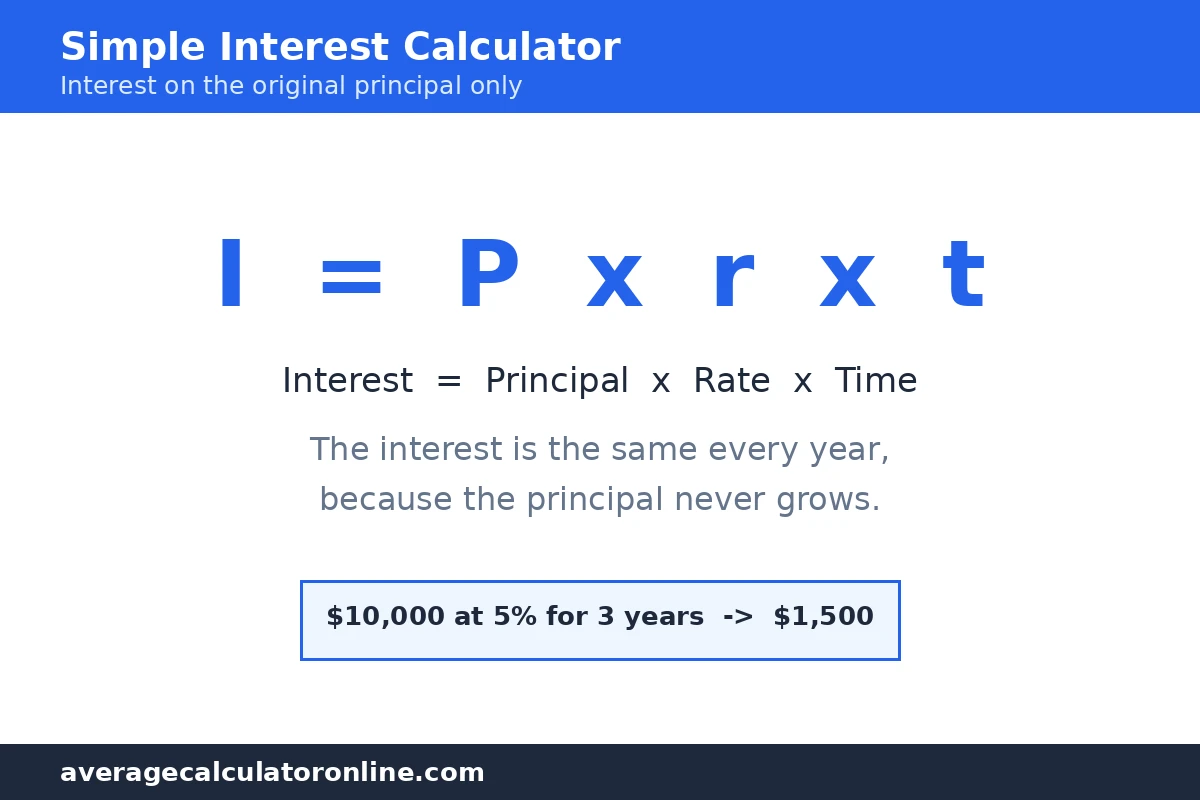
Direct answer: Simple interest is I = P x r x t. Multiply the principal by the annual rate as a decimal and by the time in years. On $10,000 at 5% for 3 years, the interest is $1,500 and the total amount is $11,500.
By Average Calculator Team. Last reviewed: 15 November 2026.
How simple interest works
Simple interest is charged only on the original principal, so the interest is the same in every year. The principal never grows, which is what makes simple interest different from compound interest. If the interest is added to the balance each year instead, use the compound interest calculator.
The formula is I = P x r x t, where I is the interest, P is the principal, r is the annual rate as a decimal, and t is the time in years. To get the total amount, add the interest to the principal: A = P + I. To use the formula, turn the percent into a decimal first: 5% is 0.05, and 3.5% is 0.035.
Worked examples
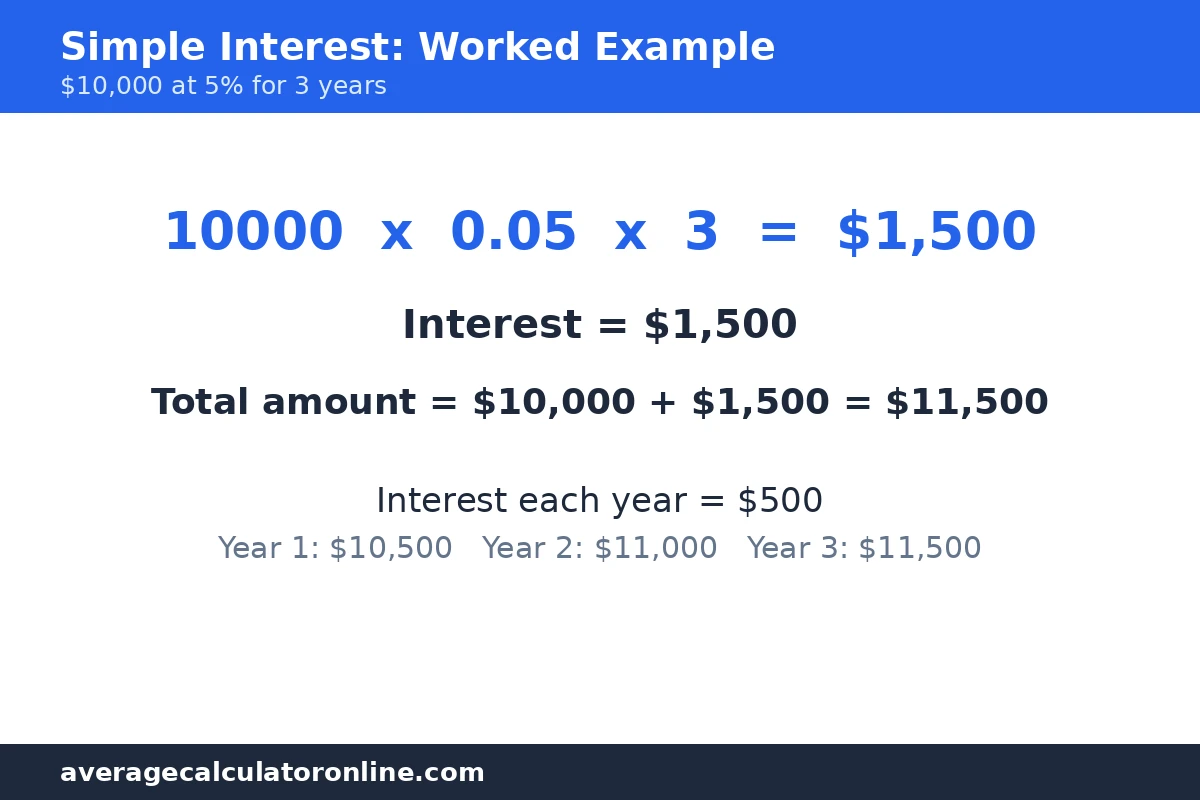
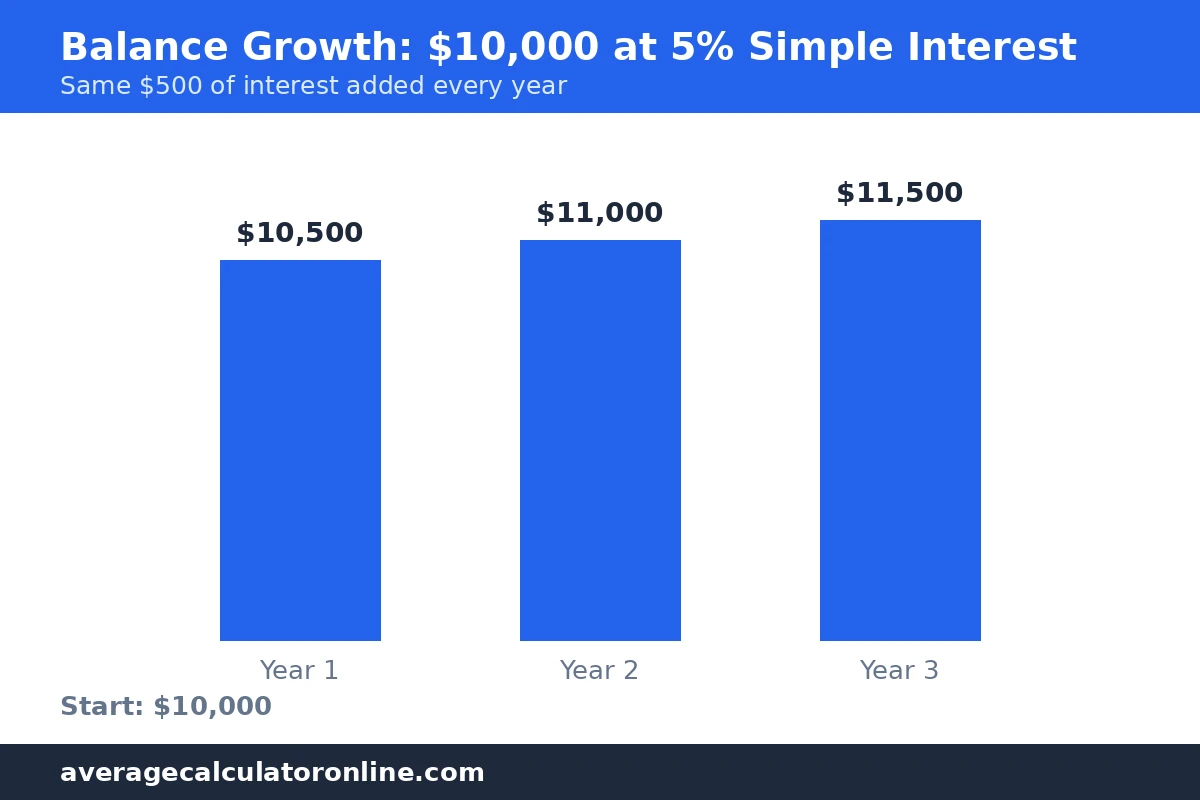
Example 1: $10,000 at 5% for 3 years. Interest = 10,000 x 0.05 x 3 = $1,500. Total = 10,000 + 1,500 = $11,500. The interest each year is $500, so the balance is $10,500 after year 1, $11,000 after year 2, and $11,500 after year 3.
Example 2: $2,500 at 4% for 6 years. Interest = 2,500 x 0.04 x 6 = $600. Total = 2,500 + 600 = $3,100. The interest each year is $100.
Example 3: $20,000 at 3.5% for 2 years. Interest = 20,000 x 0.035 x 2 = $1,400. Total = 20,000 + 1,400 = $21,400. The interest each year is $700. Many short term loans use simple interest; work out the monthly payment on the loan calculator.
Example 4, finding the rate: You paid $1,200 of interest on $8,000 over 3 years. Rearrange the formula to r = I / (P x t) = 1,200 / (8,000 x 3) = 1,200 / 24,000 = 0.05, so the rate was 5% per year.
Simple vs compound interest
On $10,000 at 5%, simple interest pays a flat $500 every year, while compound interest pays more each year because it earns interest on the interest from earlier years. The gap is small at first and grows with time.
| Year | Simple interest total | Compound interest total |
|---|---|---|
| 1 | $10,500 | $10,500.00 |
| 5 | $12,500 | $12,762.82 |
| 10 | $15,000 | $16,288.95 |
After 10 years, compound interest is $1,288.95 ahead. For long term saving and investing, that gap is why the investment calculator uses compounding. A mortgage usually uses compound interest too, so check the mortgage calculator for home loans.

Common mistakes
Forgetting to turn the percent into a decimal: 5% is 0.05, not 5. Using 5 in the formula gives an answer 100 times too big.
Mixing up months and years: the rate is annual, so the time must be in years. For 6 months, use t = 0.5, not t = 6.
Assuming a loan is simple interest: many loans compound monthly. Read the loan agreement before you compare two offers, and use the loan calculator to see the monthly payment.
Frequently asked questions
What is simple interest?
Simple interest is interest calculated only on the original principal. The interest earned each year stays the same, because the principal never grows. The formula is I = P x r x t, where P is the principal, r is the annual rate as a decimal, and t is the time in years.
What is the simple interest formula?
The simple interest formula is I = P x r x t. Multiply the principal by the annual interest rate as a decimal and by the time in years. Add the interest to the principal to get the total amount: A = P + I.
How do I calculate simple interest on 10000 dollars at 5 percent for 3 years?
Multiply 10000 by 0.05 and by 3. The interest is 1500 dollars, and the total amount is 11500 dollars. The interest each year is 500 dollars, so after year 1 the balance is 10500 dollars, after year 2 it is 11000 dollars, and after year 3 it is 11500 dollars.
What is the difference between simple interest and compound interest?
Simple interest is charged only on the original principal, so the interest is the same every year. Compound interest is charged on the principal plus all interest earned so far, so the interest grows every year. On 10000 dollars at 5 percent for 10 years, simple interest gives 15000 dollars in total, while compound interest gives 16288.95 dollars.
When is simple interest used?
Simple interest is used for many short term loans, car loans, and some personal loans, and for savings products that pay interest without reinvesting it. Lenders usually state in the loan agreement whether the interest is simple or compound, so read the agreement before you sign it.
How do I find the interest rate from the interest paid?
Rearrange the formula to r = I divided by (P x t). For example, 1200 dollars of interest on 8000 dollars over 3 years gives r = 1200 divided by 24000, which is 0.05, or 5 percent per year.
How do I calculate simple interest for 6 months?
Convert the time to years first: 6 months is half a year, so t = 0.5. On the default example, $10,000 at 5% for 6 months gives I = 10,000 x 0.05 x 0.5 = $250 of interest, for a total of $10,250. Using t = 6 by mistake would give an answer 12 times too big.
What is the daily interest?
Divide the yearly interest by 365 days. On the default example, $10,000 at 5% earns $500 of interest per year, so the daily interest is $500 divided by 365 = $1.37 per day. The interest itself stays the same each day because simple interest is always calculated on the original principal.
Note: This calculator is for education and planning only. Actual loan interest depends on the terms in your agreement, including fees and the exact way the lender counts time. The results here are estimates, not financial advice.
Source: the Consumer Financial Protection Bureau explains how a simple interest rate is calculated on the outstanding balance, daily or monthly.
Compound Interest Calculator ·
Loan Calculator ·
Investment Calculator ·
Mortgage Calculator
Last updated: November 15, 2026.