
Investment Calculator
Enter your starting amount, monthly contribution, expected annual return, and years. The calculator compounds monthly.
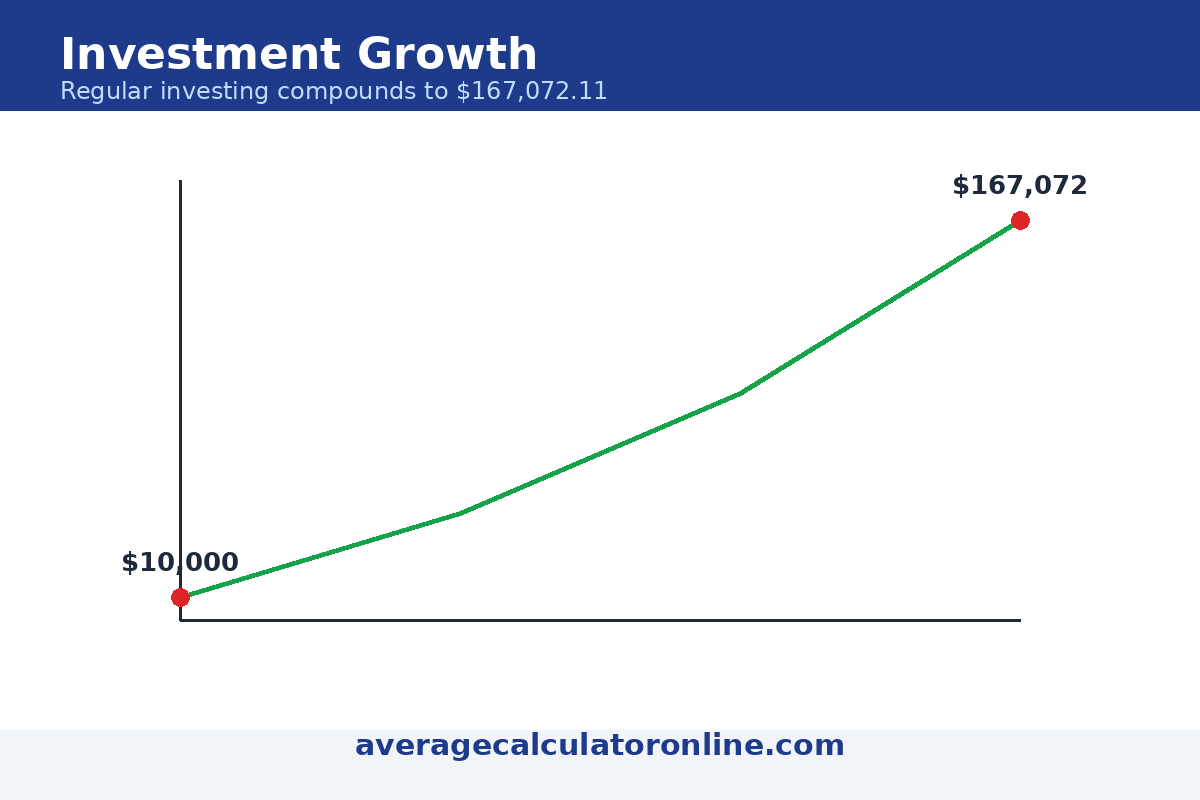
Future value: $167072.11
Total invested: $58000.00
Interest earned: $109072.11
Direct answer
An investment grows by compound interest: each month’s return is earned on the previous balance plus new contributions. The future value formula with monthly compounding is: FV = P(1 + r)^n + PMT × [((1 + r)^n − 1) / r], where P is the starting amount, PMT the monthly contribution, r the monthly rate, and n the number of months.
Investment formula
The future value has two parts. Growth of the starting amount: P × (1 + r)^n. Growth of the monthly contributions: PMT × [((1 + r)^n − 1) / r]. Add the two parts for the future value.
P is the starting amount, PMT the monthly contribution, r the monthly rate (annual rate ÷ 12), and n the number of months (years × 12). Total invested = P + PMT × n, and interest earned = future value − total invested.
Worked examples
Example 1: $10,000 starting amount, $200 per month, 8% annual return, 20 years. Monthly rate = 0.08 ÷ 12 = 0.006667, months = 240. Future value = $167,072.11. Total invested = $10,000 + ($200 × 240) = $58,000. Interest earned = $167,072.11 − $58,000 = $109,072.11.
Example 2: $5,000 lump sum, no monthly contributions, 7% annual return, 10 years. Monthly rate = 0.07 ÷ 12 = 0.005833, months = 120. Future value = $5,000 × (1.005833)^120 = $10,048.31.
Example 3: $2,000 starting amount, $100 per month, 6% annual return, 10 years. Monthly rate = 0.06 ÷ 12 = 0.005, months = 120, and (1.005)^120 = 1.819397. Future value = 2,000 × 1.819397 + 100 × [(1.819397 − 1) ÷ 0.005] = $20,026.73. Total invested = $2,000 + ($100 × 120) = $14,000. Interest earned = $20,026.73 − $14,000 = $6,026.73.
Example 4: No starting amount, $300 per month, 6% annual return, 20 years. Monthly rate = 0.005, months = 240, and (1.005)^240 = 3.310204. Future value = 300 × [(3.310204 − 1) ÷ 0.005] = $138,612.27. Total invested = $300 × 240 = $72,000. Interest earned = $138,612.27 − $72,000 = $66,612.27.
Example 5: $5,000 lump sum, no monthly contributions, 6% annual return, 20 years. Monthly rate = 0.005, months = 240. Future value = $5,000 × (1.005)^240 = 5,000 × 3.310204 = $16,551.02.
What to watch out for
Returns are never guaranteed: an 8% assumption is a planning estimate, not a promise. Taxes, fees, and inflation all reduce real returns, and this calculator does not include them.
FAQs
How does an investment calculator work?
It applies compound interest to your starting amount and monthly contributions over the years you choose, then shows future value, total invested, and interest earned.
What is a realistic annual return?
Long-term stock market averages are often quoted around 7–10% before inflation, but any single period can be much higher or lower.
Does this calculator include taxes or fees?
No. Taxes, brokerage fees, and fund expenses are excluded, so treat results as estimates.
Is compound interest monthly or yearly here?
Monthly: the annual rate is divided by 12 and applied each month, which matches most investment growth illustrations.
What is the difference between nominal and effective annual return?
The nominal rate is the advertised annual rate before compounding frequency is applied, while the effective rate includes compounding. At a 6% nominal rate compounded monthly, the effective annual rate is (1 + 0.06/12)^12 − 1 = 6.168%. That is why monthly compounding slightly beats the same nominal rate compounded once a year.
How much do monthly contributions matter compared to the starting amount?
Over long periods, contributions usually dominate because each deposit compounds for years. In the $2,000-start, $100-a-month, 6%-for-10-years example above, contributions total $12,000 of the $14,000 invested, and compounding turns them into most of the $20,026.73 future value. Starting early with smaller contributions often beats starting late with larger ones.
What return should I assume for planning?
Many planners use 6–7% nominal for a stock-heavy portfolio, or 4–5% after inflation, but no assumption is guaranteed. Run the calculator at a lower return for a cautious case and at a higher return for an optimistic one. Use the range, not a single number, when the decision matters.
Sources
For background on compound interest and investing basics, see the U.S. Securities and Exchange Commission’s compound interest calculator at Investor.gov.
Disclaimer: Results are estimates for planning only, not financial or investment advice.
Related calculators: Compound Interest Calculator · Retirement Calculator · Loan Calculator
Last updated: November 1, 2026.