

Tire Size Calculator
New tire is 0.38% larger in diameter
Current 205/55R16: 631.9 mm (24.88 in). New 225/45R17: 634.3 mm (24.97 in). At 60 mph on the speedometer, the real speed is 60.23 mph.
Direct answer: A tire size calculator compares two tire sizes and shows how the change affects your car. Changing from 205/55R16 to 225/45R17 makes the tire 0.38% larger in diameter: the old tire is 631.9 mm (24.88 in) across and the new one is 634.3 mm (24.97 in). At 60 mph on the speedometer, the real speed is 60.23 mph. A change under 1% is small enough to ignore. A change over 3% needs care, because the speedometer, the odometer, and the clearance all move with it.
By Average Calculator Team. Last reviewed: 16 November 2026.
How tire size is calculated
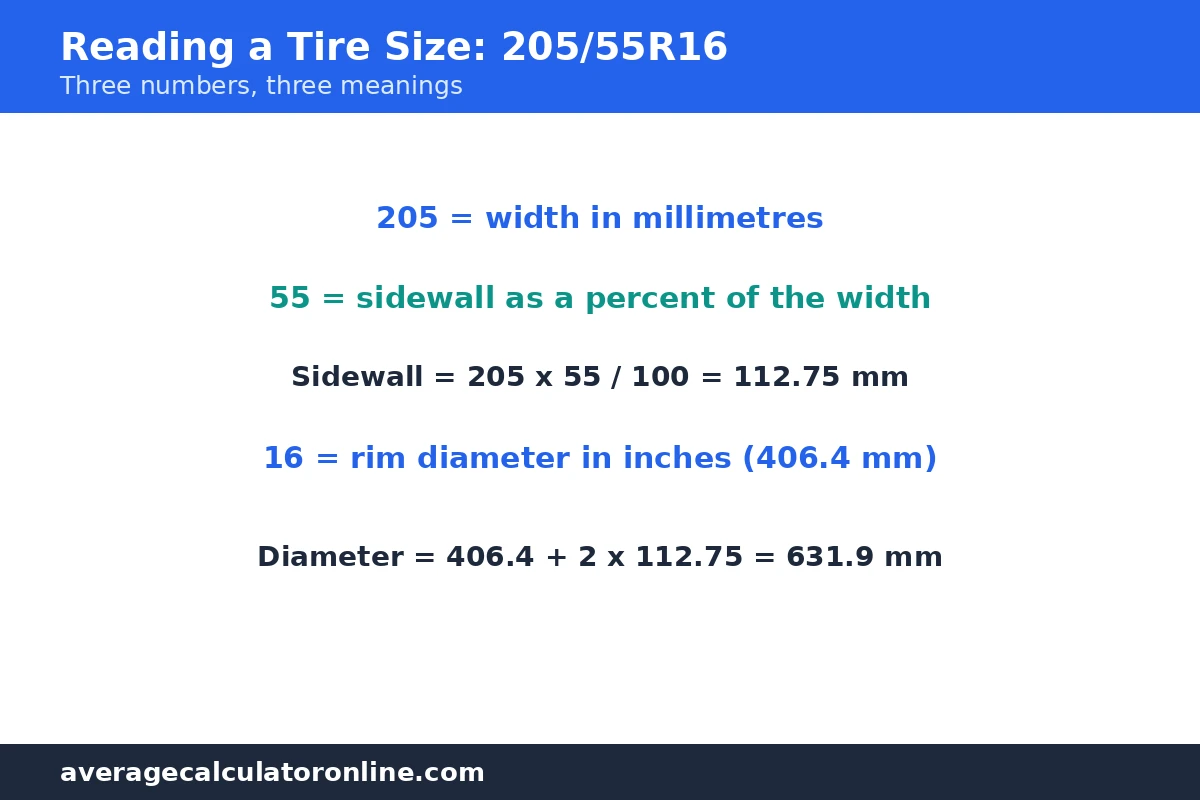
A tire size like 205/55R16 carries three numbers. The first, 205, is the tire width in millimetres. The second, 55, is the aspect ratio: the sidewall height as a percent of the width, so the sidewall is 205 x 55 / 100 = 112.75 mm tall. The third, 16, is the rim diameter in inches. The overall diameter is rim diameter in mm plus twice the sidewall height: diameter = rim x 25.4 + 2 x width x aspect / 100. One inch is 25.4 mm, so a 16 inch rim is 406.4 mm across.
The circumference is diameter x pi, and it sets how far the car rolls per turn of the wheel. The speedometer and the odometer are set for the original circumference, so a bigger tire rolls further per turn and the real speed is higher than the speedometer shows, while a smaller tire does the opposite. The percent change is (new diameter – old diameter) / old diameter x 100, and the real speed at a shown 60 mph is 60 x new diameter / old diameter. To check fuel use after a change, use the petrol mileage calculator.

Worked examples
Example 1: Old 205/55R16. Sidewall is 205 x 55 / 100 = 112.75 mm. Diameter is 16 x 25.4 + 2 x 112.75 = 406.4 + 225.5 = 631.9 mm, which is 631.9 / 25.4 = 24.88 in. Circumference is 24.88 x 3.14159 = 78.16 in. New 225/45R17. Sidewall is 225 x 45 / 100 = 101.25 mm. Diameter is 17 x 25.4 + 2 x 101.25 = 431.8 + 202.5 = 634.3 mm, which is 24.97 in. Circumference is 24.97 x 3.14159 = 78.45 in. The change is (634.3 – 631.9) / 631.9 x 100 = 0.38% larger. At 60 mph shown, the real speed is 60 x 634.3 / 631.9 = 60.23 mph.
Example 2: Old 195/65R15. Sidewall is 195 x 65 / 100 = 126.75 mm. Diameter is 15 x 25.4 + 2 x 126.75 = 381 + 253.5 = 634.5 mm, which is 24.98 in. Circumference is 24.98 x 3.14159 = 78.48 in. New 205/60R15. Sidewall is 205 x 60 / 100 = 123 mm. Diameter is 381 + 246 = 627.0 mm, which is 24.69 in. Circumference is 24.69 x 3.14159 = 77.57 in. The change is (627.0 – 634.5) / 634.5 x 100 = -1.18% smaller. At 60 mph shown, the real speed is 60 x 627.0 / 634.5 = 59.29 mph.
Example 3, a change that is too big: Old 225/60R16. Diameter is 16 x 25.4 + 2 x 225 x 60 / 100 = 406.4 + 270 = 676.4 mm, which is 26.63 in. New 235/55R17. Diameter is 17 x 25.4 + 2 x 235 x 55 / 100 = 431.8 + 258.5 = 690.3 mm, which is 27.18 in. The change is (690.3 – 676.4) / 676.4 x 100 = 2.05% larger. At 60 mph shown, the real speed is 60 x 690.3 / 676.4 = 61.23 mph. The tire is also 10 mm wider, so check clearance at full steering lock before you buy. For the distance behind the speed change, use the distance calculator.
Example 4, same diameter, wider tire: Old 205/55R16 is 631.9 mm across. New 215/50R17: sidewall is 215 x 50 / 100 = 107.5 mm, diameter is 431.8 + 215 = 646.8 mm, which is 25.46 in. That is (646.8 – 631.9) / 631.9 x 100 = 2.36% larger, not the same size at all. Wider does not mean the same diameter: the aspect ratio and the rim both move the result. Always run both sizes through the calculator instead of guessing from the width alone.
How much change is safe
Tire makers and car makers usually accept a diameter change within 1% either way, and most cars tolerate up to 3% with no rubbing and no warning light. The table shows the three examples from this page.
| Change | Diameter change | Real speed at 60 mph shown | Verdict |
|---|---|---|---|
| 205/55R16 to 225/45R17 | 0.38% larger | 60.23 mph | Fine |
| 195/65R15 to 205/60R15 | 1.18% smaller | 59.29 mph | Fine |
| 225/60R16 to 235/55R17 | 2.05% larger | 61.23 mph | Check clearance |
| 205/55R16 to 215/50R17 | 2.36% larger | 61.41 mph | Check clearance |
A bigger tire also raises the car slightly and changes the gearing, so acceleration feels a little slower and fuel use can rise. A smaller tire does the opposite and can push engine speed higher at the same road speed. Either way, the odometer reads wrong by the same percent as the speedometer, so service intervals and fuel math drift too. The average speed calculator shows how the speed gap changes a trip time.
Common mistakes
Reading the aspect ratio as millimetres: the 55 in 205/55R16 is a percent, not a height in mm. The sidewall is 55% of 205 mm, which is 112.75 mm. Treating 55 as a height gives a diameter that is far too small.
Comparing width only: a wider tire is not the same diameter. Example 4 shows a 215 width tire that is 2.36% larger than a 205 width tire, because the rim grew too. Compare the full diameter, never the width alone.
Forgetting the speedometer: a 2% larger tire makes the speedometer read low by 2%, so 60 mph shown is really 61.23 mph. That gap is enough for a speeding ticket on a road with a strict limit. Check the real speed after any change.
Ignoring clearance and load: a wider or taller tire can rub the wheel arch at full steering lock or under load, and a tire with a lower load rating than the original is unsafe even if the size fits. Match the load rating and the rim width to the original tire, and check the percentage calculator for the change as a share of the original size.
Frequently asked questions
How do I read a tire size?
A size like 205/55R16 carries three numbers. 205 is the tire width in millimetres. 55 is the aspect ratio: the sidewall height as a percent of the width, so the sidewall is 112.75 millimetres tall. 16 is the rim diameter in inches. R means radial construction.
How do I calculate tire diameter?
Diameter equals the rim diameter in millimetres plus twice the sidewall height. Sidewall height is width times aspect ratio divided by 100. On 205/55R16, the sidewall is 205 times 55 divided by 100, which is 112.75 millimetres, and the diameter is 406.4 plus 225.5, which is 631.9 millimetres, or 24.88 inches.
How much can tire size change?
A diameter change within 1 percent either way is usually fine, and most cars tolerate up to 3 percent with no rubbing and no warning light. Changing from 205/55R16 to 225/45R17 is 0.38 percent larger, which is fine. A change over 3 percent needs care with clearance, the speedometer, and the load rating.
How does tire size affect the speedometer?
The speedometer is set for the original tire circumference. A bigger tire rolls further per turn, so the real speed is higher than the speedometer shows. A tire 2.05 percent larger makes 60 mph shown into a real speed of 61.23 mph. A smaller tire does the opposite, so 60 mph shown becomes 59.29 mph.
Can I put a wider tire on the same rim?
Sometimes, but width alone does not tell you the answer. A wider tire on a bigger rim can be much larger in diameter, as Example 4 shows. Check the full diameter change, the rim width range for the tire, the load rating, and the clearance at full steering lock before you buy.
Does tire size affect fuel use?
Yes, a little. A bigger tire raises gearing and rolling resistance, so the engine works harder at low speed and fuel use can rise. A smaller tire raises engine speed at the same road speed, which can also raise fuel use. The change is usually small under 2 percent, but the odometer also reads wrong by the same percent, so fuel math drifts too.
Petrol Mileage Calculator ·
Distance Calculator ·
Percentage Calculator ·
Time Calculator ·
Average Speed Calculator ·
Last updated: November 16, 2026.