401(k) Calculator
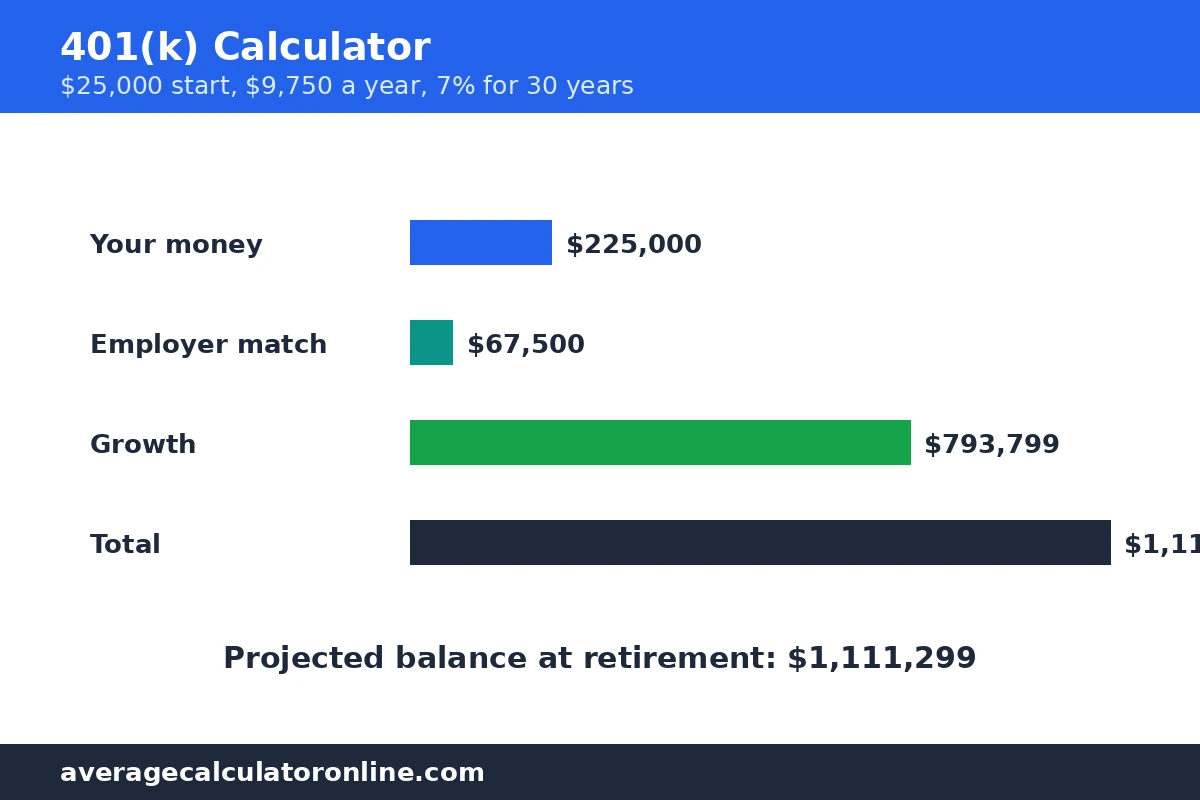
Projected balance at retirement: $1,111,299.04
Your contributions: $225,000.00. Employer match: $67,500.00. Growth: $793,799.04.
Direct answer: A 401(k) calculator projects your retirement balance from your salary, your contribution, your employer match, and a return rate you choose. With the values you entered above, your starting balance grows to $1,111,299.04 in 30 years. That is $225,000 from you, $67,500 from the match, and $793,799.04 of growth. The return rate is your assumption, not a promise: actual returns vary every year.
By Average Calculator Team. Last reviewed: 16 November 2026.
How a 401(k) works
A 401(k) is a retirement plan offered by an employer. Money comes out of your pay and goes into the account, and many employers add a match: extra money based on how much you contribute. A common match is 3% of salary when you contribute 6%, though every plan sets its own formula. Check your plan documents for the exact match and for the vesting schedule, which is the timetable for when the match money becomes fully yours.
With a traditional 401(k), contributions come out of your pay before tax, so they lower your taxable income now, and you pay tax when you withdraw in retirement. With a Roth 401(k), contributions come out after tax, and qualified withdrawals in retirement are tax-free. The calculator holds your salary flat and adds each year of contributions at the end of the year, then compounds the balance at the return rate you enter. It does not model fees, taxes, or salary growth, so treat the result as a planning estimate. To see your take-home pay after a contribution, use the paycheck calculator.

Worked examples
Example 1: $75,000 salary, 10% contribution ($7,500 a year), 3% match ($2,250 a year), 7% return, 30 years, $25,000 starting balance. Total added each year is $9,750. The balance is $1,111,299.04. Your contributions total 30 x $7,500 = $225,000, the match totals 30 x $2,250 = $67,500, and the growth is $793,799.04.
Example 2, starting from zero: $60,000 salary, 6% contribution ($3,600 a year), 3% match ($1,800 a year), 7% return, 35 years, no starting balance. Total added each year is $5,400. The balance is $746,479.14. Your contributions total 35 x $3,600 = $126,000, the match totals 35 x $1,800 = $63,000, and the growth is $557,479.14.
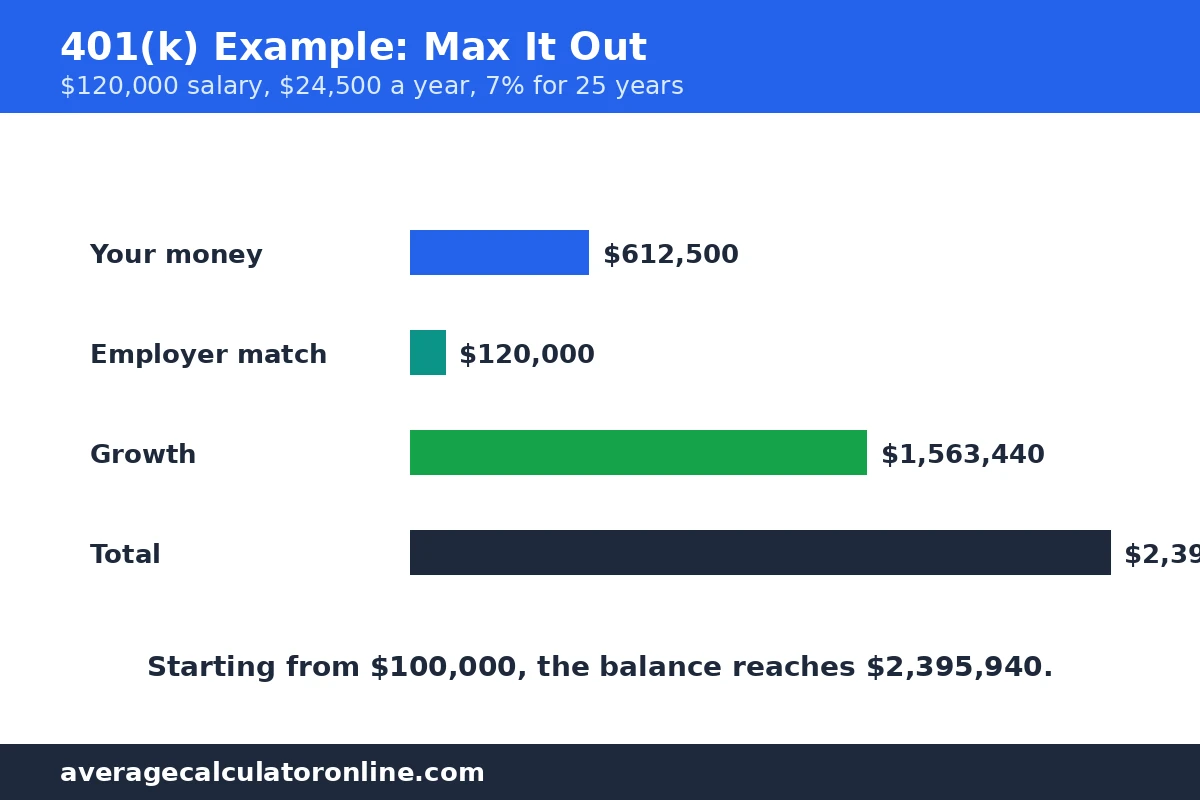
Example 3, maxing out: $120,000 salary, $24,500 a year (the 2026 limit for savers under 50), 4% match ($4,800 a year), 7% return, 25 years, $100,000 starting balance. Total added each year is $29,300. The balance is $2,395,940.07. Your contributions total 25 x $24,500 = $612,500, the match totals 25 x $4,800 = $120,000, and the growth is $1,563,440.07.
Example 4, the cost of skipping the match: $60,000 salary, 7% return, 30 years, no starting balance. Contributing 0% builds $0, because nothing goes in and there is no match to earn. Contributing 6% ($3,600 a year) with a 3% match ($1,800 a year) builds $510,088.25. The match alone is 30 x $1,800 = $54,000 of free money, your contributions are 30 x $3,600 = $108,000, and the growth is $348,088.25.
2026 401(k) contribution limits
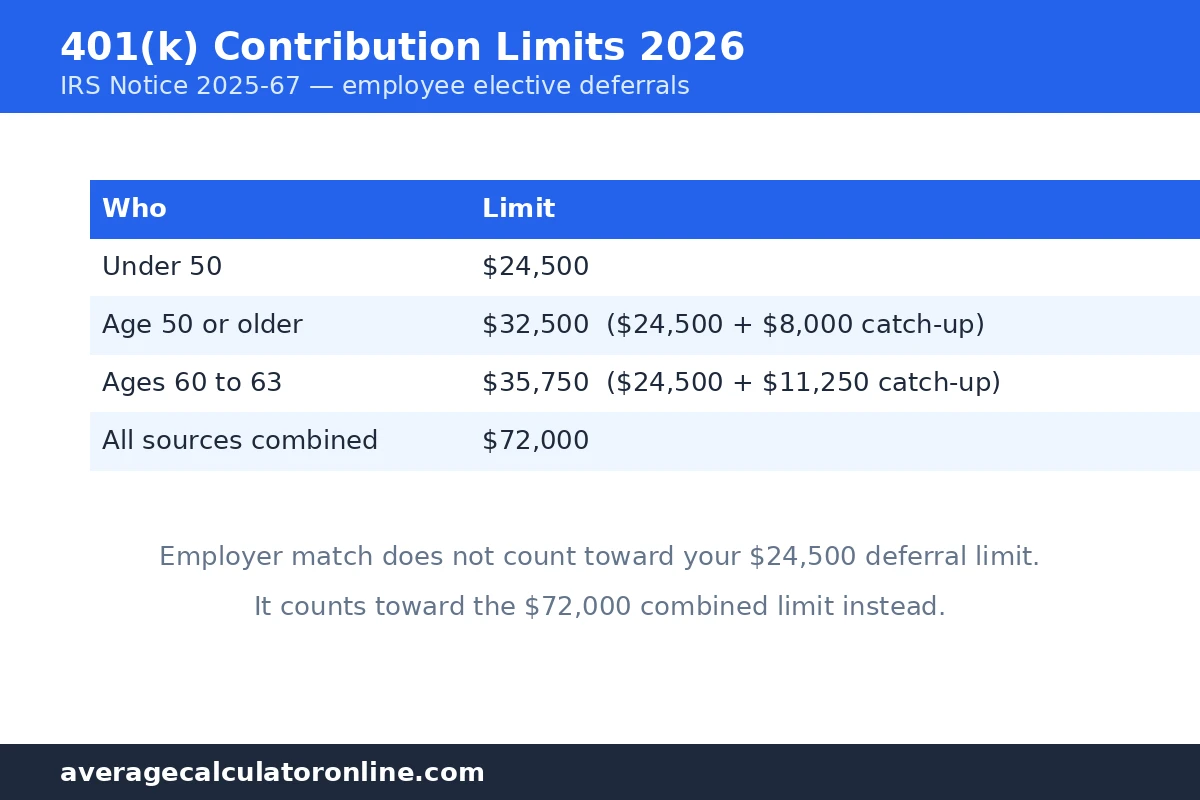
The IRS sets the limit each year. For 2026 the employee elective deferral limit is $24,500, up from $23,500 in 2025. Workers age 50 or older can add an $8,000 catch-up, for a total of $32,500. Workers ages 60 to 63 can add a higher $11,250 catch-up instead, for a total of $35,750. The limit is per person across all 401(k), 403(b), and governmental 457 plans, not per plan. Employer match and profit sharing do not count toward your $24,500 limit; they count toward the separate $72,000 combined annual additions limit for 2026. The figures come from IRS Notice 2025-67.
| Who | 2026 limit |
|---|---|
| Under 50 | $24,500 |
| Age 50 or older | $32,500 |
| Ages 60 to 63 | $35,750 |
| All sources combined | $72,000 |
Starting in 2026, catch-up contributions must go in as Roth contributions if your wages from the sponsoring employer were above $150,000 in the prior year. If your plan offers a Roth option, the compound interest calculator shows the same growth math without the plan rules.
Common mistakes
Leaving the match on the table: Example 4 shows that skipping a 3% match on a $60,000 salary throws away $54,000 over 30 years, plus all the growth on it. At minimum, contribute enough to earn the full match before you save anywhere else.
Assuming the match is yours at once: many plans vest the match over several years. If you leave early, part of the match can stay behind. Read the vesting schedule in your plan documents.
Treating the return rate as a promise: the calculator projects from a rate you enter. A 5% return instead of 7% on Example 1 gives $755,827.32, not $1,111,299.04. Try a low rate and a high rate to see the range.
Forgetting the limit is per person: if you change jobs mid-year, the $24,500 limit covers both plans together. Tell the new employer how much you already deferred, or the excess must come back out by April 15 of the next year. For the full retirement picture, see the retirement calculator.
Why use this calculator
Use it to see what your 401(k) could be worth at retirement – and how much the employer match adds. It helps employees check whether their contribution rate is enough for the retirement they want. With the defaults – a $75,000 salary, 10% contribution, 3% match, 7% return and 30 years – the projected balance is $1,111,299.04.
Frequently asked questions
What is a 401(k)?
A 401(k) is a retirement savings plan offered by an employer. Money comes out of your pay and goes into an investment account, and many employers add matching money on top. The money grows inside the plan, and you generally cannot take it out before age 59 and a half without tax and a penalty.
How much can I contribute to a 401(k) in 2026?
For 2026 you can defer up to 24500 dollars from your own pay if you are under 50. Workers age 50 or older can add an 8000 dollar catch-up, for a total of 32500 dollars. Workers ages 60 to 63 can add a higher 11250 dollar catch-up instead, for a total of 35750 dollars. The limit is per person across all plans, not per plan.
What is an employer match?
An employer match is extra money your employer adds to your 401(k) based on how much you contribute. A common formula is a 3 percent match when you contribute 6 percent of salary. The match does not count toward your 24500 dollar deferral limit, but it does count toward the 72000 dollar combined limit for 2026. Match money may vest over several years.
What is the difference between a traditional and a Roth 401(k)?
A traditional 401(k) is funded with pre-tax money, so contributions lower your taxable income now and withdrawals in retirement are taxed as income. A Roth 401(k) is funded with after-tax money, so you get no tax break now, but qualified withdrawals in retirement are tax-free. Many plans offer both, and you can split your contribution between them.
What happens to my 401(k) if I change jobs?
You can leave the money in the old plan, roll it into your new employer plan, roll it into an IRA, or cash it out. Leaving it or rolling it over keeps the tax shelter. Cashing it out usually means income tax plus a 10 percent penalty if you are under age 59 and a half, so it is usually the most expensive choice.
Can I withdraw from my 401(k) early?
Withdrawals before age 59 and a half usually mean income tax plus a 10 percent penalty, with some exceptions for hardship, disability, and separation from service at age 55 or later. Some plans also let you borrow from your balance, but a loan that is not repaid can become a taxable withdrawal.
Note: This calculator is for education and planning only. It projects growth from a return rate you enter, and it never promises a return. Actual investment returns vary, plan rules differ, and contribution limits change each year. The results here are estimates, not financial advice.
Investment Calculator ·
Compound Interest Calculator ·
Retirement Calculator ·
Paycheck Calculator ·
Simple Interest Calculator ·
Last updated: November 21, 2026.