
BMR Calculator
BMR: 1,417 calories per day
TDEE at moderate activity: 2,197 calories per day.
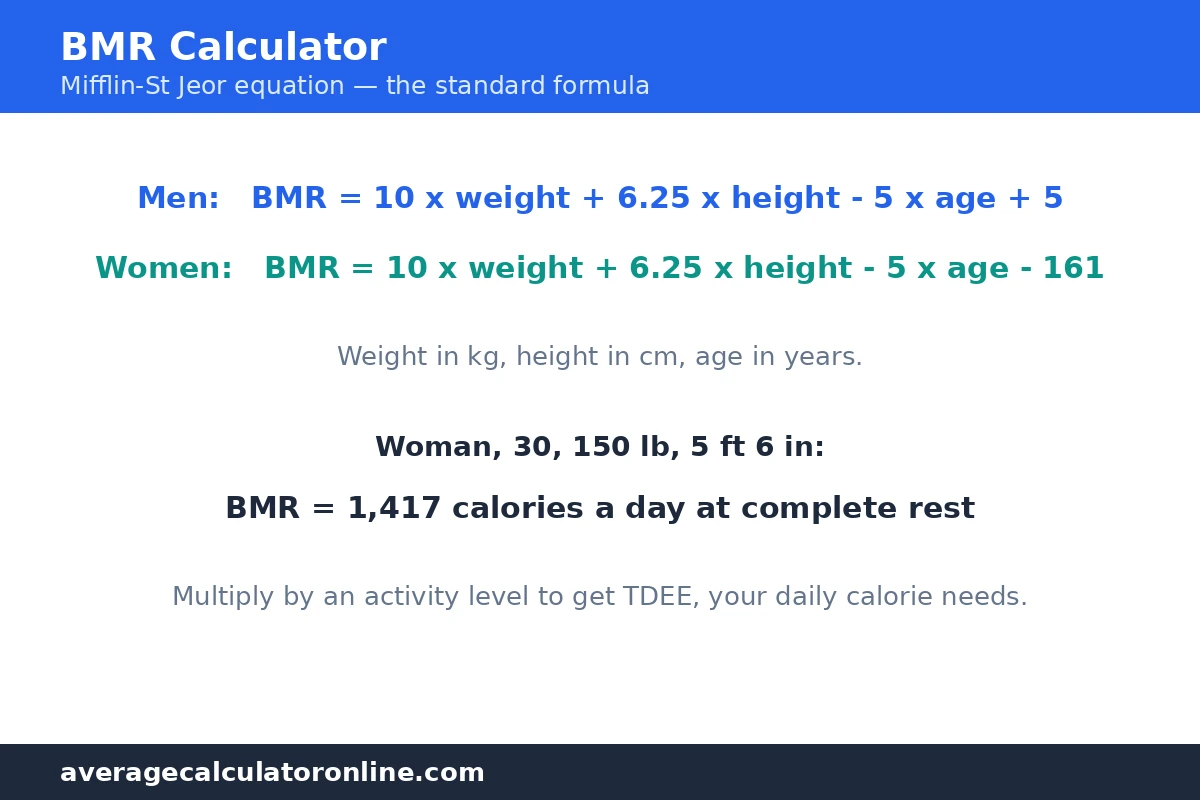
Direct answer: BMR is the calories your body burns at complete rest in a day. For a 30 year old woman who weighs 150 lb and is 5 ft 6 in tall, BMR is 1,417 calories a day. At a moderate activity level, her total daily energy expenditure (TDEE) is 2,197 calories a day. BMR is the starting point for calorie planning, not the whole answer: daily life and exercise add hundreds of calories on top.
By Average Calculator Team. Last reviewed: 16 November 2026.
How BMR is calculated
This calculator uses the Mifflin-St Jeor equation, the formula most dietitians and researchers use today. For men: BMR = 10 x weight in kg + 6.25 x height in cm – 5 x age + 5. For women: BMR = 10 x weight in kg + 6.25 x height in cm – 5 x age – 161. Weight in pounds converts to kilograms by dividing by 2.20462, and height in inches converts to centimeters by multiplying by 2.54.
BMR is what you burn lying still in a warm room after fasting, so it is a baseline, not a daily total. To get TDEE, your total daily energy expenditure, multiply BMR by an activity factor: 1.2 for sedentary, 1.375 for lightly active, 1.55 for moderately active, 1.725 for very active, and 1.9 for extra active. The TDEE calculator works through the same step in more detail, and the calorie calculator turns the result into daily targets.
Worked examples
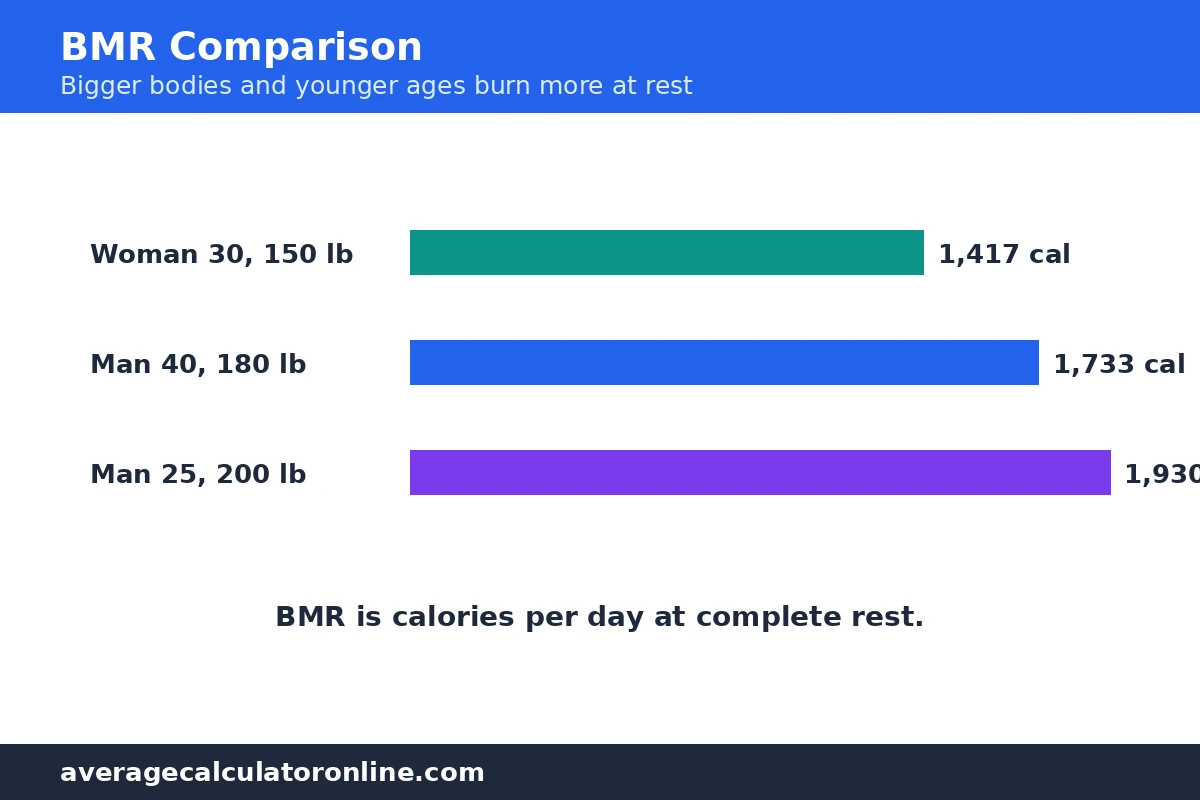
Example 1: Woman, 30 years old, 150 lb, 5 ft 6 in. Weight is 150 / 2.20462 = 68.04 kg. Height is 66 in x 2.54 = 167.64 cm. BMR = 10 x 68.04 + 6.25 x 167.64 – 5 x 30 – 161 = 680.39 + 1,047.75 – 150 – 161 = 1,417 calories a day. At moderate activity (x 1.55), TDEE is 1,417.14 x 1.55 = 2,197 calories a day.
Example 2: Man, 40 years old, 180 lb, 5 ft 10 in. Weight is 180 / 2.20462 = 81.65 kg. Height is 70 in x 2.54 = 177.80 cm. BMR = 10 x 81.65 + 6.25 x 177.80 – 5 x 40 + 5 = 816.47 + 1,111.25 – 200 + 5 = 1,733 calories a day. At sedentary activity (x 1.2), TDEE is 1,732.72 x 1.2 = 2,079 calories a day.
Example 3: Man, 25 years old, 200 lb, 6 ft 0 in. Weight is 200 / 2.20462 = 90.72 kg. Height is 72 in x 2.54 = 182.88 cm. BMR = 10 x 90.72 + 6.25 x 182.88 – 5 x 25 + 5 = 907.18 + 1,143.00 – 125 + 5 = 1,930 calories a day. At very active activity (x 1.725), TDEE is 1,930.19 x 1.725 = 3,330 calories a day.
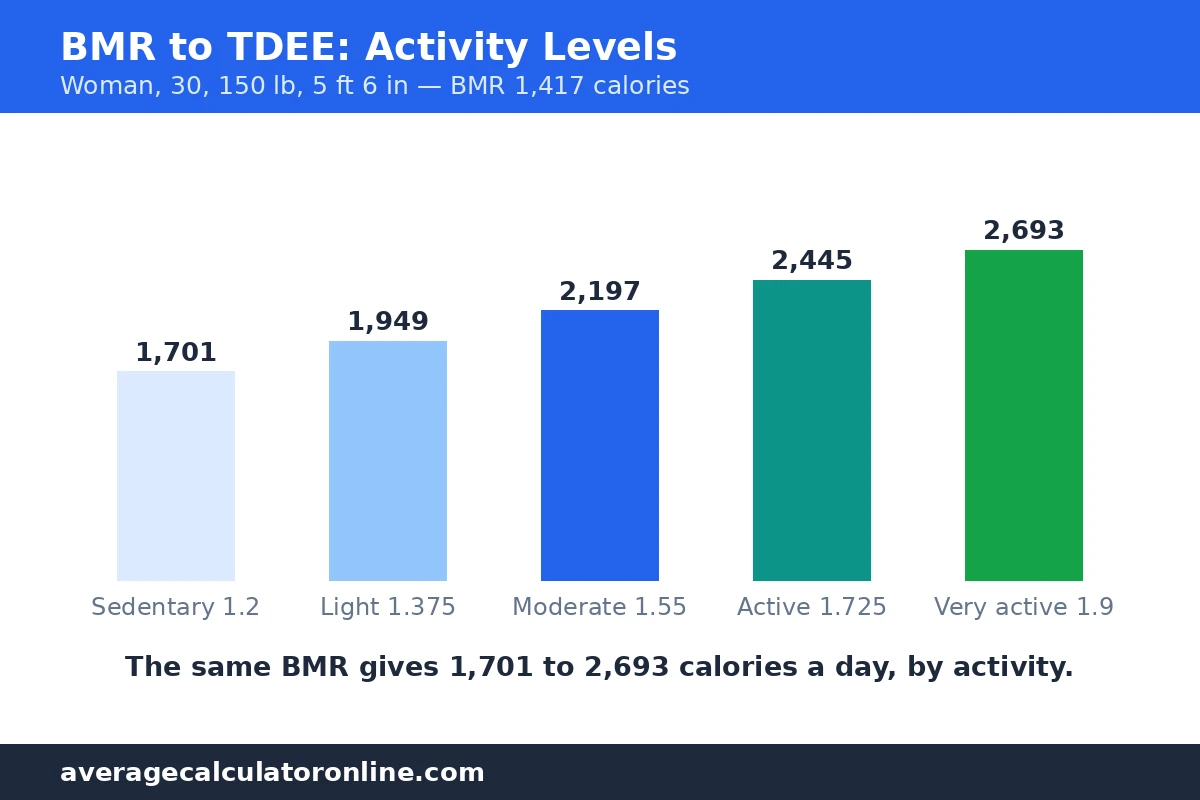
Example 4, same person, different activity: the woman from Example 1 has a BMR of 1,417 calories a day. Her TDEE is 1,701 calories a day when sedentary (x 1.2), 1,949 when lightly active (x 1.375), 2,197 when moderately active (x 1.55), 2,445 when very active (x 1.725), and 2,693 when extra active (x 1.9). Activity changes the answer by almost 1,000 calories.
Activity levels and TDEE
Pick the level that matches a typical week, not your hardest day. Most office workers who train three to five times a week are moderately active. The table shows TDEE for the woman in Example 1, whose BMR is 1,417 calories a day.
| Activity level | Factor | TDEE |
|---|---|---|
| Sedentary | 1.2 | 1,701 calories |
| Lightly active | 1.375 | 1,949 calories |
| Moderately active | 1.55 | 2,197 calories |
| Very active | 1.725 | 2,445 calories |
| Extra active | 1.9 | 2,693 calories |
If your weight is stable and you eat near your TDEE, the number is about right for you. If your weight moves steadily up or down, your real TDEE differs from the estimate, and your food log is the better guide. The BMI calculator adds weight context, and the macro calculator splits TDEE into protein, carbs, and fat.
Common mistakes
Using BMR as a calorie target: BMR is what you burn at rest. Eating at BMR while living a normal active day usually means a large deficit. Plan from TDEE, not from BMR.
Putting pounds into a kilogram formula: the Mifflin-St Jeor equation needs kilograms and centimeters. Entering 150 as kilograms instead of pounds adds about 820 calories to the answer. This calculator converts for you, but check the units if you use the formula by hand.
Picking the wrong activity level: most people overstate their activity. If you sit most of the day and train three times a week, you are moderately active at most, not very active. When in doubt, pick the lower level and adjust from real weight change.
Treating the result as exact: BMR is an estimate. Muscle mass, body composition, and health all shift the real number, so two people with the same age, weight, and height can differ by a few hundred calories. Use the result as a starting point and adjust from what actually happens. The protein calculator helps set protein while you adjust calories.
Frequently asked questions
What is BMR?
BMR is basal metabolic rate: the calories your body burns in a day at complete rest, just to keep you alive. It covers breathing, heartbeat, body temperature, and basic cell work. It does not include walking, working, exercise, or digesting food. For most adults it is roughly 60 to 70 percent of total daily calories.
What is the Mifflin-St Jeor equation?
It is the standard BMR formula. For men: BMR equals 10 times weight in kg, plus 6.25 times height in cm, minus 5 times age, plus 5. For women: the same formula, minus 161 instead of plus 5. It was published in 1990 and is still the formula most dietitians use, because it beats older formulas for most people.
What is the difference between BMR and TDEE?
BMR is what you burn at complete rest. TDEE is total daily energy expenditure: BMR plus everything else, including daily movement, exercise, and digestion. TDEE equals BMR times an activity factor from 1.2 for sedentary up to 1.9 for extra active. BMR is the baseline, TDEE is the number you plan meals from.
How accurate is a BMR calculator?
It is an estimate, not a measurement. The Mifflin-St Jeor equation is the best general formula, but real BMR varies with muscle mass, body composition, and health. Two people with the same age, weight, and height can differ by a few hundred calories a day. Use the result as a starting point and adjust from real weight change over two to four weeks.
Does muscle change BMR?
Yes. Muscle burns more calories at rest than fat does, so a muscular person has a higher BMR than a person of the same weight with more body fat. That is one reason strength training helps long term weight management: it raises the baseline you burn every day, even on rest days.
How do I use BMR to lose weight?
Start from TDEE, not BMR, then eat modestly below it and track your weight for two to four weeks. A common starting point is TDEE minus 300 to 500 calories a day, with enough protein to protect muscle. Never eat below BMR for long without guidance. For a personal plan, talk to a clinician or a registered dietitian.
TDEE Calculator ·
Calorie Calculator ·
BMI Calculator ·
Macro Calculator ·
Protein Calculator ·
Last updated: November 21, 2026.