Pace Calculator
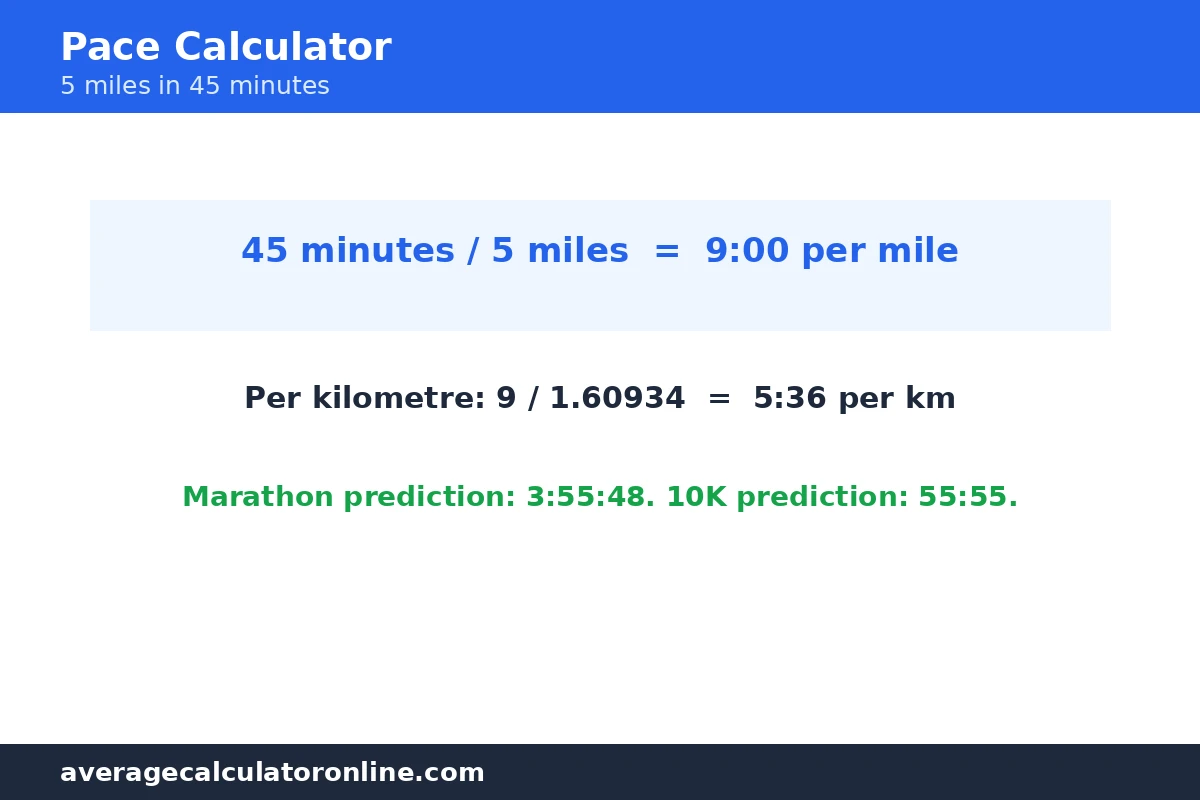
Pace: 9:00 per mile (5:36 per km)
Predicted marathon time: 3:55:48. Predicted 10K time: 55:55.
Direct answer: A pace calculator works out your running pace from a distance and a time. Run 5 miles in 45 minutes and your pace is 45 / 5 = 9:00 per mile, which is 5:36 per km. At that pace, a marathon would take 3:55:48 and a 10K would take 55:55. Race predictions assume you hold the same pace the whole way, which is a big assumption over 26.2 miles.
By Average Calculator Team. Last reviewed: 16 November 2026.
How running pace works
Pace is time divided by distance. It answers the question of how long one mile takes you, rather than how many miles you cover in an hour. That is the number runners actually use: a 9:00 pace means 9 minutes per mile. To convert to minutes per km, divide by 1.60934, because one mile is 1.60934 km. A 9:00 per mile pace is 9 / 1.60934 = 5.59 minutes per km, which is 5 minutes 36 seconds per km.
Race predictions multiply the pace by the race distance. A marathon is 26.2 miles, so 9:00 x 26.2 = 235.8 minutes, which is 3 hours 55 minutes 48 seconds. A 10K is 6.21371 miles, so 9:00 x 6.21371 = 55.92 minutes, which is 55 minutes 55 seconds. A half marathon is 13.1094 miles, so 9:00 x 13.1094 = 117.98 minutes, which is 1 hour 57 minutes 59 seconds. The prediction assumes an even pace with no slowing down, no hills, and no walk breaks. To work out speed instead of pace, use the average speed calculator.
Worked examples
Example 1: 5 miles in 45 minutes. The pace is 45 / 5 = 9:00 per mile. Per km it is 9 / 1.60934 = 5.59 minutes, which is 5:36 per km. The marathon prediction is 9 x 26.2 = 235.8 minutes, which is 3:55:48. The 10K prediction is 9 x 6.21371 = 55.92 minutes, which is 55:55.
Example 2: 10K in 55 minutes. The distance is 6.21371 miles, so the pace is 55 / 6.21371 = 8.85 minutes per mile, which is 8:51 per mile. Per km it is 55 / 10 = 5:30 per km, because a 10K is 10 km by definition.
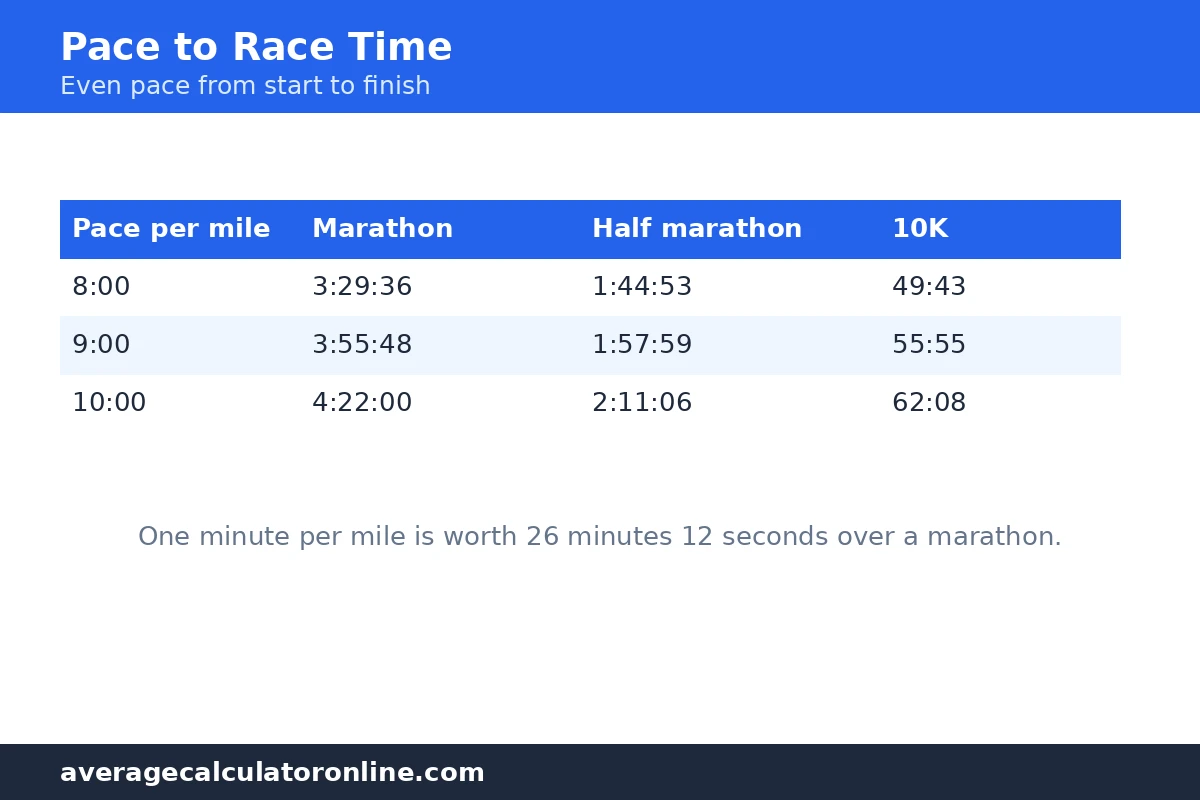
Example 3, a marathon goal: a 4 hour marathon is 240 minutes over 26.2 miles, so the pace needed is 240 / 26.2 = 9.16 minutes per mile, which is 9:10 per mile. A 3 hour 30 minute marathon is 210 minutes, so the pace needed is 210 / 26.2 = 8.02 minutes per mile, which is 8:01 per mile.
Example 4: 3 miles in 24 minutes. The pace is 24 / 3 = 8:00 per mile. A 5K is 3.10686 miles, so the 5K prediction is 8 x 3.10686 = 24.85 minutes, which is 24:51. To see how many calories that run burns, use the calorie calculator.
Pace to race time
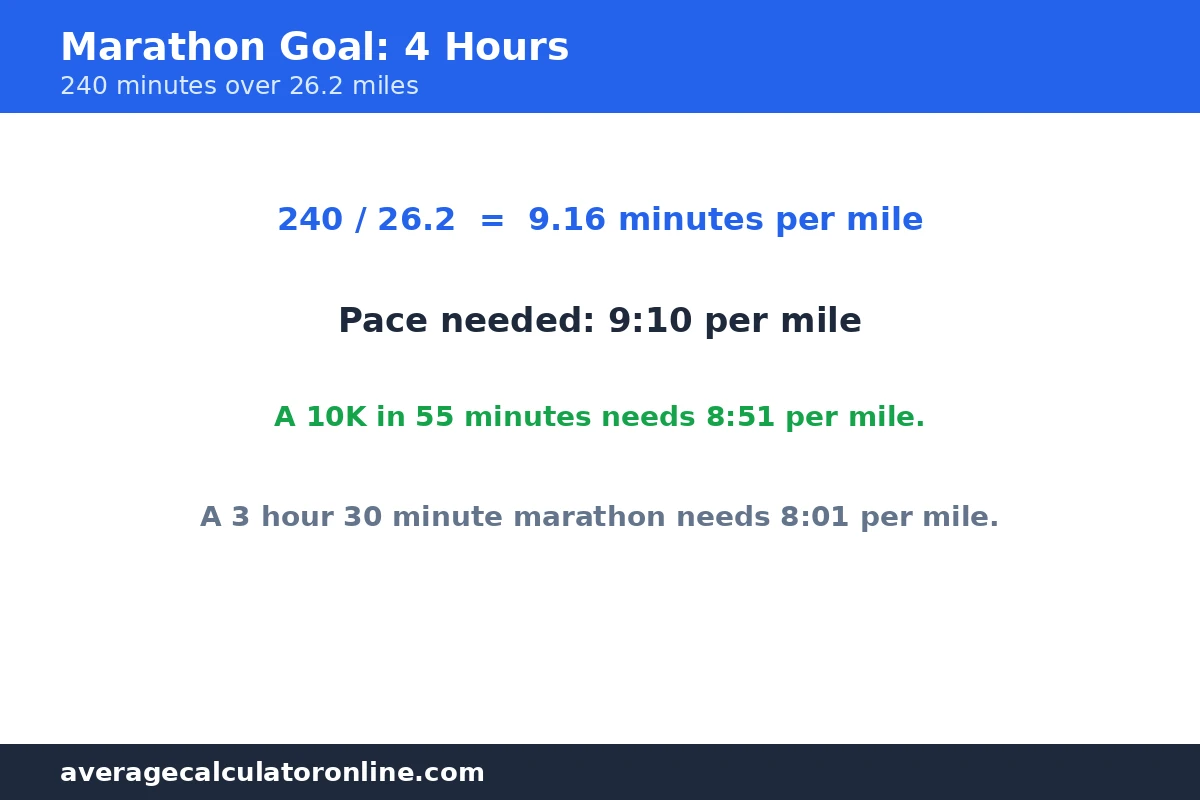
The table shows predicted race times at three common paces. Every time assumes an even pace from start to finish.
| Pace per mile | Marathon (26.2 mi) | Half marathon (13.1 mi) | 10K |
|---|---|---|---|
| 8:00 | 3:29:36 | 1:44:53 | 49:43 |
| 9:00 | 3:55:48 | 1:57:59 | 55:55 |
| 10:00 | 4:22:00 | 2:11:06 | 62:08 |
One minute per mile is worth 26 minutes 12 seconds over a marathon: 10:00 x 26.2 = 262 minutes, which is 4:22:00, while 9:00 x 26.2 = 235.8 minutes, which is 3:55:48. That is why a small pace gain matters so much over a long race. For the distance side of training, see the distance calculator.
Common mistakes
Mixing up miles and kilometres: 9:00 per mile is 5:36 per km, not 9:00 per km. A 9:00 per km pace is 14:29 per mile, which is a walk for most runners. Check the unit before you compare paces.
Trusting a marathon prediction too much: the prediction assumes an even pace, but most runners slow down after mile 20. A 9:00 pace over 10K does not guarantee a 3:55:48 marathon. Treat the prediction as a target to train toward, not a promise.
Using total time with stops: if the clock kept running while you stopped at a water station, the pace includes the stop. That is fine for race planning, but for a true running pace, use moving time only.
Rounding the pace: 8.85 minutes per mile is 8:51, not 8:85, because the decimal part is a fraction of a minute, not seconds. Multiply the decimal part by 60: 0.85 x 60 = 51 seconds. The same rule applies to the time calculator, which is the time calculator page.
Frequently asked questions
How do I calculate running pace?
Divide the time by the distance. Run 5 miles in 45 minutes and the pace is 45 divided by 5, which is 9 minutes per mile. To get the pace per kilometre, divide the per mile pace by 1.60934: 9 divided by 1.60934 is 5.59 minutes, or 5 minutes 36 seconds per kilometre.
What is a good running pace?
There is no single good pace, because it depends on the runner, the distance, and the course. A 9 minute mile is a solid pace for a recreational runner over 5 miles, while an 8 minute mile is strong and a 10 minute mile is a common starting point. Compare your pace with your own past runs, not with other runners.
How do I convert minutes per mile to minutes per km?
Divide the per mile pace by 1.60934, because one mile is 1.60934 kilometres. A 9 minute mile is 9 divided by 1.60934, which is 5.59 minutes, or 5 minutes 36 seconds per kilometre. To go the other way, multiply the per km pace by 1.60934.
How do I predict my marathon time from my pace?
Multiply your pace by 26.2, the marathon distance in miles. At 9 minutes a mile, the prediction is 9 times 26.2, which is 235.8 minutes, or 3 hours 55 minutes 48 seconds. The prediction assumes an even pace the whole way, so treat it as a target, not a promise.
What pace do I need for a 4 hour marathon?
A 4 hour marathon is 240 minutes over 26.2 miles, so the pace needed is 240 divided by 26.2, which is 9.16 minutes per mile, or 9 minutes 10 seconds per mile. A 3 hour 30 minute marathon needs 210 divided by 26.2, which is 8.02 minutes per mile, or 8 minutes 1 second per mile.
Does pace include walking breaks?
It depends on the clock. If the clock kept running while you walked, the pace includes the walking time. If you paused the watch, it does not. For race planning, use the clock time, because the race clock does not stop. For a true running pace, use moving time only.
Average Speed Calculator ·
Distance Calculator ·
Time Calculator ·
Calorie Calculator ·
Running Average Calculator ·
Last updated: November 21, 2026.