
Fantasy Trade Calculator
Enter a value for each player or pick, using your own estimates. The tool adds up each side and compares the totals.
Side A total: 85. Side B total: 80.
Side A is ahead by 5. That is within 10 percent, so most managers would call it close. The values are your own estimates, so the result only compares what you entered.
Direct answer: A fantasy trade calculator compares both sides of a trade in a single-season fantasy league. You give each player and pick a value, using your own estimates, and the tool adds up each side. Side A totals 45 + 30 + 10 = 85, and Side B totals 60 + 20 = 80, so Side A is ahead by 5. The gap is 5 / 85 = 5.9%, which is within 10 percent, so most managers would call it close. The tool has no player dataset and no rankings: every value is yours.
By Average Calculator Team. Last reviewed: 16 November 2026.
How a fantasy trade calculator works
There is no official price for a fantasy player, so the first step is yours: give every player and pick on each side a value on the same scale. A common scale runs from 0 to 100, where a star is 80 to 100, a solid starter is 40 to 60, a bench player is 10 to 20, and a pick is worth whatever you think the future player is worth. Add up Side A, add up Side B, and compare the totals. The difference is the gap, and the gap as a share of the bigger total tells you how close the trade is. On the default inputs, the gap is 85 – 80 = 5, and 5 / 85 = 5.9%, which is within 10 percent, so the trade counts as close.
The tool never judges the trade for you. A trade can be even on points and still be wrong for your team, because you may not need the position you are getting, or you may be giving up the only player you have at a thin position. Use the totals as a starting point, then ask whether the trade fixes your roster. For the numbers side of player scoring, see the statistics calculator.
Worked examples
Example 1: Side A is 45 + 30 + 10 = 85. Side B is 60 + 20 + 0 = 80. Side A is ahead by 85 – 80 = 5, which is 5 / 85 = 5.9% of the bigger total, so the trade is within 10 percent and counts as close.
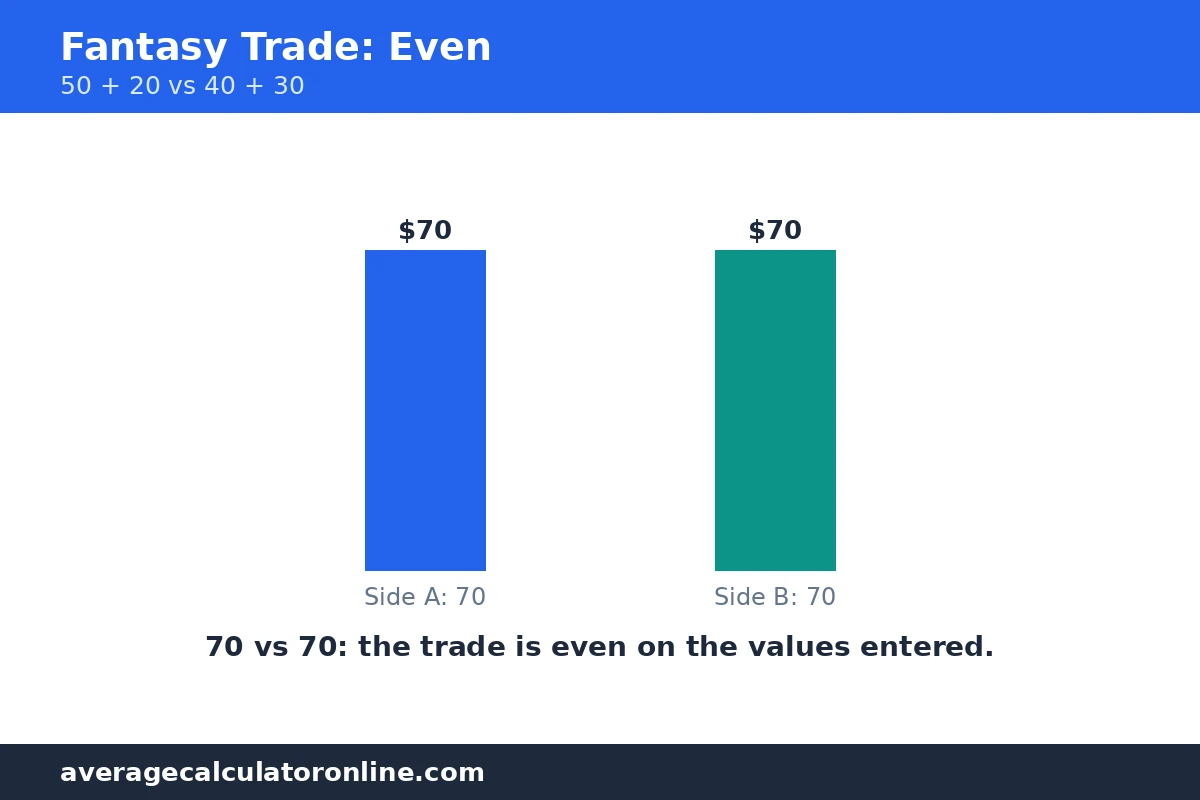
Example 2, an even trade: Side A is 50 + 20 = 70. Side B is 40 + 30 = 70. The difference is 0, so the trade is even on the values entered. Even trades still need a roster check: two starters for one star can be even on paper and still leave you short at the star position.
Example 3, a lopsided trade: Side A is 90 + 10 = 100. Side B is 55 + 15 = 70. Side A is ahead by 100 – 70 = 30, which is 30 / 100 = 30% of the bigger total, so one side is clearly ahead on the values entered.
Example 4, a pick in the deal: Side A is one player worth 65. Side B is a player worth 40 plus a pick worth 25, which is 40 + 25 = 65. The trade is even at 65 vs 65. The pick value is a guess about a future player, so it is the least certain number in the deal: if the pick turns into a bench player worth 10, Side B is really only 50. For the percentage math behind the gap, use the percentage calculator.

Example values on a 0 to 100 scale
The table shows example values only. They are not rankings and not data: they are a starting point you can adjust to your own league.
| Asset | Example value |
|---|---|
| Star player | 80 to 100 |
| Solid starter | 40 to 60 |
| Bench player | 10 to 20 |
| 1st round pick | 20 to 30 |
| 2nd round pick | 10 to 15 |
A star at 90 plus a bench player at 10 is 100, the same as two starters at 50 each. The totals match, but the rosters do not: the star side has one lineup spot filled with a top scorer, while the two-starter side has depth. Values alone cannot settle that choice, because it depends on who else is on your team.
Common mistakes
Valuing names over production: a famous player who scores 12 points a week is worth less than an unknown player who scores 18. Value this season points, not last season reputation.
Ignoring roster needs: a trade can be fair on points and still be wrong. If you trade away your only running back for two wide receivers, you may win the value comparison and lose the week, because you have nobody to start at running back.
Treating a pick as a sure thing: a pick is a chance at a player, not a player. A 1st round pick worth 25 in Example 4 only pays off if the drafted player produces. Value picks lower than a proven player with the same upside.
Using one week of points: one big week can be luck, and one bad week can be a tough match-up. Value players on the season so far, not on the last game. For season averages, see the running average calculator.
Frequently asked questions
What is a fantasy trade calculator?
A fantasy trade calculator compares both sides of a trade in a single-season fantasy league. You give each player and pick a value, the tool adds up each side, and it shows the totals, the gap, and whether the trade is close. It has no player dataset and no rankings: every value is your own estimate.
Where do the player values come from?
They come from you. This tool has no player dataset, no rankings, and no live stats, so you enter a value for each player and pick on a scale you choose, such as 0 to 100. The result only compares the numbers you entered, and different values give a different answer.
What does ahead by 10 mean?
It means one side total is 10 points higher than the other side total on the values you entered. Side A at 85 and Side B at 75 would mean Side A is ahead by 10. The gap as a share of the bigger total tells you how close the trade is: 10 out of 85 is 11.8 percent, which is more than 10 percent apart.
Is a trade fair if the totals are equal?
The trade is even on the values you entered, but fair also depends on your roster. Two starters worth 70 can be even with one star worth 70, yet the star side has one lineup spot filled with a top scorer while the other side has depth. Check positions and byes before you accept.
Should I trade a star for two starters?
It depends on your roster. Two starters worth 50 each total 100, which beats one star worth 90, but they take two lineup spots and you may already have depth at their positions. If the star is your only top scorer, keep the star. If you have two holes to fill, take the two starters.
Can this tool predict who will win my league?
No, it cannot predict anything. It only adds up the values you entered and compares the totals. Injuries, match-ups, byes, and luck all decide real weeks, and none of them are in the tool. Use it to check whether a trade is close, not to predict the season.
Percentage Calculator ·
Statistics Calculator ·
Running Average Calculator ·
Batting Average Calculator ·
Average Speed Calculator ·
Last updated: November 16, 2026.