RMD Calculator
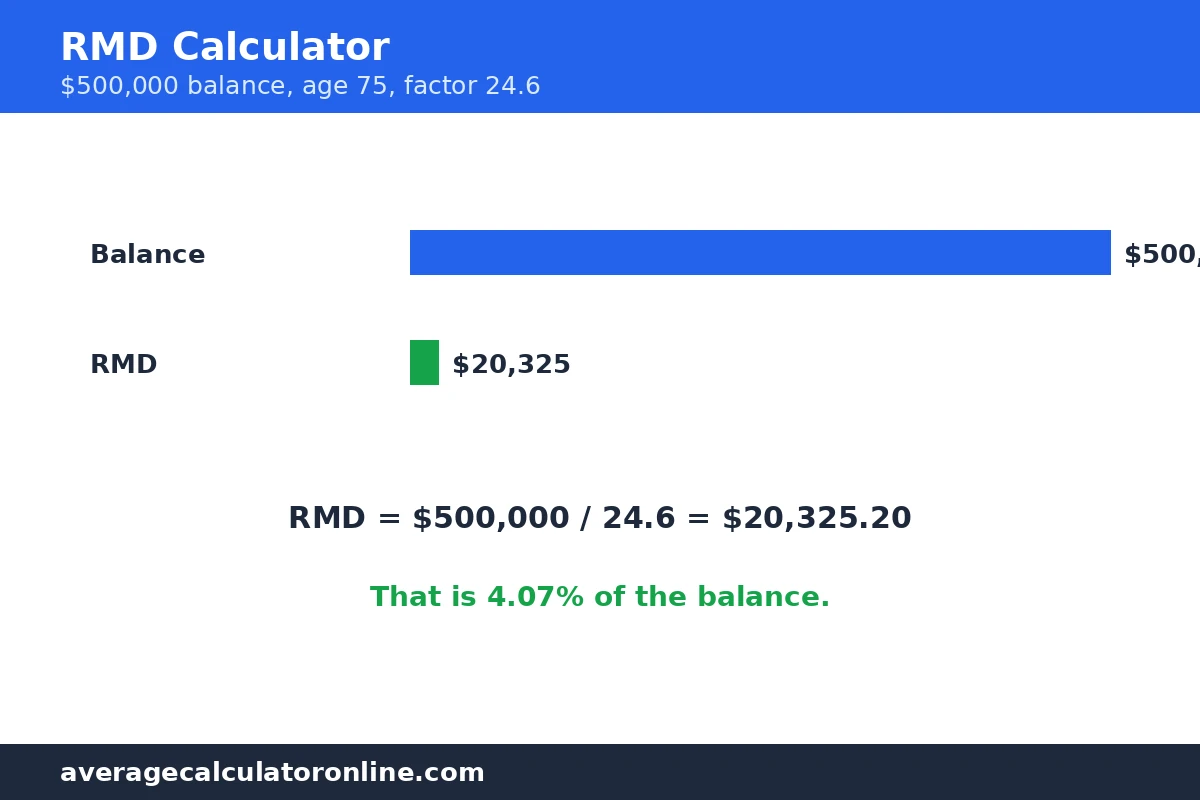
Required minimum distribution: $20,325.20
Uniform Lifetime Table factor at age 75: 24.6. That is 4.07% of the balance.
Direct answer: A required minimum distribution, or RMD, is the smallest amount you must withdraw each year from a tax-deferred retirement account once you reach the starting age. The math is one division: take the account balance on December 31 of last year and divide it by the IRS Uniform Lifetime Table factor for your age this year. On a $500,000 balance at age 75, the factor is 24.6 and the RMD is $20,325.20, which is 4.07% of the balance. In 2026, RMDs start at age 73 for people born 1951 to 1959, under the SECURE 2.0 Act.
By Average Calculator Team. Last reviewed: 16 November 2026.
How an RMD is calculated
The formula is RMD = balance on December 31 of last year / Uniform Lifetime Table factor for your age this year. The factor comes from Table III of IRS Publication 590-B, and it falls a little every year, so the RMD is a bigger share of the balance as you age. The table applies to most account owners: unmarried owners, married owners whose spouse is not the sole beneficiary, and married owners whose spouse is the sole beneficiary but is not more than 10 years younger. If your spouse is your sole beneficiary and is more than 10 years younger, a different table applies and the RMD is smaller.
RMDs apply to traditional IRAs, 401(k)s, 403(b)s, and similar tax-deferred accounts. Roth IRAs have no RMDs during the original owner lifetime. Your first RMD can wait until April 1 of the year after you reach the starting age, but then you must take two RMDs in that same calendar year. For the growth of the account itself, see the retirement calculator and the compound interest calculator.
Worked examples
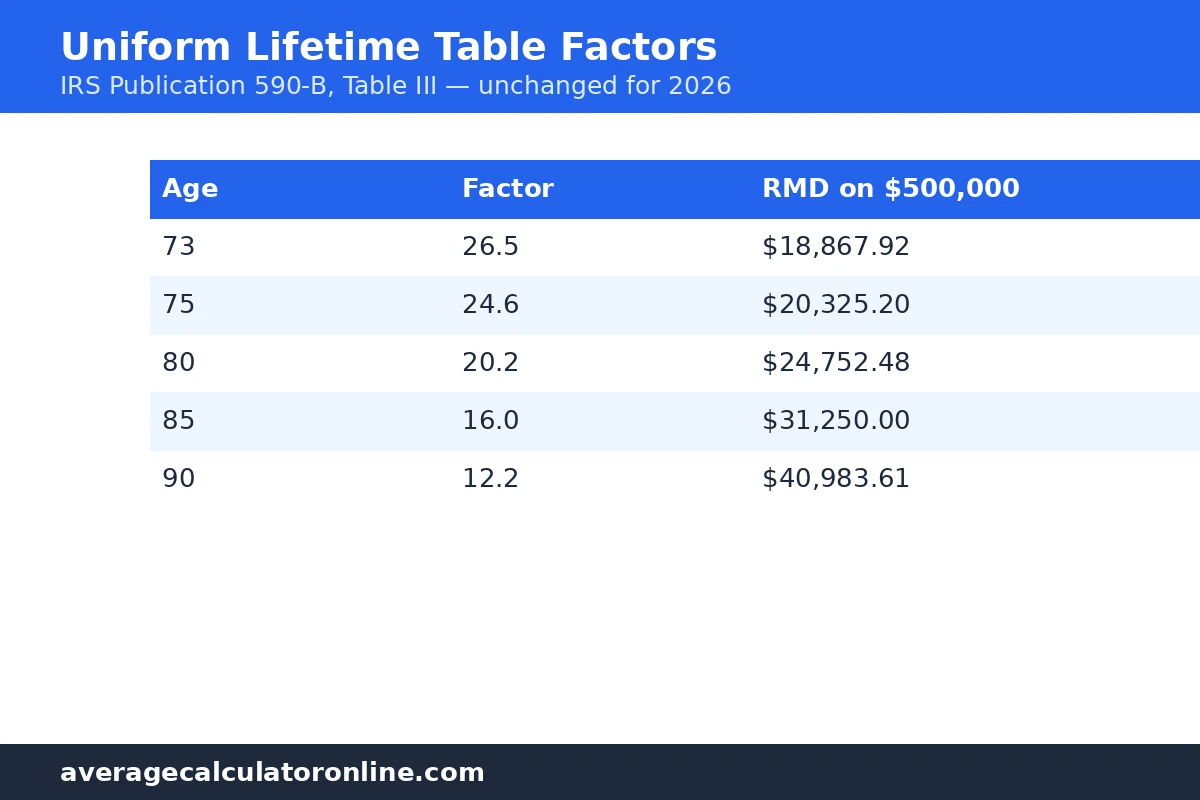
Example 1: Balance $500,000 on December 31 last year, age 75 this year. The factor at 75 is 24.6. RMD is $500,000 / 24.6 = $20,325.20. That is 100 / 24.6 = 4.07% of the balance.
Example 2, first RMD: Balance $500,000, age 73 this year. The factor at 73 is 26.5. RMD is $500,000 / 26.5 = $18,867.92. That is 100 / 26.5 = 3.77% of the balance. On a $1,000,000 balance at 73, the RMD is $1,000,000 / 26.5 = $37,735.85.
Example 3: Balance $400,000, age 80 this year. The factor at 80 is 20.2. RMD is $400,000 / 20.2 = $19,801.98. That is 100 / 20.2 = 4.95% of the balance. On a $500,000 balance at 80, the RMD is $500,000 / 20.2 = $24,752.48.
Example 4: Balance $300,000, age 85 this year. The factor at 85 is 16.0. RMD is $300,000 / 16.0 = $18,750.00. That is 100 / 16.0 = 6.25% of the balance. On a $500,000 balance at 85, the RMD is $500,000 / 16.0 = $31,250.00. The income tax calculator can estimate the tax on a withdrawal.
Uniform Lifetime Table factors, 2026
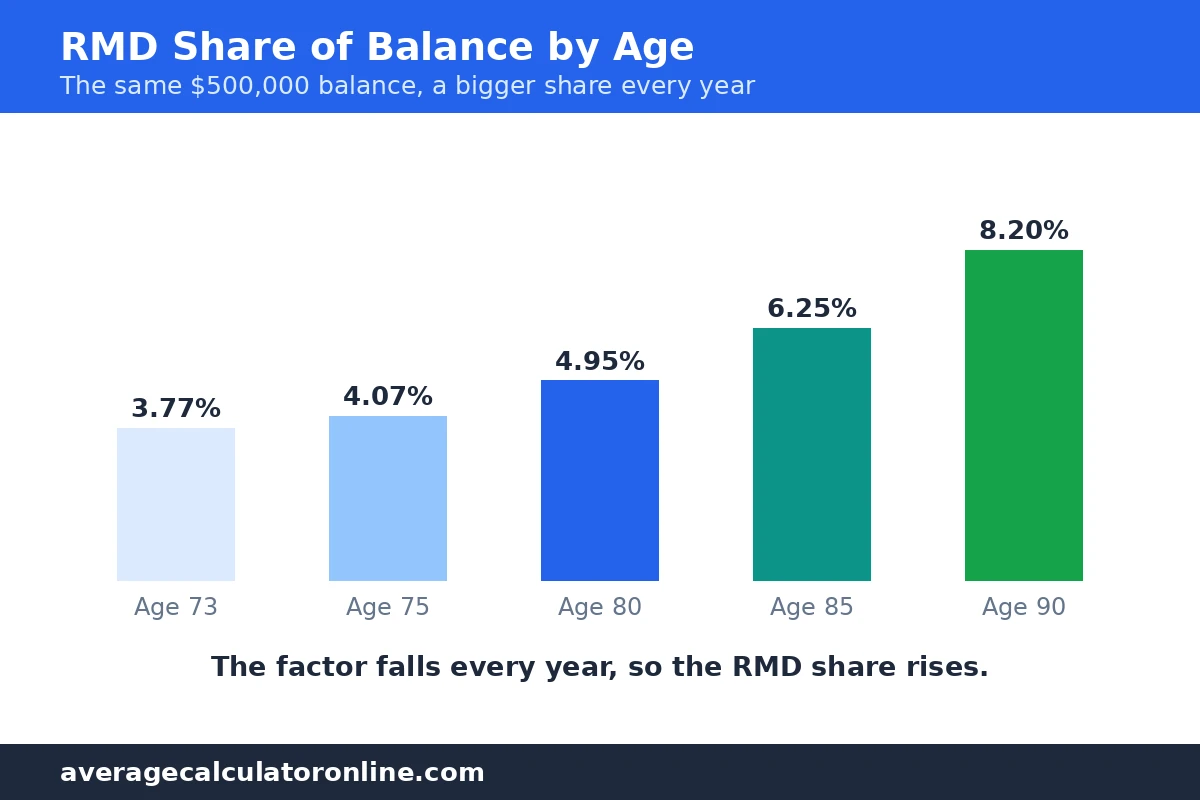
These factors are from IRS Publication 590-B, Appendix B, Table III, in effect for distribution years from 2022 onward, so they are unchanged for 2026. The calculator holds the full table from age 73 to 120. The RMD on a $500,000 balance is shown for five ages.
| Age this year | Factor | Share of balance | RMD on $500,000 |
|---|---|---|---|
| 73 | 26.5 | 3.77% | $18,867.92 |
| 75 | 24.6 | 4.07% | $20,325.20 |
| 80 | 20.2 | 4.95% | $24,752.48 |
| 85 | 16.0 | 6.25% | $31,250.00 |
| 90 | 12.2 | 8.20% | $40,983.61 |
Starting age by birth year under SECURE 2.0: born 1951 to 1959, RMDs start at 73. Born 1960 or later, RMDs start at 75, effective 2033. Born 1950 or earlier, RMDs have already started. If you take your first RMD by April 1 of the next year, remember that two RMDs land in that year, which can push income higher. The tax calculator shows the same income math in a simpler form.
Common mistakes
Using the wrong balance: the RMD divides the balance on December 31 of last year, not the balance today. A balance that grew since then gives a bigger RMD than the formula says, and a balance that fell gives a smaller one. Use the year-end statement.
Using the wrong table: the Uniform Lifetime Table covers most owners, but a spouse more than 10 years younger as sole beneficiary uses the Joint Life table instead, and inherited IRAs follow different rules entirely. Check which table fits your case before you divide.
Missing the deadline: RMDs are due by December 31 each year, except the first, which can wait until April 1 of the next year. A missed RMD can draw a 25% excise tax on the amount not taken, reduced to 10% if corrected within two years. Set a calendar reminder for November, not December.
Forgetting the tax: an RMD from a traditional IRA or 401(k) is taxed as ordinary income in the year you take it. Taking the first RMD late, so two RMDs land in one year, can push income into a higher bracket. Plan the timing with a tax professional, and see the investment calculator for the growth side of the account.
Frequently asked questions
What is an RMD?
An RMD is a required minimum distribution: the smallest amount you must withdraw each year from a tax-deferred retirement account, such as a traditional IRA or a 401(k), once you reach the starting age. You divide the account balance on December 31 of last year by the IRS Uniform Lifetime Table factor for your age this year.
At what age do RMDs start in 2026?
In 2026, RMDs start at age 73 for people born 1951 to 1959, under the SECURE 2.0 Act. People born in 1960 or later start at age 75, effective 2033. People born in 1950 or earlier have already started. Roth IRAs have no RMDs during the original owner lifetime.
How do I calculate my RMD?
Divide the account balance on December 31 of last year by the Uniform Lifetime Table factor for your age this year. On a 500000 dollar balance at age 75, the factor is 24.6, so the RMD is 500000 divided by 24.6, which is 20325.20 dollars. At age 73 the factor is 26.5, so the same balance gives 18867.92 dollars.
What is the Uniform Lifetime Table?
It is Table III in IRS Publication 590-B. It lists a distribution period, or factor, for each age from 72 to 120 and over. The factor falls as you age: 26.5 at 73, 24.6 at 75, 20.2 at 80, 16.0 at 85, and 12.2 at 90. A smaller factor means a larger required withdrawal.
What happens if I miss an RMD?
A missed RMD can draw a 25 percent excise tax on the amount not taken, reduced to 10 percent if you correct it within two years. RMDs are due by December 31 each year, except the first, which can wait until April 1 of the year after you reach the starting age. File the correction promptly if you miss one.
Are RMDs taxed?
Yes. An RMD from a traditional IRA or a 401(k) is taxed as ordinary income in the year you take it. Qualified charitable distributions can satisfy an RMD without counting as income, up to the yearly limit. Talk to a tax professional before you plan the timing, because two RMDs in one year can push income higher.
Note: This calculator is for education and planning only. It divides a balance you enter by the IRS Uniform Lifetime Table factor for your age. It does not cover inherited IRAs, the Joint Life table, employer plan delays while still working, or state tax. The results here are estimates, not tax advice. Confirm your RMD with your plan provider or a tax professional.
Retirement Calculator ·
Investment Calculator ·
Compound Interest Calculator ·
Income Tax Calculator ·
Last updated: November 21, 2026.