

Dynasty Trade Calculator
Enter a value for each player or pick, using your own estimates for multiple seasons. The tool adds up each side and compares the totals.
Side A total: 95. Side B total: 87.
Side A is ahead by 8. That is within 10 percent, so most managers would call it close. Dynasty values are your own estimates for multiple seasons, so the result only compares what you entered.
Direct answer: A dynasty trade calculator compares both sides of a trade in a dynasty league, where you keep most of your players from season to season. Values span multiple seasons, so age and future picks matter far more than in a single-season league. Side A totals 70 + 25 = 95, and Side B totals 55 + 12 + 20 = 87, so Side A is ahead by 8. The gap is 8 / 95 = 8.4%, which is within 10 percent, so most managers would call it close. The tool has no player dataset and no rankings: every value is yours.
By Average Calculator Team. Last reviewed: 16 November 2026.
How a dynasty trade calculator works
In a dynasty league you keep your players year after year, so a trade is a bet on several seasons, not one. That changes the values: a 23 year old star is worth more than a 30 year old star with the same points this season, because the younger player has more good seasons ahead, and a future 1st round pick is a real asset, because it can become the next young star. You give every player and pick a value on the same scale, the tool adds up each side, and the gap as a share of the bigger total tells you how close the trade is. On the default inputs, the gap is 95 – 87 = 8, and 8 / 95 = 8.4%, which is within 10 percent.
The other question a dynasty trade must answer is your window. A rebuilding team should trade veterans for youth and picks, even when the totals look even, because the veteran will decline before the team is ready to win. A contending team should do the opposite: trade youth and picks for a veteran who wins now. The totals cannot answer the window question, so check it separately. For the percentage math behind the gap, use the percentage calculator.
Worked examples
Example 1: Side A is a young star at 70 plus a 2027 1st round pick at 25, which is 70 + 25 = 95. Side B is a veteran at 55 plus a 2026 2nd round pick at 12 plus a player at 20, which is 55 + 12 + 20 = 87. Side A is ahead by 95 – 87 = 8, which is 8 / 95 = 8.4% of the bigger total, so the trade is within 10 percent and counts as close.
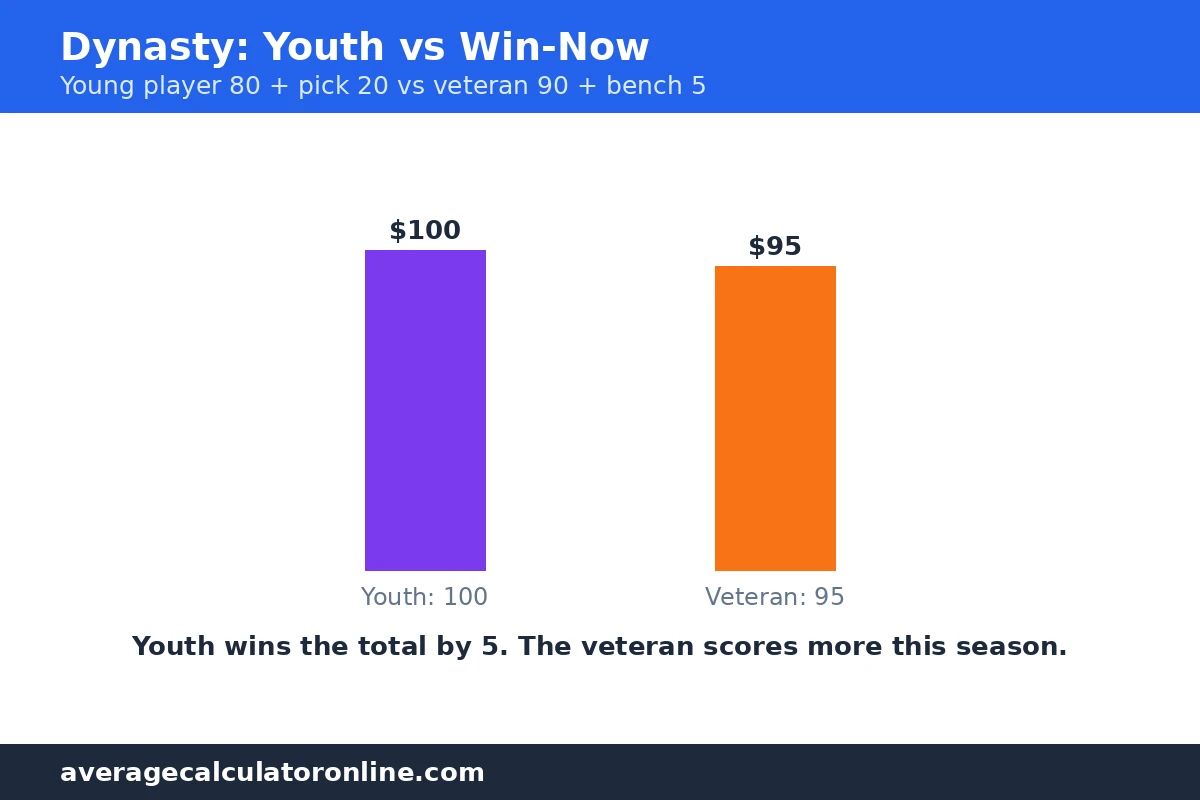
Example 2, youth vs win-now: Side A is a young player at 80 plus a pick at 20, which is 80 + 20 = 100. Side B is a veteran at 90 plus a bench player at 5, which is 90 + 5 = 95. Side A is ahead by 5 on total value, but Side B scores more this season. A rebuilding team takes Side A, and a contending team takes Side B, and both can be right.
Example 3, pick-heavy: Side A is three future picks at 25, 20, and 15, which is 25 + 20 + 15 = 60. Side B is one proven player at 70. Side B is ahead by 70 – 60 = 10. Three picks only beat one proven player if at least one of them turns into a starter.
Example 4, an even dynasty trade: Side A is a player at 60 plus a pick at 30, which is 60 + 30 = 90. Side B is a player at 70 plus a pick at 20, which is 70 + 20 = 90. The difference is 0, so the trade is even. Even so, the team that gets the better player wins now, and the team that gets the better pick wins later. For the percentage math behind the gap, use the percentage calculator.

Example age values on a 0 to 100 scale
The table shows example values only. They are not rankings and not data: they are a starting point you can adjust to your own league. Age matters because it sets how many good seasons are left.
| Player age | Example value |
|---|---|
| 22 to 24 | 80 to 100 |
| 25 to 27 | 70 to 90 |
| 28 to 29 | 50 to 70 |
| 30 and older | 30 to 50 |
A 24 year old and a 30 year old can score the same points this season and still be worth very different amounts, because the 24 year old has six or seven more peak seasons and the 30 year old has two or three. The same logic applies to picks: a pick two years away is worth less than a pick this year, because you wait longer for the player. For season averages to base values on, see the running average calculator.
Common mistakes
Valuing veterans like rookies: a veteran at 90 points this season is not worth 90 in dynasty value if he is 31, because the value covers several seasons. Age the value down every year, and trade veterans a year early rather than a year late.
Ignoring your window: a rebuilding team that trades picks for a veteran is buying points it cannot use, and a contending team that trades a veteran for picks is selling points it needs now. Match the trade to the window, not just to the totals.
Overvaluing future picks: a pick is a chance at a player, not a player, and a pick two years away is worth less than a pick this year. Three picks at 25, 20, and 15 total 60, but they only beat a proven player at 70 if one of them becomes a starter.
Treating all 1st round picks the same: the 1st overall pick is worth far more than the 12th pick, and a pick in a strong draft class is worth more than the same pick in a weak class. Value the pick you actually own, not the average 1st round pick.
Frequently asked questions
What is a dynasty trade calculator?
A dynasty trade calculator compares both sides of a trade in a dynasty league, where you keep most of your players from season to season. You give each player and pick a value, the tool adds up each side, and it shows the totals, the gap, and whether the trade is close. Every value is your own estimate for multiple seasons.
How is dynasty different from redraft fantasy?
In redraft fantasy you draft a new team every season, so only this season matters. In dynasty you keep your players year after year, so age, future picks, and several seasons of value matter. A 23 year old star is worth more in dynasty than a 30 year old star with the same points this season.
Where do the values come from?
They come from you. This tool has no player dataset, no rankings, and no live stats, so you enter a value for each player and pick on a scale you choose, such as 0 to 100. The result only compares the numbers you entered, and different values give a different answer.
How much is a future 1st round pick worth?
That is your call, because a pick is a chance at a player, not a player. As an example, many managers value a 1st round pick at 20 to 30 on a 0 to 100 scale, and a 2nd round pick at 10 to 15. A pick two years away is worth less than a pick this year, and the 1st overall pick is worth far more than the 12th pick.
Should a rebuilding team trade a veteran?
Usually yes. A rebuilding team should trade veterans for youth and picks, even when the totals look even, because the veteran will decline before the team is ready to win. A contending team should do the opposite and trade youth and picks for a veteran who wins now. Match the trade to your window, not just to the totals.
Can this tool predict future seasons?
No, it cannot predict anything. It only adds up the values you entered and compares the totals. Injuries, draft classes, and breakout seasons all change real values, and none of them are in the tool. Use it to check whether a trade is close, not to predict the next three seasons.
Percentage Calculator ·
Statistics Calculator ·
Cricket Average Calculator ·
Batting Average Calculator ·
Running Average Calculator ·
Last updated: November 16, 2026.