BAC Calculator
Estimate blood alcohol concentration from standard drinks, body weight, and time. This is an estimate only, never legal or medical advice.
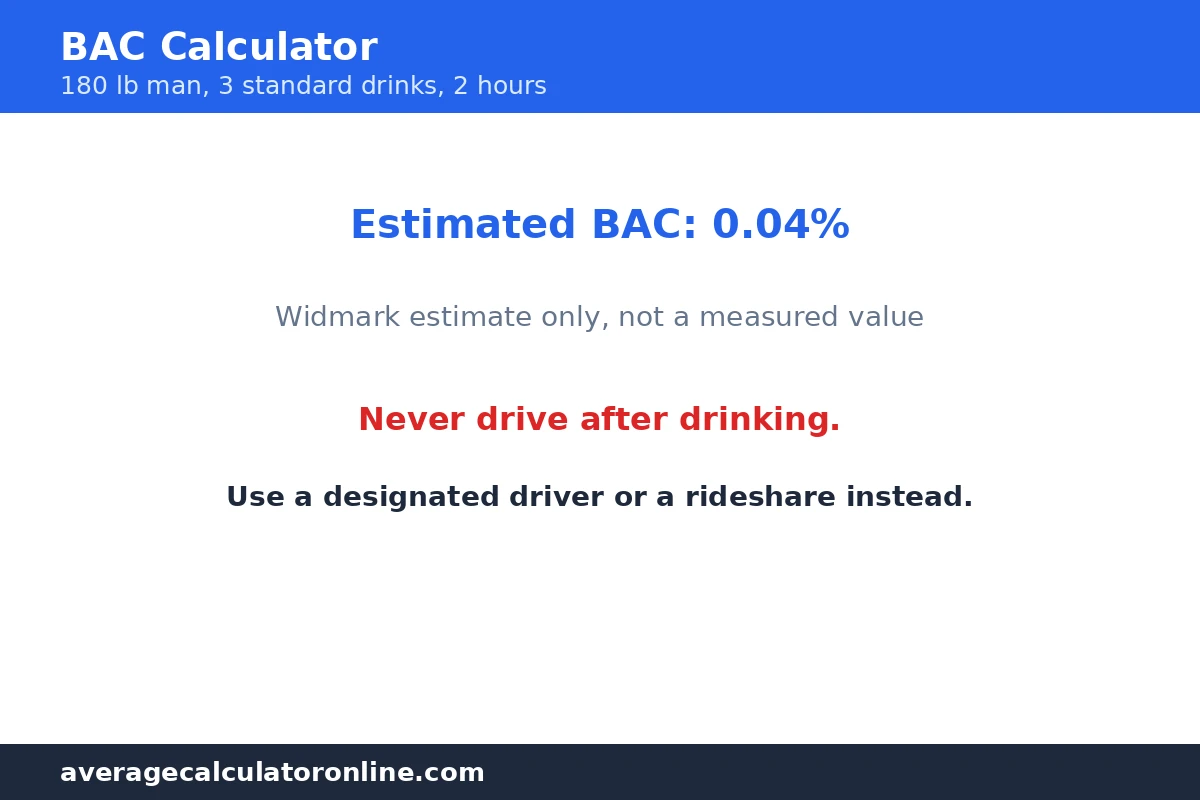
Estimated BAC: 0.04%.
This is a Widmark estimate only, not a measured value. Never drive after drinking. Use a designated driver or a rideshare instead.
Direct answer: A BAC calculator estimates blood alcohol concentration from standard drinks, body weight, and time since the first drink. A 180 pound man who had 3 standard drinks over 2 hours has an estimated BAC of 0.04%. This is a Widmark estimate only. It is not a measured value, it is never legal or medical advice, and it must never be used to decide whether to drive. Never drive after drinking. Use a designated driver or a rideshare instead.
By Average Calculator Team. Last reviewed: 16 November 2026.
How BAC is estimated
BAC is the share of alcohol in the blood, shown as a percentage. This calculator uses the Widmark formula, which is the standard estimate used in textbooks. With A as the alcohol in ounces, W as body weight in pounds, r as a body water factor, and H as the hours since the first drink, the estimate is (A x 5.14) / (W x r) minus 0.015 x H. One standard drink holds 0.6 ounces of pure alcohol, r is 0.73 for men and 0.66 for women, and 0.015 is the average rate at which BAC falls per hour. The formula is an average, and real bodies differ by food, health, medicines, and drinking speed, so two people with the same inputs can have different real BAC values. The calorie calculator shows how alcohol also adds calories, which is a separate question from BAC.
For the default inputs, A is 3 x 0.6 = 1.8 ounces of alcohol. The estimate is (1.8 x 5.14) / (180 x 0.73) minus 0.015 x 2, which is 9.252 / 131.4 minus 0.03, or 0.0704 minus 0.03 = 0.04% after rounding to two decimals. The 0.015 per hour fall is an average, not a promise, and it does not make anyone safe to drive.
Worked examples
Example 1: Male, 180 lb, 3 standard drinks, 2 hours. The alcohol is 3 x 0.6 = 1.8 ounces. The estimate is (1.8 x 5.14) / (180 x 0.73) – 0.015 x 2 = 0.0704 – 0.03 = 0.04%.
Example 2: Female, 140 lb, 2 standard drinks, 1 hour. The alcohol is 2 x 0.6 = 1.2 ounces. The estimate is (1.2 x 5.14) / (140 x 0.66) – 0.015 x 1 = 0.0668 – 0.015 = 0.05%.
Example 3: Male, 200 lb, 4 standard drinks, 3 hours. The alcohol is 4 x 0.6 = 2.4 ounces. The estimate is (2.4 x 5.14) / (200 x 0.73) – 0.015 x 3 = 0.0845 – 0.045 = 0.04%.
Example 4: Male, 160 lb, 1 standard drink, 1 hour. The alcohol is 1 x 0.6 = 0.6 ounces. The estimate is (0.6 x 5.14) / (160 x 0.73) – 0.015 x 1 = 0.0264 – 0.015 = 0.01%.
Example 5: Male, 180 lb, 5 standard drinks, 4 hours. The alcohol is 5 x 0.6 = 3.0 ounces. The estimate is (3.0 x 5.14) / (180 x 0.73) – 0.015 x 4 = 0.1174 – 0.06 = 0.06%.
What one standard drink is
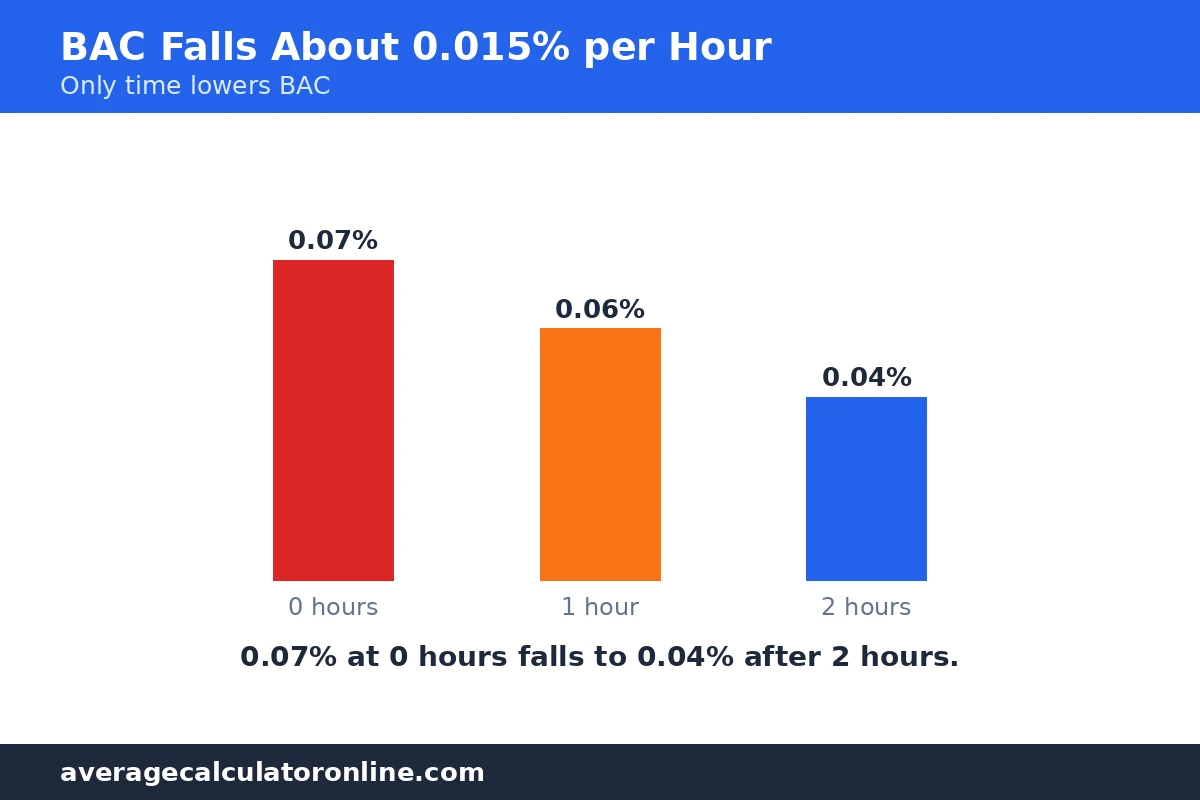
The formula counts standard drinks, not glasses, and a tall pour can hold more than one standard drink. The table shows the standard size for each drink type.
| Drink | One standard drink | Alcohol |
|---|---|---|
| Beer, 5% alcohol | 12 ounces | 0.6 ounces |
| Wine, 12% alcohol | 5 ounces | 0.6 ounces |
| Spirits, 40% alcohol | 1.5 ounces | 0.6 ounces |
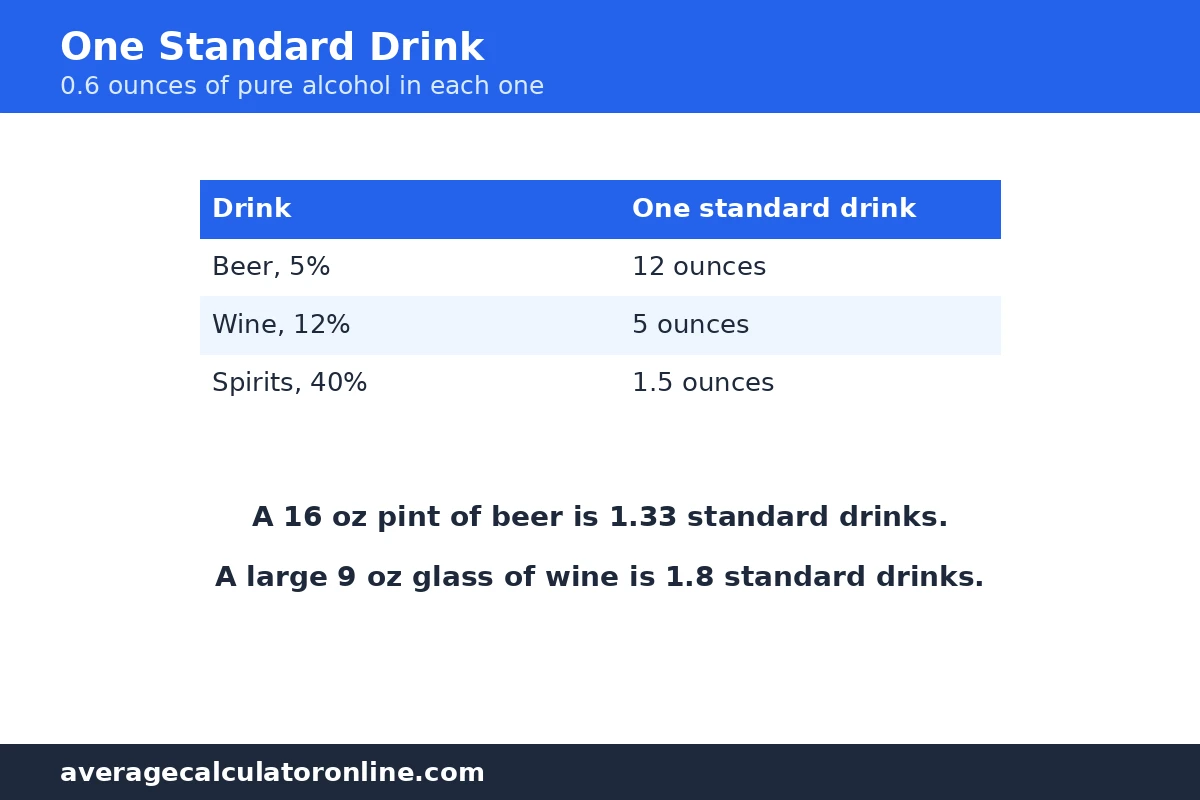
A 16 ounce pint of 5% beer is 16 / 12 = 1.33 standard drinks, not one. A large 9 ounce glass of 12% wine is 9 / 5 = 1.8 standard drinks. Counting glasses instead of standard drinks is the most common way people undercount, and the calculator can only work with the number you enter. Food slows absorption but does not change the total alcohol, and coffee does not lower BAC. Only time lowers BAC, at about 0.015% per hour on average. The percentage calculator helps with the drink size math if you need it.
Common mistakes
Counting glasses instead of standard drinks: a pint of beer is 1.33 standard drinks, and a large glass of wine is 1.8 standard drinks. Enter the standard drink count, not the glass count, or the estimate comes out too low.
Treating the estimate as a measured value: the Widmark formula is an average over many people. Your real BAC can be higher or lower, because food, health, medicines, and drinking speed all change it. Only a breath test or a blood test measures BAC, and even a low measured value does not make driving safe.
Trusting coffee or cold air: coffee, cold air, food, and exercise do not lower BAC. Only time does, at about 0.015% per hour on average. An estimate of 0.07% at zero hours falls to about 0.04% after 2 hours, because 0.07 – (2 x 0.015) = 0.04%, and it still takes hours to reach zero.
Using the result to decide about driving: never use this calculator, or any calculator, to decide whether to drive. The only safe choice after drinking is not to drive. Use a designated driver, a rideshare, or public transport, and plan the ride before the first drink. If someone shows signs of alcohol poisoning, call emergency services at once.
Frequently asked questions
What is BAC?
BAC is blood alcohol concentration, the share of alcohol in the blood, shown as a percentage. A BAC of 0.04 percent means 0.04 grams of alcohol per 100 millilitres of blood. It is measured by a breath test or a blood test, and this calculator only estimates it with the Widmark formula.
How do I calculate BAC?
Use the Widmark formula: BAC equals drinks times 0.6 times 5.14, divided by weight in pounds times a body water factor, minus 0.015 times the hours since the first drink. The factor is 0.73 for men and 0.66 for women. A 180 pound man with 3 standard drinks over 2 hours has an estimated BAC of 0.04 percent.
What is one standard drink?
One standard drink holds 0.6 ounces of pure alcohol. That is 12 ounces of beer at 5 percent, 5 ounces of wine at 12 percent, or 1.5 ounces of spirits at 40 percent. A 16 ounce pint of beer is 1.33 standard drinks, and a large 9 ounce glass of wine is 1.8 standard drinks.
How fast does BAC fall?
BAC falls by about 0.015 percent per hour on average, as the liver breaks down alcohol. An estimate of 0.07 percent at zero hours falls to about 0.04 percent after 2 hours. The rate differs by person, and nothing speeds it up: not coffee, food, cold air, or exercise. Only time lowers BAC.
Is this BAC calculator accurate?
No calculator gives an exact BAC. The Widmark formula is an average, and real BAC differs by food, health, medicines, and drinking speed. Only a breath test or a blood test measures BAC. Treat every result here as a rough estimate, never as a legal or medical fact.
Can I drive if my estimated BAC is low?
No. Never use this calculator, or any calculator, to decide whether to drive. Even a low BAC can impair judgement and reaction time, and the only safe choice after drinking is not to drive. Use a designated driver, a rideshare, or public transport, and plan the ride before the first drink.
Note: This calculator gives a Widmark estimate only. It is not a measured value, and it is never legal or medical advice. Never drive after drinking, whatever the result says. Use a designated driver or a rideshare instead. If someone shows signs of alcohol poisoning, call emergency services at once.
Calorie Calculator ·
Percentage Calculator ·
Time Calculator ·
Age Calculator ·
Statistics Calculator ·
Last updated: November 16, 2026.