
Interest Calculator
Simple interest: $1,500.00 (total $11,500.00)
Compound interest: $1,576.25 (total $11,576.25, compounded annually). Compound interest is $76.25 more than simple interest.
Direct answer: On $10,000 at 5% for 3 years, simple interest is $1,500 for a total of $11,500, while compound interest (compounded annually) is $1,576.25 for a total of $11,576.25. Compound interest is $76.25 more, because it earns interest on the interest from earlier years.
By Average Calculator Team. Last reviewed: 16 November 2026.

How interest works
Simple interest is charged only on the original principal, so the interest is the same every year: I = P x r x t, where P is the principal, r is the annual rate as a decimal and t is the time in years. The total amount is A = P + I. Compound interest is charged on the principal plus all interest earned so far: A = P x (1 + r / n) to the power (n x t), where n is how many times a year the interest compounds. The more often interest compounds, the faster the balance grows. This page shows both kinds side by side; for a tool that does only simple interest, use the simple interest calculator, and for compounding only, use the compound interest calculator.
Simple vs compound over time
The table below uses $10,000 at 5%, compounded annually. The gap between simple and compound interest is small at first and grows with time, which is why compounding matters most for long-term saving and investing.
| Years | Simple interest total | Compound interest total | Gap |
|---|---|---|---|
| 1 | $10,500.00 | $10,500.00 | $0.00 |
| 3 | $11,500.00 | $11,576.25 | $76.25 |
| 5 | $12,500.00 | $12,762.82 | $262.82 |
| 10 | $15,000.00 | $16,288.95 | $1,288.95 |
After 1 year there is no gap at all, because the interest has not had a second year to compound. After 10 years the gap is $1,288.95. For long-term saving, that gap is why the investment calculator uses compounding.
Worked examples
Example 1: $10,000 at 5% for 3 years. Simple interest = 10,000 x 0.05 x 3 = $1,500, total $11,500. Compound interest (annually) = 10,000 x 1.05 to the power 3 – 10,000 = 11,576.25 – 10,000 = $1,576.25, total $11,576.25. Compound interest is $76.25 more.
Example 2: $5,000 at 4% for 10 years. Simple interest = 5,000 x 0.04 x 10 = $2,000, total $7,000. Compound interest (annually) = 5,000 x 1.04 to the power 10 – 5,000 = 7,401.22 – 5,000 = $2,401.22, total $7,401.22. Compound interest is $401.22 more.
Example 3: $2,000 at 6% for 5 years, compounded monthly. Monthly rate = 0.06 / 12 = 0.005, and there are 60 months. Total = 2,000 x 1.005 to the power 60 = $2,697.70, so the compound interest is $697.70. Simple interest on the same money would be 2,000 x 0.06 x 5 = $600, so monthly compounding adds $97.70.
Example 4, doubling your money: $1,000 at 7% compounded annually. The rule of 72 estimates the doubling time as 72 / 7 = about 10.29 years. The exact answer is log(2) / log(1.07) = 10.24 years, so the rule of 72 is close. At 5%, the rule of 72 gives 72 / 5 = 14.4 years, while the exact answer is 14.21 years.
How often interest compounds
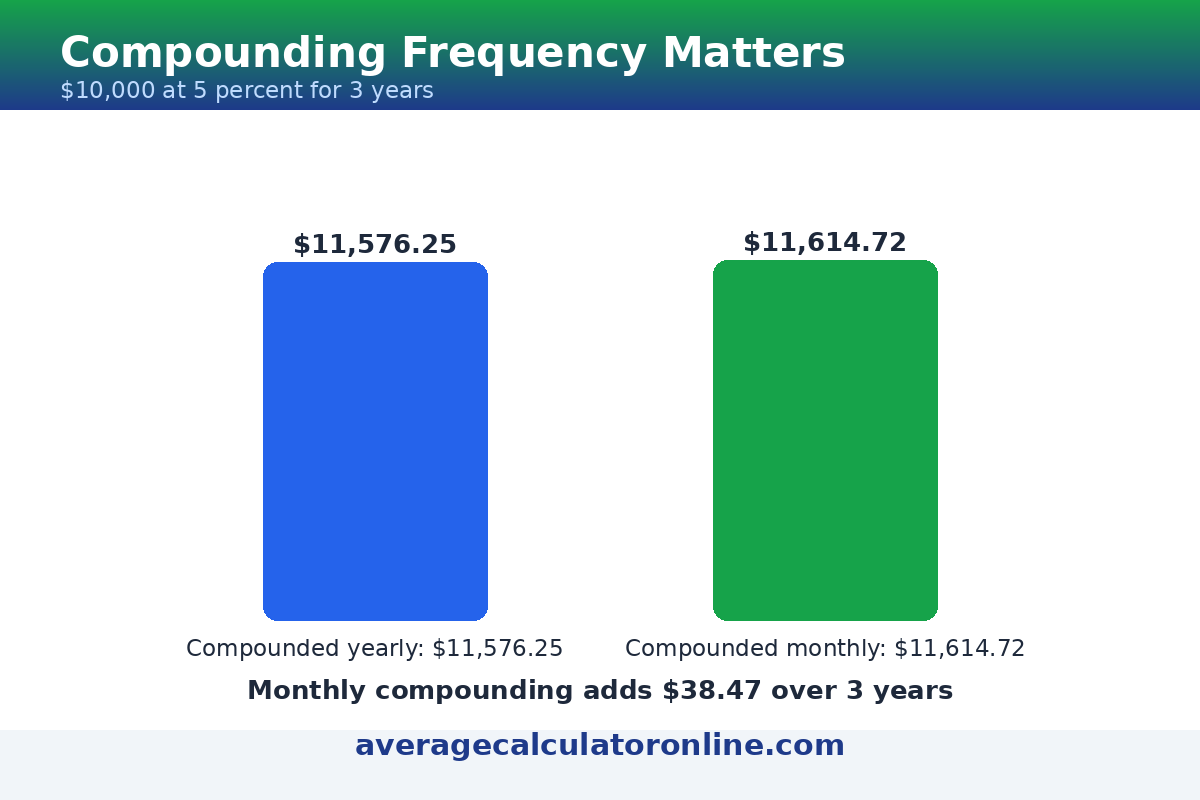
On $10,000 at 5% for 3 years, annual compounding gives $11,576.25 and monthly compounding gives $11,614.72, a difference of $38.47. Daily compounding gives a little more again, but the gain from compounding more often is small compared with the gain from a higher rate or a longer time. A mortgage usually compounds monthly, so check the mortgage calculator for home loans, and the loan calculator for monthly loan payments.
Common mistakes
Forgetting to turn the percent into a decimal: 5% is 0.05, not 5. Using 5 in the formula gives an answer 100 times too big.
Mixing up months and years: the rate is annual, so the time must be in years. For 6 months, use t = 0.5, not t = 6.
Using the wrong compounding frequency: annual and monthly compounding give different answers. On $10,000 at 5% for 3 years, annual compounding gives $11,576.25 and monthly compounding gives $11,614.72.
Assuming a loan is simple interest: many loans compound monthly. Read the loan agreement before you compare two offers.
Frequently asked questions
What is the difference between simple and compound interest?
Simple interest is charged only on the original principal, so the interest is the same every year. Compound interest is charged on the principal plus all interest earned so far, so the interest grows every year. On $10,000 at 5 percent for 3 years, simple interest gives $11,500 in total and compound interest gives $11,576.25.
How do I calculate interest on $10,000 at 5 percent for 3 years?
Simple interest is 10,000 x 0.05 x 3 = $1,500, for a total of $11,500. Compound interest, compounded annually, is 10,000 x 1.05 to the power 3 – 10,000 = $1,576.25, for a total of $11,576.25.
What is the compound interest formula?
The compound interest formula is A = P x (1 + r / n) to the power (n x t), where P is the principal, r is the annual rate as a decimal, n is how many times a year interest compounds, and t is the time in years. The interest earned is A – P.
How often should interest compound?
It depends on the account or loan. Savings accounts often compound monthly or daily, while many bonds compound twice a year. More frequent compounding gives a slightly higher total: on $10,000 at 5 percent for 3 years, monthly compounding gives $11,614.72 and annual compounding gives $11,576.25.
How long does it take money to double at 7 percent?
About 10.24 years with annual compounding. The rule of 72 gives a quick estimate: 72 divided by 7 is about 10.29 years, which is close to the exact answer.
Is simple or compound interest better for savings?
Compound interest is better for savings, because you earn interest on your interest. On $5,000 at 4 percent for 10 years, simple interest gives $7,000 in total and compound interest gives $7,401.22. For a loan, the opposite is true: simple interest costs less.
Note: This calculator is for education and planning only. Actual interest depends on the terms in your agreement, including fees and the exact way interest is counted. The results here are estimates, not financial advice.
Source: the Investor.gov explains how compound interest grows savings over time.
Compound Interest Calculator ·
Simple Interest Calculator ·
Investment Calculator ·
Mortgage Calculator ·
Loan Calculator
Last updated: November 16, 2026.