Mortgage Calculator
Total of payments: $546106.77
Total interest: $306106.77
You can compare your current home loan costs using the mortgage calculator above – see What is a home loan?.
Direct answer
Monthly mortgage payment = P × r × (1 + r)ⁿ ÷ ((1 + r)ⁿ − 1), where P is the loan amount, r is the monthly interest rate, and n is the number of monthly payments. This calculator covers principal and interest only — taxes, insurance, and HOA fees are extra.
Who this is for: home buyers estimating the principal-and-interest part of a monthly mortgage payment.
Limitations: principal and interest only — taxes, insurance, HOA fees and PMI are not included.
How to use: Enter the home price, down payment, annual rate and loan term, then press Calculate Payment — the tool shows the monthly payment, total paid and total interest.
How the formula works
Example: $300,000 home with $60,000 down leaves a $240,000 loan. At 6.5% over 30 years (360 payments), the monthly rate is 0.065 ÷ 12 = 0.005417. Monthly payment = 240,000 × 0.005417 × (1.005417)³⁶⁰ ÷ ((1.005417)³⁶⁰ − 1) = $1,516.96. Over 360 payments you repay $546,106.77 in total, of which $306,106.77 is interest — more than the loan itself.
Worked examples
Example 1 — shorter term: The same $240,000 at 6.5% over 15 years (180 payments) → $2,090.66/month ($574 more each month), but total repaid is $376,319 with interest of only $136,319 — about $169,800 less interest than the 30-year version. Term length is the single most powerful lever on total interest.
Example 2 — bigger down payment: $300,000 home with 30% down ($90,000) leaves a $210,000 loan → $1,327.34/month at 6.5% over 30 years, total repaid $477,843, interest $267,843 — about $38,000 less interest than the 20%-down case, before even counting PMI savings.
What this calculator does not include
Real monthly housing cost is usually PITI: principal + interest + property taxes + homeowner’s insurance, plus PMI if your down payment is under 20%, and HOA dues where applicable. Use this tool for the loan payment, then add taxes and insurance for the full picture. Lenders also check affordability with your debt-to-income ratio — the share of your monthly income that goes to debt payments. If the loan is not for a home, the same monthly-payment maths works on the loan calculator, and the amortization calculator shows the full schedule of interest and principal for every payment.
Comparing the monthly payment with the full cost? The Mortgage Payment Calculator breaks the monthly payment into principal and interest with an amortisation table, and the worked examples above show the total cost of the loan, including the down payment and all the interest.
What is a home loan?
A home loan is a loan taken out to buy a home. The home itself is the security for the loan, and the borrower repays it in monthly payments of principal and interest over the loan term. In everyday use, home loan and mortgage mean the same thing: a mortgage is the legal arrangement that secures a home loan against the property.
A home loan calculator shows the full cost of buying a home, not just the monthly payment. On a $400,000 home with an $80,000 down payment, the loan is $320,000. At 6.5% over 30 years, the monthly payment for principal and interest is $2,022.62, the total paid is $728,143.20, the total interest is $408,143.20, and the total home cost is $808,143.20. The interest alone is more than the loan itself, which is normal on a 30-year loan.
Home loan vs mortgage: what is the difference?
There is no difference in the loan itself. A home loan is the money borrowed to buy a home, and a mortgage is the legal charge on the home that secures that loan. Lenders, buyers and calculators use the two terms interchangeably, and the loan maths underneath is the same.
The difference is in what each calculator emphasises. This mortgage calculator focuses on the monthly payment, with the formula, worked examples and the principal-and-interest split. The former home loan calculator framed the same answer as the total cost of the home: down payment plus everything paid on the loan, with the down payment angle front and centre. That total-cost view is now part of this page, in the worked examples and the sections below.
How Much Home Can I Afford?
Affordability depends on income, the down payment, the rate and the term. A common rule is that housing should cost no more than about 28% of gross monthly income, and that rule covers principal, interest, tax and insurance together, not principal and interest alone.
Example – a $100,000 salary: A $100,000 salary is about $8,333 a month before tax. At 28%, that allows about $2,333 a month for housing. At 6% over 30 years, a $2,333 monthly payment supports a loan of about $389,000. With a 20% down payment, that is a home of about $486,000, with about $97,000 down. Tax, insurance and upkeep are extra, so the home you can comfortably afford is usually lower than this principal-and-interest figure.
Example – a $400,000 home at 6%: With a $400,000 home and a 20% down payment of $80,000, the loan is $320,000. At 6% over 30 years, the monthly payment is $1,918.56. The total paid is $690,682.20, the total interest is $370,682.20, and the total home cost is $770,682.20. Test these numbers in the calculator above by entering a $400,000 home price, an $80,000 down payment, a 6% rate and a 30-year term.
The down payment is the only input that cuts all three costs at once: a bigger down payment means a smaller loan, a smaller monthly payment and less total interest. On a $400,000 home at 6.5% over 30 years:
| Down payment | Loan | Monthly payment | Total interest | Total home cost |
|---|---|---|---|---|
| $40,000 (10%) | $360,000 | $2,275.44 | $459,158.40 | $859,158.40 |
| $80,000 (20%) | $320,000 | $2,022.62 | $408,143.20 | $808,143.20 |
| $130,000 (32.5%) | $270,000 | $1,706.58 | $344,368.80 | $744,368.80 |
Moving from a 10% down payment to 20% saves $51,015.20 in interest and $252.82 a month. A 20% down payment also usually avoids private mortgage insurance.
Why use this calculator
Use it before you make an offer or lock a rate, to see the monthly payment a home commits you to – not just the asking price. It helps buyers compare homes, down payments and loan terms on the same basis. With the defaults – a $300,000 home, $60,000 down and 6.5% over 30 years – the loan is $240,000 and the payment is $1,516.96 a month.
Frequently asked questions
How much is the monthly principal-and-interest payment on a $300,000 mortgage?
With 20% down ($60,000), a $240,000 loan at 6.5% over 30 years costs $1,516.96 per month in principal and interest.
What is the mortgage formula?
M = P × r × (1 + r)ⁿ ÷ ((1 + r)ⁿ − 1). P is the loan amount, r the monthly rate, n the number of payments.
Does this calculator include taxes and insurance in its monthly payment result?
No. It calculates principal and interest only. Add property tax, insurance, PMI, and HOA separately.
Is a 15-year or 30-year mortgage better?
A 15-year term has higher monthly payments but much less total interest. A 30-year term is easier monthly but costs far more interest overall.
How does a bigger down payment help?
It lowers the loan amount, the monthly payment, and the total interest — and 20% down usually avoids PMI.
Do extra payments save money?
Yes. Extra principal payments shorten the loan and cut total interest, because interest is charged on the remaining balance.
What is PITI?
PITI stands for principal, interest, taxes, and insurance — the four parts of a typical monthly housing payment. This calculator covers only the first two, principal and interest, so add property tax and homeowner insurance separately to work out your full monthly housing cost.
Does this mortgage calculator include PMI?
No. This calculator covers principal and interest only. PMI (private mortgage insurance) is a separate monthly cost that lenders typically require when the down payment is under 20% — with 20% down, PMI is usually avoided.
Fixed vs ARM — which is which?
A fixed-rate mortgage keeps the same interest rate for the whole loan term, so the principal-and-interest payment never changes. An adjustable-rate mortgage (ARM) starts with a lower rate for an initial period and then adjusts with the market, so the monthly payment can go up or down.
What’s the difference between a home loan and a mortgage?
There is no difference in the loan itself. A home loan is the money borrowed to buy a home, and a mortgage is the legal charge on the home that secures that loan. The loan maths is the same, and the two terms are used interchangeably.
How much house can I afford with a $100,000 salary?
As a guide, housing should cost no more than about 28% of gross monthly income. A $100,000 salary is about $8,333 a month, so about $2,333 a month for housing. At 6% over 30 years, that supports a loan of about $389,000, or a home of about $486,000 with a 20% down payment of about $97,000. Tax, insurance and upkeep are extra.
Should I pay extra on my mortgage or invest?
Paying extra on the mortgage is a certain saving: extra principal payments shorten the loan and cut total interest, because interest is charged on the remaining balance. Investing may earn more, but it is not certain and it does not cut the interest on the loan. If the mortgage rate is high, or the extra payment also removes PMI, paying extra is usually the safer choice.
How does a down payment affect my monthly payment?
A bigger down payment cuts the loan, the monthly payment and the total interest all at once. On a $400,000 home at 6.5% over 30 years, a $40,000 down payment gives a monthly payment of $2,275.44, an $80,000 down payment gives $2,022.62, and a $130,000 down payment gives $1,706.58.
Disclaimer: This calculator provides estimates for education only and is not financial, mortgage, or legal advice. Actual payments depend on your lender, credit, taxes, insurance, and fees. Consult a qualified mortgage professional before making a borrowing decision.
Mortgage payment with taxes and insurance
Principal and interest are only part of most monthly mortgage payments. Many lenders also collect property tax and home insurance with the payment and hold them in escrow. On a $300,000 loan at 6.5% for 30 years, the principal-and-interest payment is $1,896.20 a month. With $300 of property tax and $150 of home insurance, the total monthly payment is $2,346.20. The total interest over 30 years is $382,633.47, calculated from the unrounded payment.
What makes up the monthly payment
| Part | Default example | What it is |
|---|---|---|
| Principal | Part of $1,896.20 | Repaying the loan itself |
| Interest | Part of $1,896.20 | The cost of borrowing |
| Taxes | $300.00 | Property tax, held in escrow |
| Insurance | $150.00 | Home insurance, held in escrow |
Principal and interest are fixed for a fixed-rate loan, but taxes and insurance can change from year to year.
First year on a $300,000 loan at 6.5%
The first payment is mostly interest: $1,625.00 of interest and only $271.20 of principal, leaving a balance of $299,728.80. In the first year you pay about $19,401 of interest and about $3,353 of principal. After 5 years the balance is $280,832.93, and after 10 years it is $254,328.38.
| Month | Interest | Principal | Balance after |
|---|---|---|---|
| 1 | $1,625.00 | $271.20 | $299,728.80 |
| 2 | $1,623.53 | $272.67 | $299,456.12 |
| 12 | $1,608.40 | $287.81 | $296,646.82 |
More worked examples
$400,000 at 6% for 30 years. Monthly principal and interest = $2,398.20. Total interest = $463,352.76, calculated from the unrounded payment. A bigger loan at a lower rate can still cost more interest in total than a smaller loan at a higher rate.
15 years vs 30 years on $250,000 at 7%. Over 30 years the payment is $1,663.26 a month and the total interest is $348,772.25. Over 15 years the payment is $2,247.07 a month and the total interest is $154,472.72. The 15-year loan saves $194,299.52 of interest, but the monthly payment is $583.81 higher.
Extra $200 a month. On the $300,000 loan at 6.5% for 30 years, paying $200 extra every month pays the loan off in 277 months instead of 360, which is 83 months sooner, and the total interest falls to $279,184.67, saving $103,448.79.
Common mistakes
Budgeting for principal and interest only: taxes and insurance add $450 a month in the default example above. Always budget for the full payment. Using the annual rate as the monthly rate: divide the annual rate by 12 first. Using 6.5% as a monthly rate would give a payment many times too high. Thinking the interest share stays the same: the interest share falls every month as the balance falls. In month 1 it is $1,625.00 of the $1,896.20 payment. Ignoring the term: a 15-year loan costs much less interest in total, but the monthly payment is much higher. Choose the term you can afford every month.
More questions about mortgage payments
How much is the monthly payment on a $300,000 mortgage with taxes and insurance?
At 6.5 percent for 30 years, the principal and interest payment on a $300,000 loan is $1,896.20 a month. With $300 of property tax and $150 of home insurance, the total monthly payment is $2,346.20.
How much of my first mortgage payment is interest?
On a $300,000 loan at 6.5 percent, the first payment is $1,625.00 of interest and $271.20 of principal, leaving a balance of $299,728.80.
How much does an extra $200 a month save on a mortgage?
On a $300,000 loan at 6.5 percent for 30 years, paying $200 extra every month pays the loan off in 277 months instead of 360, saving $103,448.79 of interest. The total interest falls to $279,184.67.
Does a mortgage payment include taxes and insurance?
It can do. Most lenders collect property taxes and home insurance with the monthly payment and pay them from escrow. In the example above, $300 of tax and $150 of insurance add $450 to the $1,896.20 principal-and-interest payment, giving a total of $2,346.20 a month. This calculator itself works out principal and interest only.
How Amortization Works: A Deep Dive
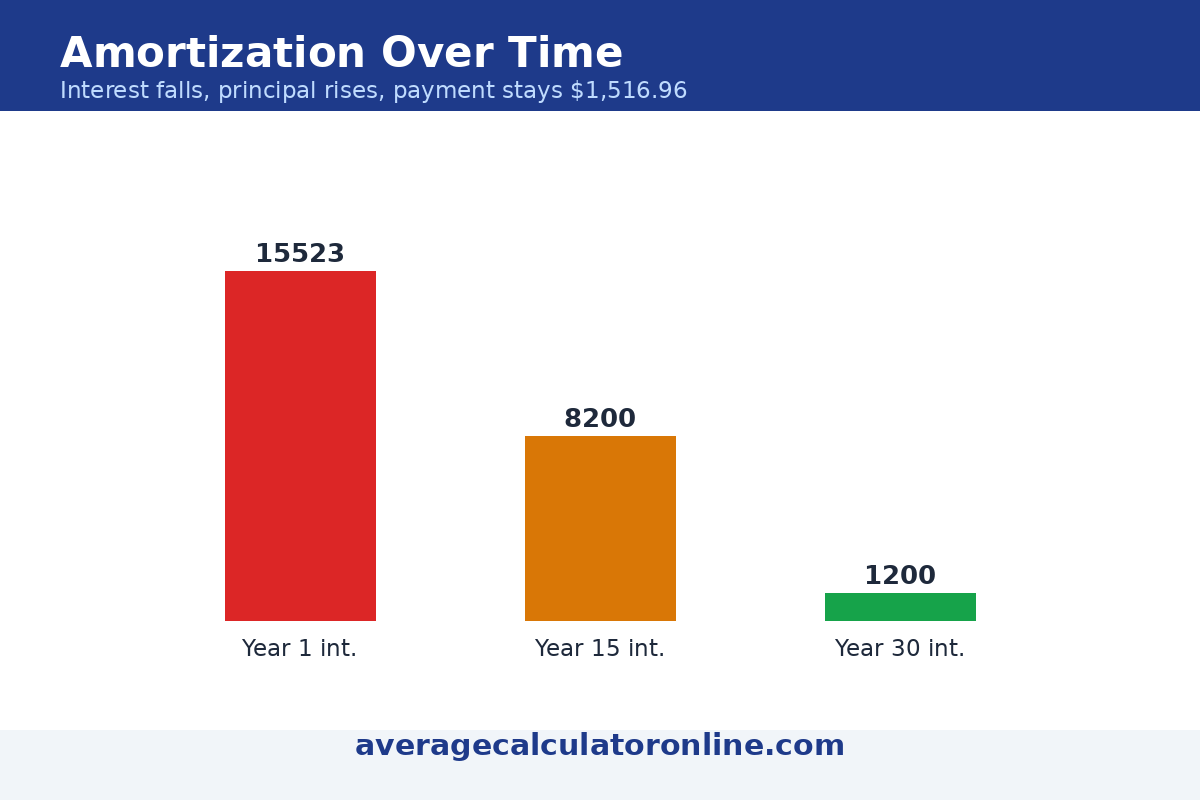
A mortgage calculator spreads one fixed monthly payment over hundreds of equal installments — but the mix inside each payment changes every month. This process is called amortization. Every payment covers the interest charged on the current balance first, and only what is left over reduces the principal.
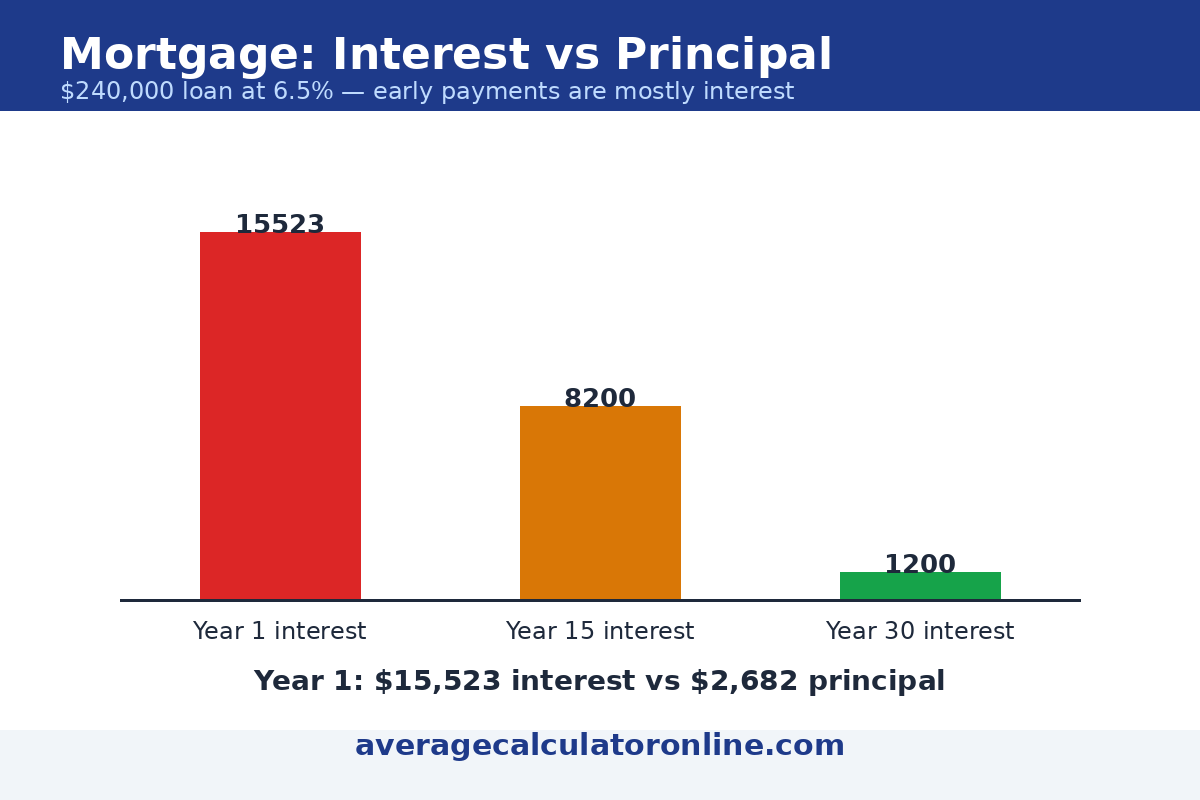
That ordering is why payoff starts so slowly. Take the default case on this page: a $240,000 loan at 6.5% over 30 years. The monthly payment is $1,516.96. In month one, interest alone is $240,000 × 0.065 ÷ 12 = $1,300 — so just $217 of the payment touches the principal. Across the entire first year, you pay $15,521 in interest and only $2,683 toward the loan itself.
The balance curve tells the same story visually: after 15 years — halfway through the loan — you still owe about $174,000, or 73% of what you borrowed. The balance falls slowly at first and then faster, because as the balance shrinks, less interest accrues and more of each fixed payment flows to principal.


Down Payment Impact: A Deep Dive
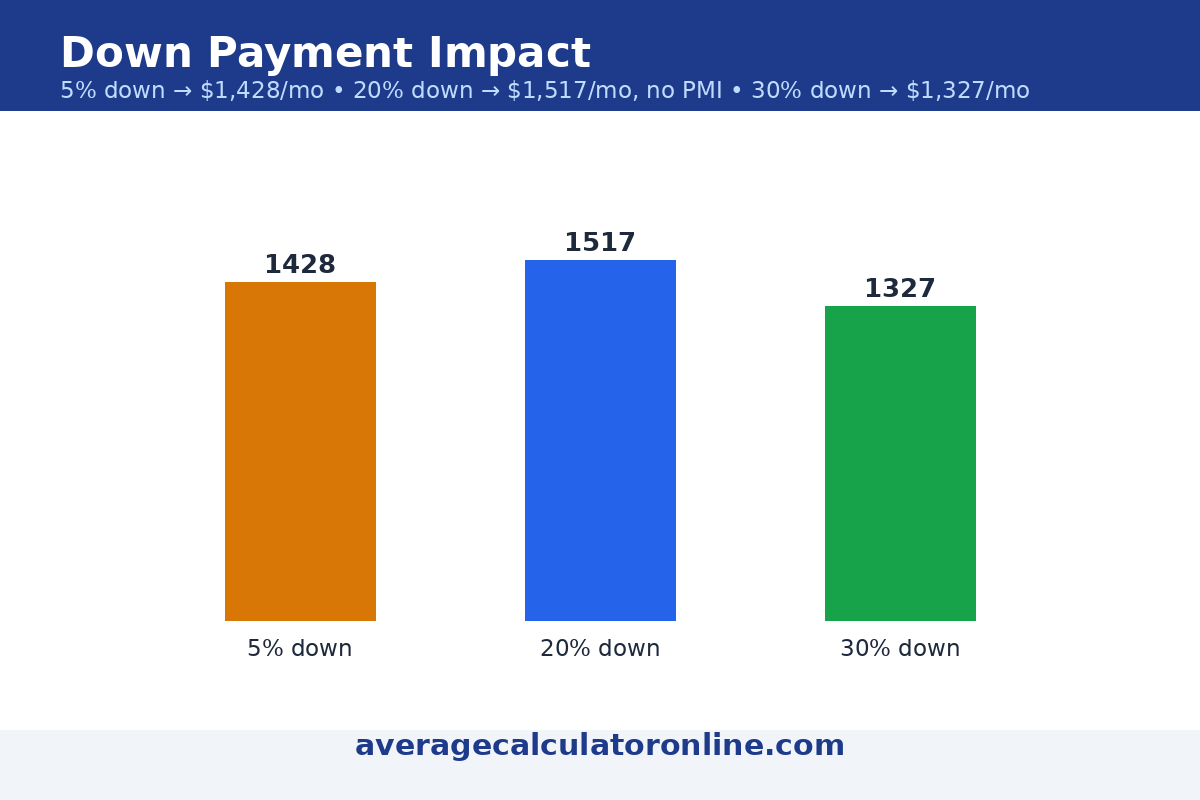
A bigger down payment does three things at once: it shrinks the loan amount, it shrinks the monthly payment, and it shrinks the total interest — because every dollar of down payment is a dollar you never borrow and never pay interest on. The diagram below compares three down payments on the same $300,000 home at 6.5% over 30 years.
Moving from 5% down to 20% down costs an extra $45,000 upfront but cuts the monthly payment by $284 and saves about $57,000 in interest over the life of the loan. Moving from 20% to 30% saves another $190 a month and roughly $38,000 more in interest. There is also a second, often bigger, win at 20%: most conventional lenders stop charging private mortgage insurance (PMI) at 20% down, which can save $100–$200 a month on top.
The trade-off is liquidity. Money put into a down payment is locked in the house — it earns no market return and is expensive to access. The right size is the one that avoids PMI and keeps an emergency fund intact, not necessarily the largest you can stretch to.
Run your own numbers in the mortgage calculator above — try changing the term and the down payment to see how strongly they move the total interest.
Sources & review
Figures on this page were checked against guidance from the Consumer Financial Protection Bureau (consumerfinance.gov) and the IRS (irs.gov). Reviewed by the Average Calculator Team. Last reviewed: 7 November 2026. This calculator gives planning estimates only and is not financial or mortgage advice.
Last updated: November 22, 2026.