Amortization Calculator
Estimates only, not financial advice. The figures on this page are estimates from the numbers you enter. They are not financial advice, and they do not include taxes, insurance, fees, or any charges your lender may add.
How to use: Enter the loan amount, annual rate and term, then press Calculate — the tool shows your monthly payment and the full amortization schedule.
Direct answer
The monthly payment on a fixed-rate loan is:
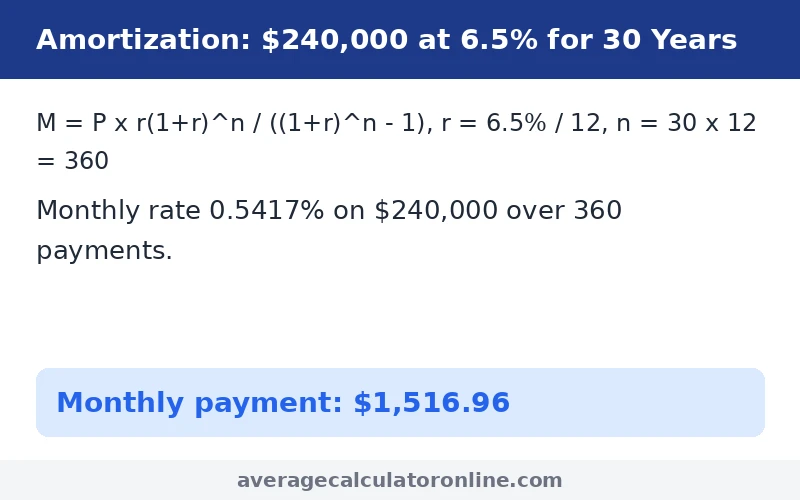
M = P × r(1+r)^n ÷ ((1+r)^n − 1)
where P is the loan amount, r is the monthly interest rate (annual rate ÷ 12), and n is the number of monthly payments (years × 12).
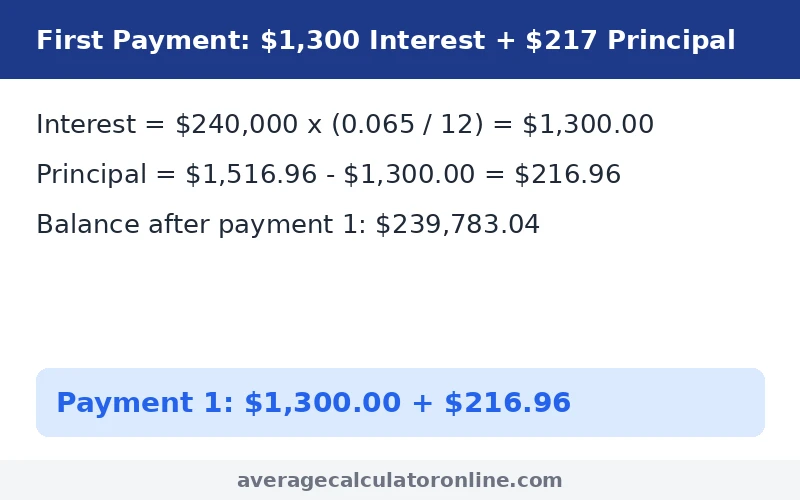
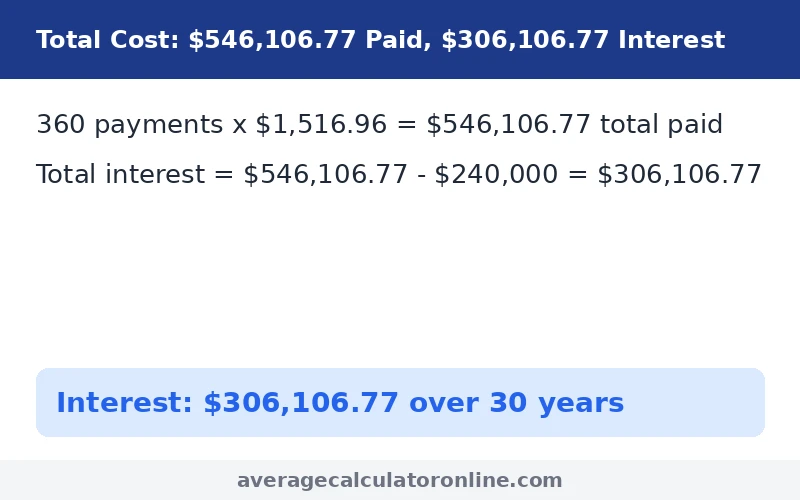
For a $240,000 loan at 6.5% for 30 years: r = 0.065 ÷ 12 = 0.00541667, n = 30 × 12 = 360, so the monthly payment is $1,516.96. The first payment splits into $1,300.00 interest and $216.96 principal, leaving a balance of $239,783.04. Over the full 30 years you pay $546,106.77 in total, of which $306,106.77 is interest. Enter your own loan below and the tool builds the full schedule for you.
Amortization Calculator
How it works
- Enter the loan amount (P). This is the amount you borrow — the starting balance.
- Enter the annual interest rate. The tool divides it by 12 to get the monthly rate r. For 6.5%, r = 0.065 ÷ 12 = 0.00541667 (about 0.5417% per month).
- Enter the term in years. The tool multiplies by 12 to get the number of payments n. For 30 years, n = 360.
- The formula sets the fixed monthly payment so the loan reaches exactly zero after the last payment: M = P × r(1+r)^n ÷ ((1+r)^n − 1).
- Each payment is split. That month’s interest is the current balance × r; the rest of the payment is principal, which reduces the balance. Because the balance falls, the interest part shrinks and the principal part grows with every payment — that is amortization.
Amortization schedule — first 12 monthly payments
$240,000 at 6.5% for 30 years, monthly payment $1,516.96.
| Payment | Interest | Principal | Balance |
|---|---|---|---|
| 1 | $1,300.00 | $216.96 | $239,783.04 |
| 2 | $1,298.82 | $218.14 | $239,564.90 |
| 3 | $1,297.64 | $219.32 | $239,345.58 |
| 4 | $1,296.46 | $220.51 | $239,125.07 |
| 5 | $1,295.26 | $221.70 | $238,903.37 |
| 6 | $1,294.06 | $222.90 | $238,680.46 |
| 7 | $1,292.85 | $224.11 | $238,456.35 |
| 8 | $1,291.64 | $225.32 | $238,231.03 |
| 9 | $1,290.42 | $226.55 | $238,004.48 |
| 10 | $1,289.19 | $227.77 | $237,776.71 |
| 11 | $1,287.96 | $229.01 | $237,547.71 |
| 12 | $1,286.72 | $230.25 | $237,317.46 |
After the first year you have paid $15,521.02 in interest and only $2,682.54 in principal — that is normal for a long loan: early payments are mostly interest because the balance is at its highest. If you want the monthly payment for a home loan, start with the mortgage calculator, and for any other loan, the loan calculator applies the same formula to your amount, rate and term.
Yearly summary — $240,000 at 6.5% for 30 years
| Year | Interest paid | Principal paid | Balance at year end |
|---|---|---|---|
| 1 | $15,521.02 | $2,682.54 | $237,317.46 |
| 2 | $15,341.36 | $2,862.20 | $234,455.26 |
| 3 | $15,149.68 | $3,053.88 | $231,401.38 |
| 4 | $14,945.15 | $3,258.41 | $228,142.97 |
| 5 | $14,726.93 | $3,476.63 | $224,666.35 |
| 6 | $14,494.09 | $3,709.46 | $220,956.88 |
| 7 | $14,245.67 | $3,957.89 | $216,998.99 |
| 8 | $13,980.60 | $4,222.96 | $212,776.03 |
| 9 | $13,697.78 | $4,505.78 | $208,270.24 |
| 10 | $13,396.02 | $4,807.54 | $203,462.70 |
| 11 | $13,074.05 | $5,129.51 | $198,333.19 |
| 12 | $12,730.51 | $5,473.04 | $192,860.15 |
| 13 | $12,363.97 | $5,839.58 | $187,020.56 |
| 14 | $11,972.89 | $6,230.67 | $180,789.89 |
| 15 | $11,555.61 | $6,647.95 | $174,141.94 |
| 16 | $11,110.38 | $7,093.18 | $167,048.76 |
| 17 | $10,635.34 | $7,568.22 | $159,480.54 |
| 18 | $10,128.48 | $8,075.08 | $151,405.46 |
| 19 | $9,587.68 | $8,615.88 | $142,789.58 |
| 20 | $9,010.66 | $9,192.90 | $133,596.68 |
| 21 | $8,394.99 | $9,808.57 | $123,788.11 |
| 22 | $7,738.09 | $10,465.47 | $113,322.64 |
| 23 | $7,037.20 | $11,166.36 | $102,156.28 |
| 24 | $6,289.37 | $11,914.19 | $90,242.09 |
| 25 | $5,491.45 | $12,712.11 | $77,529.99 |
| 26 | $4,640.10 | $13,563.46 | $63,966.53 |
| 27 | $3,731.73 | $14,471.83 | $49,494.70 |
| 28 | $2,762.53 | $15,441.03 | $34,053.67 |
| 29 | $1,728.41 | $16,475.15 | $17,578.52 |
| 30 | $625.04 | $17,578.52 | $0.00 |
The crossover is late: in year 15 you still pay more interest ($11,555.61) than principal ($6,647.95). Only in the final years does principal dominate — in year 30, $17,578.52 of the $18,203.56 paid is principal.
Note: yearly totals in the schedule use the exact monthly payment ($1,516.9633…) before rounding, so the year-30 total of $18,203.56 is 4 cents more than 12 × the rounded $1,516.96 ($18,203.52).
Worked examples
Example 1 — The default loan: $240,000 at 6.5% for 30 years
- Monthly rate: 0.065 ÷ 12 = 0.00541667; payments: 30 × 12 = 360
- Monthly payment: $1,516.96
- First payment: interest $240,000 × 0.00541667 = $1,300.00; principal $1,516.96 − $1,300.00 = $216.96; balance $240,000 − $216.96 = $239,783.04
- Total paid: 360 × $1,516.96 = $546,106.77
- Total interest: $546,106.77 − $240,000 = $306,106.77
Example 2 — A shorter term: $150,000 at 5.5% for 15 years
- Monthly rate: 0.055 ÷ 12 = 0.00458333; payments: 15 × 12 = 180
- Monthly payment: $1,225.63
- First payment: interest $150,000 × 0.00458333 = $687.50; principal $1,225.63 − $687.50 = $538.13
- Total paid: 180 × $1,225.63 = $220,612.53
- Total interest: $220,612.53 − $150,000 = $70,612.53
Example 3 — A larger loan, mid term: $300,000 at 7% for 20 years
- Monthly rate: 0.07 ÷ 12 = 0.00583333; payments: 20 × 12 = 240
- Monthly payment: $2,325.90
- First payment: interest $300,000 × 0.00583333 = $1,750.00; principal $2,325.90 − $1,750.00 = $575.90
- Total paid: 240 × $2,325.90 = $558,215.23
- Total interest: $558,215.23 − $300,000 = $258,215.23
Example 4 — Paying extra: $200 more a month on the default loan
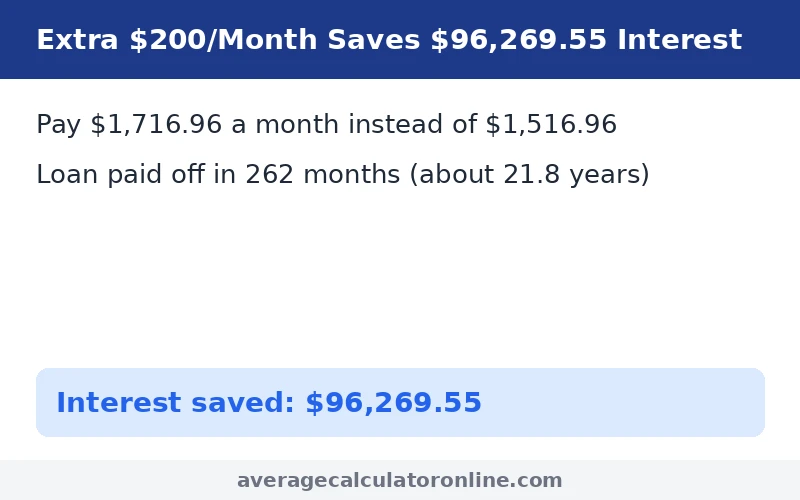
Take the default loan ($240,000 at 6.5% for 30 years, $1,516.96 a month) and pay $1,716.96 a month instead — $200 extra, all of it going to principal.
- Loan paid off in 262 months (about 21.8 years) instead of 360 months — about 8.2 years sooner
- Total interest: $209,837.22 instead of $306,106.77
- Interest saved: $96,269.55
Tips and mistakes
- Use the annual rate divided by 12, not the rate as typed. The most common error is entering 6.5 as the monthly rate — that would make the payment absurd. The tool divides by 12 for you; if you calculate by hand, remember r = annual rate ÷ 12.
- Count payments in months, not years. A 30-year loan is 360 payments, not 30. Using n = 30 in the formula gives a wildly wrong payment.
- Expect slow progress at first. After 5 years on the default loan you still owe $224,666.35 of $240,000 — only $15,333.65 of principal repaid. That is how amortization works, not a mistake in the schedule.
- Compare terms on the same loan. The same $240,000 at 6.5% over 15 years costs $2,090.66 a month — $573.70 more than the 30-year payment — but total interest is only $136,318.38, saving $169,788.39 versus the 30-year loan. A shorter term costs more per month and far less overall.
- Check how extra payments are applied. Extra money only saves interest if your lender applies it to principal. Ask your lender before assuming the saving in Example 4 applies to your loan.
- This schedule excludes taxes, insurance, and fees. A real mortgage payment is usually higher than the principal-and-interest figure here because of escrow and charges. The tool shows the loan itself, not the full monthly bill.
Sources
The schedule uses the standard amortization formula — see Amortization on MathWorld. Reviewed by the Average Calculator Team. Last reviewed: 7 November 2026.
Frequently asked questions
How do you calculate the monthly amortization payment?
Use M = P × r(1+r)^n ÷ ((1+r)^n − 1), where P is the loan amount, r is the monthly interest rate (annual rate ÷ 12), and n is the number of monthly payments (years × 12). For $240,000 at 6.5% for 30 years, r = 0.00541667 and n = 360, giving a monthly payment of $1,516.96.
What is amortization?
Amortization is the process of paying off a loan in fixed monthly payments, where each payment is split into interest and principal. The interest part is the current balance times the monthly rate, and the rest of the payment reduces the balance. Early payments are mostly interest; late payments are mostly principal.
Why is most of my first payment interest?
Because interest is charged on the full balance, which is at its highest at the start. On a $240,000 loan at 6.5%, the first month’s interest is $240,000 × (0.065 ÷ 12) = $1,300.00 of the $1,516.96 payment, leaving only $216.96 for principal. As the balance falls, the interest part shrinks.
How much interest will I pay on a $240,000 loan at 6.5% for 30 years?
Total interest is $306,106.77. You pay 360 payments of $1,516.96, which is $546,106.77 in total, minus the $240,000 borrowed. That means you pay more in interest than the amount you borrowed.
Does paying extra each month reduce the total interest?
Yes. Paying $200 extra a month on the $240,000 loan at 6.5% for 30 years ($1,716.96 instead of $1,516.96) pays the loan off in 262 months instead of 360 and saves $96,269.55 in interest. The saving works because every extra dollar goes to principal, which then stops earning interest.
What is the difference between an amortization calculator and a mortgage calculator?
A mortgage calculator focuses on the monthly payment and total cost of a home loan. An amortization calculator shows the payment-by-payment schedule: how much of each payment is interest, how much is principal, and what the balance is after every payment. This page is the schedule view; the mortgage page is the payment view.
Disclaimer
Estimates only, not financial advice. All figures on this page are estimates calculated from the numbers you enter. They do not include taxes, insurance, lender fees, or any other charges, and they are not a loan offer or financial advice. Actual loan terms depend on your lender, your credit, and the loan agreement. For decisions about borrowing, speak to a qualified financial adviser or your lender.
Related calculators
- Mortgage Calculator — monthly payment and total cost of a home loan
- Loan Calculator — general loan payments and total interest
- Compound Interest Calculator — how interest grows savings and investments over time
- Car Payment Calculator — monthly payments on a vehicle loan
- Percentage Calculator — percentage change between two loan figures
Last updated: November 7, 2026.