

Salary Calculator
Annual salary: $52,000.00
Monthly: $4,333.33. Weekly: $1,000.00. Biweekly: $2,000.00. Daily (8 hours): $200.00. Overtime pay per week: $0.00.
Direct answer: Salary is hourly rate times hours per week times weeks per year. At $25 an hour, 40 hours a week, 52 weeks a year, the annual salary is $52,000, the monthly pay is $4,333.33 and the weekly pay is $1,000.
By Average Calculator Team. Last reviewed: 16 November 2026.
How salary is calculated
Annual salary is the hourly rate multiplied by the hours worked each week and by the weeks worked in a year: annual salary = hourly rate x hours per week x weeks per year. A full-time year is usually 40 hours a week for 52 weeks, which is 2,080 hours. Monthly pay is the annual salary divided by 12, weekly pay is the annual salary divided by 52, and biweekly pay (every two weeks) is the weekly pay times 2. To go the other way, divide an annual salary by 2,080 to get the hourly rate: a $75,000 salary is $36.06 an hour and $6,250 a month. If you want the take-home amount after tax, use the income tax calculator.
Hourly rate to annual salary
The table below uses 40 hours a week for 52 weeks (2,080 hours a year). Part-time hours give a lower annual total: at $32 an hour and 35 hours a week, the annual salary is $58,240.
| Hourly rate | Weekly pay | Monthly pay | Annual salary |
|---|---|---|---|
| $15 | $600 | $2,600.00 | $31,200 |
| $20 | $800 | $3,466.67 | $41,600 |
| $25 | $1,000 | $4,333.33 | $52,000 |
| $30 | $1,200 | $5,200.00 | $62,400 |
| $40 | $1,600 | $6,933.33 | $83,200 |
Worked examples
Example 1: $25 an hour, 40 hours a week, 52 weeks a year. Annual salary = 25 x 40 x 52 = $52,000. Monthly pay = 52,000 / 12 = $4,333.33. Weekly pay = 25 x 40 = $1,000. Biweekly pay = 1,000 x 2 = $2,000. One 8 hour day pays 25 x 8 = $200.
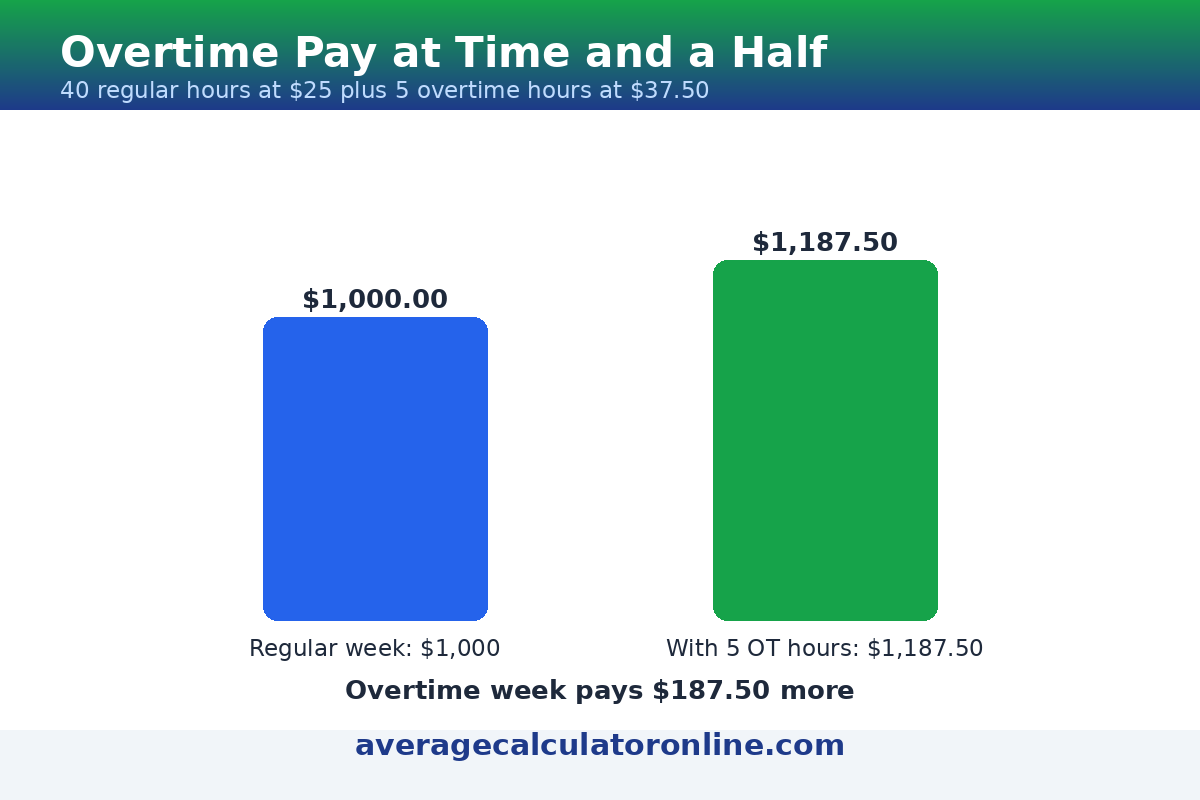
Example 2, with overtime: $25 an hour, 40 regular hours plus 5 overtime hours a week. Overtime pays 1.5 x 25 = $37.50 an hour. Weekly pay = (40 x 25) + (5 x 37.50) = 1,000 + 187.50 = $1,187.50. If every week is the same, the annual salary is 1,187.50 x 52 = $61,750.
Example 3: $18 an hour, 40 hours a week, 52 weeks a year. Annual salary = 18 x 40 x 52 = $37,440. Monthly pay = 37,440 / 12 = $3,120. Weekly pay = 18 x 40 = $720.
Example 4, part-time: $32 an hour, 35 hours a week, 52 weeks a year. Annual salary = 32 x 35 x 52 = $58,240. Monthly pay = 58,240 / 12 = $4,853.33. Weekly pay = 32 x 35 = $1,120. Fewer hours a week can still beat a lower full-time rate: this part-time job pays more than $25 an hour full-time, which is $52,000 a year.

Overtime rules in the United States
Under federal law, most hourly workers must be paid at least 1.5 times their regular rate for hours over 40 in a workweek. That is why overtime at $25 an hour pays $37.50 an hour. Some states and some employers pay overtime on a daily basis or pay double time, so check your contract and your state rules. Salaried workers are often exempt from overtime, which is one reason a salary and an hourly wage are not always directly comparable. If your pay is per paycheck rather than per hour, the paycheck calculator breaks it down by pay period, and the living wage calculator shows what a wage covers where you live.
Common mistakes
Using 48 weeks instead of 52: a full year has 52 weeks. Using 48 weeks understates the annual salary by a whole month of pay.
Forgetting the overtime multiplier: overtime hours are not paid at the regular rate. At $25 an hour, 5 overtime hours pay $187.50, not $125.
Confusing biweekly and semimonthly pay: biweekly pay comes 26 times a year (every two weeks) and semimonthly pay comes 24 times a year (twice a month). A $2,000 biweekly paycheck is $52,000 a year, while a $2,000 semimonthly paycheck is $48,000 a year.
Comparing gross pay with take-home pay: salary figures here are gross pay before tax. Taxes, retirement savings and health insurance all reduce the amount that reaches your bank account.
Frequently asked questions
How do I calculate my annual salary from an hourly rate?
Multiply the hourly rate by the hours worked each week and by the weeks worked in a year. At $25 an hour, 40 hours a week, 52 weeks a year: 25 x 40 x 52 = $52,000 a year.
What is my monthly salary if I earn $25 an hour?
A $52,000 annual salary divided by 12 months is $4,333.33 a month. Weekly pay is $1,000, biweekly pay is $2,000, and one 8 hour day pays $200.
How is overtime pay calculated?
In the United States, overtime is usually 1.5 times the regular hourly rate for hours over 40 in a week. At $25 an hour, overtime pays $37.50 an hour. Five overtime hours add $187.50, so a 45 hour week pays $1,187.50.
How do I convert an annual salary to an hourly rate?
Divide the annual salary by the number of hours worked in a year. A $75,000 salary at 40 hours a week for 52 weeks is 75,000 divided by 2,080 hours, which is $36.06 an hour.
How many weeks a year should I use in a salary calculation?
Use 52 weeks for a full year of work. If you take unpaid time off, use fewer weeks: 50 weeks at $25 an hour and 40 hours a week gives $50,000 a year instead of $52,000.
Does salary include overtime and bonuses?
No. Base salary is the regular pay before overtime, bonuses, tips and commissions. Add overtime separately: 5 overtime hours a week at $37.50 adds $9,750 a year.
Note: This calculator is for education and planning only. Actual pay depends on your employer, your contract, taxes and deductions. The results here are estimates, not financial advice.
Source: the The US Department of Labor explains overtime rules under the Fair Labor Standards Act.
Paycheck Calculator ·
Income Tax Calculator ·
Living Wage Calculator ·
Loan Calculator ·
Percentage Calculator
Last updated: November 16, 2026.