

Time Clock Calculator
Enter your clock-in time, clock-out time, unpaid break, and hourly rate. Overnight shifts that cross midnight are handled for you.
Shift length: 7.5 hours (7 hours 30 minutes). Gross pay: $150.00
Clock span: 8 hours. Minus a 30 minute break, the worked time is 450 minutes. At $20.00 an hour, the gross pay is $150.00.
Direct answer: A time clock calculator works out the length of one shift from your clock-in time and clock-out time, minus any unpaid break. Clock in at 9:00 AM and clock out at 5:00 PM with a 30 minute break, and the shift is 7.5 hours. At $20 an hour, the gross pay is $150.00. Overnight shifts that cross midnight are handled for you. For a whole week of shifts, use the weekly time card page instead.
By Average Calculator Team. Last reviewed: 16 November 2026.
How a shift is calculated
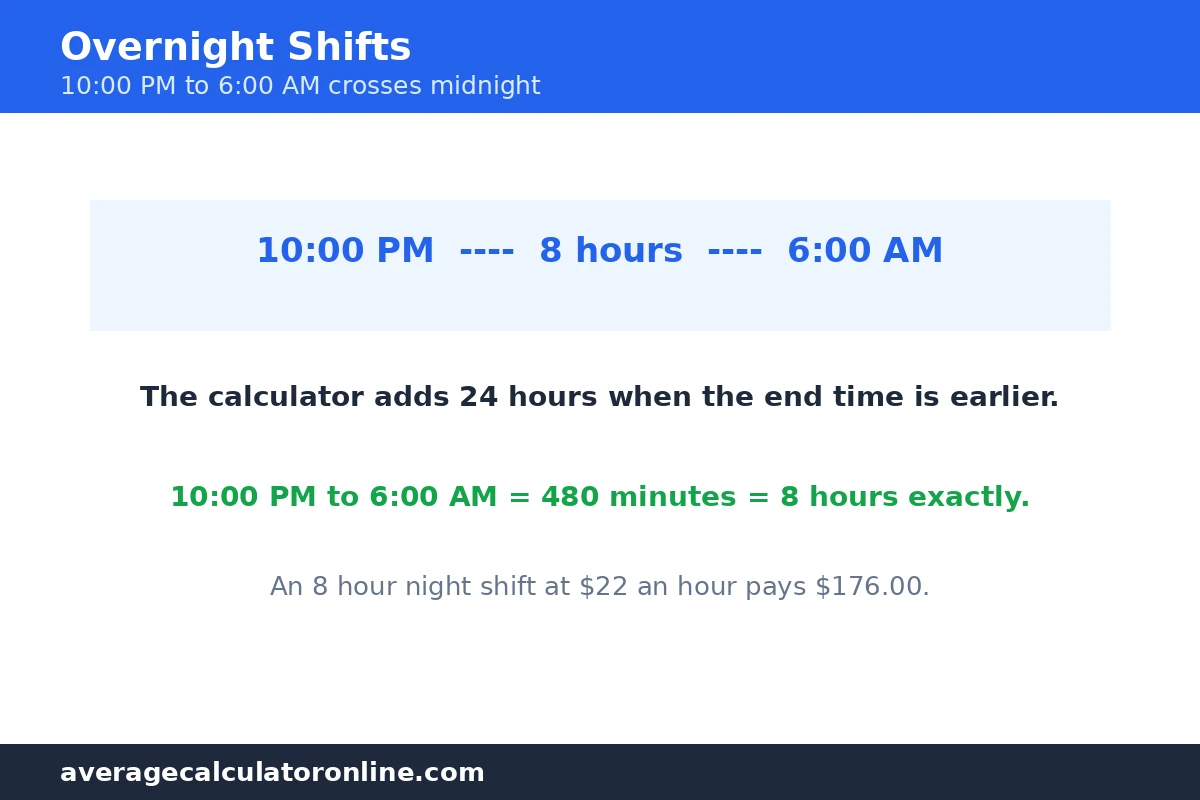
Take the clock-out time, subtract the clock-in time, and subtract the unpaid break. The result in minutes divided by 60 is the shift length in decimal hours, and the gross pay is the shift length times the hourly rate. When the clock-out time is earlier than the clock-in time, the shift crossed midnight, so add 24 hours to the clock-out time before you subtract. A shift from 10:00 PM to 6:00 AM is 6:00 AM plus 24 hours minus 10:00 PM, which is 480 minutes, or 8 hours. To check a full week of shifts at once, use the time calculator for the gaps and add the days together.
Paid rest breaks of 20 minutes or less usually count as hours worked under federal rules, while unpaid meal breaks do not. Enter only the unpaid break in this calculator. If your break was paid, leave the break at 0 and the full span counts.
Worked examples
Example 1: Clock in 9:00 AM, clock out 5:00 PM, 30 minute break, $20 an hour. The span is 8 hours, or 480 minutes. Minus the break, the worked time is 480 – 30 = 450 minutes, which is 450 / 60 = 7.5 hours. The gross pay is 7.5 x $20 = $150.00.
Example 2, overnight: Clock in 10:00 PM, clock out 6:00 AM, no break, $22 an hour. The clock-out time is earlier, so add 24 hours: 6:00 AM becomes 30:00, and 30:00 minus 22:00 is 8 hours. The gross pay is 8 x $22 = $176.00.
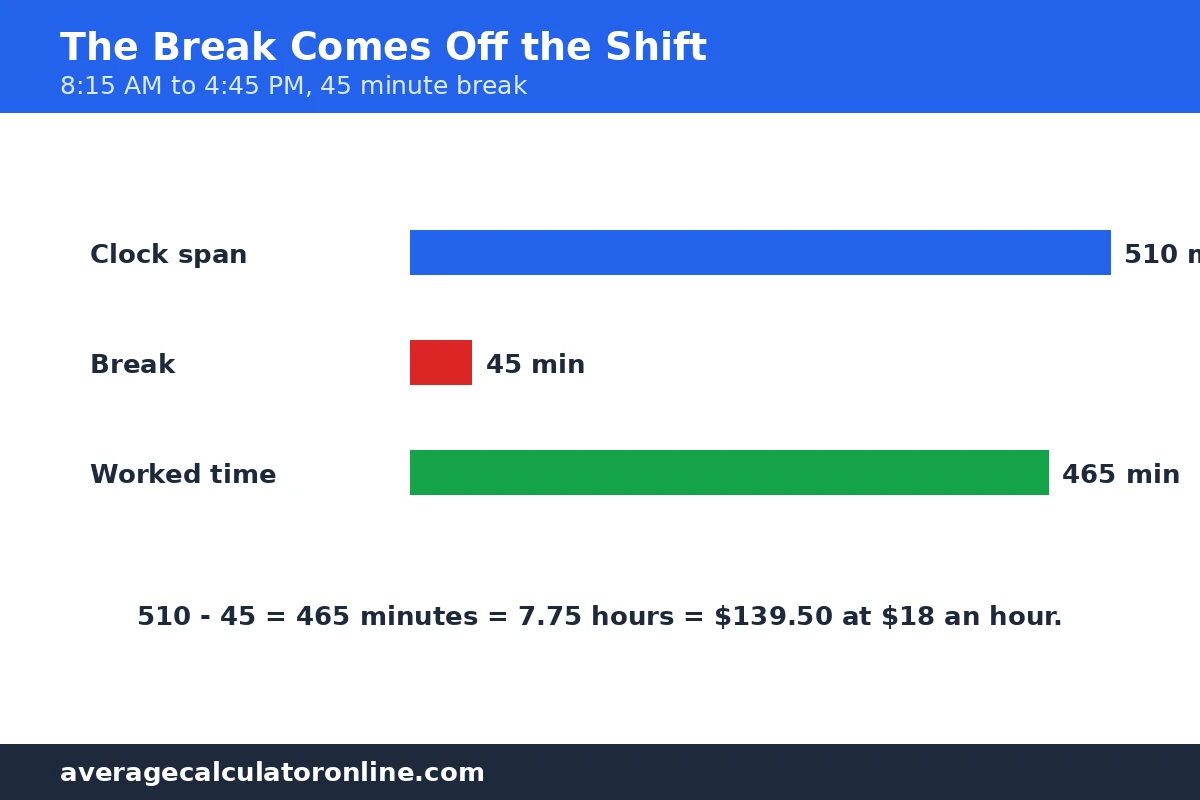
Example 3, a long break: Clock in 8:15 AM, clock out 4:45 PM, 45 minute break, $18 an hour. The span is 4:45 PM minus 8:15 AM = 510 minutes. Minus the break, the worked time is 510 – 45 = 465 minutes, which is 465 / 60 = 7.75 hours. The gross pay is 7.75 x $18 = $139.50.
Example 4, an hour lunch: Clock in 9:30 AM, clock out 6:00 PM, 60 minute break, $25 an hour. The span is 6:00 PM minus 9:30 AM = 510 minutes. Minus the break, the worked time is 510 – 60 = 450 minutes, which is 450 / 60 = 7.5 hours. The gross pay is 7.5 x $25 = $187.50.
Minutes to decimal hours
Payroll uses decimal hours, not hours and minutes. The conversion is minutes divided by 60, and the most common mistake is writing 7 hours 30 minutes as 7.3 hours, when it is really 7.5 hours.
| Worked time | Decimal hours | Pay at $20 an hour |
|---|---|---|
| 450 minutes | 7.5 hours | $150.00 |
| 465 minutes | 7.75 hours | $155.00 |
| 480 minutes | 8 hours | $160.00 |
| 510 minutes | 8.5 hours | $170.00 |
The 465 minute row is worth a second look: 465 / 60 is 7.75 hours, and 7.75 x $20 is $155.00. A 15 minute error in the break is worth $5.00 on one shift at $20 an hour. For the weekly total and the overtime split, use the paycheck calculator to see the take-home pay.
Common mistakes
Forgetting the break: 9:00 AM to 5:00 PM is 8 hours on the clock, but 7.5 hours worked after a 30 minute unpaid break. At $20 an hour, the forgotten break is worth $10.00 on one shift.
Mixing up AM and PM: 5:00 PM is 17:00, not 5:00. Entering 5:00 AM as the clock-out time for a 9:00 AM start gives a negative span, which the overnight rule turns into a 20 hour shift. Check AM and PM before you press calculate.
Entering a paid break as unpaid: a paid 15 minute rest break counts as hours worked, so it should not be subtracted. Only meal breaks you are not paid for come off the shift.
Rounding the shift by hand: some employers round to the nearest quarter hour, but you should record exact minutes first and let the payroll system do the rounding. Rounding each shift by hand can cost or gain real money over a month. The percentage calculator works out what share of your pay a rounding error takes.
Frequently asked questions
How do I calculate my shift length?
Subtract the clock-in time from the clock-out time, then subtract any unpaid break. Clock in at 9:00 AM and clock out at 5:00 PM with a 30 minute break, and the shift is 7.5 hours. If the clock-out time is earlier than the clock-in time, add 24 hours first, because the shift crossed midnight.
How do I calculate pay for one shift?
Multiply the shift length in decimal hours by the hourly rate. A 7.5 hour shift at 20 dollars an hour pays 150 dollars, and a 7.75 hour shift at 18 dollars an hour pays 139.50 dollars. Gross pay is before tax and deductions, so take-home pay is lower.
How do I calculate an overnight shift?
Add 24 hours to the clock-out time when it is earlier than the clock-in time, then subtract as usual. A shift from 10:00 PM to 6:00 AM is 6:00 AM plus 24 hours minus 10:00 PM, which is 480 minutes, or 8 hours. At 22 dollars an hour, that shift pays 176 dollars.
Do breaks count as work time?
Unpaid meal breaks do not count as hours worked, so subtract them. Paid rest breaks of 20 minutes or less usually do count as hours worked under federal rules, so leave them in. If you are not sure whether a break was paid, check your pay slip or ask your employer.
What is 7 hours 30 minutes in decimal hours?
7 hours 30 minutes is 7.5 hours, because 30 minutes is half an hour. The common mistake is writing 7.3 hours, which is only 7 hours 18 minutes. Divide the minutes by 60 every time: 30 divided by 60 is 0.5, so the answer is 7.5 hours.
What is the difference between a time clock and a time card?
A time clock covers one shift: clock in, clock out, and the shift length is the gap between the two times. A time card is the weekly record, one row per day, used to work out weekly pay and overtime above 40 hours. This page is the single shift tool, and the time card page covers the whole week.
Time Calculator ·
Date Calculator ·
Paycheck Calculator ·
Percentage Calculator ·
Living Wage Calculator ·
Last updated: November 16, 2026.