
Time Duration Calculator
Enter a start date and time and an end date and time to find the gap between them.
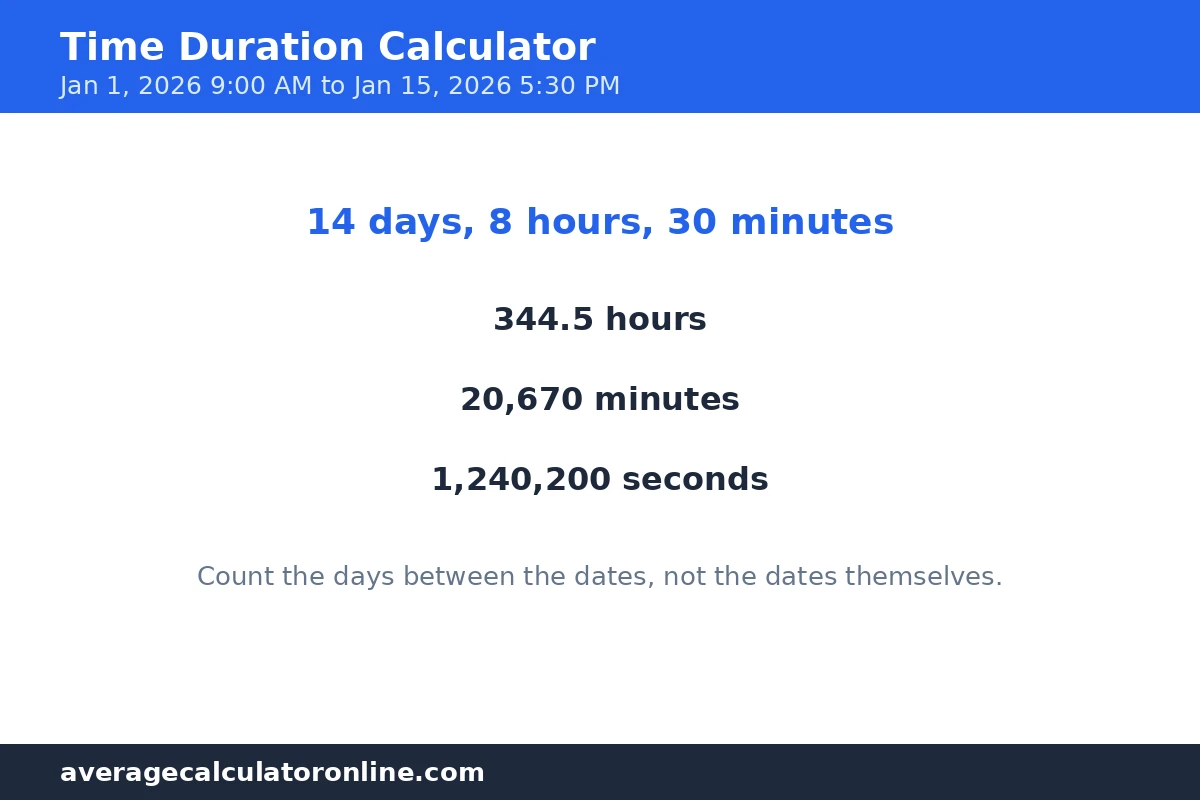
Duration: 14 days, 8 hours, 30 minutes.
That is 344.5 hours, or 20,670 minutes, or 1,240,200 seconds.
Direct answer: A time duration calculator finds the exact gap between two dates and times. From January 1, 2026 at 9:00 AM to January 15, 2026 at 5:30 PM is 14 days, 8 hours, and 30 minutes. That is 344.5 hours, or 20,670 minutes, or 1,240,200 seconds. This page covers the gap between two dates and times. For the gap between two clock times on one day, use the time clock page, and for a weekly record of hours, use the time card page.
By Average Calculator Team. Last reviewed: 16 November 2026.
How a time duration is calculated
Convert both dates and times to a single count of minutes, subtract the start from the end, and split the result back into days, hours, and minutes. One day is 1,440 minutes, and one hour is 60 minutes. The tool does the split for you, and it also shows the total in hours, minutes, and seconds, which is the form most people need for planning, billing, or travel. The date calculator finds the gap between two dates without times, and the time calculator covers two clock times on the same day.
Calendar months make durations tricky, because months have 28, 29, 30, or 31 days. A duration of one month means a different number of days in February than in July, so this calculator counts exact days instead of rounding months. February 2026 has 28 days, because 2026 is not a leap year, while February 2028 has 29 days, because 2028 is a leap year.
Worked examples
Example 1: January 1, 2026 at 9:00 AM to January 15, 2026 at 5:30 PM. The gap is 14 full days plus 8 hours 30 minutes, which is 14 days, 8 hours, 30 minutes. In hours that is 14 x 24 + 8.5 = 344.5 hours. In minutes that is 344.5 x 60 = 20,670 minutes. In seconds that is 20,670 x 60 = 1,240,200 seconds.
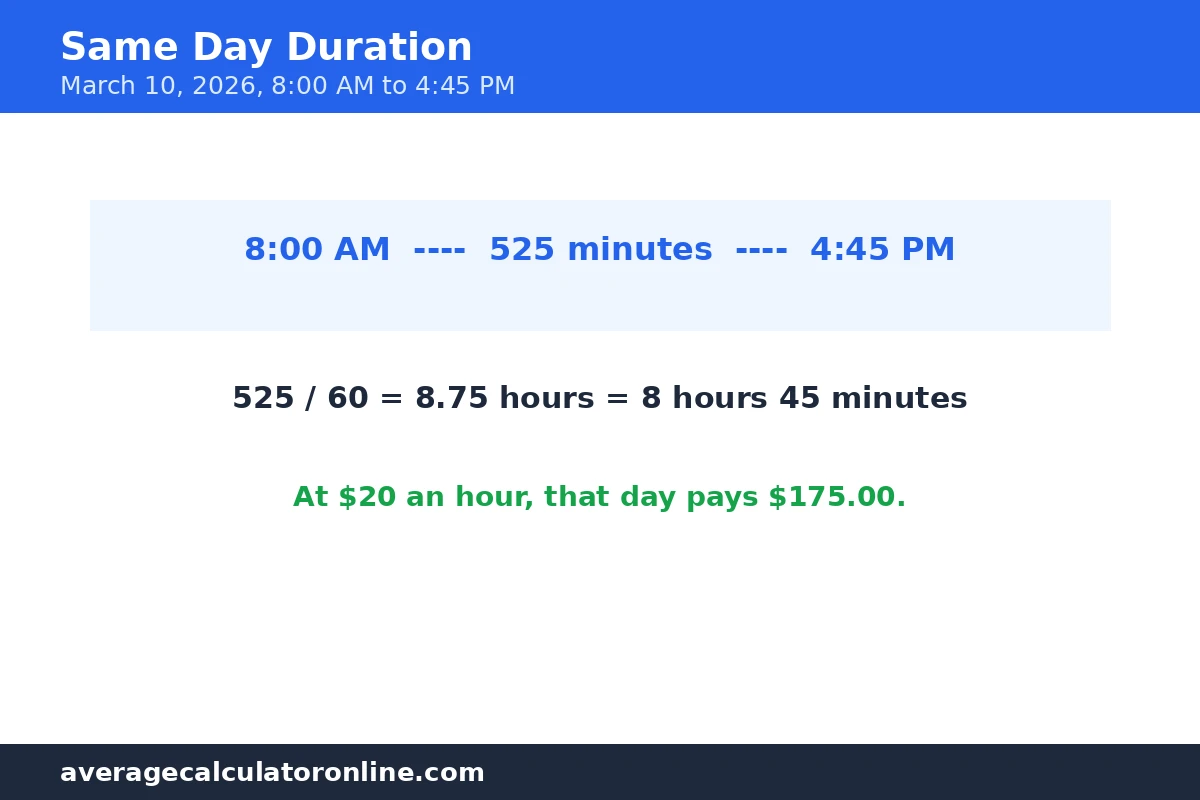
Example 2, same day: March 10, 2026 at 8:00 AM to March 10, 2026 at 4:45 PM. The gap is 4:45 PM minus 8:00 AM = 525 minutes, which is 525 / 60 = 8.75 hours, or 8 hours 45 minutes.
Example 3, across New Year: December 24, 2025 at 6:00 PM to January 1, 2026 at 12:00 AM. The gap is 7 full days plus 6 hours, which is 7 days, 6 hours. In hours that is 7 x 24 + 6 = 174 hours.
Example 4, a full month: February 1, 2026 at 12:00 AM to March 1, 2026 at 12:00 AM. February 2026 has 28 days, so the gap is 28 days. In hours that is 28 x 24 = 672 hours. In a leap year the same span would be 29 days, or 696 hours.

Durations in different units
The same gap looks different in each unit, and the right unit depends on what you are doing. Days suit travel and deadlines, hours suit work and billing, and minutes suit schedules and cooking.
| Gap | Days | Hours | Minutes |
|---|---|---|---|
| Jan 1, 9:00 AM to Jan 15, 5:30 PM | 14 days 8.5 hours | 344.5 | 20,670 |
| Mar 10, 8:00 AM to 4:45 PM | 0 days 8.75 hours | 8.75 | 525 |
| Dec 24, 6:00 PM to Jan 1, 12:00 AM | 7 days 6 hours | 174 | 10,440 |
| Feb 1 to Mar 1, 2026 | 28 days | 672 | 40,320 |
To turn a duration into pay, multiply the hours by the hourly rate. The 8.75 hour day in Example 2 pays 8.75 x $20 = $175.00 at $20 an hour. For the weekly pay version, use the paycheck calculator.
Common mistakes
Counting both end days: the gap from January 1 to January 15 is 14 days, not 15, because you count the days between the dates, not the dates themselves. The same rule gives 28 days from February 1 to March 1, not 29.
Forgetting the time of day: January 1 at 9:00 AM to January 15 at 5:30 PM is 14 days 8 hours 30 minutes, not 14 days flat. The extra 8.5 hours matter when you book travel or plan a deadline.
Assuming every month is 30 days: February has 28 days in a normal year and 29 in a leap year, while April, June, September, and November have 30 days and the rest have 31. A 30 day estimate for February is 2 days too long, which is 48 hours of error.
Mixing up AM and PM: 5:30 PM is 17:30, not 5:30. Entering 5:30 AM as the end of a 9:00 AM start gives a negative gap, and the calculator will ask for an end time after the start. The age calculator uses the same date logic for birthdays and anniversaries.
Frequently asked questions
How do I calculate the duration between two dates?
Convert both dates and times to minutes, subtract the start from the end, and split the result into days, hours, and minutes. From January 1, 2026 at 9:00 AM to January 15, 2026 at 5:30 PM is 14 days, 8 hours, and 30 minutes, which is 344.5 hours or 20670 minutes.
How many hours are in 14 days?
14 days are 336 hours, because one day is 24 hours and 14 times 24 is 336. A gap of 14 days, 8 hours, and 30 minutes is 344.5 hours in total, because the extra 8.5 hours add to the 336 hours of the 14 full days.
How do I calculate the duration between two times on the same day?
Subtract the start time from the end time. From 8:00 AM to 4:45 PM is 525 minutes, which is 8.75 hours, or 8 hours 45 minutes. If the end time is earlier than the start time, the shift crossed midnight, so add 24 hours to the end time first.
Does a time duration calculator count leap years?
Yes, it counts exact calendar days, so leap years are handled. February 2026 has 28 days, so February 1 to March 1, 2026 is 28 days, or 672 hours. In a leap year like 2028, the same span is 29 days, or 696 hours.
What is the difference between duration and time?
Time is a point, like 9:00 AM on January 1, and duration is the gap between two points, like 14 days, 8 hours, and 30 minutes. This page finds the gap between two dates and times, while the time calculator finds the gap between two clock times on one day.
How do I turn a duration into pay?
Multiply the hours by the hourly rate. An 8.75 hour day at 20 dollars an hour pays 175 dollars, and a 344.5 hour gap at 20 dollars an hour pays 6890 dollars. For a full week with overtime, use the time card page, which splits regular and overtime hours.
Time Calculator ·
Date Calculator ·
Age Calculator ·
Percentage Calculator ·
Statistics Calculator ·
Last updated: November 16, 2026.