
Timecard Calculator
Worked: 7.50 hours a day, 37.50 hours a week
Gross pay: $150.00 a day, $750.00 a week.
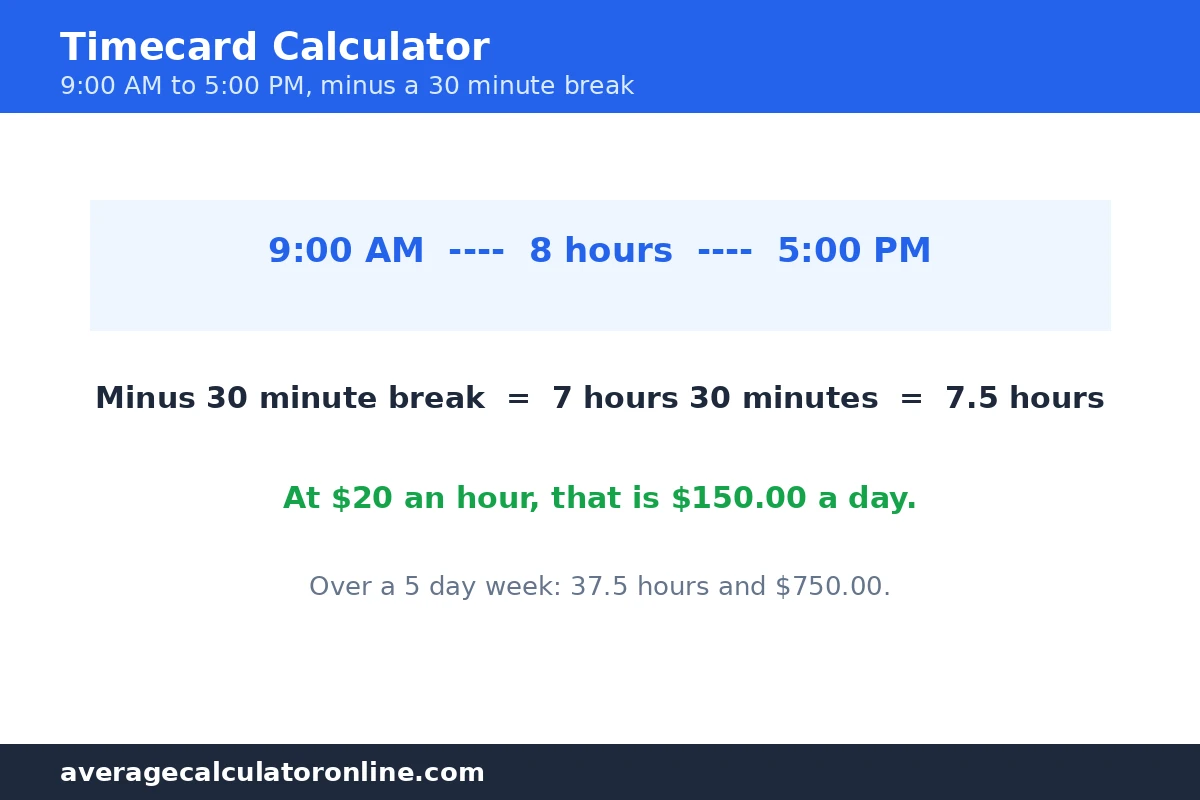
Direct answer: A timecard calculator adds up the hours on a timecard and turns them into pay. Clock in at 9:00 AM, clock out at 5:00 PM, take a 30 minute unpaid break, and you worked 7.50 hours. At $20 an hour that is $150.00 a day, and over a 5 day week it is 37.50 hours and $750.00. Timecard is the one-word spelling of time card, and this page totals a full work week from one daily shift.
By Average Calculator Team. Last reviewed: 16 November 2026.
How a timecard works
A timecard records when a shift starts and ends. The span from clock in to clock out is the gross time, and the unpaid break comes off it. From 9:00 AM to 5:00 PM is 8 hours, or 480 minutes. Minus a 30 minute break, the net time is 450 minutes, which is 450 / 60 = 7.5 hours. Multiply by the hourly rate to get the pay: 7.5 x $20 = $150.00 a day. Multiply by the days per week to get the weekly figures: 7.5 x 5 = 37.5 hours and $150 x 5 = $750.00 a week.
Overnight shifts need one extra step. When the clock out time is earlier than the clock in time, the calculator adds 24 hours to the clock out time first, so 10:00 PM to 6:00 AM is read as 10:00 PM to 6:00 AM the next day, which is 480 minutes. Payroll almost always uses decimal hours, so 7 hours 30 minutes is written as 7.5 hours, never as 7.3 hours. To add up two clock times without a break or a rate, use the time calculator.

Worked examples
Example 1: Clock in 9:00 AM, clock out 5:00 PM, 30 minute break, $20 an hour, 5 days a week. The span is 480 minutes, minus 30 is 450 minutes, which is 7.5 hours a day. The week is 7.5 x 5 = 37.5 hours, and the pay is 7.5 x $20 = $150.00 a day and $150 x 5 = $750.00 a week.
Example 2: Clock in 8:30 AM, clock out 4:45 PM, 45 minute break, $22 an hour. The span is 495 minutes, minus 45 is 450 minutes, which is 7.5 hours. The pay is 7.5 x $22 = $165.00 a day.
Example 3, an overnight shift: Clock in 10:00 PM, clock out 6:00 AM, 30 minute break, $25 an hour. The span crosses midnight, so it is 480 minutes, minus 30 is 450 minutes, which is 7.5 hours. The pay is 7.5 x $25 = $187.50 for the night.
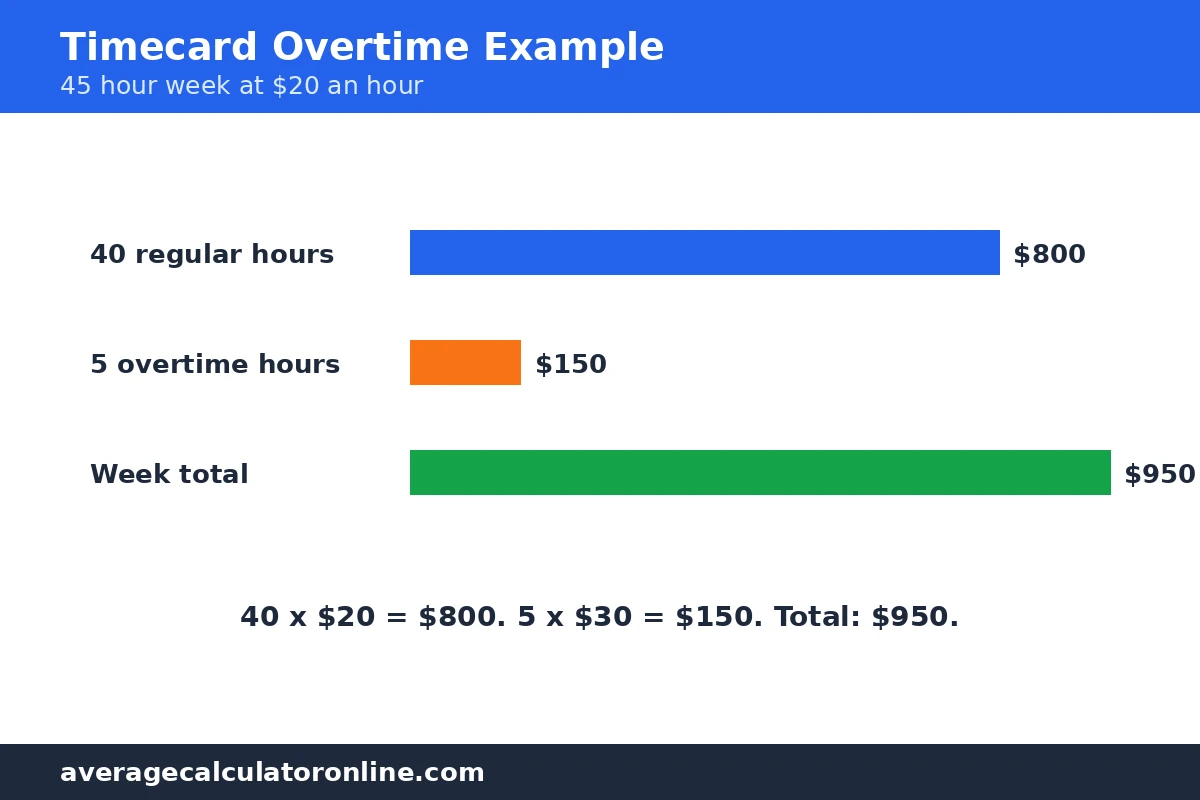
Example 4, overtime: A 45 hour week at $20 an hour, with overtime at time and a half ($30 an hour) after 40 hours. The regular pay is 40 x $20 = $800.00. The overtime pay is 5 x $30 = $150.00. The week pays $800 + $150 = $950.00. This calculator totals regular hours; work out overtime separately with the same 1.5 times rate. To see what the $950 week leaves after tax, use the paycheck calculator.
Common shifts
The table shows the net hours for common shifts after the unpaid break. Two shifts can look the same on the clock and still pay differently once the break is subtracted.
| Shift | Break | Net hours |
|---|---|---|
| 9:00 AM to 5:00 PM | 30 minutes | 7.5 hours |
| 8:00 AM to 4:00 PM | 30 minutes | 7.5 hours |
| 10:00 AM to 6:00 PM | 60 minutes | 7.0 hours |
| 7:00 AM to 3:30 PM | 30 minutes | 8.0 hours |
The 10:00 AM to 6:00 PM shift is 480 minutes on the clock, the same as the 9:00 AM to 5:00 PM shift, but the 60 minute break leaves only 420 minutes, which is 7.0 hours. The 7:00 AM to 3:30 PM shift is 510 minutes on the clock, minus 30 is 480 minutes, which is 8.0 hours. Always subtract the break before you multiply by the rate.
Common mistakes
Forgetting the break: the break is unpaid time, so it comes off the total. A 30 minute break at $25 an hour is worth $12.50 a day, or $62.50 over a 5 day week. Count it and the pay comes out too high.
Writing 7.3 for 7 hours 30 minutes: decimal hours divide the minutes by 60, so 30 minutes is 0.5 hours and the answer is 7.5 hours. Writing 7.3 hours means 7 hours 18 minutes, because 0.3 x 60 = 18. Divide the minutes by 60 every time.
Forgetting the overnight step: a shift from 10:00 PM to 6:00 AM is 8 hours, not minus 16 hours. Add 24 hours to the end time whenever it is earlier than the start time, then subtract as usual. To check whether a wage covers your costs, see the living wage calculator.
Rounding minutes away: 7 hours 45 minutes is 7.75 hours, not 8 hours. Rounding every shift up by 15 minutes adds 1.25 hours a week, which is $25.00 a week at $20 an hour. Keep the exact minutes and let the calculator do the division.
Frequently asked questions
What is a timecard calculator?
A timecard calculator adds up the hours on a timecard and turns them into pay. You enter the clock in time, the clock out time, the unpaid break in minutes, the hourly rate, and the days per week. It gives the hours a day, the hours a week, and the gross pay a day and a week.
How do I calculate hours from a timecard?
Subtract the clock in time from the clock out time, then subtract the unpaid break. From 9:00 AM to 5:00 PM is 480 minutes, and minus a 30 minute break it is 450 minutes, which is 7.5 hours. Multiply the hours by the hourly rate to get the pay.
How do I handle an overnight shift on a timecard?
Add 24 hours to the clock out time when it is earlier than the clock in time, then subtract as usual. A shift from 10:00 PM to 6:00 AM is 6:00 AM plus 24 hours minus 10:00 PM, which is 480 minutes, or 8 hours. Minus a 30 minute break, the shift is 7.5 hours.
How do I convert minutes to decimal hours?
Divide the minutes by 60. 15 minutes is 0.25 hours, 30 minutes is 0.50 hours, 45 minutes is 0.75 hours, and 90 minutes is 1.50 hours. To go back, multiply the decimal part by 60: 0.25 hours times 60 is 15 minutes.
How do I add overtime to a timecard total?
Pay the first 40 hours at the normal rate and the extra hours at time and a half. A 45 hour week at 20 dollars an hour pays 40 times 20, which is 800 dollars, plus 5 times 30, which is 150 dollars, for a total of 950 dollars. This calculator totals regular hours, so work out overtime separately.
What is the difference between a timecard calculator and a time card calculator?
There is no difference in meaning: timecard is the one-word spelling of time card. This page totals a full work week from one daily shift, a break, and a pay rate, and it handles overnight shifts that cross midnight.
What is time and a half?
Time and a half means 1.5 times the normal hourly rate. At 20 dollars an hour, time and a half is 30 dollars an hour, and at 22 dollars an hour it is 33 dollars an hour. It is the standard overtime rate in the United States for hours above 40 in a week.
How many hours is full time?
Full time is usually 40 hours a week, or 8 hours a day, Monday to Friday. Some employers count 35 hours a week as full time for benefits, and some count 32 hours. The exact line is set by the employer and by the benefits plan, not by a single federal rule.
Do lunch breaks count on a time card?
Unpaid meal breaks do not count as hours worked, so subtract them from the shift. A 9:00 AM to 5:00 PM shift with a 30 minute unpaid lunch is 7.5 hours worked. Paid rest breaks of 20 minutes or less usually do count as hours worked under federal rules.
What is the difference between a time card and a time clock?
A time card is the weekly record of hours worked, usually one row per day, used to work out weekly pay and overtime. A time clock is the tool for a single shift: you clock in, you clock out, and the shift length is the gap between the two times. This page is the weekly time card, and the time clock page covers one shift at a time.
Time Calculator ·
Date Calculator ·
Paycheck Calculator ·
Living Wage Calculator ·
Percentage Calculator ·
Last updated: November 19, 2026.