How to Use a Math Calculator: BODMAS, Percentages and Everyday Sums
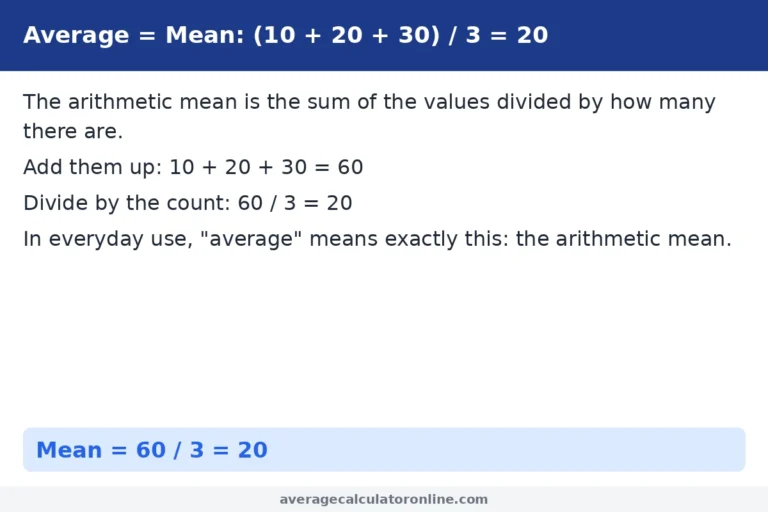
Short answer: A math calculator does the four basic operations, add, subtract, multiply and divide, and the expression calculator on the math calculator page follows BODMAS, so 6 + 2 × 3 equals 12. The percent key works out a percentage of the number before it, so 50 + 10% gives 55. This guide shows each operation, the order of operations, percentages and everyday sums, with every answer checked by the opposite operation.
The four basic operations
The four operations cover almost every everyday sum. Addition combines two numbers into a total. Subtraction takes the second number away from the first. Multiplication adds a number to itself a number of times. Division splits the first number into equal parts of the second number size.
| Operation | Symbol | Meaning | Example |
|---|---|---|---|
| Addition | + | Combine two numbers into a total | 12 + 8 = 20 |
| Subtraction | − | Take the second number away from the first | 25 − 13 = 12 |
| Multiplication | × | Add a number to itself a number of times | 7 × 6 = 42 |
| Division | ÷ | Split the first number into equal parts | 84 ÷ 7 = 12 |
On the math calculator page, the tool loads with the default calculation 12 + 8 = 20. Enter your own two numbers, pick the operation, and the tool shows the full expression and the result, so you can check the inputs as well as the answer. Whole numbers and decimals both work: 12.5 + 8.25 = 20.75. The expression calculator below the basic tool takes a whole calculation at once, with keys for square root, powers and percentages.
BODMAS: the order of operations
When a calculation has more than one operation, BODMAS sets the order. Brackets come first, then Orders, which means powers and roots, then Division and Multiplication from left to right, then Addition and Subtraction from left to right. PEMDAS is the same rule with American names: Parentheses, Exponents, Multiplication, Division, Addition, Subtraction.
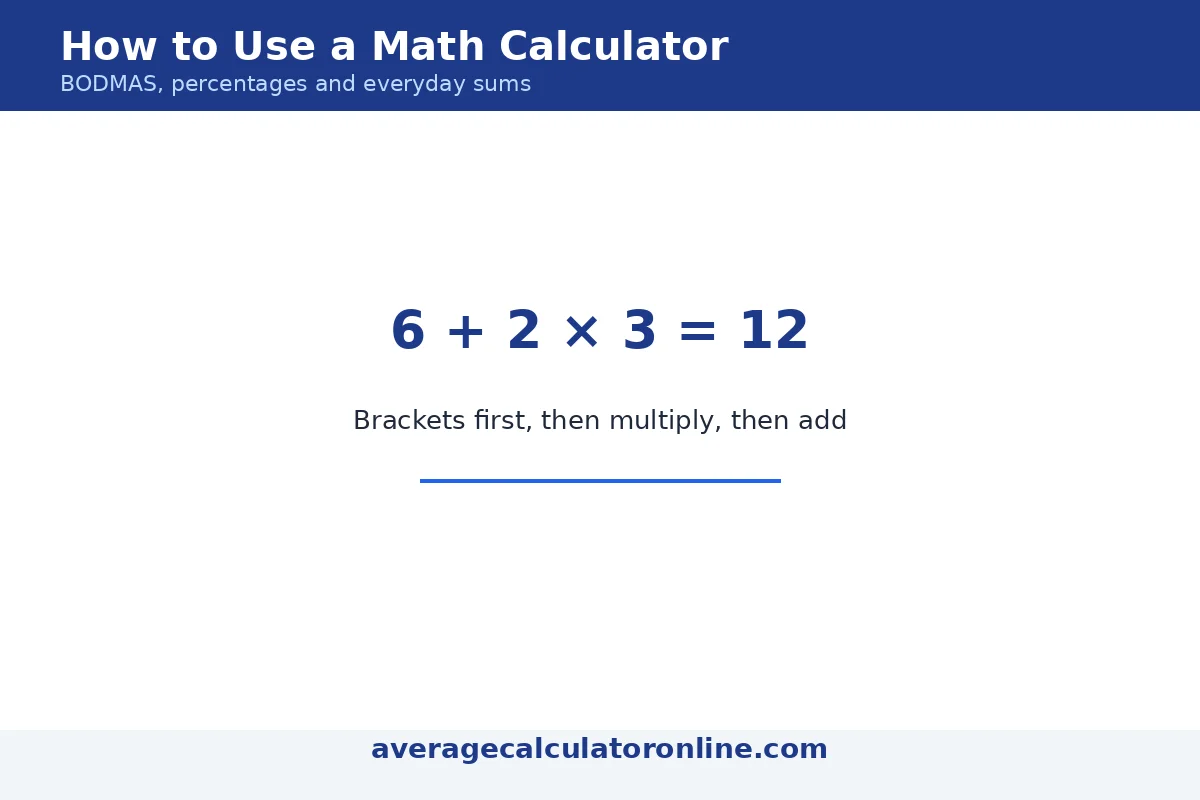
Example: 6 + 2 × 3 = 12, because multiplication comes first. Work out 2 × 3 = 6, then 6 + 6 = 12. Working from left to right instead would give 24, which is wrong. Brackets change the order: (6 + 2) × 3 = 24, because the brackets are done first, 6 + 2 = 8, then 8 × 3 = 24.
Two more checks show the same rule. First, 10 − 2 × 3 = 4, because 2 × 3 = 6 and 10 − 6 = 4. With brackets, (10 − 2) × 3 = 24, because 10 − 2 = 8 and 8 × 3 = 24. Second, 3 + 4 × 2 = 11, because 4 × 2 = 8 and 3 + 8 = 11. The scientific calculator handles powers, roots and trigonometry when a sum goes past the keys on the math calculator page.
Percentages on a math calculator
The percent key works out a percentage of the number before it. Type 50 + 10% to add 10 percent of 50. The answer is 55, because 10 percent of 50 is 5. Type 200 × 15% for 15 percent of 200, which is 30.
Percentages show up in shops, tips and discounts. A price of 80 dollars with 20 percent off loses 16 dollars, because 20 percent of 80 is 16, so you pay 64 dollars. A 15 percent tip on a 40 dollar meal is 6 dollars, because 15 percent of 40 is 6, so the total is 46 dollars. A quarter of 200 dollars is 50 dollars, because 25 percent of 200 is 50.
For percentage problems that need more than the percent key, such as finding what percentage one number is of another, use the percentage calculator. It shows each step, so you can see the part, the whole and the percentage together.
Worked everyday sums
Example 1, addition: 12 + 8 = 20. Check it by counting on from 12, eight more steps, 13, 14, 15, 16, 17, 18, 19, 20, or by subtraction, 20 − 8 = 12, which is the first number back.
Example 2, subtraction: 25 − 13 = 12. Check it by addition, 12 + 13 = 25, which is the starting number back.
Example 3, multiplication: 7 × 6 = 42. As repeated addition that is 6 + 6 + 6 + 6 + 6 + 6 + 6 = 42. Check it by division, 42 ÷ 7 = 6, which is the second number back. The 8 times table is handy for checking multiplication by 8: 8 × 7 = 56.
Example 4, division: 84 ÷ 7 = 12. Check it by multiplication, 12 × 7 = 84, which is the starting number back. A second division check is 100 ÷ 4 = 25. Splitting a bill works the same way: 84 dollars shared by 7 people is 12 dollars each.
Example 5, decimals: 12.5 + 8.25 = 20.75. Line the decimal points up before you add, and the answer keeps two decimal places. Fractions work the same way in steps, and the fraction calculator adds, subtracts, multiplies and divides fractions step by step.
Common mistakes
Skipping BODMAS: 6 + 2 × 3 is 12, not 24. Do the multiplication and division before addition and subtraction, and do brackets first.
Dividing by zero: 12 ÷ 0 has no answer. The tool says so plainly instead of showing Infinity. Change the second number to anything except 0.
Swapping the numbers: 25 − 13 = 12, but 13 − 25 = −12. Division is the same: 84 ÷ 7 = 12, but 7 ÷ 84 = 0.08. Swapping the numbers changes the answer, unlike addition and multiplication, where the order does not matter.
Losing the decimal point: adding 12.5 + 8.25 as if they were 125 + 825 gives the wrong answer. Line the decimal points up. Long decimal answers are rounded to 10 significant figures on the tool, so 1 ÷ 3 shows as 0.3333333333, and the full answer continues past the digits shown.
Percentages with money: discounts, tips and tax
The percentage examples in this guide use small round numbers, but the same steps work on any price. A discount is a percentage taken off, a tip is a percentage added on, and sales tax is a percentage added to the price after any discount.
Example, a discount: a jacket costs 120 dollars with 25 percent off. 25 percent of 120 is 30 dollars, so the sale price is 120 minus 30, which is 90 dollars.
Example, a tip: a meal costs 64 dollars and you leave a 20 percent tip. 20 percent of 64 is 12.80 dollars, so the total is 64 plus 12.80, which is 76.80 dollars.
Example, a price rise: an item costs 45 dollars and the price rises by 10 percent. 10 percent of 45 is 4.50 dollars, so the new price is 45 plus 4.50, which is 49.50 dollars.
Example, discount plus tax: take the 90 dollar jacket and add 8 percent sales tax on the sale price, not on the original price. 8 percent of 90 is 7.20 dollars, so the amount to pay is 90 plus 7.20, which is 97.20 dollars. Tax is worked out after the discount in most places, so work out the sale price first and then add the tax. For longer percentage problems, use the percentage calculator, and for splitting a restaurant bill with a tip, use the tip calculator.
FAQ
What does BODMAS mean?
BODMAS stands for Brackets, Orders, Division, Multiplication, Addition and Subtraction. It is the order in which the parts of a calculation are worked out. Brackets come first, then powers, then division and multiplication from left to right, then addition and subtraction from left to right.
How do you work out 6 plus 2 times 3?
Work out the multiplication first. 2 times 3 is 6, then 6 plus 6 is 12. If you work from left to right without BODMAS, you get 24, which is wrong. Brackets change the answer: 6 plus 2 in brackets times 3 is 24.
What is 12 plus 8?
12 plus 8 is 20. That is the default calculation on the math calculator page. The tool loads with 12, Add, and 8, and it shows the full expression and the result before you type anything.
How do you work out a percentage on a calculator?
Use the percent key for a percentage of a number. For example, 10 percent of 50 is 5, so 50 plus 10 percent is 55. For other percentage problems, enter the numbers and use the percentage calculator on this site.
What happens if you divide by zero?
There is no answer to division by zero. The math calculator shows a plain message that you cannot divide by zero. Change the second number to anything except zero and work out the sum again.
How do you check a subtraction answer?
Check a subtraction with addition. If 25 minus 13 is 12, then 12 plus 13 must be 25. Check a division with multiplication in the same way: if 84 divided by 7 is 12, then 12 times 7 must be 84.
Related calculators: Math Calculator · Percentage Calculator · Scientific Calculator · Fraction Calculator