Grade Average & GPA Guide: How to Calculate Your Grades
Short answer: To find your grade average, add up all your grades and divide by how many grades there are. To find your GPA on the common US 4.0 scale, convert each letter grade to grade points (A = 4.0, B = 3.0, C = 2.0, D = 1.0, F = 0), add the points, and divide by the number of courses.
Grades decide more than a single report card. They shape scholarships, college applications, and academic standing. Yet many students only ever see the final number, never the arithmetic behind it. This guide shows every step, with worked examples.
The Grade Average Formula
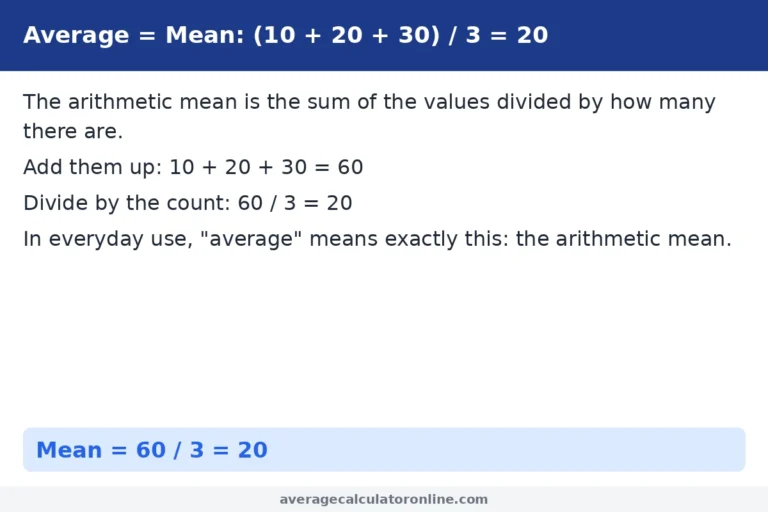
The grade average is the arithmetic mean of your grades. The formula is simple:
Grade average = (sum of all grades) / (number of grades)
That is all there is to it — provided every grade counts equally. If your teacher weights tests more than homework, or your courses carry different credits, you need the weighted version below.
One thing to check before you start: make sure all your grades are on the same scale. You cannot average a percentage (say, 88) with a letter grade (say, B+) without converting one of them first.
Worked Example 1: Five Grades
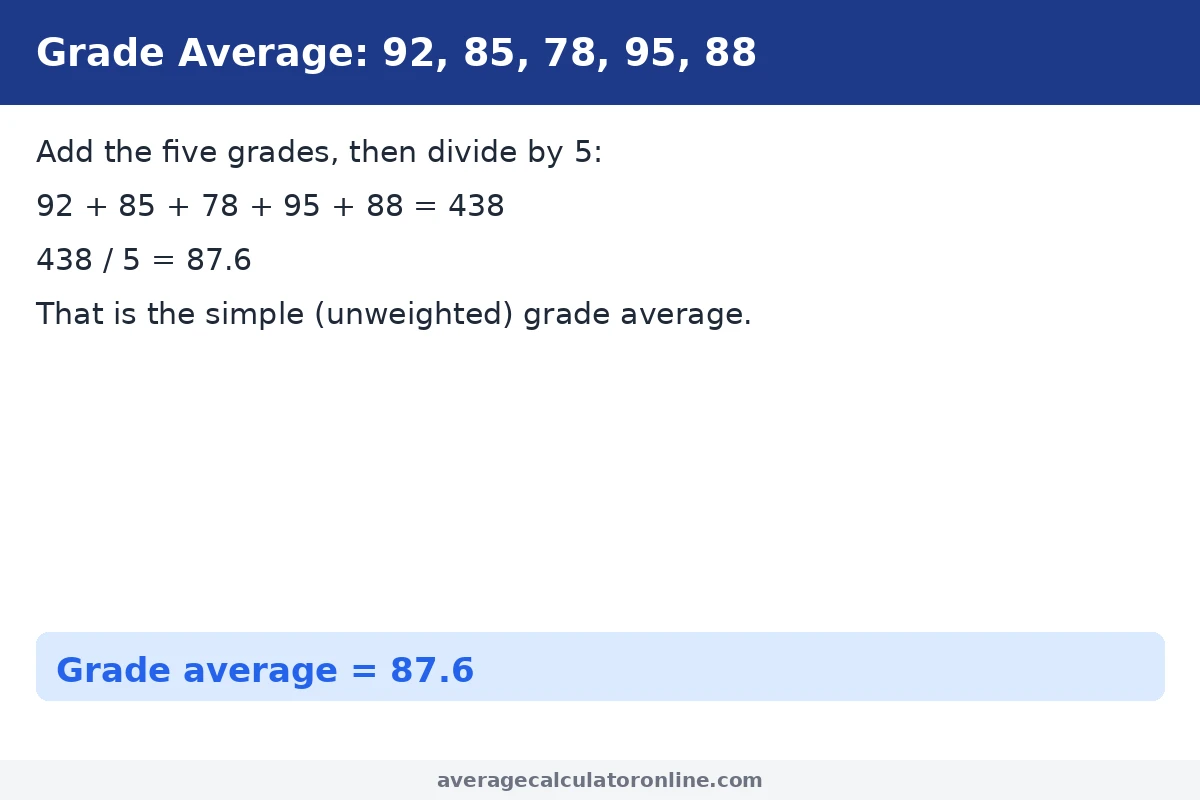
Suppose your five quiz grades are 92, 85, 78, 95, and 88:
- Add the grades: 92 + 85 + 78 + 95 + 88 = 438
- Count the grades: there are 5
- Divide: 438 / 5 = 87.6
Your grade average is 87.6. A useful sanity check: an average can never be higher than your best grade or lower than your worst. If your result falls outside that range, you have made an arithmetic error.
Worked Example 2: A Semester Average
Now take four semester grades: 88, 91, 76, and 84.
- Add them: 88 + 91 + 76 + 84 = 339
- Count them: 4
- Divide: 339 / 4 = 84.75
The semester average is 84.75. In many schools this would round to 85, which is often the boundary of a B grade — but rounding rules differ by school, so check how yours rounds.
How GPA Works: The 4.0 Scale
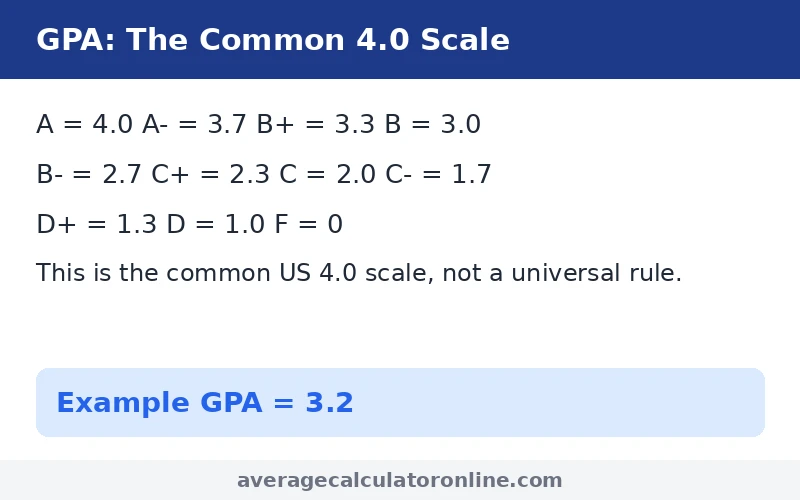
GPA — grade point average — applies the same idea to letter grades converted into points. On the common US 4.0 scale, each letter grade is worth a fixed number of points:
| Letter grade | Grade points |
|---|---|
| A | 4.0 |
| A− | 3.7 |
| B+ | 3.3 |
| B | 3.0 |
| B− | 2.7 |
| C+ | 2.3 |
| C | 2.0 |
| C− | 1.7 |
| D+ | 1.3 |
| D | 1.0 |
| F | 0 |
This table is the common US 4.0 scale — not a universal rule. Some schools use a 4.3 scale, some give A+ a value of 4.0 or 4.3, and some do not use plus and minus grades at all. If your school publishes its own conversion table, use that one.
The GPA formula is:
GPA = (sum of grade points) / (number of courses)
Worked Example 3: GPA on a 4.0 Scale
Suppose your five course grades are A, B+, A−, B, and C. Convert each to points:
- A = 4.0
- B+ = 3.3
- A− = 3.7
- B = 3.0
- C = 2.0
Add the points: 4.0 + 3.3 + 3.7 + 3.0 + 2.0 = 16.0. Divide by 5 courses: 16.0 / 5 = 3.2.
Your GPA is 3.2 on a 4.0 scale — a solid B average.
Weighted vs Unweighted GPA
An unweighted GPA treats every course equally. A weighted GPA gives more influence to courses that carry more credits — or, in some schools, to harder courses such as honours or AP classes.
The weighted GPA formula is:
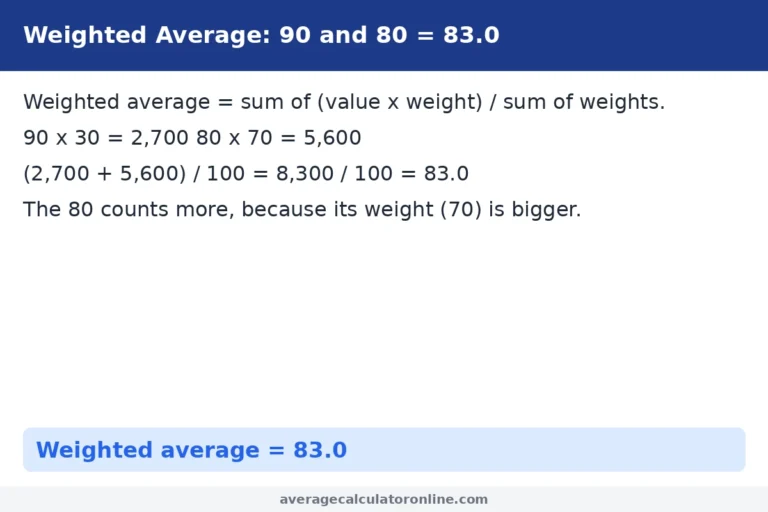
Weighted GPA = (sum of grade points × credits) / (total credits)
Here is a worked example with three courses:
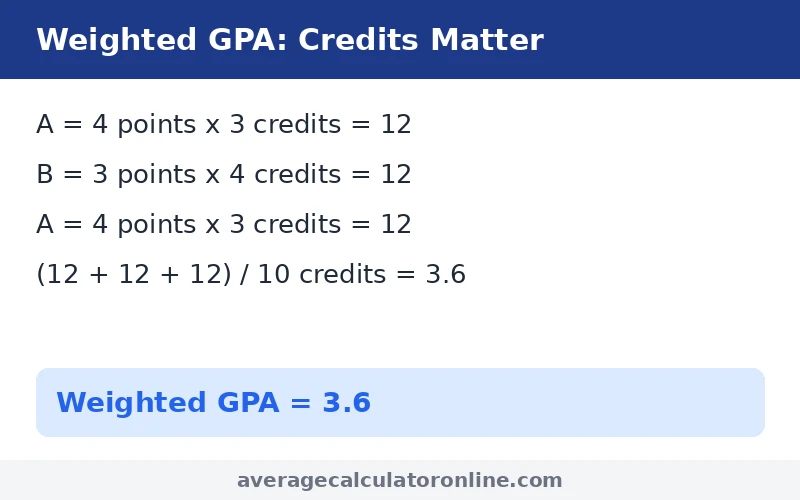
- Course 1: A (4 points), 3 credits → 4 × 3 = 12
- Course 2: B (3 points), 4 credits → 3 × 4 = 12
- Course 3: A (4 points), 3 credits → 4 × 3 = 12
Total grade points: 12 + 12 + 12 = 36. Total credits: 3 + 4 + 3 = 10. Weighted GPA: 36 / 10 = 3.6.
Compare that with the unweighted GPA for the same three grades: (4 + 3 + 4) / 3 = 3.67. The weighted result is slightly lower, because the B sits in the 4-credit course and therefore pulls the average down more.
If your school adds extra points for honours or AP courses, that is a different kind of weighting — check your school’s policy for the exact weights it applies.
What Score Do I Need on the Final?
This is one of the most common grade questions students ask: given my current average, what do I need on the final exam to reach my target grade? The method is straightforward once you know the weights.
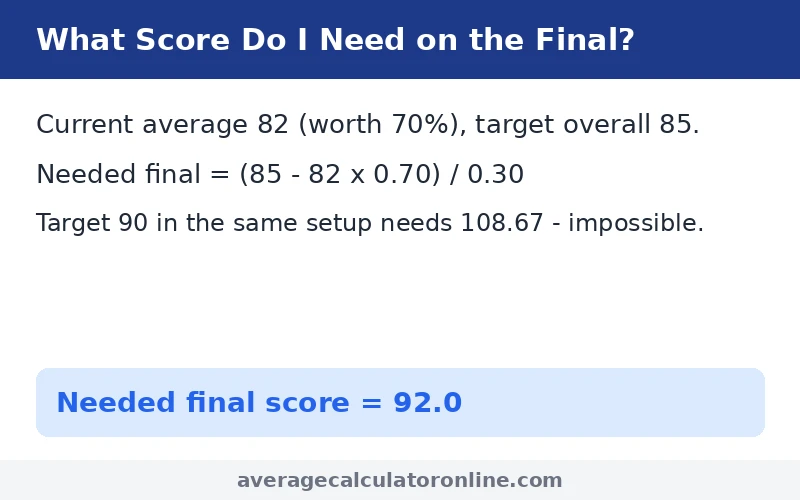
Suppose your current average is 82, it counts for 70% of your final grade, and the final exam counts for 30%. You want an overall grade of 85.
Needed final score = (target − current average × current weight) / final weight
Plug in the numbers:
- Current contribution: 82 × 0.70 = 57.4
- Remaining points needed: 85 − 57.4 = 27.6
- Divide by the final’s weight: 27.6 / 0.30 = 92.0
You need 92.0 on the final exam to finish at 85 overall. That is a demanding but achievable target.
Now try the same setup with a target of 90:
- Current contribution: 82 × 0.70 = 57.4
- Remaining points needed: 90 − 57.4 = 32.6
- Divide by the final’s weight: 32.6 / 0.30 = 108.67
A score of 108.67 on a 100-point exam is impossible. This is an important lesson: some targets cannot be reached, no matter how well you do on the final. When the required score is above 100, the honest answer is to lower the target, or to check whether there is extra credit that can still move the average. The Final Grade Calculator runs this same calculation for any weights and targets.
Converting a 100-Point Score to a 4.0 GPA
Students often ask what a percentage score such as 88 means on a 4.0 GPA scale. There is no single conversion: a score of 88 might be a B+ at one school and an A− at another. As a rough approximation only, a simple linear mapping — where 100 maps to 4.0 and 0 maps to 0 — would put a score of 88 at roughly 3.5 (88 / 100 × 4.0 = 3.52). Treat that as an approximation, not a rule. The reliable route is to convert your percentage to a letter grade using your school’s own scale first, then convert the letter to grade points using the table above.
Common Mistakes to Avoid
Averaging letter grades without converting them to points. Letters are labels, not numbers. Convert each letter to its grade points first, then average the points.
Forgetting credit weights. A 4-credit course should count more than a 1-credit course. If you average grade points without weighting by credits, a small course has the same influence as a large one, and the result will be wrong.
Mixing scales. Do not average a 4.0-scale GPA with a percentage, or a 100-point grade with a 5.0-scale grade. Convert everything to one scale first.
Rounding too early. Keep one or two extra decimal places through the calculation and round only the final answer. Rounding each grade first can shift the result at a grade boundary.
Counting a grade twice — or not at all. Before dividing, count the grades in your list and check the count matches the number of courses or assignments.
Try It
Work out your own numbers with the free tools on this site: the Grade Calculator, the GPA Calculator, the Weighted Average Calculator, and the Final Grade Calculator.
Frequently Asked Questions
How do I calculate my grade average?
Add all your grades together and divide by the number of grades. For example, grades of 92, 85, 78, 95, and 88 add up to 438; dividing by 5 gives an average of 87.6. If grades have different weights, use a weighted average instead.
How do I calculate my GPA on a 4.0 scale?
Convert each letter grade to grade points on the common US 4.0 scale (A = 4.0, B = 3.0, C = 2.0, D = 1.0, F = 0, with plus and minus grades in between), add the points, and divide by the number of courses. For example, A, B+, A−, B, and C give (4.0 + 3.3 + 3.7 + 3.0 + 2.0) / 5 = 3.2. Always check your school’s own scale, because tables differ.
What is the difference between weighted and unweighted GPA?
An unweighted GPA treats every course equally. A weighted GPA multiplies each grade’s points by the course’s credits (and sometimes adds extra points for honours or AP courses) before dividing by total credits. In the example in this guide, the same three grades give an unweighted GPA of 3.67 but a weighted GPA of 3.6, because the B sits in a 4-credit course.
What score do I need on my final exam to get an 85?
It depends on your current average and the weights. With a current average of 82 counting 70% and a final worth 30%, you need 92.0 on the final to reach 85 overall: (85 − 82 × 0.70) / 0.30 = 92.0. Use the Final Grade Calculator on this site to test your own numbers.
What if the score I need on the final is above 100?
Then the target cannot be reached on that exam alone. In the example in this guide, a target of 90 with the same setup would need a final score of 108.67, which is impossible on a 100-point exam. Lower the target, or ask your teacher whether extra credit or another graded item can still change the average.
What GPA is an 88 on a 4.0 scale?
There is no universal conversion, because schools use different tables. Under a simple linear mapping, 88 out of 100 converts to roughly 3.5 on a 4.0 scale — but that is only an approximation. Convert the percentage to a letter grade using your school’s own scale first, then convert that letter to grade points.
Related calculators: Grade Calculator · GPA Calculator · Final Grade Calculator · Weighted Average Calculator