Grade Calculator: Weighted Grades and the Final Exam Score You Need
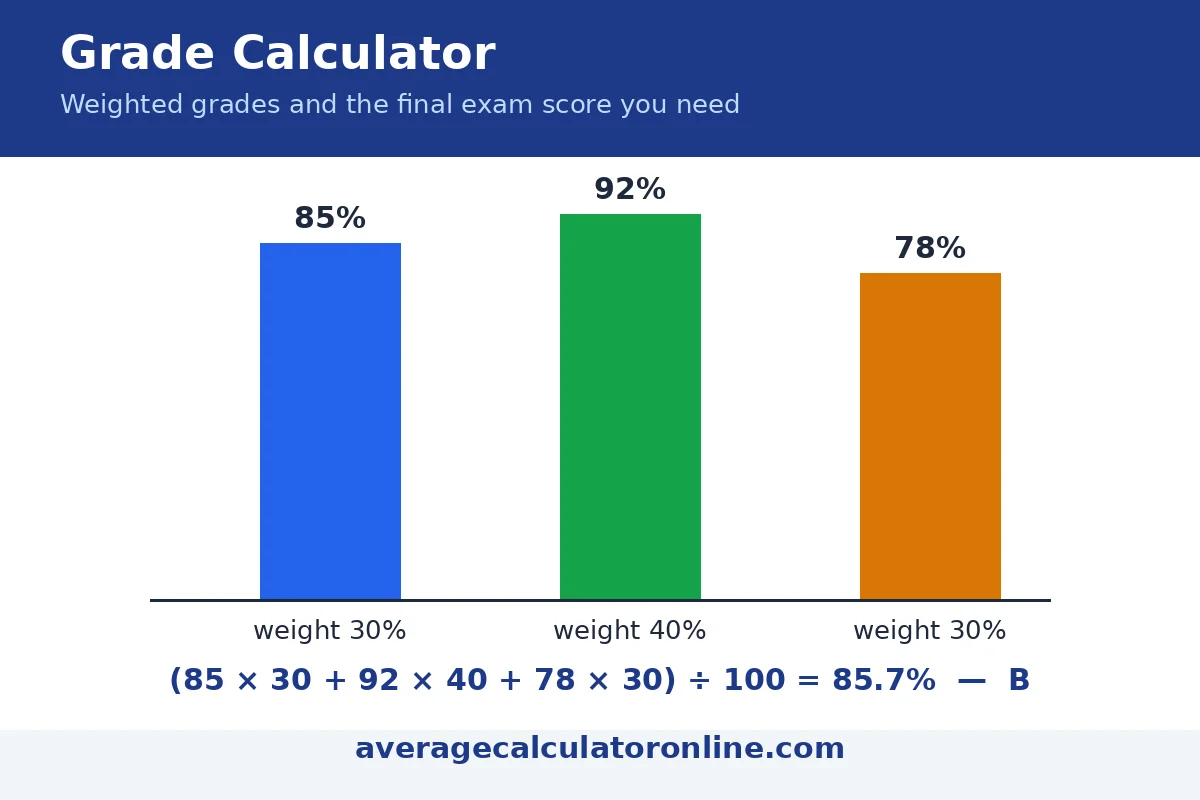
Short answer: A weighted grade is the sum of each score times its weight, divided by the total weight. Scores of 85, 92 and 78 with weights of 30, 40 and 30 give (85 times 30 + 92 times 40 + 78 times 30) divided by 100, which is 85.7 percent, a B. To find the final exam score you need, solve the same formula backwards. Use the grade calculator for the weighted grade, and the final grade calculator for the score you need on the final.
How weighted grades work
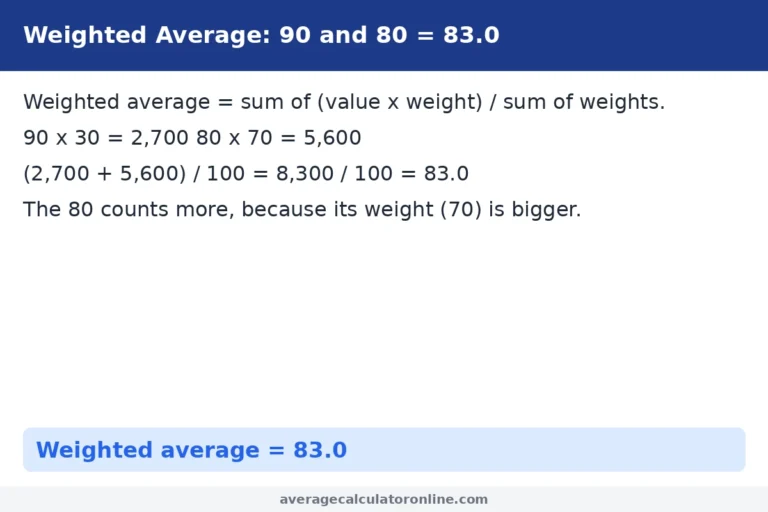
Not every assignment counts the same. A final exam worth 50 percent influences the result five times more than homework worth 10 percent. A weighted grade respects that: each score is multiplied by its weight, the products are added, and the total is divided by the total weight.
Example 1, the default: scores 85 with weight 30, 92 with weight 40, and 78 with weight 30. Overall grade is (85 times 30 + 92 times 40 + 78 times 30) divided by 100. The products are 2550, 3680 and 2340. Their sum is 8570, and 8570 divided by 100 is 85.7 percent, a B. The plain average of the same three scores is 85.0 percent.
Example 2: scores 90 with weight 20, 84 with weight 30, and 76 with weight 50. Overall grade is (90 times 20 + 84 times 30 + 76 times 50) divided by 100. The products are 1800, 2520 and 3800. Their sum is 8120, and 8120 divided by 100 is 81.2 percent, a B. The plain average of the same scores is 83.33 percent.
Weights do not have to add up to 100. The calculator divides by the total of the weights you entered, so the result stays correct as a weighted average. Scores of 90, 80 and 70 with weights of 3, 2 and 1 give (270 + 160 + 70) divided by 6, which is 500 divided by 6, which is 83.33 percent. The same rule covers points: if every assignment is out of the same total, convert points to a percentage first, then enter it here.
The final exam score you need
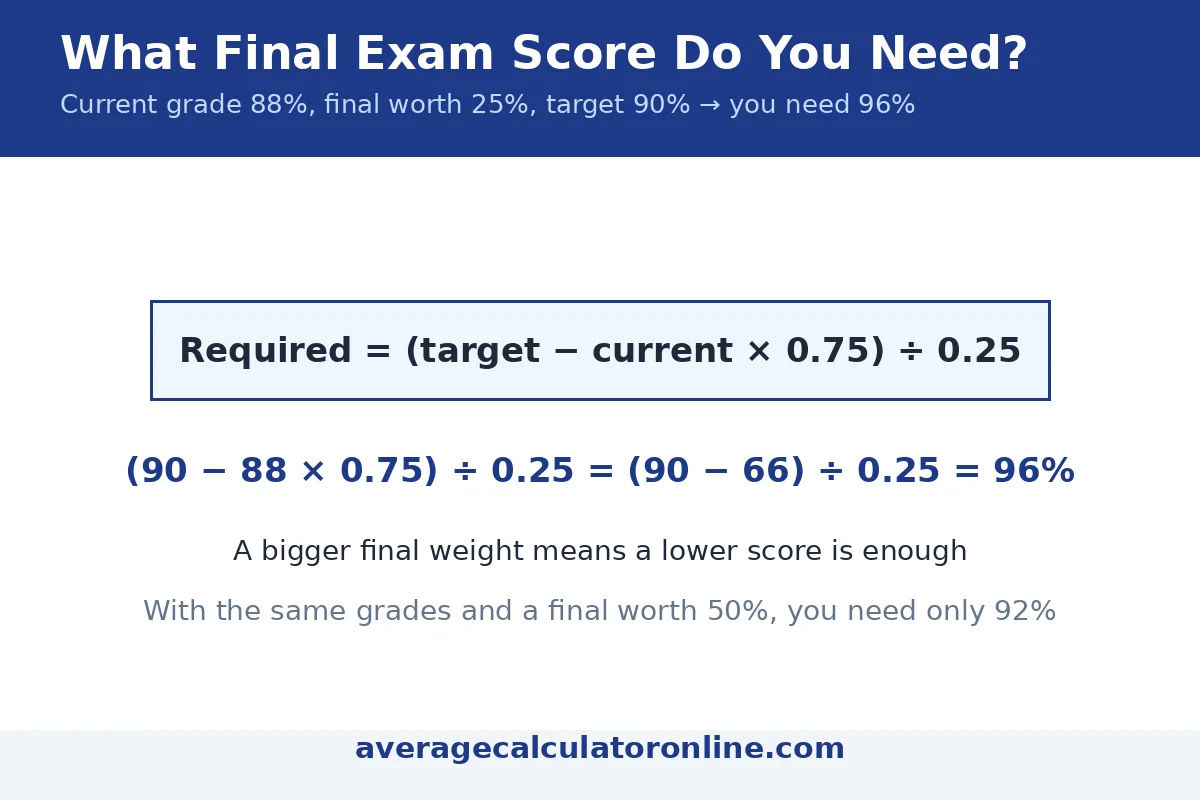
The final exam question runs the formula backwards: required score equals target grade minus current grade times one minus the final weight, all divided by the final weight.
Example 3, aiming for an A: current grade 88 percent, final worth 25 percent, target 90 percent. Required score is (90 minus 88 times 0.75) divided by 0.25. 88 times 0.75 is 66, 90 minus 66 is 24, and 24 divided by 0.25 is 96 percent. You need 96 percent on the final to finish with a 90.
Example 4, aiming to hold a B: current grade 78 percent, final worth 20 percent, target 80 percent. Required score is (80 minus 78 times 0.8) divided by 0.2. 78 times 0.8 is 62.4, 80 minus 62.4 is 17.6, and 17.6 divided by 0.2 is 88 percent. You need 88 percent on the final to finish with an 80.
Example 5, already above target: current grade 91 percent, final worth 30 percent, target 90 percent. Required score is (90 minus 91 times 0.7) divided by 0.3. 91 times 0.7 is 63.7, 90 minus 63.7 is 26.3, and 26.3 divided by 0.3 is 87.67 percent, about 87.7 percent.
Example 6, an impossible target: current grade 82 percent, final worth 30 percent, target 90 percent. Required score is (90 minus 82 times 0.7) divided by 0.3. 82 times 0.7 is 57.4, 90 minus 57.4 is 32.6, and 32.6 divided by 0.3 is 108.67 percent. No score on the final can reach the target, because the required score is above 100 percent. The honest options are to raise the current grade before the final, if any work is still open, or to choose a lower target.
How the final weight changes the answer
The same current grade and target give a very different required score when the final is worth more or less. Take a current grade of 88 percent and a target of 90 percent. With a final worth 50 percent, the required score is 92 percent. With a final worth 25 percent, it is 96 percent, as in Example 3. With a final worth 10 percent, it is 108 percent, which is not possible.
Letter grades
Letter grades use the standard US scale on this site: A is 90 to 100, B is 80 to 89, C is 70 to 79, D is 60 to 69, and below 60 is F. Your school scale may differ.
| Letter | Score range | GPA points |
|---|---|---|
| A+ | 97 to 100 | 4.0 |
| A | 93 to 96 | 4.0 |
| A- | 90 to 92 | 3.7 |
| B+ | 87 to 89 | 3.3 |
| B | 83 to 86 | 3.0 |
| B- | 80 to 82 | 2.7 |
| C+ | 77 to 79 | 2.3 |
| C | 73 to 76 | 2.0 |
| C- | 70 to 72 | 1.7 |
| D | 60 to 69 | 1.0 |
| F | Below 60 | 0.0 |
A grade calculator and a GPA calculator answer different questions. A grade calculator turns assignment scores and weights into one overall percentage and letter grade for one course. A GPA calculator turns letter grades and credit hours into a GPA on the 4.0 scale for a whole term. Use the GPA calculator to work out yours.
Common mistakes
Averaging scores without weights: the plain average of 85, 92 and 78 is 85.0 percent, but the weighted grade is 85.7 percent. When weights differ, the plain average is wrong.
Forgetting to divide by the total weight: weights of 3, 2 and 1 add up to 6, not 100. Divide by 6, not by 100, or the answer comes out far too small.
Mixing points and percentages: if assignments are out of different totals, convert each one to a percentage first. Adding raw points from a 20 point quiz and a 100 point exam gives the exam five times too much weight.
Chasing an impossible target: if the required score is above 100 percent, the target cannot be reached on the final alone. Check the number before you plan around it.
From letter grades to GPA: a worked term
A grade calculator gives one course grade. A GPA turns a whole term of letter grades into one number on the 4.0 scale, using the letter table in this guide: A is 4.0, A minus 3.7, B plus 3.3, B 3.0, C 2.0, D 1.0 and F 0.0. Each course counts by its credit hours: multiply the points by the credits, add the results, and divide by the total credits.
Example, one term: English A, 3 credits; Math B plus, 4 credits; History C, 3 credits; Science A minus, 2 credits. The quality points are 4.0 times 3, which is 12.0; 3.3 times 4, which is 13.2; 2.0 times 3, which is 6.0; and 3.7 times 2, which is 7.4. The total is 38.6 quality points over 12 credits. The GPA is 38.6 divided by 12, which is 3.22.
One better grade moves the result. If the History C becomes a B, worth 3.0 points, the History points rise from 6.0 to 9.0, the total rises to 41.6, and the GPA becomes 41.6 divided by 12, which is 3.47. A 3.22 is a B average, and a 3.47 sits between B plus and A minus. Plus and minus scales vary by school, so check your own scale before comparing GPAs. Work out a whole term with the GPA calculator, and the score you need on one final exam with the final grade calculator.
FAQ
How do you calculate a weighted grade?
Multiply each score by its weight, add the results, and divide by the total weight. Scores of 85, 92 and 78 with weights of 30, 40 and 30 give 85.7 percent, which is a B.
What final exam score do I need to get an A?
Use the formula: required score equals target grade minus current grade times one minus the final weight, all divided by the final weight. With a current grade of 88 percent, a final worth 25 percent, and a target of 90 percent, the required score is 96 percent.
What if the score I need is above 100 percent?
Then the target cannot be reached on the final exam alone. For example, a current grade of 82 percent with a final worth 30 percent cannot reach a target of 90 percent, because the required score is 108.67 percent. Raise the current grade or choose a lower target.
What is a B grade in percentage?
On the standard US scale, B is 80 to 89 percent. A is 90 to 100 percent, C is 70 to 79 percent, D is 60 to 69 percent, and below 60 percent is F. Your school scale may differ.
Do weights have to add up to 100?
No. The calculator divides by the total of the weights you entered, so the result stays correct. Scores of 90, 80 and 70 with weights of 3, 2 and 1 give 83.33 percent.
What is the difference between a grade calculator and a GPA calculator?
A grade calculator turns assignment scores and weights into one overall percentage and letter grade. A GPA calculator turns letter grades and credit hours into a GPA on the 4.0 scale. Use the grade calculator for one course and the GPA calculator for a whole term.
Related calculators: Grade Calculator · Final Grade Calculator · GPA Calculator · Percentage Calculator