Time Calculator: Add, Subtract and Convert Hours and Minutes
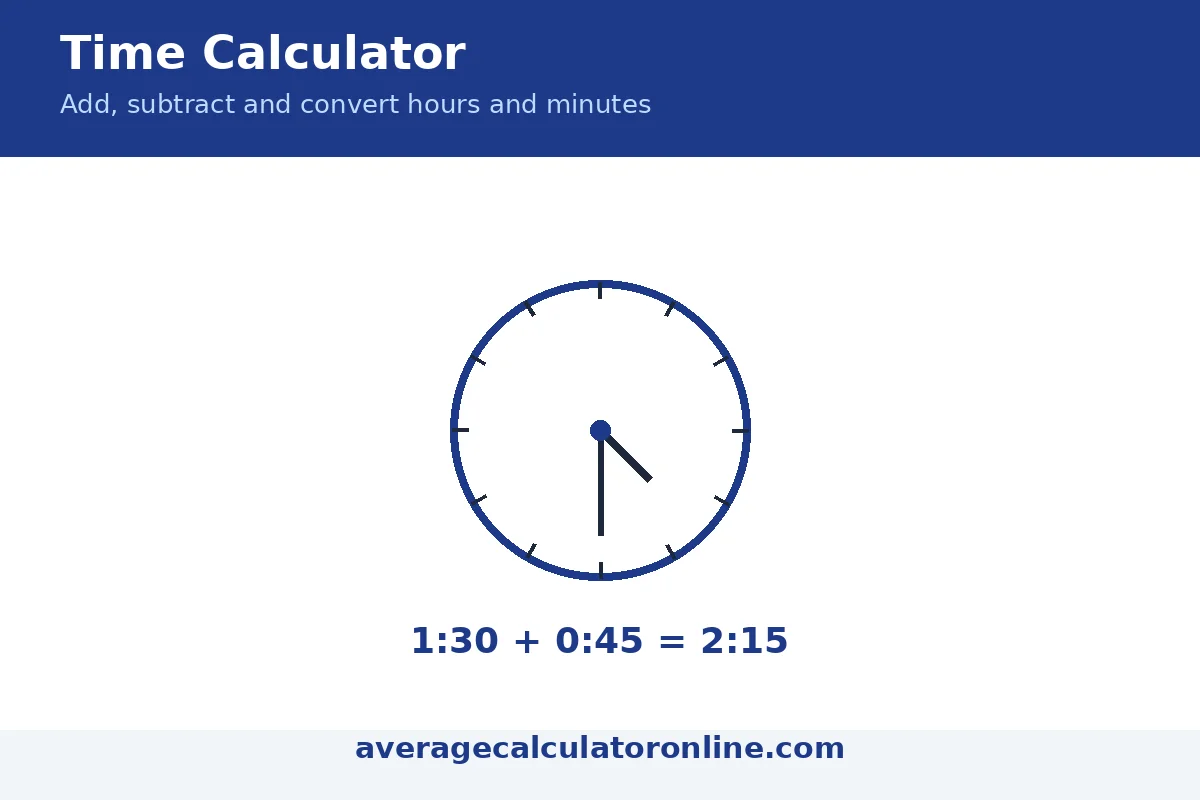
Short answer: To add hours and minutes, add the minutes first and carry every 60 minutes into 1 hour. 1 hour 30 minutes plus 45 minutes is 2 hours 15 minutes, because 30 plus 45 is 75 minutes, which is 1 hour and 15 minutes. Use the time calculator to add times, subtract times, find the duration between two clock times, and average a list of times.
How to add hours and minutes
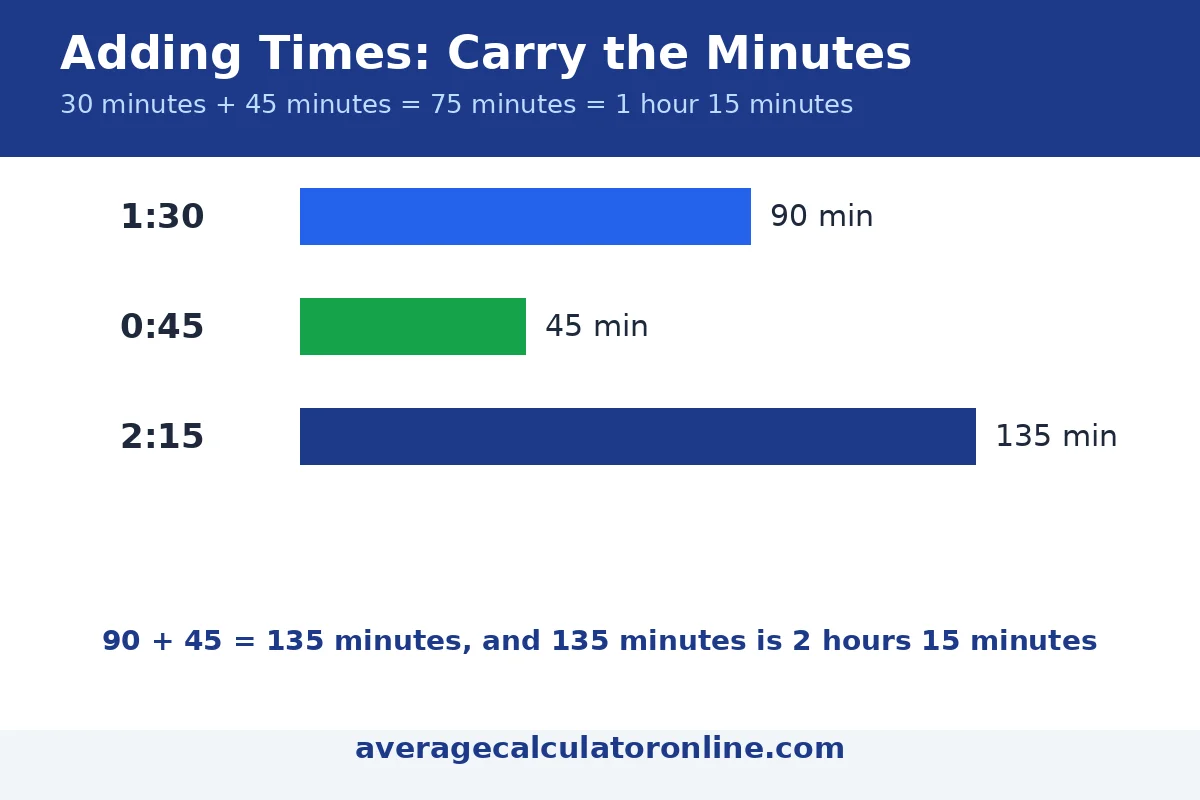
Adding times is a two step job. First add the minutes, then add the hours, and carry 60 minutes into 1 hour whenever the minutes reach 60 or more. The carry is the only part that trips people up, because time does not work in tens the way ordinary numbers do. 1 hour is 60 minutes, so 75 minutes is 1 hour and 15 minutes, not 0.75 hours written as 75 minutes.
Example 1: 1:30 + 0:45. Add the minutes: 30 + 45 = 75. 75 minutes is 1 hour and 15 minutes, so carry 1 hour and keep 15 minutes. Add the hours: 1 + 0 + 1 carried = 2 hours. The answer is 2 hours 15 minutes. In minutes, the same sum is 90 + 45 = 135 minutes, and 135 divided by 60 is 2.25 hours.
Example 2: 2:45 + 3:20. Add the minutes: 45 + 20 = 65, which is 1 hour and 5 minutes. Add the hours: 2 + 3 + 1 carried = 6 hours. The answer is 6 hours 5 minutes. In minutes, the sum is 165 + 200 = 365 minutes, and 365 divided by 60 is 6 hours with 5 minutes left over.
How to subtract hours and minutes
Subtraction runs the other way round. Subtract the minutes first. If the top minutes are smaller than the bottom minutes, borrow 1 hour from the hours column, which adds 60 minutes to the minutes column, then subtract.
Example 3: 10:30 minus 08:15. The minutes are 30 minus 15, which is 15. The hours are 10 minus 8, which is 2. The answer is 2 hours 15 minutes. In minutes, the difference is 630 minus 495, which is 135 minutes.
Example 4, with borrowing: 5:20 minus 2:45. The minutes are 20 minus 45, which cannot be done as it stands, so borrow 1 hour: 5:20 becomes 4:80. Now 80 minus 45 is 35 minutes, and 4 minus 2 is 2 hours. The answer is 2 hours 35 minutes. Check it in minutes: 320 minus 165 is 155 minutes, and 155 minutes is 2 hours 35 minutes.
Borrowing is the most common subtraction mistake. People who forget to borrow get a negative number of minutes and a wrong answer. If your subtraction ever gives a negative number of minutes, borrow 1 hour and try again.
Duration between two times
A duration is the end time minus the start time. The time calculator on this site uses a start of 9:00 AM and an end of 5:30 PM as its default example, and the answer is 8 hours 30 minutes, which is 510 minutes. In 24 hour form the same sum is 17:30 minus 9:00, which is 8 hours 30 minutes.
Overnight spans need one extra step. If the end time is earlier than the start time, the span crosses midnight, so add 24 hours to the end time. A shift from 10:00 PM to 6:00 AM is 8 hours, not a negative number: 6:00 AM plus 24 hours is 30:00, and 30:00 minus 22:00 is 8 hours. The same rule covers any night shift, late flight, or event that runs past midnight.
Converting between hours, minutes and seconds
Time units convert by 60, not by 10 or 100. 1 hour is 60 minutes, 1 minute is 60 seconds, and 1 hour is 3600 seconds. The table below covers the conversions this guide uses most.
| Minutes | Hours | Seconds |
|---|---|---|
| 30 | 0.5 | 1800 |
| 45 | 0.75 | 2700 |
| 90 | 1.5 | 5400 |
| 135 | 2.25 | 8100 |
| 510 | 8.5 | 30600 |
To turn minutes into hours, divide by 60. To turn hours into minutes, multiply by 60. To turn seconds into hours, minutes and seconds, divide by 3600 and keep the whole hours, divide the remainder by 60 for the minutes, and what is left is the seconds. For example, 510 minutes is 8.5 hours, and 6750 seconds is 1 hour, 52 minutes and 30 seconds, because 6750 divided by 3600 is 1 with 3150 left over, and 3150 divided by 60 is 52 with 30 left over.
The decimal form causes the most confusion. 2.25 hours is 2 hours 15 minutes, not 2 hours 25 minutes, because 0.25 of an hour is 15 minutes. Convert the decimal part by multiplying it by 60.
Averaging times
To average durations, convert every time to seconds, add them up, divide by how many there are, then convert the result back. Four durations of 1:30, 2:15, 0:45 and 3:00 add up to 450 minutes. 450 divided by 4 is 112.5 minutes, which is 1 hour 52 minutes 30 seconds. In seconds the same sum is 27000 seconds, and 27000 divided by 4 is 6750 seconds.
Clock times are different, because they live on a circle that wraps at midnight. Never average clock times like ordinary numbers near midnight. The straight average of 23:50 and 00:10 is 12:00, which is wrong: the two times are 20 minutes apart across midnight, so their circular mean is 00:00. To average them, unwrap the timeline by treating 00:10 as 24:10, then average 23:50 and 24:10 to get 24:00, which is 00:00.
Common mistakes
Adding minutes past 60 without carrying: 1:30 + 0:45 is 2:15, not 1:75. Every 60 minutes becomes 1 hour.
Reading 2.25 hours as 2 hours 25 minutes: the decimal part is a fraction of an hour, so 0.25 hours is 15 minutes.
Forgetting the overnight rule: an end time earlier than the start time means the next day. Add 24 hours before you subtract.
Averaging clock times near midnight: 23:50 and 00:10 average to 00:00 on the circle, not 12:00. Unwrap the timeline first.
Minutes to decimal hours: work time and pay
Payroll systems record work time in decimal hours, not in hours and minutes, so minutes must be turned into a fraction of an hour. Divide the minutes by 60. 15 minutes is 0.25 hours, 30 minutes is 0.5 hours, 45 minutes is 0.75 hours, 90 minutes is 1.5 hours, 105 minutes is 1.75 hours, and 150 minutes is 2.5 hours. The decimal part is a fraction of an hour, so 2.25 hours is 2 hours 15 minutes, not 2 hours 25 minutes.
Example, a day of work: 7 hours 30 minutes at 20 dollars an hour is 7.5 times 20, which is 150 dollars. Five such days are 37.5 hours, and 37.5 times 20 is 750 dollars for the week.
Example, overtime: 40 regular hours at 20 dollars an hour is 800 dollars, and 5 overtime hours at time and a half, which is 30 dollars an hour, add 5 times 30, which is 150 dollars. The weekly total is 800 plus 150, which is 950 dollars. Convert the minutes first, then multiply by the rate, and check the result with the paycheck calculator, which also works out tax and take home pay. For the division itself, the math calculator gives the decimal answer directly.
FAQ
How do you add hours and minutes?
Add the minutes first. Every 60 minutes becomes 1 hour, then add the hours. For example, 1 hour 30 minutes plus 45 minutes is 2 hours 15 minutes, because 30 plus 45 is 75 minutes, which is 1 hour and 15 minutes.
How do you subtract hours and minutes?
Subtract the minutes first. If the top minutes are smaller, borrow 1 hour, which is 60 minutes, from the hours. For example, 10 hours 30 minutes minus 8 hours 15 minutes is 2 hours 15 minutes.
How do you find the duration between two times?
Subtract the start time from the end time. If the end time is earlier than the start time, add 24 hours, because the span crosses midnight. For example, 9:00 AM to 5:30 PM is 8 hours 30 minutes, which is 510 minutes.
How many minutes are in 8 hours 30 minutes?
Multiply the hours by 60 and add the minutes. 8 times 60 is 480, plus 30 is 510 minutes.
Can a time calculator handle overnight shifts?
Yes. An end time earlier than the start time is treated as the next day. A shift from 10:00 PM to 6:00 AM is 8 hours, not a negative number.
Why is the average of 23:50 and 00:10 not 12:00?
Clock times wrap around midnight, so they cannot be averaged like ordinary numbers. The two times are 20 minutes apart across midnight, and their circular mean is 00:00. To average them, treat 00:10 as 24:10 first.
Related calculators: Time Calculator · Date Calculator · Age Calculator · Percentage Calculator