Volume Calculator: Box, Cylinder, Sphere and Everyday Volumes
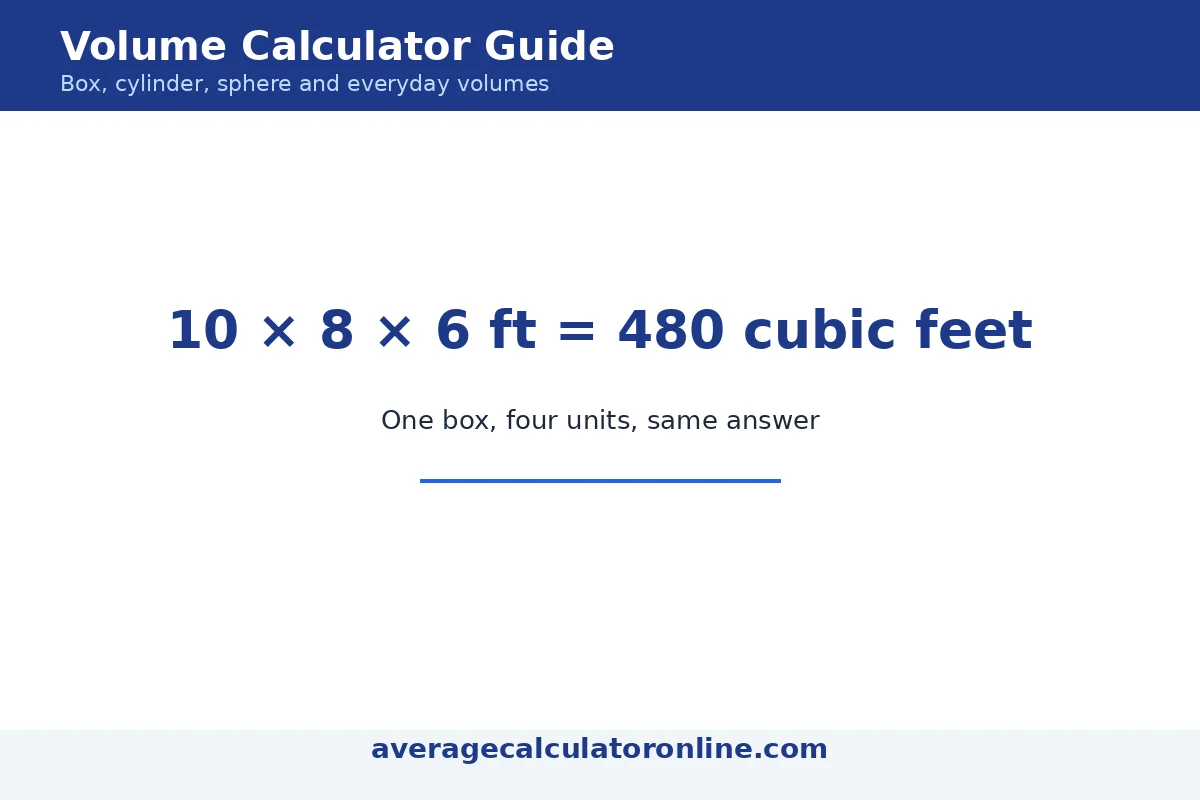
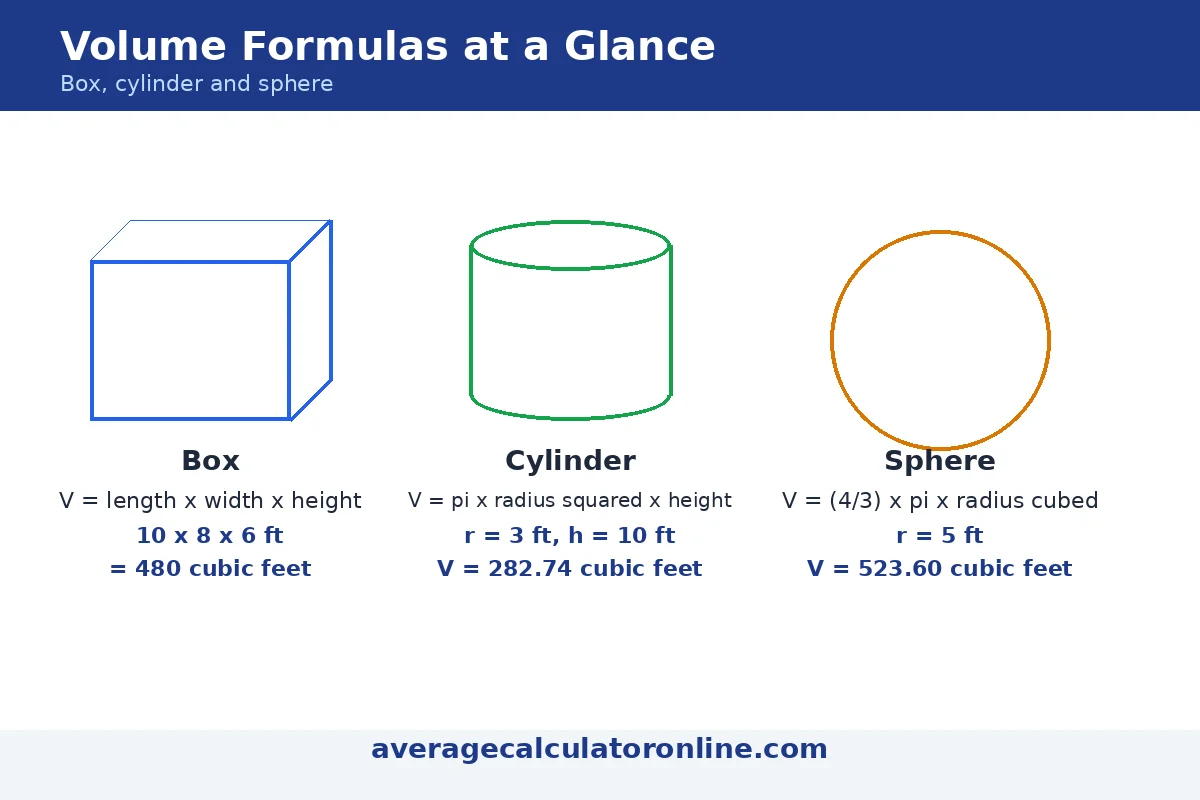
Short answer: Volume measures three dimensional space. A box is length × width × height, a cylinder is π × radius² × height, and a sphere is (4/3) × π × radius³. The volume calculator works out boxes, cylinders, spheres, cones, pyramids, prisms and ellipsoids, and converts the answer into cubic feet, cubic yards, litres and gallons. A box 10 feet long, 8 feet wide and 6 feet high holds 480 cubic feet, which is 17.78 cubic yards, 13,592.1 litres and 3,590.6 US gallons.
Volume formulas for common shapes
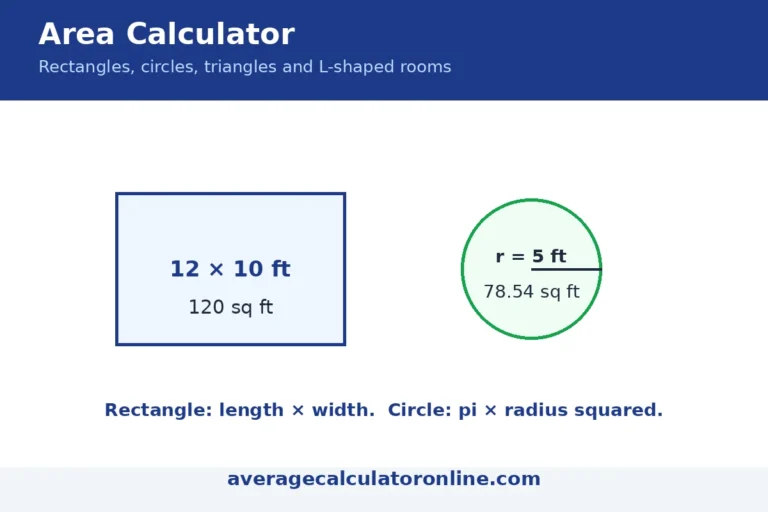
Each shape in the calculator uses one formula, and every dimension must be in the same unit before you start. Measure a flat surface first with the area calculator if you only have the floor size, then add the height to get volume.
| Shape | Formula |
|---|---|
| Box | V = length × width × height |
| Cylinder | V = π × radius² × height |
| Sphere | V = (4/3) × π × radius³ |
| Cone | V = (1/3) × π × radius² × height |
| Square pyramid | V = (1/3) × base² × height |
| Triangular prism | V = (base × height ÷ 2) × length |
| Ellipsoid | V = (4/3) × π × semi-axis 1 × semi-axis 2 × semi-axis 3 |
The ellipsoid axes are semi-axes, which means half the full length, width and height. The cone and the square pyramid both use a third of the matching box or cylinder, which is why the (1/3) factor appears in both formulas.
Worked examples
Example 1, box: 10 ft × 8 ft × 6 ft = 480 cubic feet. Convert it: 480 ÷ 27 = 17.78 cubic yards, 480 × 28.3168 = 13,592.1 litres, and 480 × 7.48052 = 3,590.6 US gallons. The same box holds the same amount in every unit; only the number changes.
Example 2, cylinder: a cylinder with a radius of 3 feet and a height of 10 feet. Volume = π × 3² × 10 = 282.74 cubic feet. That is the shape of a water tank or a round storage bin, and the radius is measured from the centre to the edge, not across the whole width.
Example 3, cone: a cone with a radius of 3 feet and a height of 7 feet. Volume = (1/3) × π × 3² × 7 = 65.97 cubic feet. A cone holds exactly one third of the cylinder with the same radius and height.
Example 4, sphere: a sphere with a radius of 5 feet. Volume = (4/3) × π × 5³ = 523.60 cubic feet. Doubling the radius multiplies the volume by 8, because the radius is cubed, so small changes in radius make a large difference to the answer.
Converting between volume units
Volume units convert with fixed factors, and the calculator does them for you. There are exactly 27 cubic feet in a cubic yard, because 1 yard is 3 feet and 3³ = 27. One cubic foot holds 28.3168 litres, and one cubic foot holds 7.48052 US gallons. One litre is 1,000 cubic centimetres, so a cube 10 centimetres on each side holds 10 × 10 × 10 = 1,000 cubic centimetres, which is exactly 1 litre.
To convert by hand, multiply or divide by the factor in the right direction. Divide cubic feet by 27 to get cubic yards. Multiply cubic feet by 28.3168 to get litres, and by 7.48052 to get US gallons. Always write the unit next to the number while you work, and check that the answer is in the unit you wanted before you use it.
Everyday volumes
A moving box is the most common everyday volume. A box 10 feet long, 8 feet wide and 6 feet high holds 480 cubic feet, which is a large storage space, and the calculator converts it to 17.78 cubic yards for comparison with a truck or a skip.
A cylindrical water tank shows the same idea in gallons. A tank with a radius of 3 feet and a height of 10 feet holds 282.74 cubic feet, which is 2,115.07 US gallons. That conversion matters when you buy a pump or a filter rated in gallons, because the tank size is usually measured in feet.
Building work uses volume too. A concrete slab is a flat box, so its volume is length × width × thickness, and the concrete calculator turns that volume into cubic yards and bags. The math calculator is handy for the multiplication itself when the numbers get long.
Common mistakes
Mixed units: entering length in feet and height in inches gives a wrong answer. Pick one unit and enter every dimension in it, then let the calculator convert the result.
Radius and diameter: the cylinder, cone and sphere formulas use the radius, which is half the diameter. Using the full diameter as the radius makes the answer 8 times too big for a sphere and 4 times too big for a cylinder.
Square and cubic units: area is measured in square units and volume in cubic units. A floor of 80 square feet is not 80 cubic feet; volume needs the third dimension as well.
Forgetting the (1/3) factor: a cone or a square pyramid holds one third of the matching cylinder or box. Leaving the factor out triples the answer.
Everyday volume conversions: cups, litres and gallons
Kitchen and household volumes use cups, litres and gallons, and the conversion factors between them are fixed. One US gallon is 16 US cups and 3.78541 litres. One litre is 4.22675 US cups. One cubic foot is 7.48052 US gallons and 28.3168 litres. Keep the US gallon in mind: a US gallon is smaller than an imperial gallon, so a conversion from a UK recipe needs the imperial factor, not the US one.
Example, a bucket: a 5 gallon bucket holds 5 times 16, which is 80 cups.
Example, a bottle: a 2 litre bottle holds 2 times 4.22675, which is 8.45 cups after rounding to two decimal places.
Example, a box: a box of 10 cubic feet holds 10 times 7.48052, which is 74.81 gallons, and 10 times 28.3168, which is 283.17 litres.
Example, a drum: a 55 gallon drum holds 55 divided by 7.48052, which is 7.35 cubic feet, and 55 times 3.78541, which is 208.20 litres. For building work, the concrete calculator turns a volume in cubic feet into cubic yards and bags, and the math calculator is handy for the multiplication itself when the factors get long.
FAQ
How do you calculate the volume of a box?
Multiply length by width by height, with all three dimensions in the same unit. A box 10 feet long, 8 feet wide and 6 feet high holds 10 times 8 times 6, which is 480 cubic feet.
What is the volume formula for a cylinder?
The volume of a cylinder is pi times the radius squared times the height. A cylinder with a radius of 3 feet and a height of 10 feet holds 282.74 cubic feet.
What is the volume formula for a sphere?
The volume of a sphere is four thirds times pi times the radius cubed. A sphere with a radius of 5 feet holds 523.60 cubic feet.
How many cubic feet are in a cubic yard?
There are exactly 27 cubic feet in a cubic yard, because 1 yard is 3 feet and 3 cubed is 27. Divide cubic feet by 27 to get cubic yards. For example, 480 cubic feet divided by 27 is 17.78 cubic yards.
How many litres are in a cubic foot?
One cubic foot holds 28.3168 litres. Multiply cubic feet by 28.3168 to get litres. For example, 480 cubic feet is 13592.1 litres.
What is the difference between volume and area?
Area measures a flat surface in square units. Volume measures three dimensional space in cubic units. You need length and width for area, and length, width and height for volume.
Related calculators: Volume Calculator · Area Calculator · Concrete Calculator · Math Calculator