Factor Calculator: Factors, Prime Factors and Greatest Common Factor
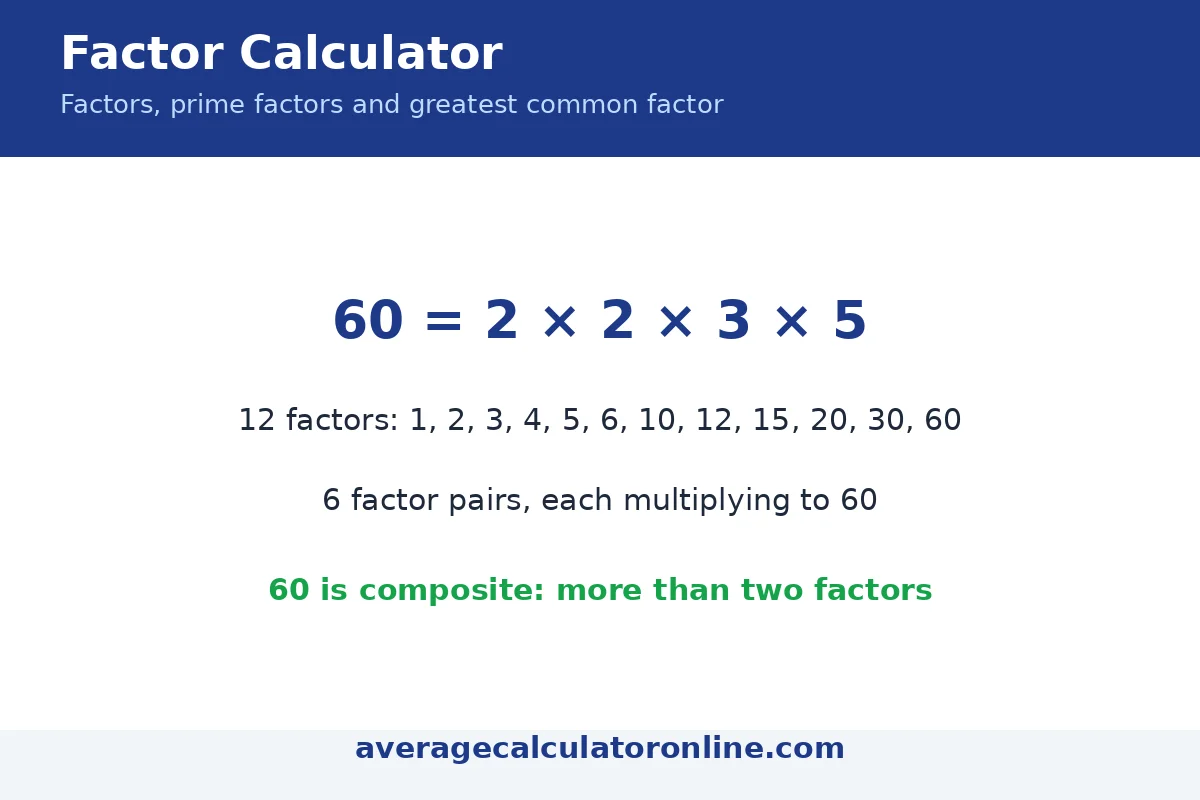
Short answer: A factor of a number is a whole number that divides it with no remainder. The factors of 60 are 1, 2, 3, 4, 5, 6, 10, 12, 15, 20, 30 and 60, which is 12 factors in total, and its prime factorization is 60 = 2 squared times 3 times 5. Use the factor calculator to list all the factors, the factor pairs, and the prime factorization of any whole number.
What is a factor
A factor is a whole number that divides another number exactly, with no remainder. 5 is a factor of 60 because 60 divided by 5 is 12 with nothing left over. 7 is not a factor of 60, because 60 divided by 7 is 8.57, which is not a whole number.
Factors are finite: a number has only so many divisors. Multiples are the opposite: the multiples of 12 are 12, 24, 36, 48, and so on forever. Confusing factors with multiples is the most common mistake in this topic.
How to find all the factors
Test divisors up to the square root of the number. To factor 60, test 1 through 7, because the square root of 60 is about 7.75. Every divisor found gives two factors at once: the divisor and its quotient. For example, 60 divided by 5 is 12, so both 5 and 12 are factors.
Example 1, the default: factors of 60. Divisors that divide 60 evenly are 1, 2, 3, 4, 5 and 6. The full factor list is 1, 2, 3, 4, 5, 6, 10, 12, 15, 20, 30, 60, which is 12 factors. The factor pairs are 1 times 60, 2 times 30, 3 times 20, 4 times 15, 5 times 12 and 6 times 10, which is 6 pairs.
Example 2, a perfect square: factors of 36. Test divisors up to the square root of 36, which is 6. The full list is 1, 2, 3, 4, 6, 9, 12, 18, 36, which is 9 factors. The pairs are 1 times 36, 2 times 18, 3 times 12, 4 times 9 and 6 times 6, which is 5 pairs. The middle pair 6 times 6 is why the count is odd.
Example 3, a prime number: factors of 97. Test divisors up to the square root of 97, which is about 9.85, so test 2 through 9. None of them divides 97 evenly. The full list is 1 and 97, which is 2 factors, and the only pair is 1 times 97. Exactly two factors means 97 is prime.
Example 4, a round number: factors of 100. Test divisors up to the square root of 100, which is 10. The full list is 1, 2, 4, 5, 10, 20, 25, 50, 100, which is 9 factors. The pairs are 1 times 100, 2 times 50, 4 times 25, 5 times 20 and 10 times 10, which is 5 pairs. 100 is composite.
Prime factorization
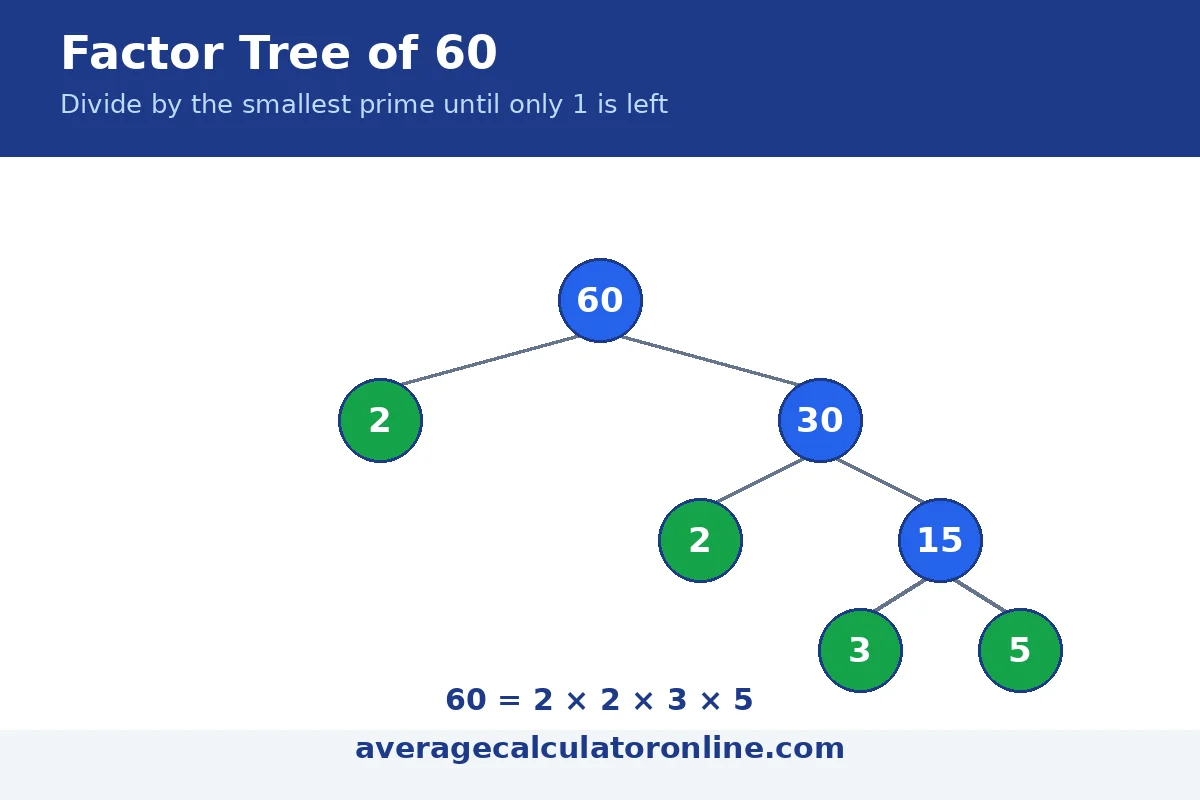
Prime factorization breaks a number into prime factors by repeated division. Divide by the smallest prime that goes in evenly, and repeat on the quotient until only 1 is left. For 60 the steps are 60 divided by 2 is 30, 30 divided by 2 is 15, 15 divided by 3 is 5, and 5 divided by 5 is 1, so 60 is 2 squared times 3 times 5.
Prime factorization is unique. Every whole number greater than 1 breaks into exactly one set of prime factors, in a different order at most. That is why 60 is always 2 squared times 3 times 5 and never anything else. The same idea gives 36 as 2 squared times 3 squared, and 100 as 2 squared times 5 squared.
A factor tree shows the same steps as a picture: 60 splits into 2 and 30, 30 splits into 2 and 15, and 15 splits into 3 and 5. The leaves of the tree are the prime factors. A prime number has no tree at all: 97 is itself prime, so its prime factorization is just 97.
Prime or composite
A number with exactly two factors, 1 and itself, is prime. A number with more than two factors is composite. The number 1 has only one factor, so it is neither prime nor composite. Saying 1 is prime is the most common factor mistake.
The primes below 20 are 2, 3, 5, 7, 11, 13, 17 and 19. Each has exactly two factors. 2 is the only even prime, because every other even number is divisible by 2 as well as by 1 and itself. Perfect squares, 1, 4, 9 and 16, have an odd number of factors, because their square root pairs with itself. 16 has 5 factors: 1, 2, 4, 8 and 16.
Greatest common factor
The greatest common factor, or GCF, of two numbers is the largest number that divides both of them. Factor both numbers, keep the primes they share, and multiply those shared primes together.
Example, 48 and 60: 48 is 2 to the power 4 times 3, and 60 is 2 squared times 3 times 5. The shared primes are 2 squared times 3, which is 4 times 3, so the GCF is 12. Check it: 48 divided by 12 is 4, and 60 divided by 12 is 5, and 4 and 5 share no factor bigger than 1.
Example, 18 and 24: 18 is 2 times 3 squared, and 24 is 2 to the power 3 times 3. The shared primes are 2 times 3, so the GCF is 6.
Common mistakes
Testing past the square root: once you pass the square root of the number, every divisor you find is a repeat of a pair already found. For 60, the square root is about 7.75, so testing 1 through 7 finds all 12 factors.
Forgetting 1 and the number itself: every positive whole number has 1 and itself as factors. A common mistake is listing only the middle factors and missing these two.
Confusing factors with multiples: factors divide a number, and multiples are what you get by multiplying it. Factors of 12 are 1, 2, 3, 4, 6 and 12. Multiples of 12 are 12, 24, 36, 48, and so on.
Calling 1 prime: 1 has only one factor, so it is neither prime nor composite. A prime number needs exactly two factors.
Factor pairs of 60, and how factors link to LCM
The factors of 60 fall into pairs, and each pair multiplies to 60.
| Pair | Product |
|---|---|
| 1 × 60 | 60 |
| 2 × 30 | 60 |
| 3 × 20 | 60 |
| 4 × 15 | 60 |
| 5 × 12 | 60 |
| 6 × 10 | 60 |
That is 6 pairs and 12 factors in total. The same prime factors also give the lowest common multiple, or LCM, the smallest number that both numbers divide.
Example, 12 and 18: 12 equals 2 squared times 3, and 18 equals 2 times 3 squared. Take the highest power of each prime, 2 squared times 3 squared, which is 36. Check it: 36 divided by 12 is 3, and 36 divided by 18 is 2.
Example, 48 and 60: 48 equals 2 to the power 4 times 3, and 60 equals 2 squared times 3 times 5. The highest powers give 2 to the power 4 times 3 times 5, which is 240. The GCF of 48 and 60 is 12, and 12 times 240 is 2880, which equals 48 times 60: GCF times LCM always equals the product of the two numbers. The same exponents give the factor count: 72 equals 2 to the power 3 times 3 squared, so it has 3 plus 1 times 2 plus 1, which is 12 factors: 1, 2, 3, 4, 6, 8, 9, 12, 18, 24, 36 and 72. See the LCM calculator for any LCM.
FAQ
What is a factor of a number?
A factor is a whole number that divides another number with no remainder. For example, the factors of 60 are 1, 2, 3, 4, 5, 6, 10, 12, 15, 20, 30 and 60.
How do you find all the factors of 60?
Test divisors up to the square root of 60, which is about 7.75, so test 1 through 7. Every divisor gives two factors at once, the divisor and its quotient, which gives 12 factors in total.
What is the prime factorization of 60?
Divide by the smallest prime that goes in evenly and repeat until only 1 is left. 60 divided by 2 is 30, 30 divided by 2 is 15, 15 divided by 3 is 5, and 5 divided by 5 is 1, so 60 equals 2 squared times 3 times 5.
What is the greatest common factor of 48 and 60?
List the prime factors of each number and multiply the primes they share. 48 equals 2 to the power 4 times 3, and 60 equals 2 squared times 3 times 5, so the shared primes give 2 squared times 3, which is 12.
Is 1 a prime number?
No. 1 has only one factor, itself, so it is neither prime nor composite. A prime number has exactly two factors, 1 and itself.
What is the difference between factors and multiples?
Factors divide a number, and there are only a few of them. Multiples are what you get by multiplying a number, and they go on forever. The factors of 12 are 1, 2, 3, 4, 6 and 12, while the multiples of 12 are 12, 24, 36, 48, and so on.
Related calculators: Factor Calculator · LCM Calculator · Math Calculator