
CD Calculator
Maturity value: $10,511.62
Interest earned: $511.62 on a $10,000.00 deposit at 5% for 12 months, compounded monthly.
Direct answer: A CD calculator works out what a certificate of deposit is worth at maturity. With a $10,000 deposit, a 5% annual rate, a 12 month term, and monthly compounding, the maturity value is $10,511.62, which is $511.62 of interest. You enter the rate your bank offers, because this calculator never assumes a current market rate. Rates change, and the rate you lock in is the rate that counts.
By Average Calculator Team. Last reviewed: 16 November 2026.
How a certificate of deposit works
A certificate of deposit, or CD, is a savings account where you agree to leave money with a bank for a fixed term, from a few months to several years. In return the bank pays a fixed interest rate, and you get the deposit plus the interest back at maturity. Taking money out early usually costs a penalty, often several months of interest, so a CD suits money you will not need before the term ends. For a plain savings comparison, see the compound interest calculator.
The calculator uses the compound interest formula. With P as the deposit, r as the annual rate as a decimal, n as the number of compounding periods per year, and t as the term in years, the maturity value is P x (1 + r / n) raised to the power (n x t). The interest earned is the maturity value minus the deposit. Compounding more often adds a small bonus, because each interest payment starts earning interest sooner. The simple interest calculator shows the same deposit without any compounding, so you can see the difference.
Worked examples
Example 1: $10,000 deposit, 5% annual rate, 12 months, compounded monthly. The maturity value is $10,511.62, and the interest earned is $10,511.62 – $10,000 = $511.62.
Example 2, a 3 year CD: $10,000 deposit, 5% annual rate, 36 months, compounded monthly. The maturity value is $11,614.72, and the interest earned is $11,614.72 – $10,000 = $1,614.72. The extra two years add $1,103.10 of interest on top of Example 1.
Example 3, a 5 year CD: $10,000 deposit, 5% annual rate, 60 months, compounded monthly. The maturity value is $12,833.59, and the interest earned is $12,833.59 – $10,000 = $2,833.59.
Example 4, a smaller deposit: $5,000 deposit, 4% annual rate, 24 months, compounded annually. The maturity value is $5,408.00, and the interest earned is $5,408.00 – $5,000 = $408.00.
Example 5, an 18 month CD: $20,000 deposit, 4.5% annual rate, 18 months, compounded quarterly. The maturity value is $21,388.54, and the interest earned is $21,388.54 – $20,000 = $1,388.54.

How compounding frequency changes the result
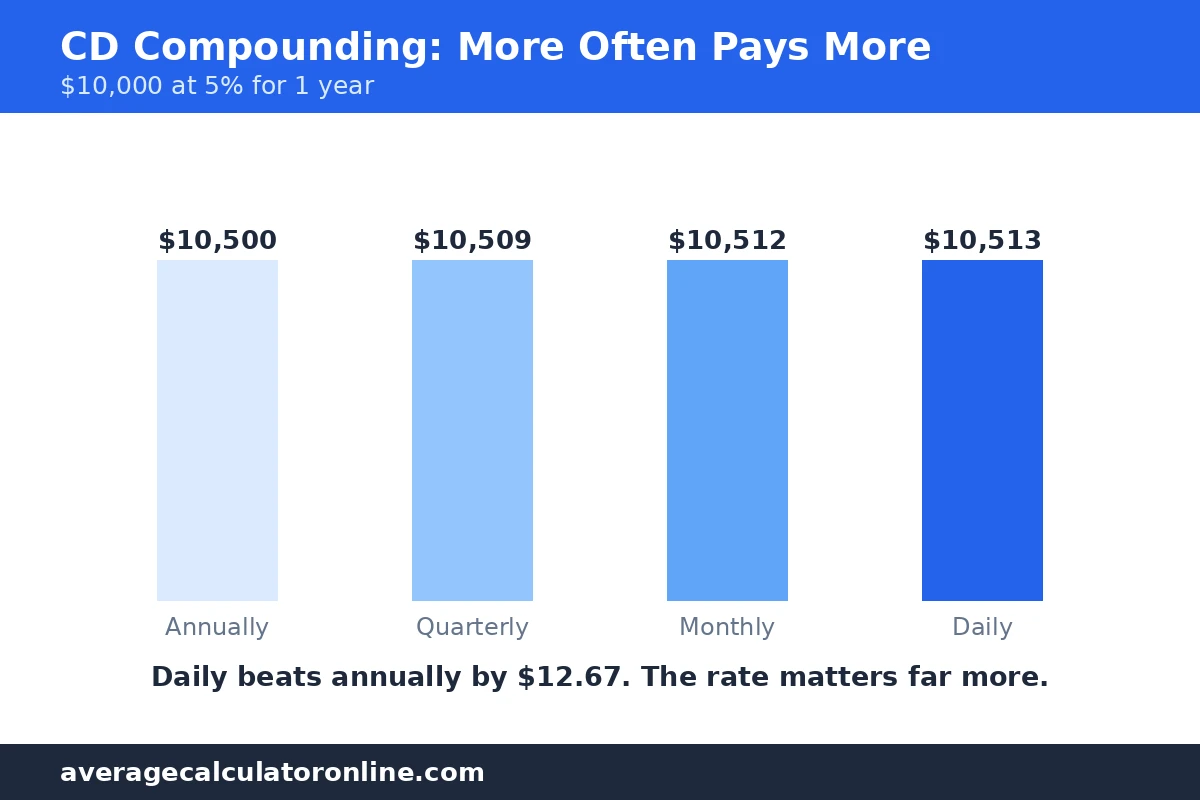
On the same $10,000 deposit at 5% for 1 year, the compounding frequency changes the maturity value by a few dollars. The table shows the range, and it also shows why the rate matters far more than the frequency.
| Compounding | Maturity value | Interest |
|---|---|---|
| Annually | $10,500.00 | $500.00 |
| Quarterly | $10,509.45 | $509.45 |
| Monthly | $10,511.62 | $511.62 |
| Daily | $10,512.67 | $512.67 |
Daily compounding beats annual compounding by $12.67 on $10,000, while a rate of 6% instead of 5% adds about $100. When you compare two CDs, compare the rate and the term first, and treat the compounding frequency as a tiebreaker. A 3 rung ladder of $10,000 at 5% for 1, 2, and 3 years grows to $10,511.62 + $11,049.41 + $11,614.72 = $33,175.75 in total. If you want to see the same money grow over a longer horizon, the investment calculator runs the same math for years instead of months.
Common mistakes
Using a rate from an old advert: CD rates move with the market, and a rate quoted last year is not the rate on offer today. Always enter the rate your bank quotes now, and check whether it is an annual percentage yield or a simple annual rate.
Forgetting the early withdrawal penalty: most CDs charge a penalty of several months of interest if you take money out early. On a 5 year CD the penalty can wipe out a full year of interest, so only deposit money you can leave alone for the whole term.
Mixing up months and years: the term goes in as months in this calculator, and the formula converts it to years. Entering 12 as the term means 12 months, not 12 years. A $10,000 deposit at 5% for 12 years would be $18,198.49, not $10,511.62.
Ignoring tax: CD interest is taxed as ordinary income in the year it is earned, even if you leave it in the CD. A 5% CD in a 22% tax bracket keeps about 3.9% after tax. The income tax calculator shows how the bracket works.
Frequently asked questions
What is a CD?
A CD, or certificate of deposit, is a savings account where you leave money with a bank for a fixed term, from a few months to several years. The bank pays a fixed interest rate, and you get the deposit plus the interest back at maturity. Taking money out early usually costs a penalty.
How do I calculate CD interest?
Use the compound interest formula: maturity value equals the deposit times 1 plus the annual rate divided by the number of compounding periods per year, raised to the power of periods per year times years. The interest is the maturity value minus the deposit. A 10000 dollar deposit at 5 percent for 1 year compounded monthly grows to 10511.62 dollars.
What is the difference between APY and interest rate?
The interest rate is the simple annual rate, while the annual percentage yield, or APY, includes compounding. A 5 percent rate compounded monthly has an APY of about 5.12 percent, because the interest itself earns interest. When you compare two CDs, compare the APY, since it reflects the real yearly growth.
Is a CD a good investment?
A CD is a low risk place to keep money you will not need before the term ends, because the rate is fixed and the deposit is usually insured up to the legal limit. The trade off is a lower return than stocks and no access to the money without a penalty. It suits short term goals, not long term growth.
What happens when a CD matures?
At maturity the bank usually gives you a short grace period, often 7 to 10 days, to take the money out or move it. If you do nothing, most banks renew the CD automatically into a new term at the current rate, which may be lower or higher than the old one. Check the renewal rate before the grace period ends.
Can I lose money in a CD?
You cannot lose the deposit in a CD from market moves, because the rate is fixed. You can lose interest if you withdraw early and pay a penalty, and inflation can eat into the real value if prices rise faster than the rate. A 5 percent CD while prices rise 3 percent a year still grows your buying power, just more slowly.
Note: This calculator is for education and planning only. It works out maturity values from a rate you enter, and it never promises a rate or a return. Actual CD rates, terms, penalties, and tax treatment differ by bank and change over time. The results here are estimates, not financial advice.
Compound Interest Calculator ·
Simple Interest Calculator ·
Investment Calculator ·
Mortgage Calculator ·
Inflation Calculator ·
Last updated: November 16, 2026.