Fixed-Rate Inflation Calculator
Future cost: $1343.92
Direct answer
Inflation raises prices over time. Future cost = amount × (1 + rate)^years. Past value = amount ÷ (1 + rate)^years. The rate is the average annual inflation you assume. Because the rate is fixed, the result is a planning estimate, not a forecast based on actual CPI data.
Inflation formulas
Future cost = A × (1 + r)^n
Past value = A ÷ (1 + r)^n
A is the starting amount, r is the annual inflation rate as a decimal (3% = 0.03), and n is the number of years. Both formulas compound the rate once per year for the full period, so the same r and n convert an amount in either direction.
Worked examples
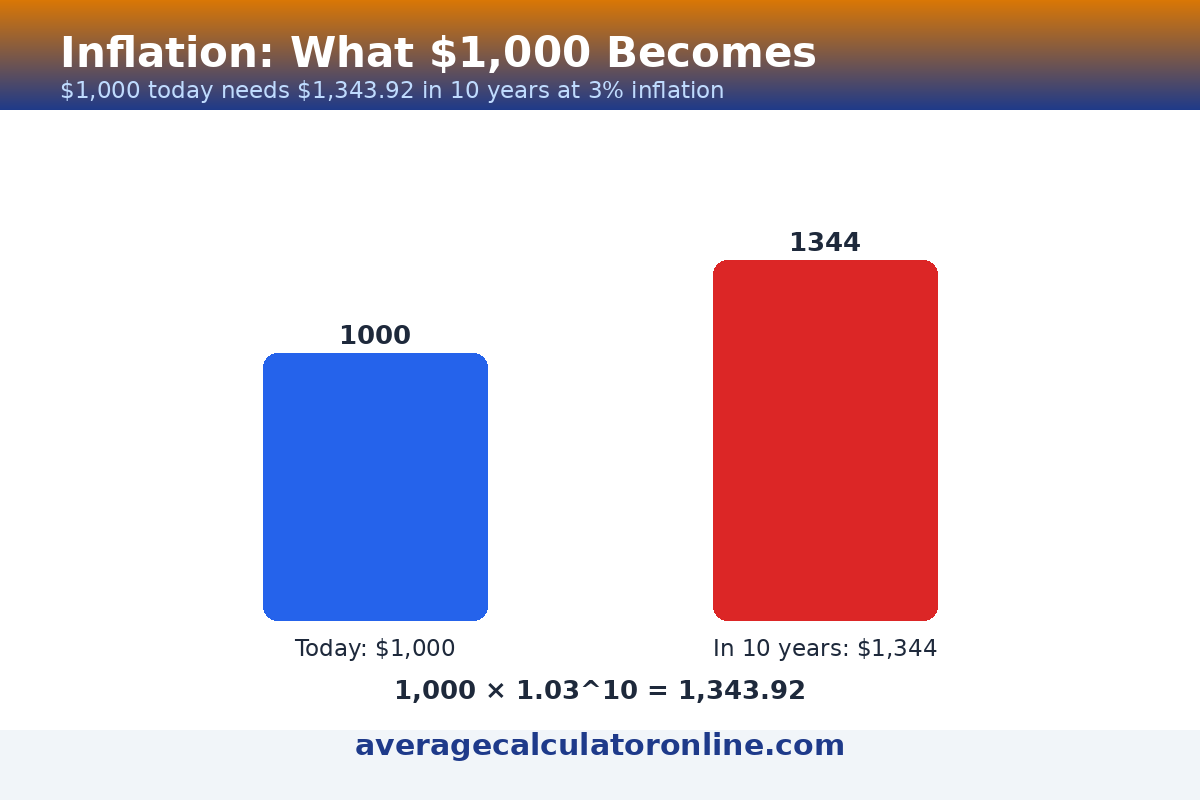
Example 1 (future cost): $1,000 today, 3% annual inflation, 10 years. $1,000 × (1.03)^10 = $1,343.92. Something costing $1,000 today would cost about $1,343.92 in 10 years.
Example 2 (long horizon): $100 in the year 2000, assuming a 2.5% average rate, over 24 years. $100 × (1.025)^24 = $180.87.
Example 3 (past value): $1,343.92 due in 10 years, 3% annual inflation. Past value = 1,343.92 ÷ (1.03)^10 = $1,000.00 (rounded). This is the mirror image of Example 1: the same rate and period convert in both directions.
Example 4 (future cost, higher rate): $500 today, 5% annual inflation, 20 years. Future cost = 500 × (1.05)^20 = $1,326.65. The same $500 at only 2% would reach just $742.97 — small rate differences grow large over decades.
Example 5 (past value): To keep the buying power of $2,000 in 15 years at 2% inflation, you need 2,000 ÷ (1.02)^15 = $1,486.03 today.
What to watch out for
A single fixed rate is a simplification: real inflation varies year by year, and different goods inflate at different rates. This calculator shows the effect of an average rate, not a CPI-based historical series.
FAQs
How does an inflation calculator work? It compounds an amount by an annual inflation rate over a number of years, forward for future cost or backward for past value.
What inflation rate should I use? Many planners use 2–3% for the US long-term average; use a higher rate for a cautious estimate.
What is the difference between future cost and past value? Future cost projects today’s amount forward at the fixed rate you enter; past value discounts a future amount back to the present at that same fixed rate.
Does this calculator use real CPI data? No. This is a fixed-rate estimator: it compounds only the annual rate you enter and does not use official CPI index values. For official U.S. CPI data, see the U.S. Bureau of Labor Statistics.
Why does inflation compound instead of just adding up? Because each year’s price increase applies to the already-increased price, not the original price. At 3% inflation, a $100 item costs $103 after one year and $106.09 after two years, not $106. That compounding is why the formula raises (1 + rate) to the power of the number of years.
What happens if I underestimate the inflation rate? A rate that is too low makes future costs look smaller than they are likely to be, which can leave a savings plan short. For example, matching $100,000 of spending power in 30 years needs $181,136 at 2% inflation but $324,340 at 4%. Many planners run both a base case and a higher-rate case to see the range.
Can inflation be negative? Yes — falling prices are called deflation, and you can model them here with a negative rate. Entering −2% for 5 years turns $1,000 into $1,000 × (0.98)^5 = $903.92 of future cost. Deflation is rare and usually brief, but the same compounding math applies in reverse.
Sources
For official U.S. price data, see the U.S. Bureau of Labor Statistics Consumer Price Index program. This page’s calculator uses only the fixed rate you enter, not BLS data.
Disclaimer: Results are estimates for planning only, not financial advice.
Related calculators: Compound Interest Calculator · Retirement Calculator · Mortgage Calculator
Last updated: November 1, 2026.