How to Calculate an Average: Step-by-Step with Worked Examples
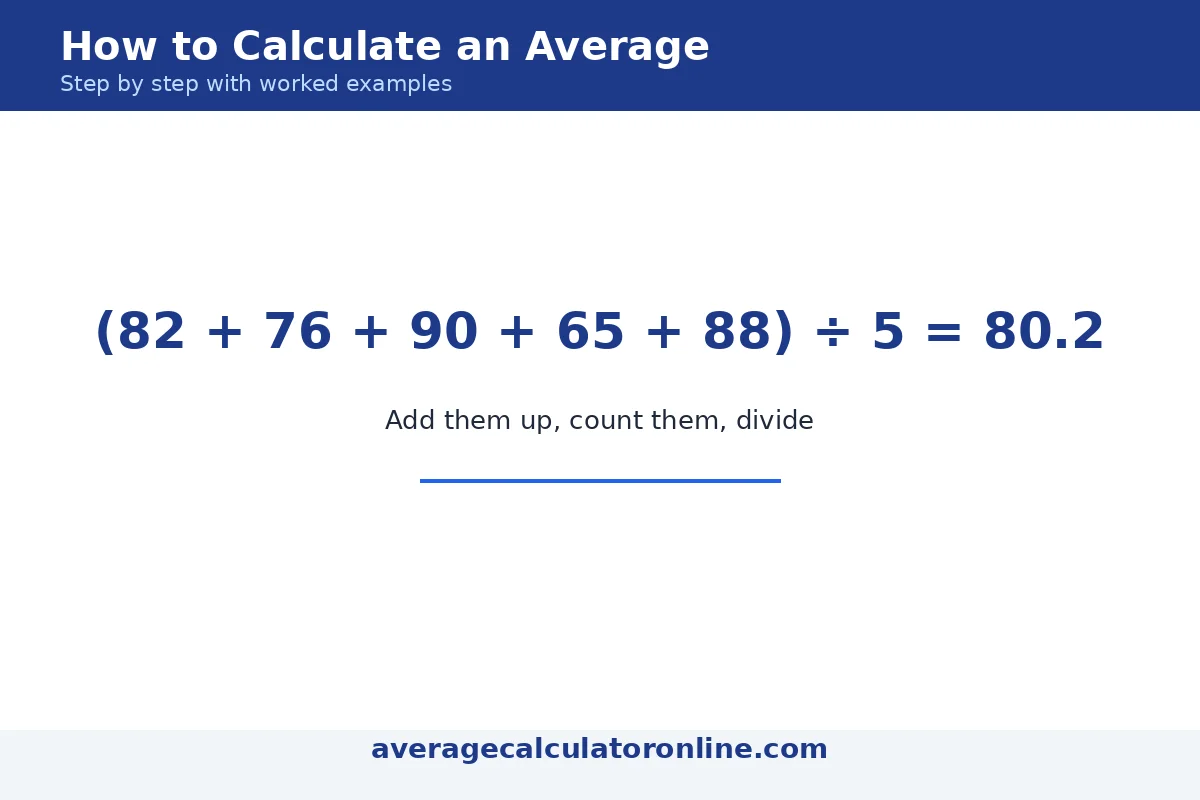
Short answer: To calculate an average, add all the numbers together, count how many numbers there are, and divide the sum by the count. The average calculator on the homepage does all three steps at once, and its worked example uses the grades 82, 76, 90, 65 and 88, which add up to 401 and give an average of 80.2. This guide works through the same steps by hand, so you can check any answer the tool gives you.
How to calculate an average in three steps
Step 1, add: add all the numbers together to get the sum. For the five grades, 82 + 76 + 90 + 65 + 88 = 401.
Step 2, count: count how many numbers there are. Here the count is 5. A common slip is to divide by the wrong count, often because one value was missed out while adding, so count the values again before you divide.
Step 3, divide: divide the sum by the count. Here that is 401 ÷ 5 = 80.2. The result is the arithmetic mean, which is what most people mean when they say average. Paste the same numbers into the average calculator and it shows the sum, the count and the mean, plus the median, the mode and the range.
Worked examples
Example 1, five grades: 82, 76, 90, 65, 88. Add the five numbers to get 401, then divide by 5. The average is 80.2. Sorted, the same five numbers are 65, 76, 82, 88, 90, so the median is 82 and the range is 25, from a low of 65 to a high of 90.
Example 2, average of two numbers: to average two numbers, add them and divide by 2. Using two grades from the first example, 82 + 76 = 158, and 158 divided by 2 is 79. The average of 82 and 76 is 79.
Example 3, average of three numbers: add all three and divide by 3. Using three grades from the first example, 82 + 76 + 90 = 248, and 248 ÷ 3 = 82.67, rounded to two decimal places. The average of 82, 76 and 90 is 82.67.
Example 4, decimal numbers: add decimal numbers exactly as you would whole numbers, then divide by the count. For example, 2.5 + 3.5 + 4.0 = 10, and 10 ÷ 3 = 3.33, rounded to two decimal places. The average of 2.5, 3.5 and 4.0 is 3.33.
Example 5, a simple set: 70, 80, 90 and 100 add up to 340, and 340 ÷ 4 = 85. The average is 85, which sits in the middle because the numbers are spaced evenly. The same steps work for a class average: add every score in the class and divide by the number of students.
Mean, median and mode: which one to use
The mean, the median and the mode all measure the centre of a set of numbers, but they do it in different ways. The mean is the sum divided by the count. The median is the middle value when the numbers are sorted. The mode is the value that appears most often. The statistics calculator reports all three at once for any set of numbers.
| Measure | What it is | Use it when |
|---|---|---|
| Mean | Sum divided by count | The data has no extreme outliers |
| Median | Middle value when sorted | Outliers would skew the mean, such as salaries |
| Mode | Most frequent value | You need the most common value |
Salaries show why the choice matters. Five salaries of 40, 45, 50, 55 and 400 thousand dollars have a mean of 118 thousand dollars, but the median is 50 thousand dollars. The mean is pulled up by the one very large salary, so the median describes the typical salary far better. When some scores count more than others, use the weighted average calculator instead.
Weighted averages and missing numbers
A weighted average gives some values more weight than others. Multiply each value by its weight, add the results, and divide by the sum of the weights. For example, a score of 90 with a weight of 30 and a score of 80 with a weight of 70 gives 90 × 30 = 2700 and 80 × 70 = 5600, and 2700 + 5600 = 8300, so the weighted average is 8300 ÷ 100 = 83. The simple average of the same two scores would be 85, so the weights pull the result toward 80.
You can also work backwards to find a missing number. If the average of 5 numbers must be 18, the required sum is 18 × 5 = 90. If the four numbers you know add up to 72, the missing number is 18, because 90 − 72 = 18. The grade calculator does the same kind of working for test scores, turning a set of scores into a percentage and a letter grade.
Common mistakes
Dividing by the wrong count: if you add 5 numbers, divide by 5, not 4. Count the values twice, once before adding and once before dividing.
Rounding too early: keep the full sum while you work, and round only the final answer. Rounding each number first can move the average by more than you expect.
Using the mean when the median fits better: a single very large or very small value pulls the mean away from the typical value. Check the median as well, and report it when it describes the data better.
Mixing different units: all the numbers must be in the same unit before you average them. Convert first, then add, count and divide.
The average of averages: when a simple average misleads
Never average two averages unless the groups are the same size. An average hides how many values went into it, and a big group should count for more than a small group. Averaging the averages gives each group the same weight, even when the groups are very different in size.
Example: Class A has 10 students with an average score of 90, and Class B has 30 students with an average score of 70. The simple average of the two averages is 90 plus 70 divided by 2, which is 80. That is wrong. The true combined average weights each class by its size: 10 times 90 is 900, and 30 times 70 is 2100. Add them to get 3000, then divide by the total of 40 students. The true average is 75, which is 5 points lower than the naive answer, because the bigger class scored lower.
The two methods agree only when the groups are the same size: two classes of 20 students with averages of 60 and 80 give 2800 divided by 40, which is 70, the same as the simple average. Whenever the group sizes differ, weight by size. The weighted average calculator does this weighting for you, and the statistics calculator shows the mean, the median and the range together, so you can check whether one average tells the whole story.
FAQ
What is the formula for an average?
The formula is average equals the sum of all values divided by the count of values. Add all the numbers together, count how many numbers there are, and divide the sum by the count.
How do you calculate the average of 82, 76, 90, 65 and 88?
Add the five numbers to get 401, then divide by 5. The average is 80.2. The same five numbers have a median of 82 and a range of 25, from a low of 65 to a high of 90.
How do you average two numbers?
Add the two numbers together and divide by 2. For example, 82 plus 76 is 158, and 158 divided by 2 is 79. The average of 82 and 76 is 79.
What is the difference between the mean and the median?
The mean is the sum divided by the count. The median is the middle value when the numbers are sorted. The median is the better choice when one very large or very small value would pull the mean away from the typical value.
How do you calculate a weighted average?
Multiply each value by its weight, add the results, and divide by the sum of the weights. For example, 90 with a weight of 30 and 80 with a weight of 70 gives a weighted average of 83.
What is the average of 10, 20 and 30?
Add 10, 20 and 30 to get 60, then divide by 3. The average is 20. It is the middle value here because the three numbers are spaced evenly.
Related calculators: Average Calculator · Grade Calculator · Weighted Average Calculator · Statistics Calculator