Living Wage Calculator: What Counts as a Living Wage in 2026?
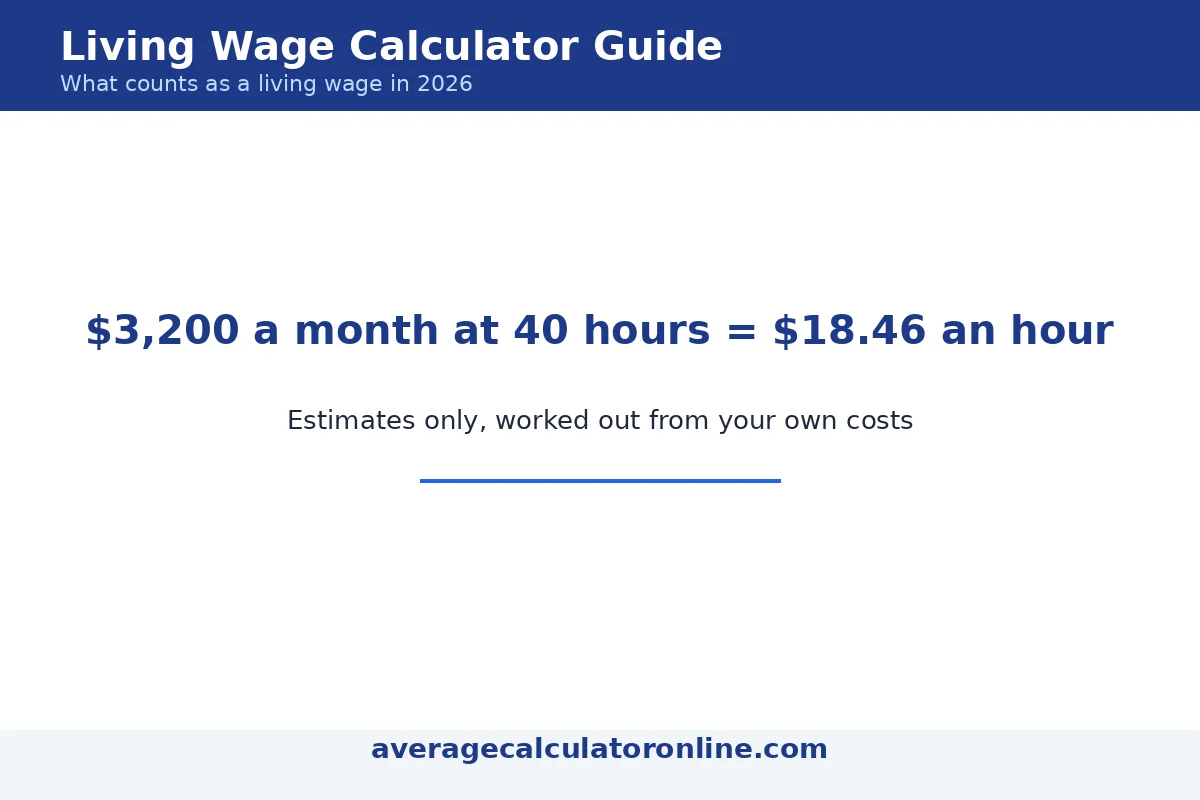
Short answer: A living wage is the hourly pay a household needs to cover its basic monthly expenses, housing, food, transport, healthcare, childcare and other essentials, without outside help. The living wage calculator works it out from your own expenses: required hourly wage = total monthly expenses ÷ (hours worked per week × 52 ÷ 12). For example, $3,200 of monthly expenses at 40 hours a week needs $18.46 per hour before tax, or $38,400 a year. The result is an estimate only, not financial advice, because real needs vary by household, location and benefits.
How the living wage is worked out
The calculation has four steps. Step 1: add up monthly expenses across six categories, housing, food, transport, healthcare, childcare and other essentials. Step 2: add a savings buffer if you want one; 0% keeps the result at bare costs. Step 3: divide the required monthly income by monthly work hours to get the required hourly wage. Step 4: multiply the required monthly income by 12 to get the required annual salary.
The monthly hours come from the 52 ÷ 12 factor, which converts weekly hours into average monthly hours. A 40 hour week gives 40 × 52 ÷ 12 = 173.33 hours a month. That is why $3,200 a month at 40 hours a week gives $3,200 ÷ 173.33 = $18.46 per hour before tax. The calculator works from your own expenses, not from a government table, so it gives a US dollar estimate for any place: enter what your household actually spends, and it tells you the hourly wage and annual salary that spending requires.
Worked examples
| Household | Monthly expenses | Hours per week | Required hourly wage, before tax | Required annual salary, before tax |
|---|---|---|---|---|
| Single adult, low costs | $1,800 | 40 | $10.38 | $21,600 |
| Family, typical costs | $3,200 | 40 | $18.46 | $38,400 |
| Family, part time hours | $3,200 | 25 | $29.54 | $38,400 |
The third row shows the part time trap. The annual salary stays $38,400 because the household costs did not change, but fewer hours mean each hour must pay more: $3,200 a month at 25 hours a week needs $29.54 an hour. A 10% savings buffer on the family example raises the monthly target to $3,520, which needs $20.31 an hour and $42,240 a year. In a two earner household the required wage can be split: $38,400 a year divided by 2 earners is $19,200 each, or $9.23 an hour each at 40 hours a week. The calculator shows the single earner figure, so divide the annual salary by the number of earners for a per person target.
What counts as a basic expense
| Category | Usually includes |
|---|---|
| Housing | Rent or mortgage payment, utilities |
| Food | Groceries and basic household food |
| Transport | Car costs or public transit, fuel |
| Healthcare | Insurance premiums, regular medical costs |
| Childcare | Daycare, after school care |
| Other essentials | Clothing, phone, basic household goods |
Luxuries, vacations and debt payments are not basic expenses. If you include them, the result is a comfortable wage, not a living wage. It is still a useful number, but it is a different number, so keep the expense list to basic needs when you want a true living wage figure. Housing is usually the largest share, which is why rent changes move the living wage more than any other expense.
Living wage and minimum wage
The minimum wage is the lowest hourly pay the law allows. In the United States, the federal minimum wage is $7.25 per hour, unchanged since 2009, and many states and cities set higher rates. The living wage is the hourly pay that actually covers a household basic costs in a given place. A job can pay above the minimum wage and still fall short of the living wage, and that gap is what the calculator measures when you enter your current wage for comparison.
Two households in the same city can have very different living wages if one has children and the other does not. Higher rents raise the figure, and children raise it further through childcare, food and healthcare costs. The minimum wage is a floor set by law; the living wage is a target set by costs. They measure different things, so comparing a pay offer with the minimum wage alone does not tell you whether the pay covers basic costs.
How to use the result
Use the result in a pay conversation. A specific number, such as my household needs $18.46 an hour to cover $3,200 of costs, is far stronger than a general request for a raise. See what that wage means per paycheck with the paycheck calculator, and estimate the tax on that salary with the tax calculator, because the living wage figures are before tax.
Recalculate when costs change. Rent rises, childcare starts or ends, or hours change, and each one changes the required wage. Keep the expense list realistic and up to date, and treat the result as a planning estimate. Actual needs vary by location, household and personal circumstances, and the figures are before tax, so they are a starting point for planning, not a promise about what any household must earn.
What the result is not
The result is an estimate only, not financial advice. It depends on the expenses and hours you enter, and it leaves out taxes, savings goals beyond the buffer you set, and costs that change from month to month. It does not set a legal wage, and it does not replace advice from a qualified professional for your own situation. Use it to understand what your household costs require, to compare pay offers, and to plan, and check the numbers again whenever your costs or your hours change.
What goes into a living wage estimate
A living wage is built from the household budget, not from a single official number. The table below splits the 3,200 dollar family example from this guide into its six categories. It is one illustration, not a standard split: your own rent, food and childcare costs will give different shares, and the calculator uses your own figures.
| Category | Monthly cost | Share of 3,200 dollars |
|---|---|---|
| Housing | 1,400 dollars | 43.75 percent |
| Food | 600 dollars | 18.75 percent |
| Transport | 350 dollars | 10.94 percent |
| Healthcare | 300 dollars | 9.38 percent |
| Childcare | 400 dollars | 12.50 percent |
| Other essentials | 150 dollars | 4.69 percent |
The shares add to 100.01 percent because of rounding to two decimal places. Housing is the largest share at 43.75 percent, which is why rent changes move the living wage more than any other cost. Childcare is the second most variable cost: it can be zero for a household with no children, or the largest cost for a household with two small children in daycare.
Small changes in one category change the answer. Take childcare out of this example and the monthly target falls from 3,200 dollars to 2,800 dollars, which needs 16.15 dollars an hour at 40 hours a week, or 33,600 dollars a year. Rework the split whenever a cost changes, and see what the result means per paycheck with the paycheck calculator, and what tax it may attract with the tax calculator. The figures stay estimates only, before tax.
FAQ
What is a living wage?
A living wage is the hourly pay a household needs to cover its basic monthly expenses, such as housing, food, transport, healthcare, childcare and other essentials, without outside help. It is worked out from real costs, so it changes by place and by household.
How do you calculate a living wage?
Add up monthly basic expenses, then divide by monthly work hours. The formula is required hourly wage equals monthly expenses divided by hours per week times 52 divided by 12. For 3200 dollars a month at 40 hours a week, the result is 18.46 dollars per hour before tax.
Is a living wage the same as the minimum wage?
No. The minimum wage is a legal floor set by law. In the United States, the federal minimum wage is 7.25 dollars per hour. A living wage is a target set by costs, and it is usually higher than the minimum wage.
Does the living wage change by city or family size?
Yes. Higher rents raise it, and children raise it further through childcare, food and healthcare costs. The living wage calculator uses your own expense figures, so it reflects your place and your household.
What expenses should I include?
Include basic needs only: housing, food, transport, healthcare, childcare and other essentials. Leave out luxuries, vacations and debt payments if you want a true living wage figure. Those extras give a comfortable wage, which is a different number.
Is the living wage result financial advice?
No. The result is an estimate only, based on the expenses and hours you enter. Actual needs vary by location, household and personal circumstances, and the figures are before tax. Use the result for planning and for pay conversations, not as financial advice.
Related calculators: Living Wage Calculator · Paycheck Calculator · Income Tax Calculator · Percentage Calculator