Date Calculator: Days Between Dates, Age and Deadlines
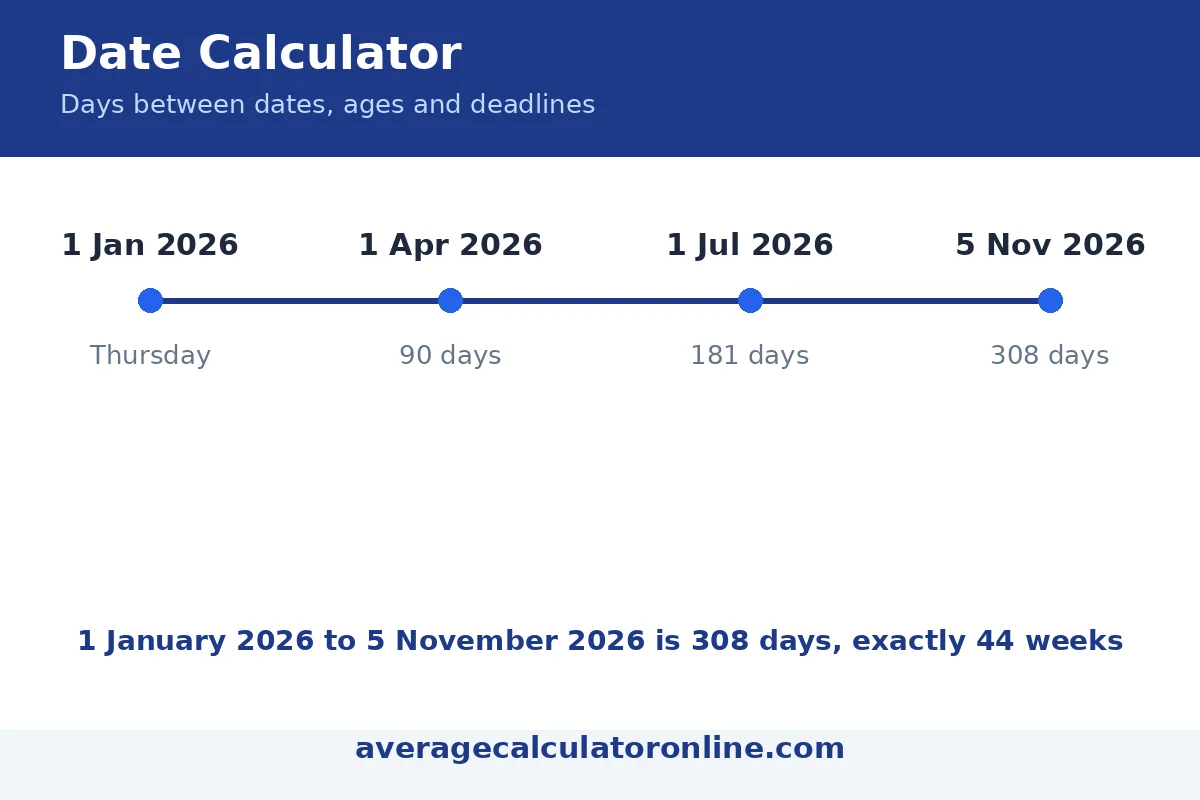
Short answer: The number of days between two dates is the count of calendar days from the start date to the end date, not including the end date. From 1 January 2026 to 5 November 2026 that is 308 days, exactly 44 weeks, or 10 months and 4 days. Use the date calculator to count the gap, see the weeks breakdown, and add or subtract days from any start date.
How to count the days between two dates
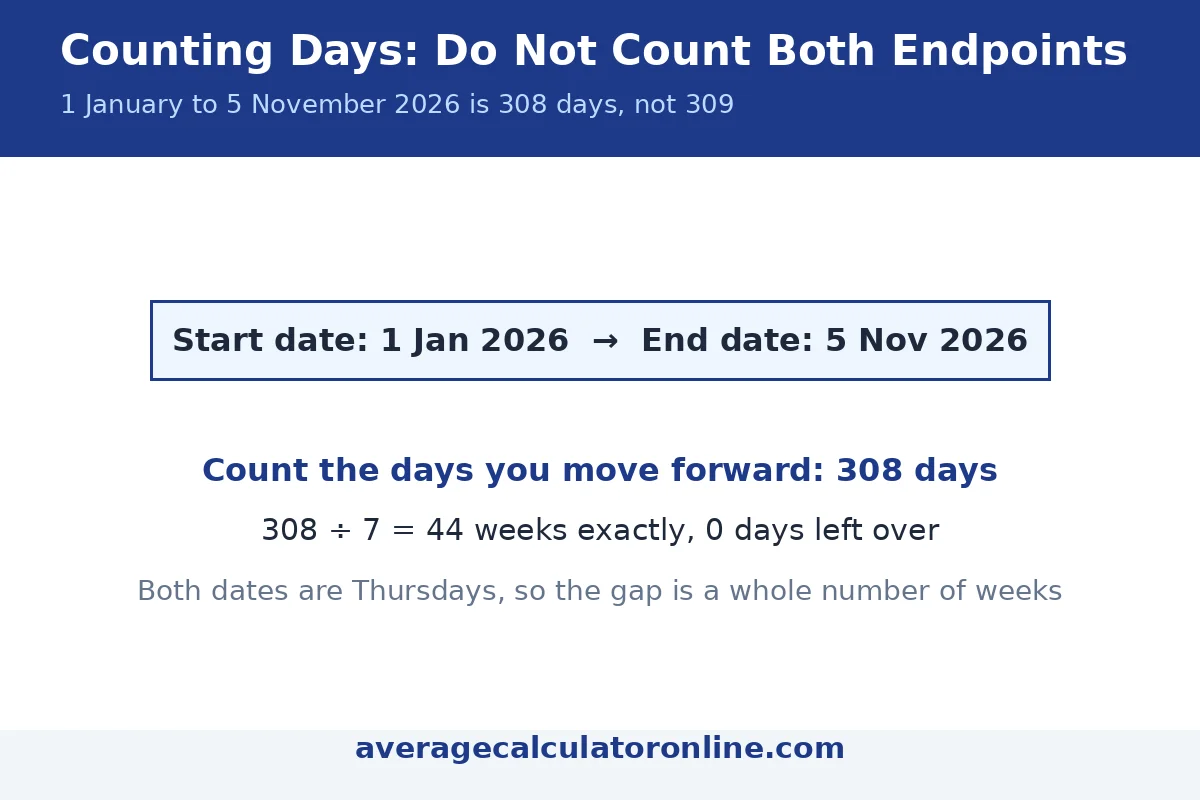
The tool subtracts the start date from the end date in calendar days. The count runs from the start date up to, but not including, the end date, so the result is the number of days you have to move forward to reach the end date. That is why 1 January 2026 to 5 November 2026 is 308 days: move forward 308 days from 1 January and you land on 5 November.
Both dates fall on a Thursday, which is why the gap is an exact number of weeks. 308 divided by 7 is 44, so the gap is 44 weeks and 0 days. Any two dates on the same weekday are an exact number of weeks apart, because weekdays repeat every 7 days. If the weekdays differ, the gap has leftover days: a gap of 97 days is 13 weeks and 6 days, because 97 divided by 7 is 13 with 6 left over.
The calendar breakdown of the default example is 0 years, 10 months and 4 days. Calendar months are not equal in length, so use the day count for an exact length and the months breakdown for calendar months, for example for a notice period.
Worked examples
Example 1, the default: 1 January 2026 to 5 November 2026. 5 November 2026 minus 1 January 2026 is 308 days. 308 divided by 7 is 44.00 weeks, exactly 44 weeks and 0 days. Both dates are Thursdays.
Example 2, a spring to summer gap: 15 March 2026, a Sunday, to 20 June 2026, a Saturday. 20 June 2026 minus 15 March 2026 is 97 days. 97 divided by 7 is 13.86 weeks, which is 13 weeks and 6 days.
Example 3, one week over New Year: 25 December 2025, a Thursday, to 1 January 2026, a Thursday. 1 January 2026 minus 25 December 2025 is 7 days, which is exactly 1.00 week. Short gaps across a year boundary work the same way as any other gap: subtract and count forward.
Example 4, a full year: 1 January 2026 to 1 January 2027 is 365 days, which is 52 weeks and 1 day. The leap year 2024 gives 1 January 2024 to 1 January 2025 as 366 days, because 2024 has 29 days in February.
| From | To | Days | Weeks |
|---|---|---|---|
| 1 Jan 2026 | 1 Feb 2026 | 31 | 4 weeks, 3 days |
| 1 Jan 2026 | 1 Apr 2026 | 90 | 12 weeks, 6 days |
| 1 Jan 2026 | 1 Jul 2026 | 181 | 25 weeks, 6 days |
| 1 Jun 2026 | 1 Sep 2026 | 92 | 13 weeks, 1 day |
| 1 Mar 2026 | 31 Mar 2026 | 30 | 4 weeks, 2 days |
| 14 Feb 2026 | 25 Dec 2026 | 314 | 44 weeks, 6 days |
Adding and subtracting days
The second mode of the date calculator takes one start date and a number of days and returns the resulting date and its weekday. 1 January 2026 plus 100 days is 11 April 2026, a Saturday. Counting forward 100 days from New Year Day crosses January, February and March, and lands in mid April. The same mode works backwards with a minus sign: 5 November 2026 minus 30 days is 6 October 2026, a Tuesday.
Adding days is how most deadlines are set. A contract signed on 15 March 2026 with a 97 day delivery term is due on 20 June 2026. A 30 day notice given on 5 November 2026 ends on 5 December 2026. A 90 day trial starting on 1 January 2026 ends on 1 April 2026. In each case the calculator does the month crossing for you, including the short month of February.
Age from a date of birth
The same day counting idea powers the age calculator, which works out an exact age from a date of birth. Subtract the birth year from the current year, then subtract one year if the birthday has not happened yet this year. A person born on 15 March 1990 turns 36 on 15 March 2026. Before that date in 2026, the same person is 35.
Exact ages in years, months and days need the same care as any date gap. From 15 March 1990 to 15 March 2026 is 36 years exactly. From 15 March 1990 to 20 June 2026 is 36 years, 3 months and 5 days. The months part counts whole calendar months, and the days part counts what is left over after those months.
Deadlines and planning
A deadline is a date, and a date calculator turns it into a number of days left. A project due on 20 June 2026 with work starting on 15 March 2026 has 97 days, which is 13 weeks and 6 days. Split that into weekly milestones and each week is about 7 days of work, with 6 days left over for review at the end.
Long gaps are easier to plan in weeks: 308 days is 44 weeks, so a plan from 1 January 2026 to 5 November 2026 has 44 weekly check ins. Short gaps are easier in days. Pick the unit that matches how you will do the work.
Watch the weekday of a deadline: a deadline that lands on a Saturday or Sunday may really mean the Friday before it.
Common mistakes
Counting both endpoints: the standard day count stops at the end date without including it. 1 January to 5 November 2026 is 308 days, and counting both endpoints gives 309. If your count is one day higher than the tool, this is almost always the reason.
Forgetting leap years: any range that includes 29 February gains one extra day. A year starting 1 January 2024 to 1 January 2025 is 366 days, not 365. Check whether February in your range has 28 or 29 days.
Treating months as equal: a 3 month gap can be 89, 90, 91 or 92 days depending on which months it covers. January to April 2026 is 90 days, while June to September 2026 is 92 days. Use the months breakdown for calendar months and the day count for exact lengths.
Ignoring the weekday: two dates on the same weekday are an exact number of weeks apart. If the weekdays differ, the gap has leftover days, and a plan built on whole weeks will be off by those days.
Business days versus calendar days
Calendar days count every day, including Saturdays and Sundays. Business days count only Monday to Friday, which is what most work deadlines, notice periods and delivery estimates really mean. A gap that looks long in calendar days can be much shorter in business days, and the difference matters whenever a deadline falls on a working schedule.
Example, the 308 day gap: 1 January 2026 to 5 November 2026 is 308 calendar days, which is exactly 44 weeks. Every full week has 5 business days, so the same gap is 44 times 5, which is 220 business days.
Example, the 100 day gap: 1 January 2026 plus 100 days is 11 April 2026. Those 100 calendar days contain 72 business days, because the 14 full weeks give 70 business days and the last 2 days, Thursday 9 April and Friday 10 April 2026, are both business days.
Example, the 97 day gap: 15 March 2026 to 20 June 2026 is 97 calendar days, which contain 70 business days. Public holidays are not counted here: a holiday on a weekday is still a business day in this count, so check your own holiday calendar before promising a date. Leap years add one calendar day, 29 February, and the next one is in 2028, which has 366 days. Work out the calendar gap first with the date calculator, and use the time calculator to add up the working hours inside those business days.
FAQ
How do you count the days between two dates?
Subtract the start date from the end date. The count runs from the start date up to, but not including, the end date. For example, 1 January 2026 to 5 November 2026 is 308 days.
How many weeks are in 308 days?
Divide the days by 7. 308 divided by 7 is 44, so 308 days is exactly 44 weeks and 0 days.
What date is 100 days after 1 January 2026?
Add 100 days to 1 January 2026 to get 11 April 2026, which is a Saturday.
Is 2026 a leap year?
No. 2026 is not a leap year, so February has 28 days and the year has 365 days in total. The leap year 2024 has 29 days in February and 366 days in total.
Why is my day count one day higher than the calculator?
The standard count stops at the end date without including it. Counting both endpoints adds one extra day, so 1 January to 5 November 2026 becomes 309 instead of 308.
How do you work out an age from a date of birth?
Subtract the birth year from the current year, then subtract one year if the birthday has not happened yet this year. For example, a person born on 15 March 1990 turns 36 on 15 March 2026.
Related calculators: Date Calculator · Age Calculator · Time Calculator