
Petrol Mileage Calculator
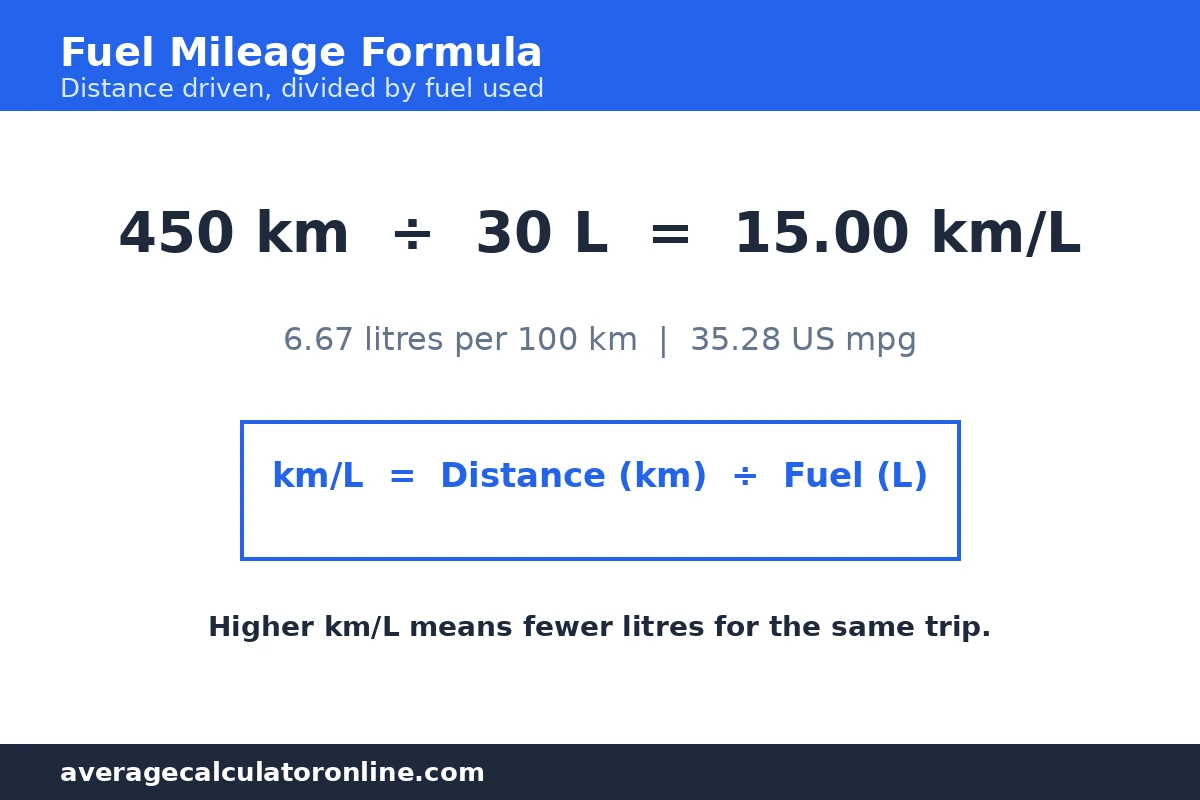
Fuel mileage in kilometres per litre is distance driven divided by fuel used:
km/L = Distance (km) ÷ Fuel (L)
Drive 450 km on 30 litres and your mileage is 450 ÷ 30 = 15.00 km/L, which is the same as 6.67 litres per 100 km and 35.28 US miles per gallon. Enter your own distance and fuel below and the tool does the same division for you, plus the L/100km, US mpg, UK mpg, trip-cost and tank-range figures.
How it works
- Measure distance. Note your trip-meter reading, or use the full-to-full method: fill the tank, reset the trip meter, drive normally, then fill again.
- Measure fuel. The litres on the second fill are the fuel used for exactly that distance.
- Divide. Distance ÷ fuel gives km/L. The tool also converts the same result into L/100km (used in most of the world outside the US) and miles per gallon (used in the US and UK).
- Read the extras. Trip cost multiplies the fuel needed by your fuel price; tank range multiplies your tank size by your mileage.
Conversion table
| km/L | L/100km | US mpg | UK mpg |
|---|---|---|---|
| 10 | 10.00 | 23.52 | 28.25 |
| 12 | 8.33 | 28.23 | 33.90 |
| 15 | 6.67 | 35.28 | 42.37 |
| 18 | 5.56 | 42.34 | 50.85 |
| 20 | 5.00 | 47.04 | 56.50 |
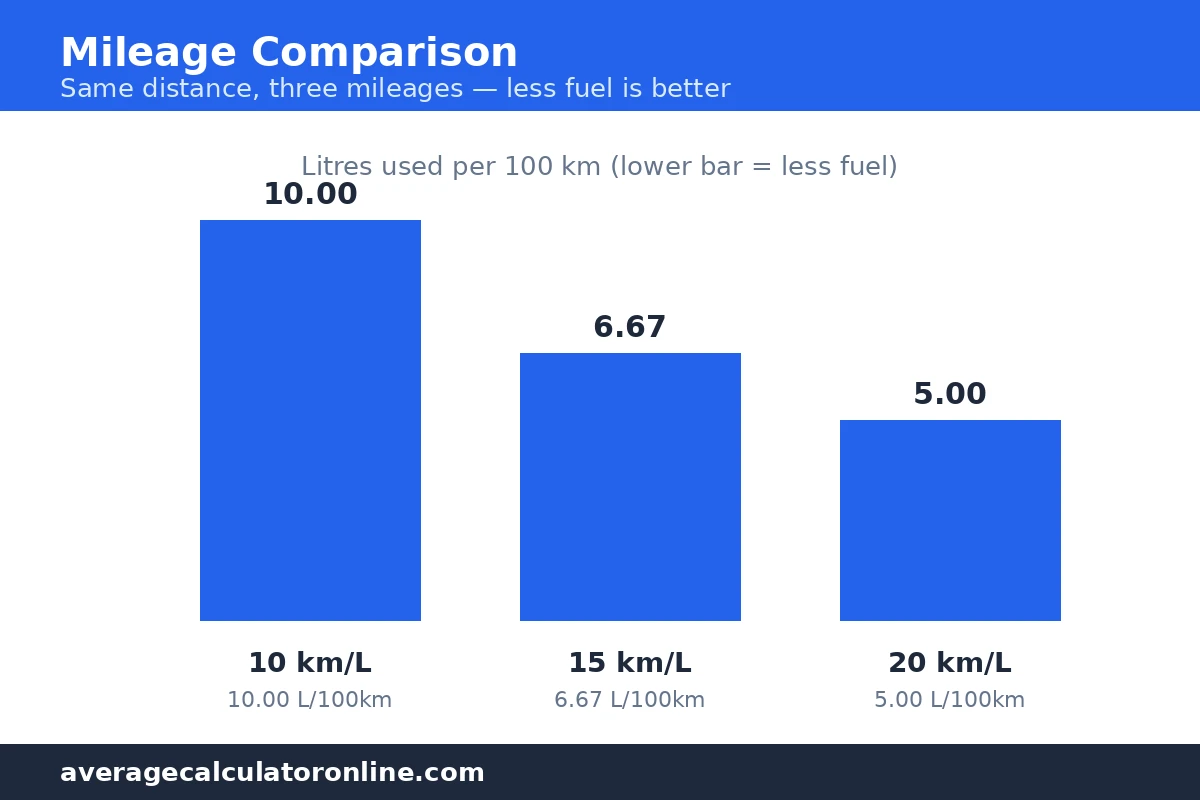
Note that km/L and L/100km move in opposite directions: a higher km/L means a lower L/100km, and both mean less fuel for the same trip. US and UK gallons are different sizes, so the same car shows a higher UK mpg than US mpg.
Worked examples
Example 1 — A routine week: 15.00 km/L
Distance 450 km, fuel 30 L.
- 450 ÷ 30 = 15.00 km/L
- 100 ÷ 15.00 = 6.67 L/100km
- 15.00 × 2.35215 = 35.28 US mpg
- 15.00 × 2.82481 = 42.37 UK mpg
Example 2 — A longer highway run: 16.32 km/L
Distance 620 km, fuel 38 L.
- 620 ÷ 38 = 16.32 km/L (16.3158 before rounding)
- 100 ÷ 16.32 = 6.13 L/100km
- 16.32 × 2.35215 = 38.38 US mpg
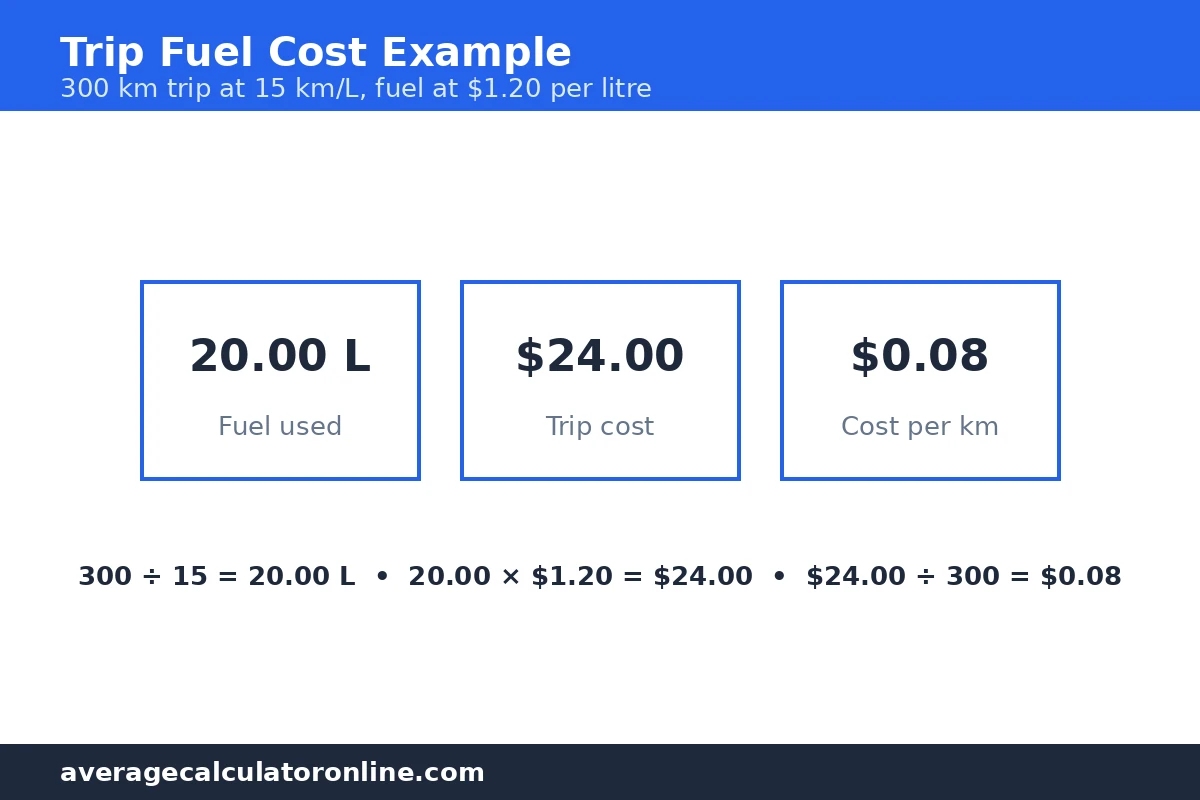
Example 3 — What the trip costs: $24.00
A 300 km trip in a car doing 15 km/L, with fuel at $1.20 per litre (example price only).
- Fuel needed: 300 ÷ 15 = 20.00 L
- Trip cost: 20.00 × $1.20 = $24.00
- Cost per kilometre: $24.00 ÷ 300 = $0.08/km
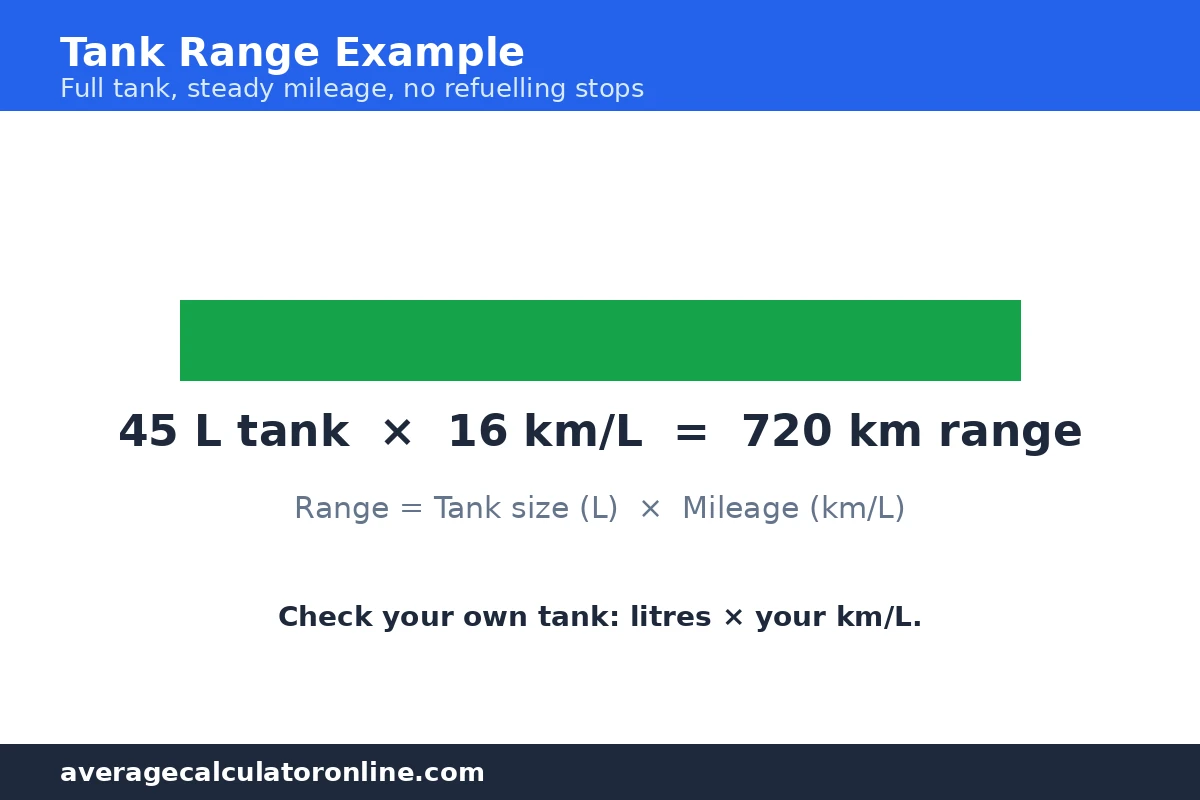
Example 4 — How far a full tank goes: 720 km
Tank size 45 L, mileage 16 km/L.
- Range: 45 × 16 = 720 km
Tips and mistakes
- Use the full-to-full method. Dashboard averages are estimates; filling twice and dividing is the measurement.
- Do not mix units. Kilometres with litres, or miles with gallons — never kilometres with gallons. The tool converts for you, but the inputs must match.
- Compare like with like. City driving, short trips, air conditioning, heavy loads and under-inflated tyres all lower mileage, so a single tank is not a verdict on the car.
- Judge improvement in litres, not just km/L. Going from 13.50 to 15.80 km/L over 1,500 km a month saves 111.11 − 94.94 = 16.17 litres (14.6%). Small km/L gains on a thirsty car save more fuel than big gains on an efficient one.
- Do not trust one fill. A pump that clicks off early or late skews one reading; average three or more fills for a stable figure.
Frequently asked questions
How do you calculate km/L?
Divide the distance driven in kilometres by the fuel used in litres: km/L = Distance (km) ÷ Fuel (L). For example, 450 km on 30 litres is 450 ÷ 30 = 15.00 km/L.
What is a good km/L figure?
There is no single good number: it depends on the vehicle, the road and the driving mix. Compare your figure with the same car’s own figures under similar driving, and track whether your number improves over several fills rather than chasing one universal target.
How do I convert km/L to miles per gallon?
Multiply by 2.35215 for US miles per gallon, or by 2.82481 for UK miles per gallon. For example, 15 km/L is 15 × 2.35215 = 35.28 US mpg and 15 × 2.82481 = 42.37 UK mpg. The two gallon sizes differ, so the UK figure is always higher.
What is L/100km and how does it relate to km/L?
L/100km is litres used per 100 kilometres: L/100km = 100 ÷ km/L. For 15 km/L that is 100 ÷ 15 = 6.67 L/100km. Unlike km/L, a lower L/100km is better.
Should I use the full-to-full method or my dashboard reading?
Use full-to-full: fill the tank, reset the trip meter, drive normally, fill again, and divide the trip distance by the litres on the second fill. Dashboard averages are convenient estimates, but pump cut-offs and sensor rounding make them less exact than the measured division.
Does speed, air conditioning or load affect mileage?
Yes. Faster driving, air conditioning, heavy loads, roof cargo and under-inflated tyres all increase fuel use, so the same car returns different mileage on different trips. That is why one tank is a snapshot, not a verdict — average several fills.
Disclaimer
Mileage figures are estimates from the numbers you enter. Real fuel use varies with vehicle, road, weather, load and driving style, and differs from manufacturer test figures. The $1.20 fuel price in Example 3 is an example only — enter your local price for your own cost. This page is not a substitute for your vehicle manual or a mechanic’s advice.
Related calculators
- Average Calculator Online — the homepage average tool
- Car Payment Calculator — loan payments, for readers who need financing math rather than fuel math
- Percentage Calculator — percentage change between two mileage figures
- Grade Calculator — another average-based tool
Last updated: November 3, 2026.